A Norwegian electric car maker that survived Ford ownership, two rescues and a long run of cash crises before its final collapse in 2011.
Founded as Pivco in Baerum in 1991, THINK built the TH!NK City and spent part of its life under Ford ownership. Ford had acquired a 51% stake, and the company went bankrupt in June 2011, its fourth filing in 20 years. Production finally ended in August 2012.
THINK was a Norwegian electric car maker that began life as Pivco in Baerum in 1991. It spent much of its life short of money, passing through Ford ownership, American demonstration fleets, a 2009 recapitalisation and a final bankruptcy in 2011. Its two-seat City remains the best-known car from a company that was always looking for its next round of funding.
Who founded THINK and where did it start?
THINK began in January 1991 in Baerum, Norway, as Pivco, short for Personal Independent Vehicle Company. Its early prototypes, starting with the PIV2, used an aluminium chassis and a one-piece body moulded from polyethylene. Ten of 15 prototypes were ready for the Lillehammer Winter Olympics in 1994.
The chassis was developed by Hydro Aluminium Tonder in Tonder, Denmark, and it was one of the main reasons Ford later bought into the firm. The early battery used NiCd cells and drove a three-phase AC induction motor through the front wheels.
The next model, the PIV3 City Bee, arrived in 1995 and was sold as the Citi in the US. Of the 120 built, 40 took part in the San Francisco Bay Area Station Car Demonstration from 1995 to 1998. The production model, PIV4, later called the TH!NK, was developed with Lotus Cars as consultant.
The production car kept the basic construction of the prototypes, but it used a roof of ABS plastic and steel lower frame elements. Its range was 85 kilometres (53 mi) on the modified ECE101 cycle, and its top speed was 90 km/h (56 mph).
A Norwegian city car that outlived several owners, yet never found the funding to match its engineering.
How did Ford come to own THINK?
Development of the production model took more time and money than planned, and by the time it was finished in 1999 the company's finances had run dry. Ford then acquired THINK, put the TH!NK City into production and later held 51% of the stock. Under Ford, the brand also covered electric bicycles and golf carts.
The short-lived Ford line included four models: two small electric cars, the Neighbor and the City, and two electric bicycles, the Bike Traveler and the Bike Fun. Ford eventually sold its stock, and the resulting company, Think Global, went on to produce electric cars in Norway.
How did the Ford TH!NK programme perform in America?
The City demonstration programme began in late 2001 and was completed in April 2005, placing 376 vehicles in fleets across the United States. Most went to customers in California, New York and Georgia, while 52 stayed in Ford's own operations in Dearborn, Michigan.
Phase I placed vehicles with users in 2002, Phase II monitored the fleet until 2004, and Phase III covered decommissioning and export, finishing in 2005. Of the 376 vehicles, 372 were available for customers and 4 were engineering prototypes or study cars. Hertz was among the rental customers.
As leases expired, the cars were retired or sent on to KamKorp in Norway. The final vehicles were back in hand by April 2005.
Why did Ford give up THINK in 2003?
Ford gave up the THINK brand on 31 January 2003, probably because of changes to California's zero-emissions vehicle policy. The company went to KamKorp, owned by Indian businessman Kamal Siddiqi, and development of a City successor was halted. Production had already ended in 2002 after 1,005 units.
A controversy followed when Ford decided to crush off-lease City cars stockpiled in the US. After protests, including a Greenpeace rally on the roof of Ford's Norway offices, Ford shipped the surplus vehicles to Norway. Demand for used cars there stayed high, because electric cars enjoyed tax exemptions, free parking and access to bus lanes.
How did THINK return to private hands in 2006?
At the end of March 2006 InSpire, a Norwegian investment group, bought Think Nordic. Partners included the original founder Jan Otto Ringdal and Jan-Olaf Willums, an engineer educated at the ETH Zurich, and the company was renamed THINK Global.
The new owners inherited prototypes of the TH!NK public micro bus, which the company had developed before entering receivership in 2006. The public bus was meant to be rented to customers for inner city travel.
Did the Tesla and GE deals help THINK?
Both deals were significant, but neither solved the funding problem. Tesla agreed in May 2007 to sell 43 million dollars of battery systems to THINK for the next City, then backed out on 2 November 2007. In March 2008 GE, battery maker A123 Systems and THINK announced a partnership, with GE investing US$4 million in THINK.
The assembly line restarted in late November 2007 to build the redesigned City. The company introduced the car in the UK in July 2008, and the plant had made some 100 City cars for Norway by August 2008. Porsche Consulting supported the plant, which was described as lean and ready for efficient production.
Why did THINK stop production in December 2008?
On 15 December 2008 THINK suspended all vehicle production and laid off 50% of its staff while it negotiated up to $29 million in working capital funding. The company cited urgent financial distress. A bridge loan of 40 million Norwegian kroner, about $5.69 million, followed on 13 January 2009.
Much of the bridge loan came from EnerDel, one of its battery suppliers. On 27 August 2009 THINK completed a $47 million recapitalisation that let it leave court protection. EnerDel took 31%, and US venture firms RockPort Capital Partners, Element Partners and Kleiner Perkins joined, along with Valmet Automotive of Finland and Investinor, the Norwegian venture capital sovereign fund.
Where was the THINK City built?
Production moved to Valmet Automotive in Uusikaupunki, Finland, where production started on 10 December 2009. The company then announced plans for a US plant in Elkhart, Indiana, starting in 2011. Mass production had restarted in Finland that December, after a failed start-up in Norway in 2008.
Valmet invested around 3 million euros ($4.27 million) in the project and became a minor shareholder. The Elkhart plant delivered its first 15 cars to the state of Indiana in December 2010. The company said this was the first American-made electric vehicle with lithium-ion batteries bought for US fleet operation, and each car could travel 100 miles (160 km) on a charge.
What were the main THINK models?
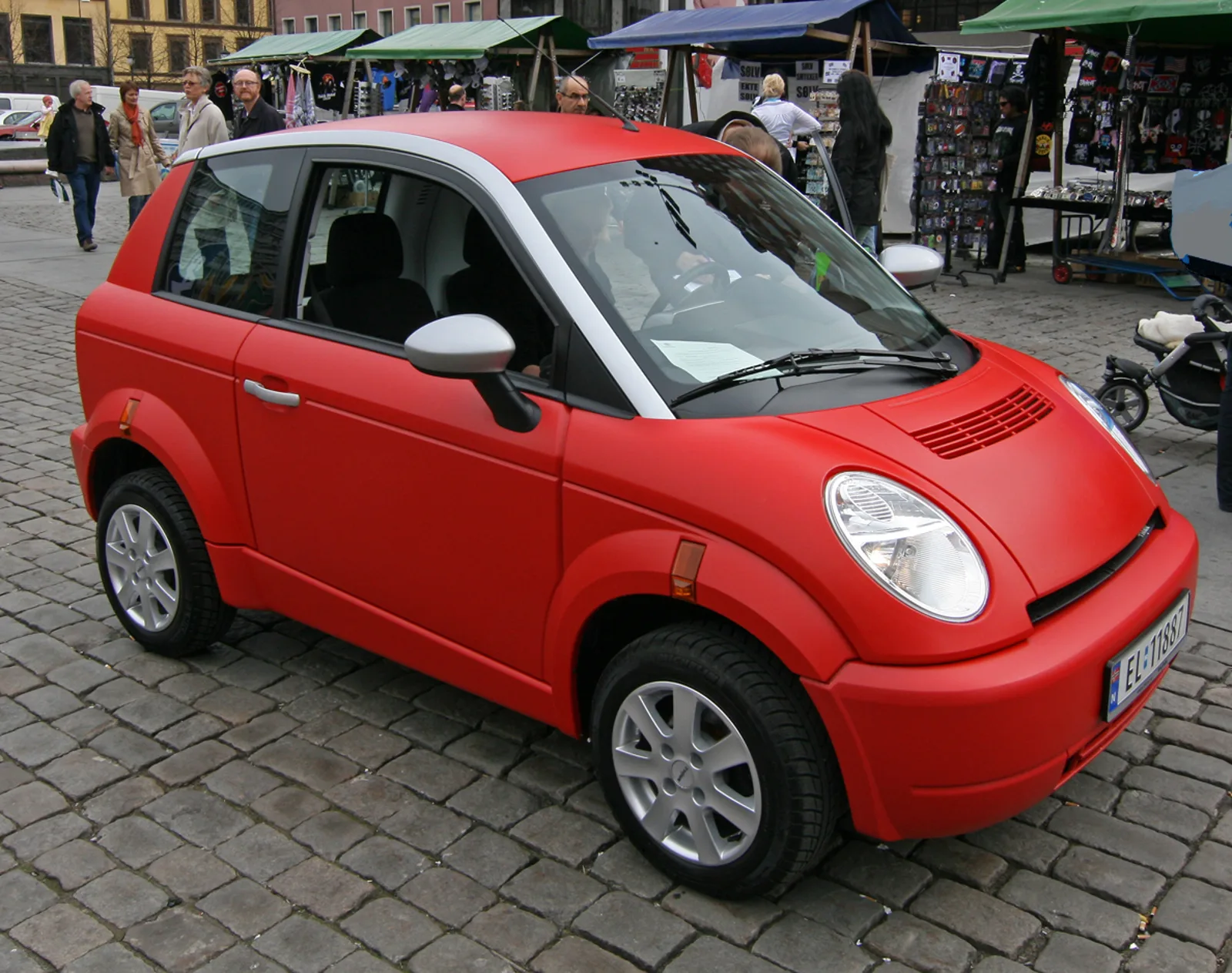
The THINK range comprised the two-door City, the Neighbor for neighbourhood and golf use, the TH!NK Ox five-seat concept and the three-door TH!NK open. The City reached 110 km/h (68 mph) with a 160 km (99 mi) in-town range, while the Neighbor was governed to 40 km/h (25 mph) under NHTSA rules.
The two-door City seated a driver and one passenger and was 3.0 m (9.8 ft) long. The Neighbor came as a two-seater, a four-seater, and later a two-passenger utility truck, with a fixed roof over an open cabin. Its turf mode limited speed to 24 km/h (15 mph) for golf courses.
What are the key THINK specifications?
| Model | Key figures |
|---|---|
| Think City dimensions | 3.0 m (9.8 ft) long; 1.60 m (5.25 ft) wide; 1.6 m (5.1 ft) high |
| Think City performance | Top speed 110 km/h (68 mph); 0-30 mph (48 km/h) in seven seconds on the earlier car |
| Think City range | 160 km (99 mi) in town on a full charge; 100 miles per charge |
| Ford two-door City | Top speed 90 km/h (56 mph) |
| TH!NK Neighbor | Governed to 40 km/h (25 mph); turf mode 24 km/h (15 mph) |
| Neighbor output | 7,162 units for the 2002 model year |
| TH!NK Ox concept | Five seats; 130 km/h (81 mph); 100 kW motor |
| TH!NK open concept | Three doors, two seats; 100 km/h (62 mph) |
| Demonstration fleet | 376 vehicles across the US, 372 for customers |
| Ford-era production | 1,005 units; production ceased in 2002 |
Why did THINK fail in 2011?
THINK halted City production in March 2011 and filed for bankruptcy on 22 June 2011, its fourth in 20 years. Electric Mobility Solutions AS bought the assets in July 2011 and promised a refined City in early 2012, but production ceased in August 2012.
The difficulties ran through the company's whole life. Development overran its budget in the 1990s, and the company went into court protection in 2009 before a recapitalisation.
What is THINK's legacy?
THINK is remembered as an early Norwegian attempt at a practical city electric car. The City was among the first electric cars crash-tested and certified for highway use, and the company's story shows how hard it was to fund small electric car makers in the 2000s.
The car shared that early distinction with the Tesla Roadster (2008) and the Mitsubishi i MiEV. Used cars from the US and the UK were later exported to Norway, where demand stayed high because of the government's support for electric cars.