From George Singer's 1874 bicycle works to the Singer Ten, the Rootes years and the last Singer built in 1970.
Singer began in Coventry as a bicycle maker in 1874 and moved into motor vehicles in 1901. Its Ten of 1912 became a best-seller, Singer ranked third among British car makers by 1928, and the company joined the Rootes Group in 1955 before the name ended in 1970.
Singer Motors was the British car business that grew out of George Singer's Coventry bicycle works, founded in 1874. It made the Singer Ten, a small car that became the company's first big seller in 1912, and it joined the Rootes Group in December 1955 before the Singer name ended in 1970.
How did a bicycle maker become a car company?
George Singer started his bicycle business in Coventry in 1874, with his brother-in-law J. E. Stringer as a partner. Singer Cycle began motor vehicle production in 1901 by buying the rights to the Perks and Birch Motor Wheel, and four-wheel cars followed in 1905.
Singer's bicycles had already been a step forward for safety. He raked the front forks, a first, which made the machine safer than the penny-farthing it replaced. He patented the design on 24 October 1878, and in 1879 he introduced a model with a large rear wheel and small front wheels that could be folded aside.
The business weathered several storms. In 1895 it faced a 600,000 pound flotation arranged by the promoter Terah Hooley, but it survived. It also came through the 1898 slump that wiped out many British bicycle makers, and that resilience kept the company in place when the motor age arrived.
A Coventry bicycle works that became a best-selling small car maker before the Rootes years ended the name.
How did the motor wheel and early motorcycles start Singer?
The company took up the Perks and Birch design, a 222 cc four-stroke engine housed inside a spoked aluminium wheel. The fuel tank, carburettor and magneto were all built into the wheel, and it was probably the first motor bicycle to carry magneto ignition.
The motor wheel may have been the only motorcycle engine of its period with dependable ignition, and Singer used it on bicycles and on the rear wheel and then the front wheel of a trike. The design gave the company a foothold in powered transport before its car range existed.
The motorcycle range grew steadily. In 1904 Singer developed 346 cc two-strokes, and from 1911 it offered side-valve models of 299 cc and 535 cc. In 1909 the company built a series of racers and roadsters and entered several of them in races, including the 1914 Isle of Man Senior TT.
Motorcycle racing brought fame as well. In 1912 George E. Stanley broke the one-hour record at Brooklands on a 350 cc Singer, becoming the first rider of a machine that size to cover more than 60 miles in an hour. Motorcycle production stopped when the First World War began.
What were Singer's first tricars and cars like?
The first Singer tricar was the Tri-Voiturette, which was powered by a small engine rated at two and a half horsepower and came in two versions. The No. 1 seated its passenger facing backwards, while the No. 2 seated the passenger facing forwards, and both put the passenger seat well behind the rear axle.
Four-wheel cars began in 1905 with a design by the Scottish engineer Alexander Craig, a modification of a layout he had prepared earlier for Lea-Francis. The first Singer-designed car was the 12/14 of 1906, and its engine was bought in from Aster. From 1906 the company used White and Poppe engines in its light cars.
In the 1906 Land's End to John O'Groats event, Muriel Hind was at the wheel of a Singer tricar, while the aviator Hilda Hewlett rode alongside as passenger and mechanic. Hind later took on a 24 hour London to Edinburgh trial in a tricar, with another woman riding along, and kept up a fast pace in heavy rain.
By 1907 the range included two-, three- and four-cylinder models. The Aster-powered cars were withdrawn in 1909, when a larger range replaced them, and by the First World War all models except the 20 hp were using Singer's own power units.
Why was the Singer Ten such a big seller?
The Ten made its debut at Olympia in 1912. It had a 10 hp, 1,096 cc four-cylinder engine and a three-speed gearbox built into the rear axle. William Rootes, a former Singer apprentice, contracted to buy 50 Tens, the entire first year's supply, and the Ten became a best-seller.
Lionel Martin, a former racing cyclist, bought a Ten from Singer's stand at the 1912 Olympia show. He gave it a thorough going-over, improved the engine and lifted its maximum from 40 up to 70 mph (64 to 113 km/h). He set up shop in Henniker Mews, Kensington, and his tuned Ten was successful at the Aston Clinton hillclimb.
The Ten also made news for a publicity stunt. On 11 July 1914 Beatrice Blore drove a Singer Ten up the cable track of the Great Orme at Llandudno, becoming the first woman to drive up the steep headland. The drive was staged to help sell cars at a local garage, which advertised the Ten at 195 pounds.
Production was suspended during the war and resumed afterwards. The Ten's engine stayed much the same until the car ended production in 1923, although the chassis was redesigned in 1921 and the engine was converted to overhead valves in 1923.
What did the 1920s models look like?
After the war Singer bought the motorcycle and cyclecar maker Coventry Premier in 1921 and sold its four-wheeler under that name until 1924. The 10/26 replaced the older Ten that year with a 1,308 cc engine, and the company's first six, a 1,999 cc 15 hp car from 1922, had a retractable luggage rack.
The 1926 London Motor Show introduced the Junior, a 16.5 hp overhead-valve 848 cc four priced from 148 pounds as a four-seat tourer. Only rear-wheel brakes were fitted at first. A racing Ten had earlier set the Brooklands lap record at 74.42 mph (119.77 km/h), and the Six added four-wheel servo brakes from Clayton Dewandre.
Factory space was a problem as well. Singer's site was restricted, so the company bought other concerns to gain room. In 1926 it took over Calcott Brothers, and the 15 and the Ten both offered Weymann fabric bodies in 1924, a sign of how the range was being widened.
Sales climbed through the decade. Singer produced 9,000 cars in 1926 and 28,000 in 1929. By 1928 it was Britain's third largest car maker after Austin and Morris, but in 1929, with seven factories and 8,000 employees, it held only 15 per cent of the market while Austin and Morris shared 60 per cent.
Why did Singer's sales fall in the 1930s?
Singer's cars were eclipsed by new models from Austin, Morris and Hillman, and from 1932 the Ford Model Y joined the competition. Costly acquisitions, new machinery and a moving assembly line in a newly bought factory weighed heavily on the company, and its designs began to look dated.
Leo J. Shorter became chief engineer in 1932, and he and two other designers created the Sports Nine. Its two-bearing 972 cc engine gave the car its name. Because the new bodywork was difficult to make, some Junior chassis were fitted with the Nine engine as a stopgap, which produced the very rare Junior-Nine.
The Sports Nine became popular with trials racers. A specially prepared version was entered at Le Mans, and that is how the Nine picked up its nickname. Three works Nines appeared at the 1935 Ulster Tourist Trophy, and all three crashed from steering failure at the same spot. The drivers walked away unhurt, but Singer's racing reputation suffered badly.
The Eleven of 1934 used a clutch-less Fluidrive fluid coupling and independent front suspension. The Bantam of 1935 was a close copy of the Ford Model Y, and at 127 pounds it was uncompetitive. In May 1936 W. E. Bullock resigned as managing director after shareholder criticism, and Singer & Co Limited was dissolved in December 1936.
How did Singer end up inside the Rootes Group?
Singer Motors joined the Rootes Group in December 1955, after the company had run into financial trouble it could not solve alone. The Rootes brothers had first handled Singer sales before the First World War, and their group was an enthusiastic exponent of badge engineering.
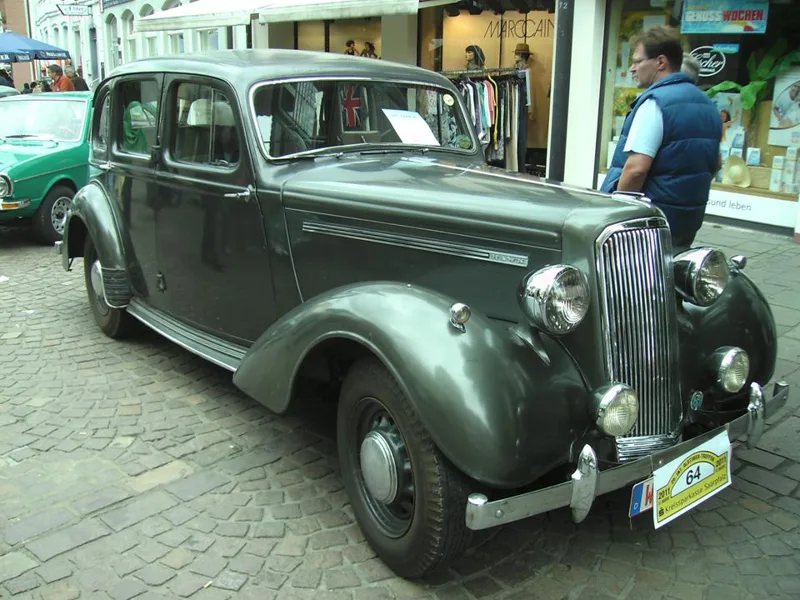
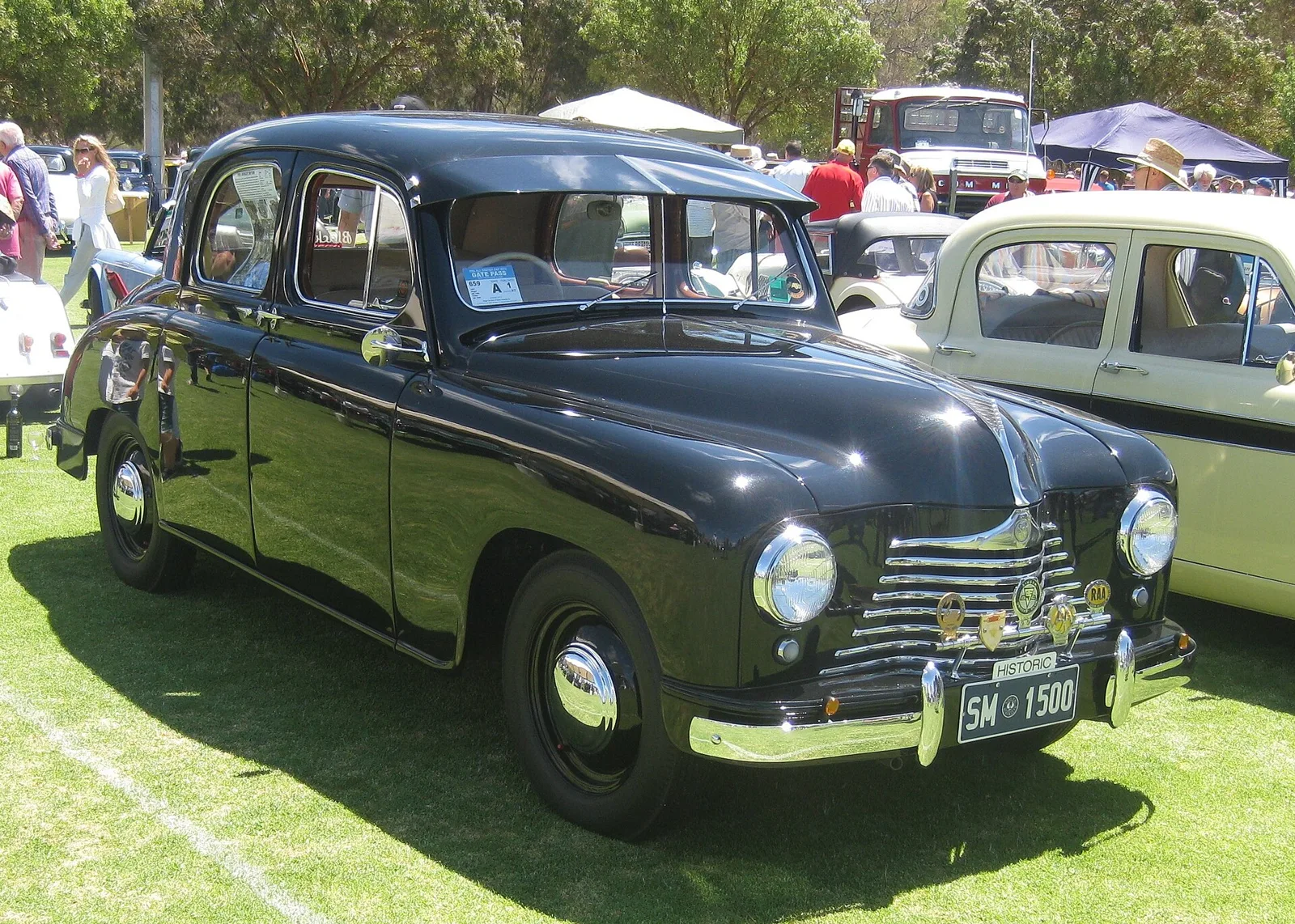
Singer's postwar cars struggled to find buyers. The SM1500 of 1948 had coil-spring independent front suspension and a separate chassis, but at 799 pounds it was expensive, and it failed to save the company. It was renamed the Hunter in 1954 with a traditional grille, and an optional HRG-designed DOHC engine was listed, although it was probably never sold.
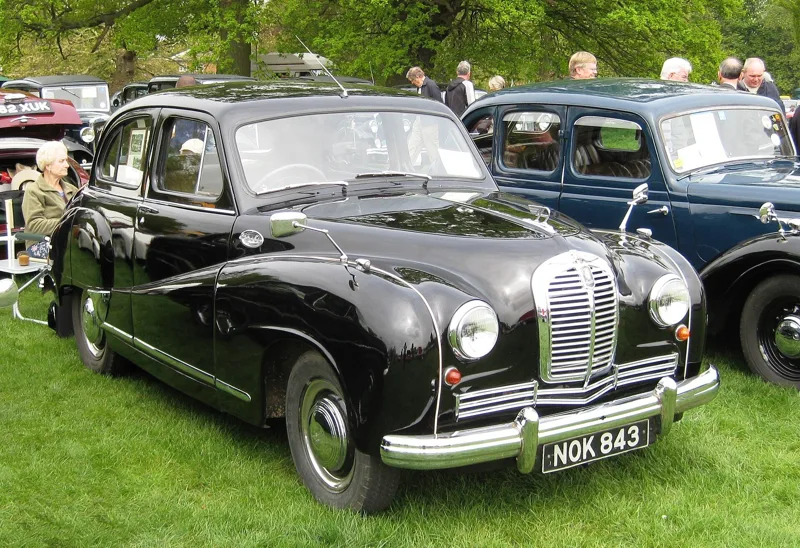
After 1958 every Singer was a badge-engineered model. The Gazelle was an upmarket Hillman Minx, and the Vogue, which ran alongside the Minx and Gazelle from 1961, was based on the Hillman Super Minx with different front styling and more luxurious trim.
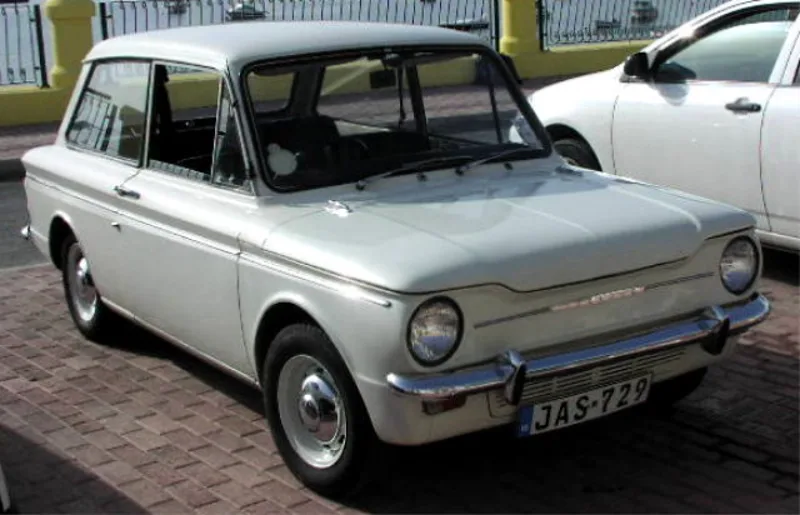
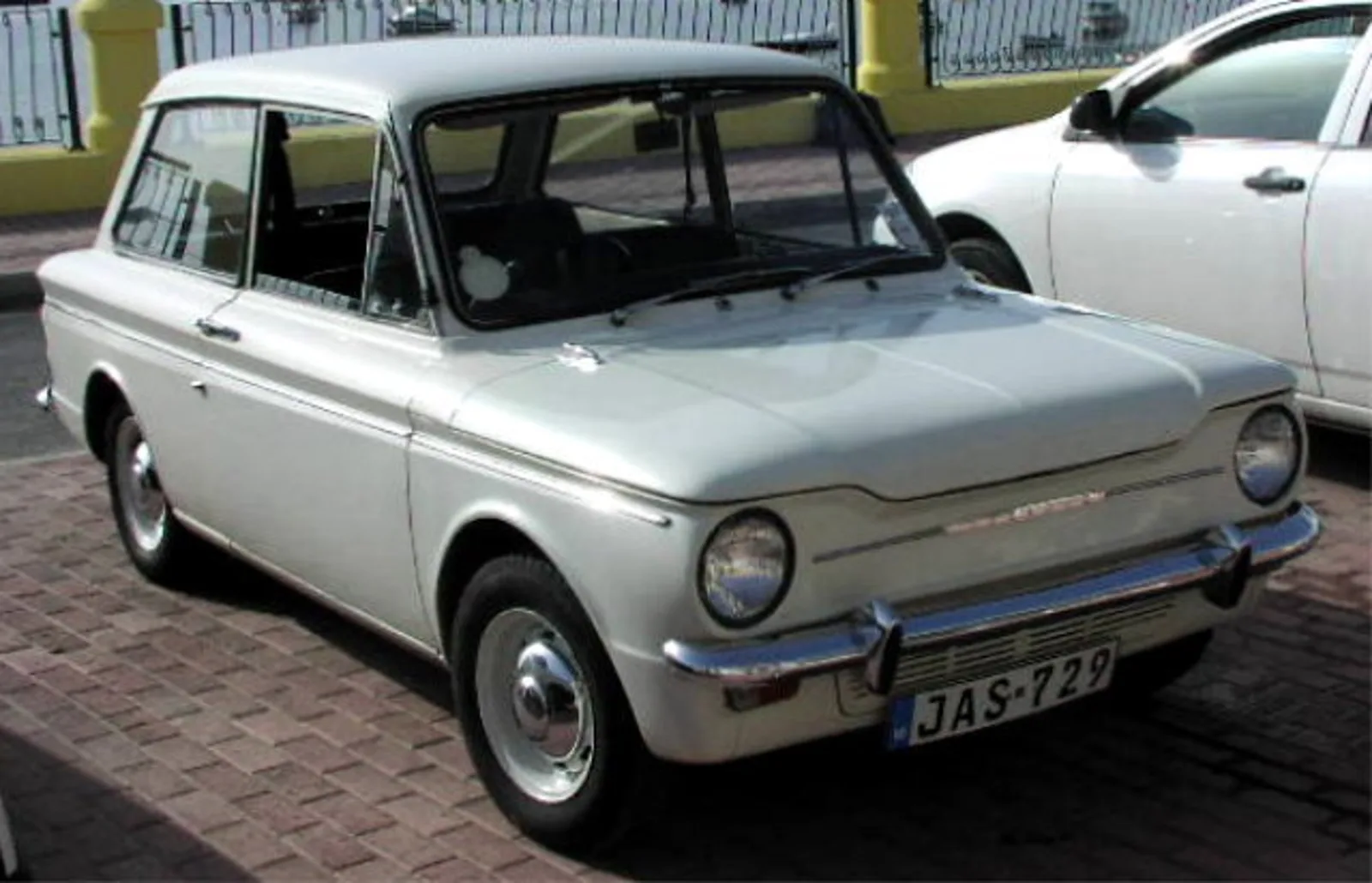
Chrysler acquired Rootes between 1964 and 1967, and by 1970 the group was struggling. The last Singer rolled off the line in April 1970. It was an upmarket version of the Hillman Imp called the Chamois, almost 100 years after George Singer built his first cycle.
What were the key Singer milestones?
| Year | Milestone | Detail |
|---|---|---|
| 1874 | Singer & Co founded | Bicycle business in Coventry |
| 1878 | Raked-fork patent | Patented on 24 October 1878 |
| 1901 | Motor production starts | Perks and Birch motor wheel taken on |
| 1912 | Singer Ten launched | 10 hp, 1,096 cc four-cylinder engine |
| 1914 | Great Orme drive | Beatrice Blore drives a Ten on 11 July 1914 |
| 1922 | First six-cylinder | 1,999 cc, 15 hp |
| 1936 | Singer & Co dissolved | Business moves to Singer Motors Limited in December 1936 |
| 1955 | Rootes Group | Singer Motors joins the group in December 1955 |
| 1970 | Last Singer | The Chamois, April 1970 |