From bicycle parts in 1898 to record-breaking racers, cab fleets and the Talbot-Darracq cars, the Suresnes company shaped French and British motoring.
Automobiles Darracq France was a Suresnes maker of cars and aero engines, founded by Alexandre Darracq in 1896. It set land speed records, won the Vanderbilt Cup in 1905 and 1906, and became Talbot S.A. in 1922.
Automobiles Darracq France was a French maker of motor vehicles and aero engines based in Suresnes, close to Paris. Alexandre Darracq founded the business, and it went on to win speed records and the Vanderbilt Cup. After the company became Talbot in 1922, cars sold in England still carried the Darracq name.
Where did Darracq begin?
The company started life as A Darracq et Cie in Suresnes. Alexandre Darracq funded the works with the profit from selling his Gladiator bicycle factory, and the first output in January 1898 consisted of bicycle parts, tricycles, quadricycles and a motorcycle with a five-cylinder rotary engine.
The first automobile was a disappointment. A voiturette tricar drawn by Leon Bollee suffered from awkward steering, a five-speed belt drive that was branded a masterpiece of bad design, and a crude hot tube ignition. Darracq had paid 10,000 pounds for that design, and the outlay proved a costly mistake.
A better result arrived in 1900, when Paul Ribeyrolles produced a 6.5 hp voiture legere. Its 785 cc single-cylinder engine drove the rear wheels through a shaft, and the gearbox used a three-speed change on the steering column.
A Suresnes works that began with bicycle parts and ended as the Talbot badge that dominated voiturette racing.
How did the Accelerator sell?
The Accelerator was bigger than the 1900 car, yet its layout closely resembled a contemporary Renault. Its notable feature let the driver vary engine speed between 100 and 2,000 rpm. Customers took to it quickly, and more than 1,000 had been sold by the end of September 1901.
Those figures were impressive for a works with only 300 staff. At that size Suresnes was essentially an assembly operation. The next step took the company to Germany.
In 1902 the company agreed a licence with Adam Opel to build vehicles in the German Empire under the brand name Opel Darracq. The arrangement was short-lived, because Opel soon began producing its own cars.
How did English ownership change Darracq?
On 30 September 1902 the French business was sold to A. Darracq and Company Limited, a British-registered concern. Alexandre Darracq retained a large minority share, and J. S. Smith-Winby took the chair. The new capital funded expansion, so the Suresnes site grew to about four acres and the company bought premises in England too.
By 1903 the line-up comprised four models, from a 1.1-litre single through 1.3 and 1.9 litre twins to a 3.8 litre four. For 1904 the chassis moved from a flitch-plated wooden frame to pressed steel. The Flying Fifteen, with a 3-litre four and a chassis pressed from one sheet of steel, carried the company to roughly a tenth of the French car market.
Late in 1904 the chairman reported sales up by 20 per cent, although costs had risen faster, so profit grew more slowly. Orders exceeded what the works could build, and the works had to grow, by as much as 50 per cent. Alexandre Darracq regarded the Flying Fifteen as his finest achievement, though its styling was unremarkable.
How fast were Darracq racers?
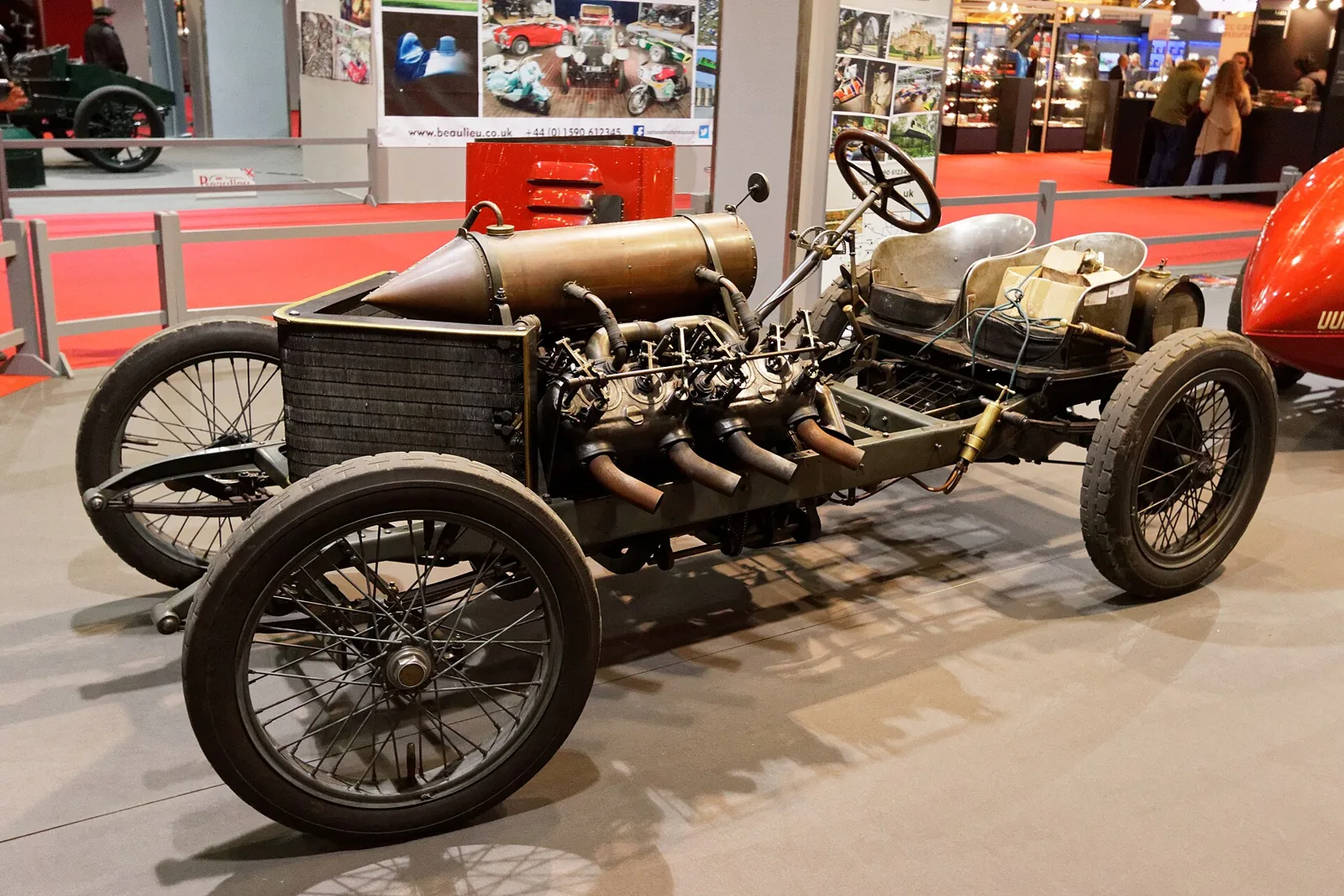
Darracq racers set a run of land speed marks in the early 1900s. Paul Baras reached 168.22 km/h (104.53 mph) at Ostend on 13 November 1904, and a 1905 machine with a 22.5 litre V8 built from two Gordon Bennett engines went faster still.
Earlier, identical 11.3 litre cars from three countries had brought Darracq no success at the 1904 Gordon Bennett Trophy. That V8 car produced 200 hp and used a single shared crankcase. Victor Hemery drove it to 176.46 km/h (109.65 mph) across the flying kilometre at Arles on 30 December 1905. Taken to Ormond Beach in Florida, it was timed at 197.06 km/h (122.45 mph) in 1906, which won it the title 1906 King of Speed, although the Stanley Rocket still held the outright record at 205.35 km/h (127.6 mph).
After its racing career the V8 passed to Algernon Lee Guinness, who went on to set further records with it. The car was retired in 1909 after a broken piston. Its original engine had survived, and the car was rebuilt in 2005 around that unit.
| Year | Milestone | Detail |
|---|---|---|
| 1898 | First production | Bicycle parts, tricycles, quadricycles and a Millet motorcycle |
| 1901 | Accelerator | More than 1,000 sold by the end of September |
| 1902 | English ownership | Sold to A. Darracq and Company Limited on 30 September |
| 1904 | Flying Fifteen | 3-litre four with a pressed-steel chassis |
| 1905 | Vanderbilt Cup | Won by Louis Wagner in a 100 hp, 12.7 litre racer |
| 1906 | Ormond Beach | 197.06 km/h (122.45 mph), the 1906 King of Speed |
| 1912 | Clegg era | Darracq resigns; the 16HP Clegg-Darracq follows |
| 1919 | Type A | 24HP with a 4,584cc V8 shown at the Paris show |
| 1922 | Talbot | Darracq name dropped in the French business |
| 1935 | Lago | Talbot S.A. acquired by investors led by Antonio Lago |
Who won the Vanderbilt Cup for Darracq?
Louis Wagner took the Vanderbilt Cup for Darracq in 1905 and again in 1906, both times on Long Island, New York. He drove a 100 hp racer with a 12.7 litre engine. The company also took the honours at a race in Havana, but the 1906 Vanderbilt Cup proved to be its last major race win.
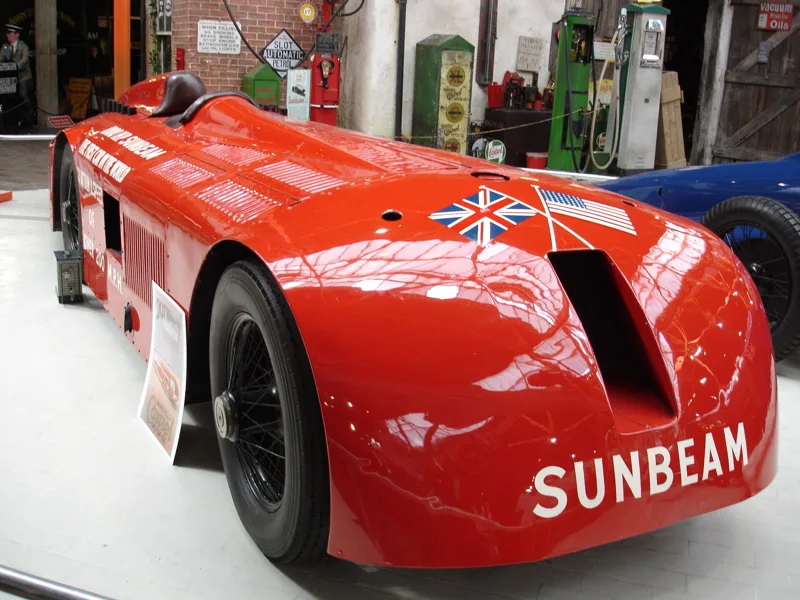
Racing continued in smaller doses. In 1908 Darracq machines placed second, third and seventh in a Tourist Trophy event on the Isle of Man. In 1912 Malcolm Campbell ran an ex-works car at Brooklands, and after the war a Sunbeam Grand Prix car, rebadged as a Talbot-Darracq, lined up for the 1921 French Grand Prix.
Did Darracq build cabs and steam buses?
Darracq did build cabs, though the venture had mixed results. An order from M. Charley for several thousand cabs led the firm to order 4,000 chassis frames and to construct a second plant beside the first. In 1907 Darracqs made up a third of New York's 1,800 cabs.
Steam buses were a different story. Designed with Leon Serpollet, the project produced only twenty examples, and the London firm, the Darracq-Serpollet Omnibus Company, was held back by delays while its factory was built. Serpollet died early in 1907 at the age of 48, and the company eventually wrote off an investment of 156,000 pounds.
By late 1909 the Compagnie Internationale des Wagons-Lits, then known as the International Sleeping Car Company, had arranged for 3,000 vehicles from the 1910 range, fitted with 14-16 hp engines, intended for taxi services in British India. Taxi work was a steady outlet, even though the steam buses had been a costly failure.
Why did Darracq sales decline after 1907?
Selling Darracq cars became harder after 1907, and the company was forced to cut prices. Alexandre Darracq had also developed an interest in flying, and by 1909 the works was producing light aero engines for pioneers such as Louis Bleriot and Alberto Santos-Dumont. Only two of those engines may have been built.
The turning point came at the end of 1911, when a 14-16 hp model priced at 260 pounds appeared with a Henriod rotary valve engine. That engine was underpowered and prone to seizing, and the failure damaged the marque badly. The London company told shareholders the problem was simply the difficulty of reaching quantity production. By February 1913 the shareholders had set up their own inquiry, which reported poor co-operation between London and Suresnes, with the two sides pulling against each other, and it also pointed to considerable losses after recent changes in personnel. Its chairman, Norman Craig, was then appointed chairman of the company.
How did Owen Clegg rebuild the works?
Paul Ribeyrolles, a former head of the Gladiator business and a keen motor racer, replaced Darracq as manager in late 1911. Darracq stepped down in June 1912 after selling his shares, and a main board director named Hopkins went to Paris to run general administration.
Owen Clegg, formerly chief engineer at Rover, was brought back from the United States, where he had been studying production methods at Darracq's expense. He adapted the proven Rover Twelve into a new Darracq model, and the Suresnes factory was reorganised for volume production. Output climbed to sixty cars a week, and by 1914 the works was turning out fourteen cars a day.
How did war and peace change Suresnes?
During the First World War the company turned to munitions, arms and aircraft, building aero engines under licence from Peugeot and Renault. In 1916 the Suresnes factory passed to Societe Anonyme Darracq, a new French company, while the British assets were placed in Darracq Motor Engineering Company Limited.
Car output resumed only once the Suresnes factory had finished making munitions, arms and planes. Car manufacturing restarted after the armistice. The prewar 16HP V14 returned with a 2,940cc four-cylinder engine. The 24HP Type A, which used a 4,584cc V8, was displayed at the 1919 Paris show. It offered four forward gears and, from 1920, four-wheel brakes, but buyers were unenthusiastic about it. After the war the prewar 16HP was the manufacturer's top-selling car in Britain.
What happened when the Talbot name arrived?
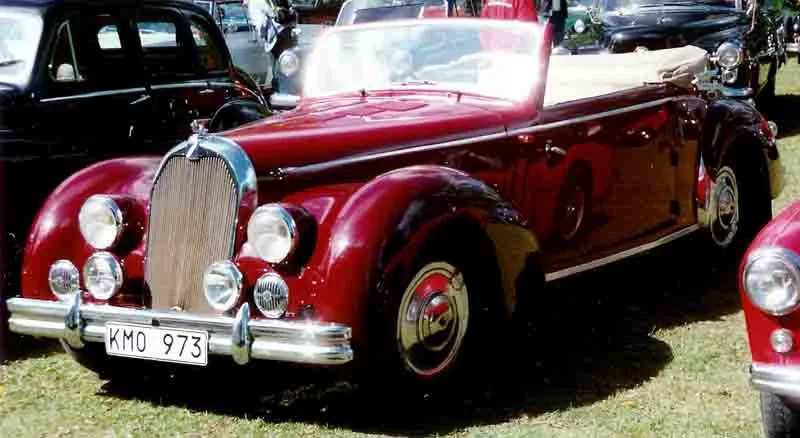
When Clement-Talbot joined the STD Motors group, Suresnes products were branded Talbot-Darracq for a time. The Darracq word was removed in 1922, and the business became Automobiles Talbot S.A. French-built Talbots reached England under the Darracq name, so that they would not be confused with the English Clement-Talbot range.
Motor racing kept the Talbot-Darracq name in view. The Invincible cars were built as smaller relatives of the Grand Prix machines, and they dominated voiturette racing at the top level over six seasons, taking every race they entered. Those successes came in the years when the STD group owned the marque.
The British parent company collapsed financially during the Great Depression. In 1935 the French firm was taken over by a group of investors headed by its managing director, Antonio Lago.