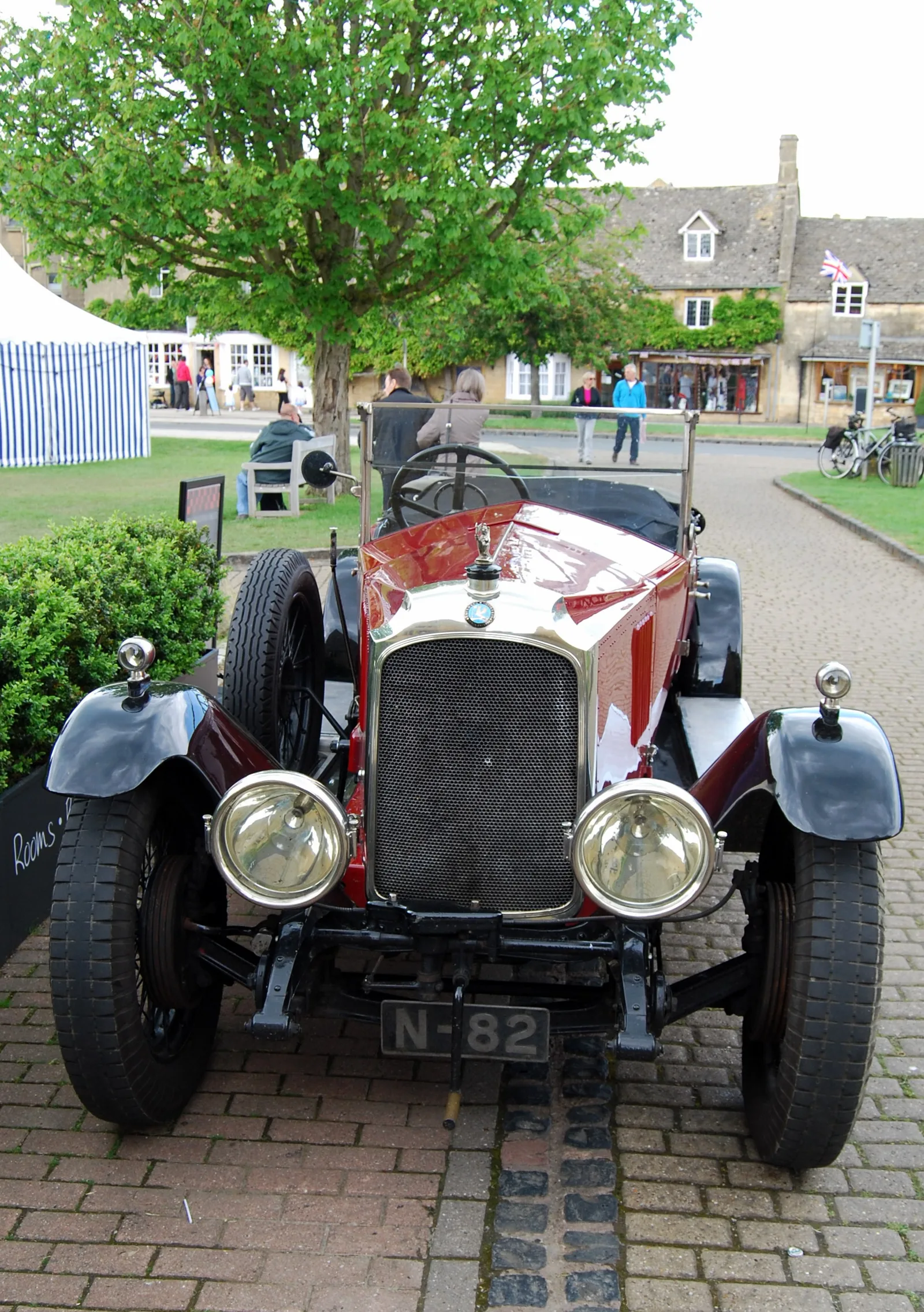
From a 20 hp Brooklands record in 1910 to a Shelsley Walsh winner that became a sporting name, two Vauxhalls and the engineer behind them.
The Vauxhall A-Type was a 3-litre four-cylinder car built at Luton from 1908 to 1914, the first production Vauxhall designed by Laurence Pomeroy. The 30-98 followed, built from 1913 to 1927 on the Prince Henry chassis with a stretched engine, and became one of Britain's best-known sports cars.
A 20 hp Vauxhall A-Type lapped Brooklands on 26 October 1910 at more than 160 km/h (100 mph), the first car of its tax class to do it. Three years later a dealer and hill-climb competitor ordered the first Vauxhall 30-98, and by 1927 the two models had given Luton's four-cylinder cars a sporting name.
What was the Vauxhall A-Type?
The A-Type was a medium-sized four-cylinder Vauxhall built from 1908 to 1914, and the first production model designed by Laurence Pomeroy. Most had a 3-litre engine rated at 20 hp for tax, making 38 bhp in early form and 60 bhp later. A few cars carried 3.5-litre engines.
Those few larger-engined cars were rated at 22 tax horsepower. Production ran in four distinct variations from 27 October 1908 until the end of 1914, and one last car was put together in 1920. In all, 950 were made, and fewer than two dozen survive today.
The car did more than sell. At Brooklands it reached 160 km/h (100 mph), and inside its 21 hp class limit it established speed and endurance records. It also stood first in a line: the A-Type preceded the Prince Henry, and the Prince Henry in turn preceded the 30-98.
Fewer than two dozen A-Types survive out of the 950 produced.
Who was Laurence Pomeroy, and how did the A-Type start?
Laurence Pomeroy joined Vauxhall in 1907 as an assistant draughtsman, aged twenty-two. He made his name at the RAC and Scottish Reliability Trial in June 1908 with a prototype called the Y1, a development of Vauxhall's 12-16, which was put into production that year as the 20 hp.
The Y1's trial was lopsided. Over the hill climbs it beat every rival in its class by an aggregate of 37 seconds, and its speeds around Brooklands were described as unparalleled. It finished the 200 miles (320 km) at an average of 74 km/h (46 mph) and the driver could relax, because the car had 89 km/h (55 mph) in hand. It went on to win class E.
How did the A-Type change from A09 to the 16-20?
There were four versions: the A09, A11, A12 and 16-20. The first two shared a four-speed gearbox, the A12 brought a major chassis revision, and the 16-20 had both engine and chassis substantially redesigned.
The 3-litre side-valve monobloc engine had forced lubrication throughout. The 16-20 was the first to drive its camshaft by chain; before that, gears turned both camshaft and magneto. At the North of England Motor Show in early 1912 the Manchester Guardian noted that the 20 h.p. engine now had new connecting rods, light and made of very high grade steel, and pistons pared down in weight to run more smoothly.
Early cars show the model's roots in its predecessor. Some of the very first still had the three-speed gearbox of the 12-16, and at least 70 of them kept its sheet copper sump.
In November 1912, just before the Olympia Show opened, Vauxhall announced its range for 1913. The 16-20 hp four-cylinder, with a bore and stroke of 90 x 120 mm, was priced as a chassis at GBP 395.
How did the Vauxhall 30-98 begin at Shelsley Walsh?
The first 30-98 was built for Joseph Higginson, a car dealer, competitor and inventor of the Autovac fuel lifter. In his new Vauxhall he won the Shelsley Walsh hill climb on 7 June 1913 and set a hill record, having already made fastest time at Waddington Pike and Aston Clinton.
Yet the 30-98 was intended as a quick tourer for long-distance driving, not a hill-climb special. In racing trim Vauxhall guaranteed it could lap Brooklands at 160 km/h (100 mph), and some owners insisted on seeing their car do exactly that before they accepted delivery.
The recipe was the Prince Henry chassis, and the new model was distinguished from its parent by a more or less flat radiator in place of the V-shaped one. Pomeroy took the Prince Henry's L-head side-valve engine and bored it out by 3 mm. To lengthen the stroke he then cold-stretched the crankshaft throws by 5 mm, a job done with a steam hammer. Up front the camshaft got a new chain drive, along with high-lift cams and fresh tappet clearances.
The chassis was only slightly modified. Over it went a narrow alloy four-seater body with a pair of alloy wings and no doors.
The war cut the story short. Only 13 were made before it intervened. They went to hand-picked drivers, and the final one, in 1915, was for Percy Kidner, who shared the managing director's job at Vauxhall. Actual production began in 1919.
What does 30-98 mean?
Nobody is sure, and three explanations are offered. One is output: the engine gave 30 bhp (22 kW) at 1,000 rpm, rising to 98 bhp (73 kW) at 3,000 rpm. A second is an RAC horsepower rating of 30 with a cylinder bore of 98 mm. The third is a rival, the Mercedes 38/90.
That last idea is perhaps the likeliest of all. The Mercedes was a popular car of the day, but heavier and slower. However the name was found, the makers felt that 30-98 looked and sounded well.
Why is the 30-98 still described as a sports car?
In its day the best-known configuration was the Velox, a standard four-seat open tourer. Vauxhall's own wording was "the 30-98 hp Vauxhall-Velox sporting car", and Velox is Latin for swift, the root of the English word velocity. Enthusiasts also use the factory chassis code, E.
A 1995 authority ranked it among the best-known sports cars Britain has produced. Automobile Quarterly, writing in the mid-twentieth century, said it was affectionately called the last of the Edwardians, and judged it the earliest British sports car and perhaps the finest.
How did the 30-98 engine change from E to OE?
The original E engine was a four-cylinder monobloc developed from the Prince Henry, enlarged to 4,525 cc and giving 90 bhp. In November 1922 Vauxhall announced the OE, with overhead valves and a detachable head, and power rose by nearly 30 per cent.
| Feature | E engine | OE engine |
|---|---|---|
| Valve gear | L-head side-valve, pushrod operated | Overhead valves |
| Cylinder head | Fixed | Detachable |
| Stroke | 150 mm | Back to the original length |
| Capacity | 4,525 cc | 4,224 cc |
| Power | 90 bhp (67 kW) at 3,000 rpm | 115 bhp (86 kW) at 3,300 rpm |
| Cars built | 274 | 313 |
The E got its extra capacity by lengthening the stroke from 140 to 150 mm. Its crankshaft turned in five bearings, oil reached them under pressure, and a single Zenith carburettor fed the cylinders. Going back to the original stroke is why the OE was slightly smaller, yet it also improved low-speed torque.
The OE car and its wheelbase were lengthened by four inches and widened by three, which gave passengers more room and more comfortable seating. The last cars, built in 1927, had a balanced crankshaft that allowed tuning to 120 bhp (89 kW) at 3,500 rpm, with a closer-ratio gearbox.
What was under the 30-98 body?
A ladder-type chassis carried the engine on its own subframe. Semi-elliptic leaf springs, shock absorbers at each end and a conventional live rear axle completed the layout. The four-speed gearbox, changed with the right hand, sent power to the rear wheels via a 3.08:1 straight-cut bevel final drive.
For 1923, with the OE engine, the axle gained spiral bevel gears and a higher 3.3:1 reduction ratio. The side rails were strengthened by widening their cross-section, while a torque arm shaped like a banjo, running beside the propeller shaft, absorbed the axle's torque. Steering was by worm and complete wheel. The springs were half-elliptic, set above the axle at the rear, with swivel anchorages on the axle sleeves, while the front pair were almost flat with snubber leaves.
How good were the Vauxhall 30-98 brakes?
Early cars relied on a transmission brake behind the gearbox, worked by the pedal, and a big lever applied the brakes on the rear wheels. Front-wheel brakes became available in late 1923, first by Bowden double-cable and later hydraulically.
In theory the transmission brake was up to the job. In practice it tended to be swamped by oil escaping from the rear bearing, and a push on the pedal then achieved little beyond a nasty smell. A driver with good hands and a feel for the handbrake could still corner fast, and handbrake turns were on offer in wet weather. One wry verdict held that in a real emergency the driver was better off steering, changing gear, leaping out or praying, perhaps in that order.
Early drums were steel, lined with riveted cast iron, and some cars had finned alloy ones. The OE switched to aluminium drums with steel liners, ribbed generously to shed heat and fitted with Ferodo linings. The final batch used 23-60 components, including very large finned front drums.
In 1927 the front brakes went hydraulic, and the system had a reputation for being temperamental. Front brakes and the transmission brake were applied by the pedal through a master plunger, the transmission brake getting only a third of the force because of its smaller pistons. The system adjusted itself, using a friction ring in the plunger, and a pressurised oil reservoir under the bonnet, held at about 7 lb per sq in, kept air out. A spare half-gallon of the special fluid came with the car.
What bodies and equipment came with a 30-98?
The standard coachwork was the Vauxhall-built Velox four-seater tourer. It looked elegant, slim and low-sided, and it was light, though rear-seat passengers paid for that with comfort. The sides were so low that, as one writer put it, they might have been warned that they travelled at their own risk.
The 1920 catalogue added a featherweight Velox coupe seating two inside, with a chauffeur's dicky seat. The example at the Scottish Motor Show was painted dark blue below the waterline and black above, with nickel fittings, a bonnet of polished aluminium and walnut on the dashboard, but those show fittings were not covered by the advertised price.
Motorboat styling was fashionable in the mid-1920s, and in 1924 Vauxhall introduced the Wensum, an ultra-sporting open two- or three-seater with a boat tail and flared wings, offered at extra cost. The third seat was there for decoration. The name came from the River Wensum near Norwich, a stretch of water where A J Hancock, the works manager, kept a fast motorboat. These bodies were not built on the Velox line. Buyers wanting their own special bodies could order a bare chassis.
Equipment was generous for the time. When production began in 1919 an electric starter cost an extra GBP 50, although it was standard on the 25 hp car. Buyers paid nothing extra for electric lighting, a clock, a speedometer, a spare wheel with tyre, a full tool kit or the number plates, and the bonnet could be polished aluminium or painted to match. Adverts for the OE in 1922 listed six lamps, an instrument board lamp, gauges and both an electric and a bulb horn. By 1927 the list ran to bucket-shaped front seats, wire wheels on Dunlop cord tyres, two spare wheels, spring gaiters, a luggage grid and a windscreen wiper, in the singular.
What did a Vauxhall 30-98 cost?
In 1924 a Velox-bodied 30-98 cost GBP 1,220, or GBP 950 as a bare chassis. Prices peaked in 1920 and were cut in 1921 after a slump in demand for all cars, then held at the lower level for the chassis through 1924.
- Chassis only: GBP 1,125 at launch in 1919, then GBP 1,275, then GBP 950 from 1921 and still GBP 950 in 1924.
- Velox body: GBP 1,475 at launch, GBP 1,676 a year later, cut to GBP 1,300 in 1921 and to GBP 1,220 by 1924.
When Rolls-Royce announced its new 20 hp car in December 1922, a chassis cost GBP 1,100, and with the most popular open tourer body the total was around GBP 1600. The 30-98 was rated at 23.8 hp for tax. In 1930 the first General Motors Vauxhall Cadet, a four-door 2-litre six-cylinder saloon, was priced at GBP 280.
How did the 30-98 do in competition?
By 1920 the 30-98 had earned a lasting name both on the road and in competition. With the OE engine, Vauxhall promised that a car stripped for competition would reach 160 km/h (100 mph).
After the war the factory never raced them. It had no significant competition department, so private owners did the campaigning, and they did it successfully. The success did not come from size, which had been the habit before 1914, when ever larger engines were thought the way to win. The engine was always a four, and the results came from overall excellence of design and sturdy construction.
Shelsley Walsh remained part of the car's story. The 2013 centenary commemorations of Higginson's win included outings at Shelsley Walsh and at Waddington Fell.
What did road testers and owners say about the 30-98?
Period testers were enthusiastic. One wrote of acceleration that was amazingly swift and smooth, yet controlled, and of a racer's character tamed into mannerly behaviour. The engine gave 100 brake horsepower on the bench and would take the car past 80 miles an hour on the flat, yet it could also be throttled down to a smooth 12-15 miles an hour.
Another driver called it the greediest motor of the touring type he had driven, not for petrol but for its straining desire to go ever faster. A quick double-clutch at 50 mph or more could be made without a sound, and the car would romp away with a slight bark on third. The catalogue's modest phrase, fast touring car, sat beside a price of GBP 1,220.
Writer Beverly R Kimes, in Automobile Quarterly, quoted one owner who said that despite eighteen years of experience he only began to motor in reality once he bought his 30-98.