A Nobel physicist's bumps, fire-engine-friendly cushions and a New Jersey road that sang in 1943 explain how roads control what drivers do.
Speed bumps, humps, cushions and tables are raised devices that slow cars by lifting them, differing in length and the speed they allow. Rumble strips instead use grooves or ridges to vibrate and sound through a car's wheels, warning drivers who drift or approach a hazard. Traffic calming includes both.
A physicist who won the 1927 Nobel Prize in Physics also invented the speed hump. Arthur Compton, famous for the Compton effect with X-rays, designed what he called "traffic control bumps" in 1953, after seeing how fast drivers passed the university he led as chancellor. The rumble strip, which wakes drivers instead of slowing them, began as a "singing lane" in New Jersey a decade earlier.
What is a speed bump?
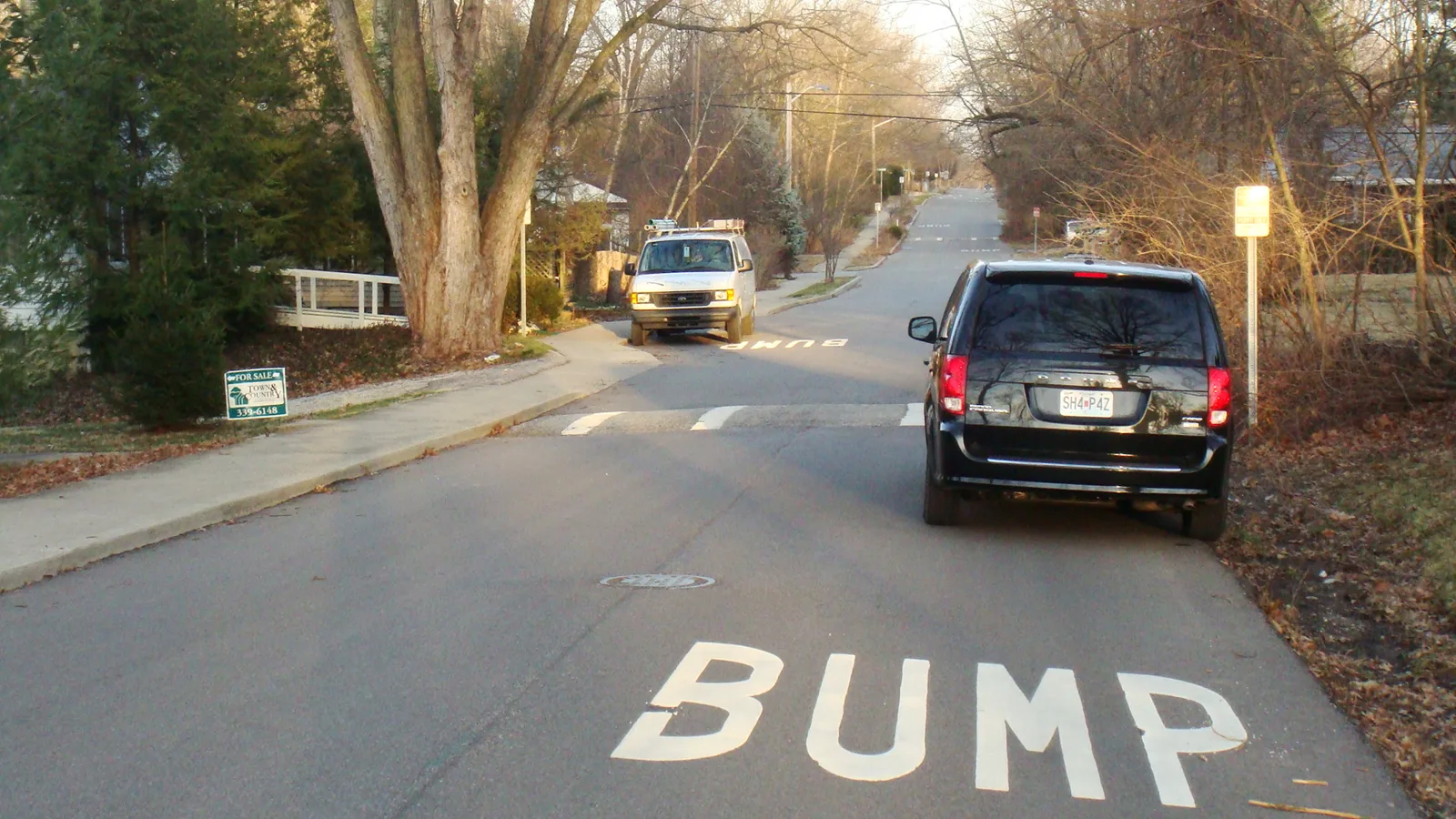
A speed bump is a raised ridge across a roadway, typically 8 to 10 centimetres (3 to 4 in) high and no more than about 0.3 m (1 ft) from front to back. It is one of the traffic calming devices that deflect a car upward, forcing it to slow, which improves safety. It goes by many names: sleeping policeman in British, Maltese and Caribbean English, judder bar in New Zealand, and lying-down policeman in Colombia, Hungary, Croatia, Russia and a long list of other countries.
The devices are widespread and are most often used to hold speeds below 40 km/h (25 mph). They are also controversial. They can raise traffic noise, damage vehicles taken over them too fast and slow emergency vehicles. A bump that is too tall or too steep jars drivers, and a car with low ground clearance may struggle with one even at very low speeds.
Bumps and their relatives are built from asphalt, concrete, recycled plastic, metal or vulcanised rubber. Asphalt and concrete are rigid and durable, so they last longer and slow traffic more. Rubber units are bolted down, which makes them easy to fit or remove, handy for trialling a layout and for lifting before the snowplows come.
A bump jolts the car, a hump lifts it and a rumble strip wakes the person driving it.
Where did speed bumps come from?
The New York Times reported on June 7, 1906 that Chatham, New Jersey intended to lift its crosswalks five inches (13 cm) higher than the road, and said it was the first town to try the idea. Cars of the day topped out at around 50 km/h (30 mph) but had poor brakes by modern standards. Compton's bumps followed in 1953. He began designing them after noticing the speed of motorists passing Brookings Hall on the campus of Washington University in St. Louis, where he was chancellor.
In 1973 Britain's Transport and Road Research Laboratory published a thorough study of how vehicles behave over a large variety of bump shapes; at that time humps were barred from public roads and had been installed only on private ones.
The Institute of Transportation Engineers dates Europe's first bump to 1970, in the Dutch city of Delft.
How do bumps, humps, cushions and tables differ?
The names refer to different shapes with different effects on a car. Length, height and the speed each device allows are what set them apart, and the figures below are typical rather than fixed.
| Device | Size | Typical speed over it | Notes |
|---|---|---|---|
| Speed bump | 8 to 10 cm high, about 0.3 m long | 10 to 15 km/h (5 to 10 mph) | Often used in parking lots |
| Speed hump | 8 to 10 cm high, 3.7 to 4.3 m long | 25 to 30 km/h (15 to 20 mph) | Used on residential streets, in series |
| Speed cushion | Several small humps across the road with gaps | Slows cars that ride over them | Wider emergency vehicles can straddle them |
| Speed table | Long hump with a flat top, a 7 m example | 32 to 48 km/h (20 to 30 mph) | Whole wheelbase rests on top |
A hump, also called a road hump, undulation or speed ramp, is a rounded device, usually parabolic, circular or sinusoidal in profile, that lowers speed and noise on residential streets. Humps are normally laid in a series about 110 to 170 m (350 to 550 ft) apart, which cuts 85th percentile speeds by 13 to 16 km/h (8 to 10 mph). Major roads, bus routes and primary emergency routes do not get them. Shorter humps and taller ones slow cars most, and the edges are tapered near the kerb so water can drain.
In the Federal Highway Administration's Traffic Calming ePrimer, five field studies of 51 humps recorded crash cuts of between 33 and 48 percent, and a run of humps usually takes about 20 percent off traffic volume.
The flat-topped table
A speed table, known also as a flat-top hump, a bus-friendly hump or a raised pedestrian crossing, is a long hump whose centre is flat, with room for a passenger car's entire wheelbase on top. Because it slows cars less than a hump or a cushion, it suits roads with typical residential limits. It can be signed as a zebra crossing, and a raised zebra crossing is called a wombat crossing in Australia. One sample of eight sites found a 45% fall in accidents per year with tables, and wombat crossings may reduce casualties by 63%.
What does a speed bump do to a car and its driver?
The shape decides how the car feels. A bump is so short that a vehicle can cross it quickly, with only a mild jolt to the wheels and suspension and hardly any to the cabin. A hump's long slopes are gentler at low to moderate speeds but create a bigger, longer vertical movement. At higher speeds the suspension absorbs less of that movement, so it affects the whole vehicle.
The driver feels it too: critics argue that bumps injure spines and worsen long-term back pain.
In Sweden, a study of spinal stress on bus drivers, measured against the ISO 2631-5 standard, led to a health-based requirement that drivers avoid certain streets until humps were modified, and that the maximum acceptable speed fall to 10 kilometres per hour (6.2 mph) on one street where drivers met 150 humps a day.
Why do emergency services dislike them?
Humps slow fire engines by 3 to 5 seconds each and ambulances carrying patients by up to 10 seconds. Local authorities have listed other drawbacks. Modesto in California cites slow emergency response, traffic diverted onto parallel residential streets and possible extra noise and pollution beside the bumps. The English town of Eastleigh lists vehicle damage, more noise when large goods vehicles pass, intrusive signs, lighting and white lines, discomfort for drivers and passengers, and trouble for emergency services and buses.
Sigurd Reinton, who chaired the London Ambulance Service in 2003, claimed that delays from speed bumps caused up to 500 avoidable deaths from cardiac arrest a year. He later denied saying so.
Fumes and fuel
One study found that on a north London street with a 20 miles per hour (32 km/h) limit, a petrol car fitted with road humps produced 64 per cent more nitrogen dioxide than on a similar street with road cushions, as well as 47 per cent more particulate matter and nearly 60 per cent more carbon monoxide. Another estimate puts the fuel wasted for a private car passing over a bump at 10 ml, which adds up across the vehicles that use one each day.
How do cushions and dynamic bumps cope?
Speed cushions are a type of hump designed to ease the harm that vertical deflection does to emergency response. An installation is several small humps across the road with gaps between them. A normal car has to ride over them with one or both wheels, while a fire engine with wider axles straddles them without slowing.
American-style ambulances may be wide enough to straddle too, but in Europe and Australia, where the Mercedes-Benz Sprinter is a common ambulance, there is no advantage, so narrower cushions are sometimes placed between lanes and ambulances cross the centre line.
Dynamic speed bumps go further and activate only for vehicles above a set speed. Sweden's Actibump uses radar to read an approaching vehicle's speed and lowers a platform a few centimetres in its path, while one at or under the limit finds a level road. Another design uses a rubber housing with a pressure relief valve that opens, letting the bump deflate, when a vehicle is slow enough, and it can be set to allow fire trucks, ambulances and buses through at higher speeds.
What is traffic calming?
Traffic calming uses road design, signs, markings, rule changes and other engineering to make roads safer for motorists, pedestrians and cyclists. The term is a literal translation of the German Verkehrsberuhigung, first published in English in 1985 by Carmen Hass-Klau. The approach is well established in Australia and in Europe, above all the north, and rarer in North America, although it is gaining ground.
The idea began in the UK in the 1930s as a way to shield residential areas from through traffic. In Donald Appleyard's 1981 Livable Streets study, people on quiet streets had three more friends on average, and twice as many acquaintances, than residents of otherwise similar busy ones.
Sideways, up and down
Horizontal deflection shifts a car's path sideways, often by narrowing lanes: bollards, kerb extensions, chicanes, roundabouts, road diets that remove a lane, and pedestrian refuges. Vertical deflection lifts the car, which is where bumps, humps, cushions, tables, raised crossings, speed dips and transverse rumble strips belong. Non-physical measures include markings that narrow lanes, changes in surface material or texture and radar speed signs.
Engineers speak of three E's: engineering, education and enforcement. Studies show that residents often contribute to a neighbourhood's speeding problem, so engineering alone will not give satisfactory results. Plans range from capital reconstruction, which takes years and millions of dollars, to operational changes such as cones, flexible bollards and repainted lines.
Does traffic calming work?
A Cochrane Review found evidence that traffic calming cuts injuries from road traffic and may lower death tolls, though more evidence is needed in low-income countries.
Results from individual places point the same way. An evaluation of 91 Irish schemes from 1997 to 2002 found collisions down 13% and fatal collisions down 52%. San Francisco's Vision Zero programme had cut fatalities by 33% by 2017, New York City corridor upgrades produced about a 6% reduction in pedestrian crashes, and a 2018 study of Portland, Oregon found daily traffic volume down 16% and home prices up 1%.
Different places lean on different tools. The woonerf, or living street, began in the Netherlands in the late 1960s, initially in Delft, and the country had over 6000 of them by 1999. The German town of Hilden reached 24% of trips by bicycle partly through 32 kilometres per hour (20 mph) zones and raised tables at cycle crossings. Graz in Austria has applied 30 km/h limits to 75% of its streets since 1994. Some people view UK and Irish schemes with road narrowings and pinch points as hostile, and they have been implicated directly in injuries to cyclists and pedestrians. In 2025 Ontario's premier removed the part of the Highway Traffic Act allowing automated speed enforcement and launched a $210 million fund for municipalities to put in traffic calming instead.
What is a rumble strip?
Rumble strips, also called sleeper lines or alert strips, alert inattentive drivers to danger with a vibration and a rumbling sound carried through the wheels into the cabin. Laid along an edge line or centre line, they warn a driver who drifts from the lane. Laid in a series across the lane, they announce a stop, a slowdown or a danger spot ahead. The nicknames are many: wake up calls, growlers, waker-uppers and drunk bumps among them.
Transverse strips sit in the travel lanes to warn of an intersection or a toll booth, and portable versions called Andreas strips warn of lane closures and road works. Centreline strips on undivided highways cut head-on collisions from cross-overs, and shoulder strips, narrower and outside the wheel paths, cut run-off-road crashes by alerting distracted or drowsy drivers.
How they are put in
Installation methods include rolled-in, pressed into warm new asphalt; milled-in, cut into hardened asphalt or concrete; formed, with a corrugated form pressed into fresh concrete; and raised plastic or ceramic units, such as Botts' dots. Profiled thermoplastic markings fuse onto the road with a pattern of highs and lows. Combined with painted lines they are called rumble stripes and are markedly more visible on wet nights. Snowplow blades scrape off surface-mount raised reflectors, which makes them impractical in many places in the United States and Canada. "Virtual" shoulder rumble strips now exist as the lane departure warning on cars and trucks, with a sound like driving over a real strip.
The singing lane
One early example dates from 1943, on Route 6 in New Jersey near Great Notch, where scoring at the dual-lane divisions caught headlights and gave off a resonant whine as tyres rolled over it. Once the "singing lane" benefit had been known for nearly a decade, the New Jersey Highway Authority chair, Ransford J. Abbott, required edge scoring on New Jersey's Garden State Parkway in the early part of the 1950s, and rumble strips were first used there in 1952. Because the groove spacing and the car's speed set the pitch, some have been laid to play tunes as "singing shoulders".
Do rumble strips work?
Under the right conditions they are effective and cost-effective, but the evidence has caveats. Run-off-road crashes can account for up to 70% of fatal single-vehicle crashes, and rumble strips only prevent those caused by inattention, which includes distraction, daydreaming, fatigue, drowsiness and impairment by alcohol or drugs.
A 2008 Swedish driving simulator study with 35 sleep-deprived drivers found an alerting effect after hitting a strip, but a short one: the signs of sleepiness returned five minutes later. A 2003 Montana study suggested that shoulder rumble strips on Interstates reduced the rate of roll-overs while making the roll-overs that still happened more severe, probably because the strips scared sleeping drivers into overreacting.
The classic one-car crash
The classic crash starts when a car drifts onto the right shoulder, hits dirt or strips, and the driver wakes and jerks the wheel left. The left front tyre strikes the raised pavement edge at a sharp angle, frequently flipping the car or sending it across into oncoming traffic. A sleeping driver may not react until all four wheels have crossed a strip, so a paved shoulder narrower than the wheel track may not stop the car leaving the road.
There are two further worries. Crashes may only migrate, moving from one car or place to another further downstream, and the strips may gradually encourage inattention, a process called behaviour adaptation. The Federal Highway Administration says the likeliest sites are long stretches of fairly straight road where little is asked of the driver, which implies that a twisty, hilly road with a narrow shoulder and a low accident rate would be a poor one.
Where do rumble strips cause trouble?
People living beside urban freeways complain about night-time noise when cars change lanes or cross transverse strips. Shoulder strips on highways with narrow shoulders can be a hazard for cyclists, and US and Canadian guidelines set minimum standards for known cycling routes. In 2009 Amish residents in Michigan said the strips were unsafe for their carriage horses and lobbied successfully to have them covered over, and in 2010 Kansas considered removing shoulder strips from an interstate so buses could use the shoulder in congestion.
Where this goes next
Lane departure warning, the virtual shoulder rumble strip, is turning up more often on private cars and commercial trucks, and virtual transverse strips aimed at preventing cross-path crashes at intersections are in development. Ontario's 2025 fund for municipal traffic calming, and the low traffic neighbourhoods and School Streets in the UK, show physical measures still being added to roads.