A rally driver built the first Gatsometer to improve his lap times. Today radar, LIDAR and number-plate recognition catch speeders, and studies put the cut in serious crashes between 11% and 44%.
Radar guns read speed from the frequency shift of a radio echo, LIDAR uses laser pulses, and average-speed systems divide a known distance by journey time. Radar guns typically carry a margin of error of about 1 to 2 mph. A worldwide review found 11% to 44% fewer fatal and serious injury crashes.
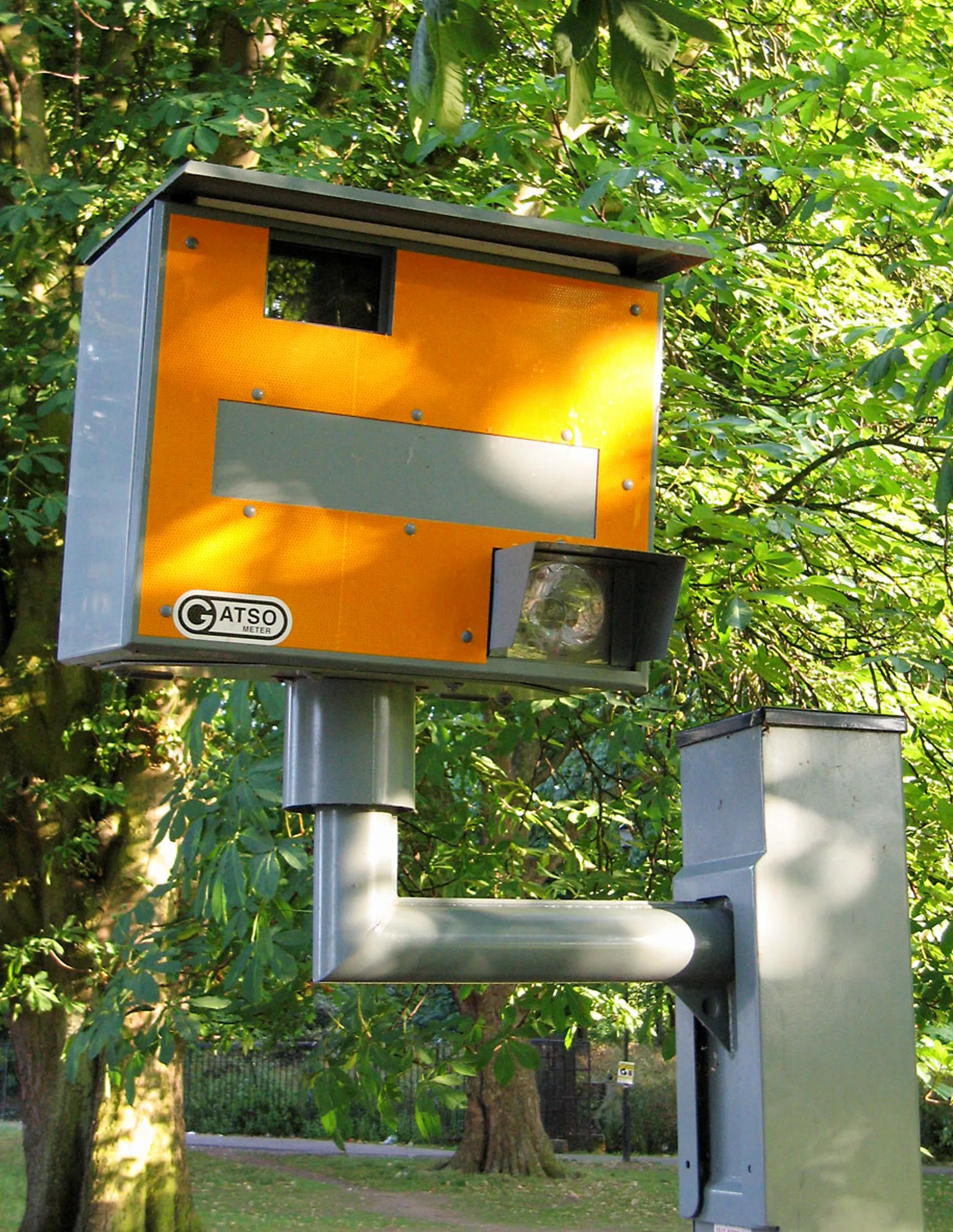
The man who gave the world the speed camera was trying to go faster. Maurice Gatsonides, a rally driver, wanted a way to watch his average speed round a circuit and so sharpen his lap times, and invented a device to do it. The Dutch company he founded in 1958, Gatsometer BV, later began supplying such devices to police as speed enforcement tools.
How do speed cameras measure speed?
The measuring is done by Doppler radar, LIDAR, stereo vision or number-plate recognition software, and a few enforcement systems skip the camera entirely. The camera may sit beside or over the road, or ride in an enforcement vehicle, and can be linked to an automated ticketing system.
Fixed units are housed in boxes, mounted on poles, or attached to gantries, overpasses and bridges, and some are hidden in rubbish bins. Mobile units are carried by hand, set on a tripod or fitted to a vehicle. A camera fixed to a moving patrol car can follow traffic, and in that case the target's relative speed is added to or subtracted from the patrol car's own speed, so the camera vehicle's speedometer must be accurately calibrated.
The Doppler radar gun
A radar speed gun sends a narrow radio beam at a vehicle and listens to the echo. Think of the pitch of a passing siren. A vehicle driving toward the gun returns the waves at a higher frequency than they were sent, and a vehicle driving away returns them at a lower one. The gap between the two frequencies is proportional to the vehicle's speed.
The gun mixes the returning signal with a little of the transmitted one to create a beat, in the same way that two musical notes played together create a third at the difference in their pitch. A digital counter measures that beat and shows it as speed. John L. Barker Sr. and Ben Midlock invented the technique for the military during the Second World War, and made their first Doppler unit from soldered coffee cans, which served as microwave resonators. The Connecticut State Police tested the system in Glastonbury in 1947 and began issuing speeding tickets from radar readings in February 1949.
A stationary gun measures the difference in speed between the target and itself, so it must stay still to give a correct figure. Moving radar solves this by comparing the target's signal with the signal bouncing back from the stationary background, such as the road surface, signs, guard rails and lamp posts; the difference between the two is the target's true speed. Modern guns usually operate in the X, K and Ka bands, and in Europe the Ku band. X band, at 8 to 12 GHz, is becoming rare because it produces a strong, easily detected beam and can be disturbed by automatic doors. Police mostly use K band, at 18 to 27 GHz, and Ka band, at 27 to 40 GHz. Radar detectors are illegal in some areas.
LIDAR
LIDAR guns use pulsed laser light instead of radar. They are often favoured for stationary enforcement because of their greater targeting precision.
The device that became the police speed camera was invented by a rally driver to improve his own lap times.
How do average-speed cameras work?
An average-speed camera records when a vehicle passes one point, records it again at a second point, and divides the known distance by the elapsed time. The sites can be fairly distant, from several hundred metres to several hundred kilometres apart, and the systems can be fixed or mobile.
They identify each vehicle by automatic number-plate recognition, and that is where the controversy lies. The latest systems can detect average speeds, and critics fear a loss of privacy, with governments able to build a mass record of where vehicles, and therefore their owners, travel. Owners are often legally obliged to name the driver. One challenge reached the European Court of Human Rights, which ruled that no rights had been breached.
How accurate are speed cameras and radar guns?
Manufacturers specify a margin of error for most radar guns, typically around 1 to 2 miles per hour. The real figure depends on the gun's quality, its calibration, the conditions and how it is used. Courts treat the margin as a critical factor when a charge needs a particular speed over the limit. In Maryland, for example, a reckless driving conviction needs a speed 30 mph over the limit. A driver clocked at exactly 80 mph in a 50 mph zone could plausibly dispute the device's margin and walk free.
Operators are trained. A trainee must consistently judge a vehicle's speed by eye to within 2 mph, so that for a target doing 30 mph the guess falls between 28 and 32. That matters because a radar gun does not tell targets apart. If seven cars are in the beam, six look to be doing about 40 mph and one about 55, and the gun reads 56, the operator knows which car it measured.
Geometry adds a small error. A gun placed above or beside the road reads at an angle, a quirk known as the cosine effect. For practical purposes the difference is inconsequential, generally under 1 mph, and it always favours the driver by showing a lower speed than the true one.
Hand-held units have other limitations. An antenna of only 2 inches (5.1 cm) produces a wide beam, so it can pick up several objects at once; the main lobe of an X-band unit spreads 22 degrees either side of the line of sight. Continuous-wave radar can be aimed at a vehicle 100 yards away and return a figure from another vehicle 1 mile down a straight road. Moving radar can lock onto a large reflective target such as a tractor trailer, though a second speed reading from the vehicle's own electronics or from GPS can cut the error. Wind-blown leaves can register through the side lobe. The television programme MythBusters tried to fool a gun by altering the surface of the passing object and saw no significant effect.
Do speed cameras reduce crashes?
The evidence says they do. A worldwide review of studies found cameras led to reductions of 11% to 44% in fatal and serious injury crashes. The British Medical Journal reported that they were effective at reducing accidents and injuries near them and recommended wider deployment.
| Source | Finding |
|---|---|
| Worldwide review of studies | 11% to 44% fewer fatal and serious injury crashes |
| UK Department for Transport | 22% reduction in personal injury collisions; 42% fewer people killed or seriously injured at camera sites |
| London School of Economics study, 2017 | 1,000 extra cameras could save up to 190 lives, avoid up to 1,130 collisions and prevent 330 serious injuries each year |
Professor Stephen Glaister summed the findings up: at camera sites speeds have fallen and, as a result, collisions causing injuries have fallen. He added that cameras show value for money, bring in little for the Treasury, and are accepted by most people. In his view they should not be the sole tool of road safety, but should not be missing from it either.
Critics focus on money and privacy. The American Civil Liberties Union claims that treating speed traps as a way to raise money undermines the credibility of safety work. Supporters point out that automated enforcement alleviates the biases associated with police stops.
What else do enforcement cameras watch for?
Plenty. A red light camera is triggered by a vehicle entering the junction above a preset minimum speed once a specified time has passed since the signal turned red, and in some cities it also catches people texting at a red light. Bus lane cameras compare number plates against a list of approved vehicles, and some are mounted on the buses themselves, as in London on routes where stopping is banned. Toll-booth, congestion-charge, parking, level-crossing and turn-ban cameras follow the same pattern.
Several systems have had a rougher ride. In 2007 stop sign cameras were installed in California state parks, with the operator paid $20 per ticket on a $100 fine; a class action followed in 2010. Noise cameras pair a microphone with a number-plate camera. Taipei set fines of US$65 to US$130 for noise, with up to US$1000 more for illegal exhausts, and the scheme won 90% voter approval. A 2020 UK feasibility study found its test camera could not take consistent readings from cars less than ten seconds apart, and a trial in Edmonton cost $192,000 against $98,000 in fines recovered. A test camera in Finland in 2011 could check speed, seat belts, following distance, insurance and tax, and in 2016 Metro Manila adopted a No Contact Apprehension Policy based on cameras.
Number-plate recognition is useful beyond traffic law. Australia's SAFE-T-CAM, built in 1991, was the world's first all-weather, 24-hour system and monitors long-distance truck drivers for avoidance of legally prescribed rest periods. In the UK, police ANPR logs the vehicles passing particular points on the national road network, which critics say can target people with no suspected offence, as happened to John Catt and his daughter in 2005.
How did speed cameras develop?
The idea is older than the car as a mass product. An 1894 science fiction novel describes police using instantaneous kodaks to enforce limits, and in 1905 Popular Mechanics reported a patent for a camera that took time-stamped images of a vehicle at the start and end of a measured section of road, enabling speed to be calculated and the driver identified.
The Gatsometer company, founded in 1958, supplied film-camera systems to police from the late 1960s. Its firsts came in a run: a red light camera in 1965, radar for road traffic in 1971 and a mobile speed camera in 1982. Digital cameras arrived from the late 1990s and bring a network connection, which speeds up the issuing of fines and eases maintenance. Film can still deliver better pictures in varied lighting, and courts in some jurisdictions require it, but digital systems are now the favourite of police forces.
America's first speed camera programmes, in two Texas towns, Friendswood in 1986 and La Marque in 1987, were both abandoned within a few months under public pressure.
Where do speed limits come from?
Limits are usually introduced for health reasons. One estimate links a 5% rise in speed to a 10% rise in injury and a 20% rise in deaths, and the World Health Organization identifies speed control as one step toward fewer road casualties. As of 2021 it estimated that about 1.3 million people die in road traffic crashes each year.
The numbers grew up with the car. The United Kingdom introduced the first numeric limit for mechanically propelled vehicles in 1861, at 10 mph (16 km/h). Walter Arnold of East Peckham, Kent, is believed to have been the first person convicted of speeding, on 28 January 1896, fined 1 shilling plus costs for driving at 8 mph (13 km/h). Britain raised its limit to 20 mph (32 km/h) in 1903, abolished limits entirely in 1930, set 30 mph (48 km/h) in urban areas in 1934 and brought in a 70 mph (110 km/h) national limit in July 1967.
The limit is not the same as a safe speed. Most legal systems expect drivers to travel at a speed safe for the conditions regardless of the posted figure, and speed managers distinguish excess speed, which is exceeding the limit, from inappropriate speed, which is going too fast for conditions. On German autobahns in 2012 excessive speed topped the list of causes: 6,587 speed-related crashes claimed 179 lives, 46.3% of 387 autobahn fatalities, though that does not mean the limit was exceeded.
Engineers commonly pitch a limit at or under the 85th percentile speed, which 15% of traffic at most exceeds; in the United States it is frequently set 4 to 8 mph (6 to 13 km/h) lower still.
Where does this go next?
Average-speed enforcement rests on number-plate systems, and the privacy debate around them has not been settled. Vision Zero, a road safety project that began in Sweden, aims at roads where nobody is killed or seriously injured. A task force of Germany's National Platform on the Future of Mobility drafted a recommendation for 130 km/h (81 mph) across all autobahns, to cut fuel use and carbon emissions. Some cities have taken limits down to 30 km/h (19 mph). Some studies suggest a lower limit does not always change average speed.