From Germany's unlimited motorways to 160 km/h in the Emirates, and the pedestrian survival figures behind the spread of 30 km/h and 20 mph streets.
Default limits vary: Germany has motorways with no maximum, the UAE posts 160 km/h, and most countries use 50 km/h in towns. A growing list of cities, from Graz and Lyon to Brussels, has adopted 30 km/h because pedestrian fatality rates climb steeply with speed.
A pedestrian hit by a car doing 24 km/h (15 mph) will, in most cases, survive and often walk away with minor injuries. At 40 km/h (25 mph) almost every crash causes severe injury and roughly half are fatal, and at 64 km/h (40 mph) 90% of crashes kill. That steep curve is a key part of the theory behind the way cities from Graz to Brussels to Lyon have rewritten the default speed on their streets. At the other extreme, some German motorways have no numerical limit at all, and two highways in the Emirates post 160 km/h.
What are the default speed limits by country?
Law sets the speed vehicles may travel on the road, normally as a ceiling, though occasionally as a floor. Advisory limits are recommended rather than mandatory. They are normally set by the national or local legislature. Comparison tables usually list each jurisdiction's default limits for different vehicles on three kinds of road, while stressing that actual posted limits can fall outside the defaults and that enforcement tolerance is expressed either in km/h or as a percentage above the limit.
The extremes are easy to name. Germany is the only country where some motorways have no maximum speed, though 130 km/h is signposted at the border as a general advisory limit, and because of those stretches Germany is considered a country with no general limit on its highways. The Isle of Man stands alone in having no general limit on its rural two-lane roads. At the other end, the fastest posted maximum in any country with a numerical cap is 160 km/h, on two highways in the United Arab Emirates. One is the E11 running in from the Saudi frontier at Ghuwaifat to Abu Dhabi, and the other the E22 linking Abu Dhabi with Al Ain.
Built-up areas and heavy vehicles
Many countries set a different default for urban roads than for the rest. The split goes back to the early 1900s in places like the United Kingdom and France, and the Vienna Convention formalises it as "road within a built-up area", though the UK has relabelled these as street-lighted or restricted areas. In 2017, most of the countries in the IRTAD group had a 50 km/h default in urban areas, sometimes lower. In the Netherlands, for example, 70% of urban roads are limited to 30 km/h. A few big countries, among them the United States, India and China, have no specific urban maximum.
Limits for heavy goods vehicles also differ by country. Most Eurasian and American countries might follow the Vienna Convention's 3.5-tonne threshold, whereas others in North America, and China, India, Australia and Ireland, may use different weight limits.
Hit at 24 km/h most pedestrians survive; hit at 64 km/h, nine in ten crashes are fatal.
What is a 30 km/h zone?
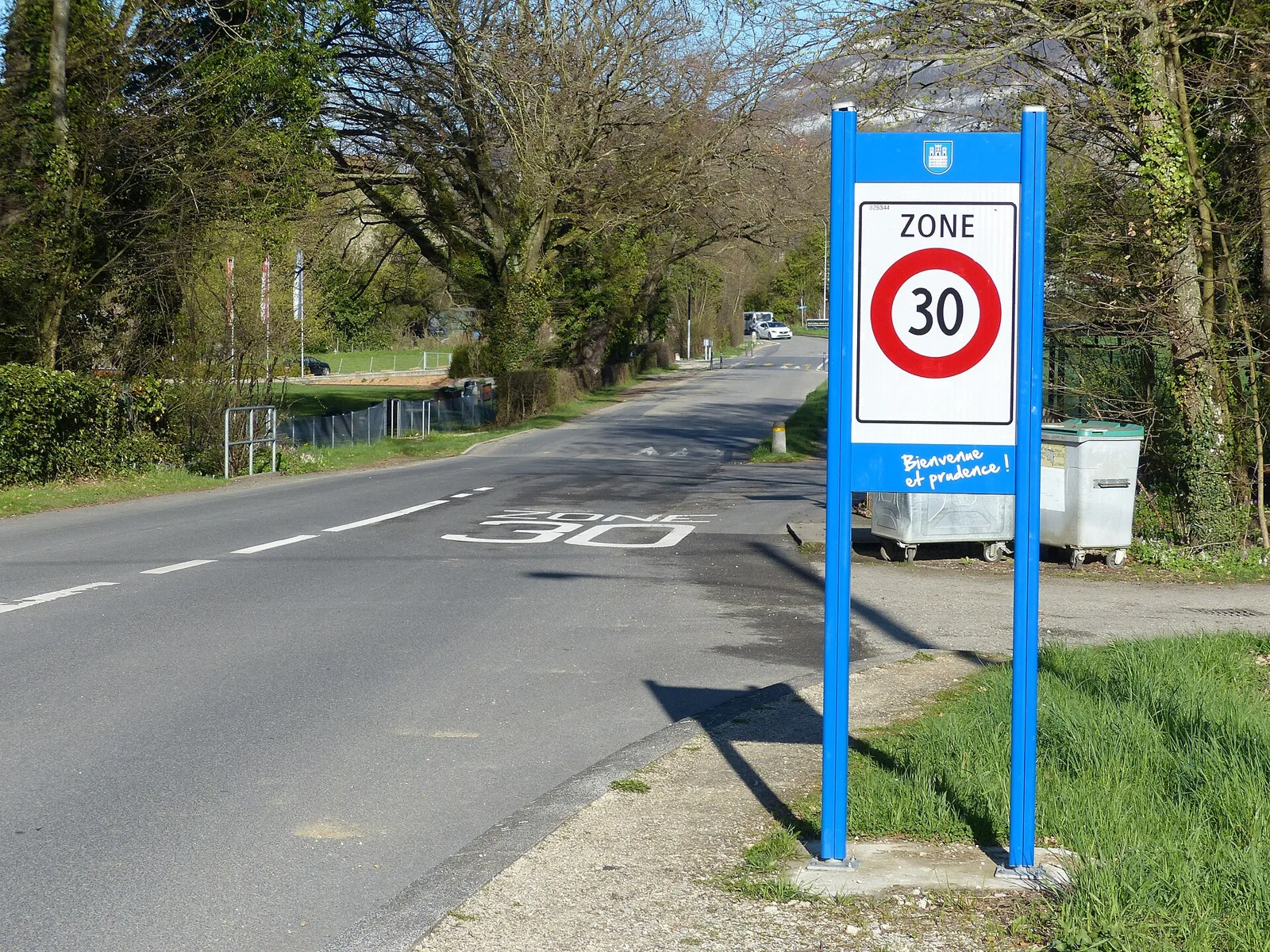
A 30 km/h zone, and its imperial twin the 20 mph zone, is a speed limit applied across a whole area of urban roads. The limit is posted, but the speeds are generally achieved through physical or psychological traffic calming rather than signs alone, although limits marked only with signs and lines are increasingly used in the UK.
The usual setting is a residential area, where the aim is to hold traffic speeds at a safe level. The philosophy treats streets in these zones as public spaces for everyone except people in motor vehicles, with the goal of cutting rat running and improving both safety and standards of living. The list of stated objectives is long: safe crossings, more walking and cycling, less obesity through active living, lower emissions, air pollution and noise, safe routes for people with disabilities and for children near schools, stronger communities, higher local property values and a livelier local economy.
Does lowering the limit work?
Research linking speed to pedestrian crash severity is well established, and lower speeds in built-up areas reduce injuries for everyone, drivers and cyclists included. Studies also find that slower roads cut community severance, the way fast traffic splits a neighbourhood, and that neighbours interact more when speeds drop to 30 km/h.
Compared with ordinary signed but unenforced limits, zones are more likely to deliver the target speed because they are paired with traffic calming. Reviews of formal studies in many countries found 20 mph zones and limits effective at reducing accidents, injuries, speed and traffic volume. Limits without any change to street layout work less well, though they still bring significant benefits. A crash at 30 km/h (20 mph) is far less likely to kill a pedestrian than one at 50 km/h (30 mph) or faster, and the limited evidence from existing 30 km/h schemes shows marked falls in deaths and casualties.
Where have 30 km/h limits spread in Europe?
Graz in Austria was the first European city to adopt a citywide 30 km/h limit, on 1 September 1992, applying it to every road except its largest. Switzerland has permitted 30 km/h zones by law since 1989 and set up the first in Zurich in 1991, and the Netherlands has them in profusion. In 2013 a network of 67 European NGOs launched a European Citizens' Initiative, "30 km/h - making streets liveable", seeking to make 30 km/h the normal limit across the European Union, with 50 km/h as the exception for local authorities to decide.
| City | What it did |
|---|---|
| Munich | 80% of its 2,300 km of urban roads are at 30 km/h or less; the rest are 50 km/h |
| Madrid | 85% of streets at 30 km/h; a May 2021 regime set most urban streets at 30, some at 20 and the rest at 50 km/h |
| Lyon | Since 30 March 2022, 84% of streets at 30 km/h, up from 37%: 610 km of 627 km |
| Brussels | January 2021: 30 km/h default across the whole 162 km2 Brussels Capital Region, then Europe's largest such zone |
| Paris | Since 30 August 2021, 30 km/h in most of the city except the peripherique, the boulevards des Marechaux and a few other streets |
| Bologna | January 2024: 30 km/h on 70% of streets, covering about 90% of the population |
In France, Toulouse leads for sheer length of 30 km/h zones with 479.5 km, ahead of Angers on 461 km and Paris on 396.7 km, while Lorient, Grenoble, Tours and Nantes each have between 179.1 km and 214.5 km. Madrid's May 2021 rules depend on the number of lanes and on whether the pavement is physically separated from the road. Amsterdam made 30 km/h the norm in more of the city on 8 December 2023 under the slogan "30 km/u in de stad", yet the municipality stresses that for legal purposes this is not a "30 km/h zone", which is a specific Dutch category with different right-of-way rules.
The United Kingdom
British campaigning has focused on 20 mph. The group 20's Plenty for Us counted local authorities covering over 15 million people committed to wide-area 20 mph limits in March 2016, including more than half of the 40 largest urban authorities. Edinburgh brought in a citywide 20 mph network in March 2018: average speeds have fallen, compliance is imperfect but support is growing, casualties have declined, and there is no evidence of traffic moving onto 30 mph streets. The Scottish Borders tried 20 mph in 97 villages and towns from October 2020, with speeds staying lower for at least eight months and the biggest drops where average speeds had been above 25 mph.
Wales went furthest. In September 2023, following supportive literature reviews, a manifesto pledge, years of pilot studies, consultation and favourable polls, it made 20 mph the default on residential roads, with councils free to make exceptions. Public Health Wales forecast that as many as ten lives and some two thousand serious injuries a year would be saved. The idea had been put to the Senedd by a Conservative member in 2018 and had all-party support for some years, but in 2023 the Welsh Conservative leader began to call it a "blanket" limit, and it became one of the most toxic issues in years. A no-confidence motion against the deputy climate change minister, Lee Waters, was backed only by Conservatives and defeated.
Data came quickly. In the first week after the change, in-vehicle GPS data showed urban speeds in Wales down by 2.9 mph, with half of drivers sticking to the new limit, and three months later average speeds were 2.4 mph below their previous levels. In June 2024 the insurer esure reported that vehicle damage claims in Wales had fallen by 20 per cent since the previous September, at times of year when claims usually rise.
What about North America, Mexico and Oceania?
In the United States 20 mph (32 km/h) limits exist along individual routes but have been slow to catch on across whole areas, though New York City uses its Neighborhood Slow Zones Program. Ten states already permit limits of 15 mph or 20 mph (24 or 32 km/h) on linear routes, mostly school zones. Alaska sets 15 mph in alleys and 20 mph in business districts. Delaware uses 20 mph in school zones, and Florida uses 10 to 20 mph, with debate over the effectiveness of its flashing yellow lights. Massachusetts requires 15 mph near a vendor's vehicle showing flashing yellow lights, an ice cream truck for example, and 20 mph in a school zone when children are present. North Carolina sets 20 mph in central business districts, Oregon applies 20 mph on school roads between 7 a.m. and 5 p.m. on school days, Pennsylvania uses 15 mph at arrival and departure times, and Rhode Island sets 20 mph within 300 ft (90 m) of a school. West Virginia has 15 mph school zones reaching 200 ft (60 m) either side of the school, and Wisconsin sets 15 mph around schools, alleys and parks where children play.
Mexico has "Zonas 30" in Monterrey, Guadalajara, Zapopan, Los Mochis and Puebla, mostly in historic downtowns.
In Australia, residential streets in the Melbourne suburbs of Fitzroy and Collingwood are zoned at 30 km/h, and community support among those living or working there rose from 47% to 68% after the change. Sydney's central business district has only one 30 km/h street, Druitt Street, next to Town Hall station, and the city had forty-four kilometres of such zones as of March 2024. Manly's town centre dropped to 30 km/h on 11 July 2020 and Liverpool city centre followed on 17 July. By July 2024 New South Wales had at most 15 locations with 30 km/h zones, including Cootamundra, which introduced one on its main street in June 2024.
New Zealand moved earlier. Wellington's suburban shopping areas have been at 30 km/h since about 2010, New Plymouth's centre followed in July 2012, Blenheim in August 2014 and central Christchurch in March 2016. Tauranga's beachside Mt Maunganui has been at 30 km/h since August 2011 and its city centre since October 2018, and in Auckland the Wynyard Quarter and Viaduct Harbour went to 30 km/h in July 2017. A growing number of central main streets, among them Queen Street in Auckland, Victoria Street in Hamilton and George Street in Dunedin, have been converted too.