How a spinning triangle won Le Mans, built the RX-7 and keeps coming back, and what makes a Wankel tick.
A rotary or Wankel engine uses a spinning triangular rotor in a figure-eight housing instead of pistons, making it compact and smooth. Mazda built it into the RX-7 from 1978 to 2002, won Le Mans with it in 1991, and revived it as a range extender in the Iconic SP concept.
The only car without a piston engine to win the 24 Hours of Le Mans did it in 1991, and as of 2026 nobody has repeated the trick. That Mazda 787B ran on a Wankel, the spinning-triangle engine that Mazda kept alive long after nearly everyone else abandoned it.
How does a rotary engine work?
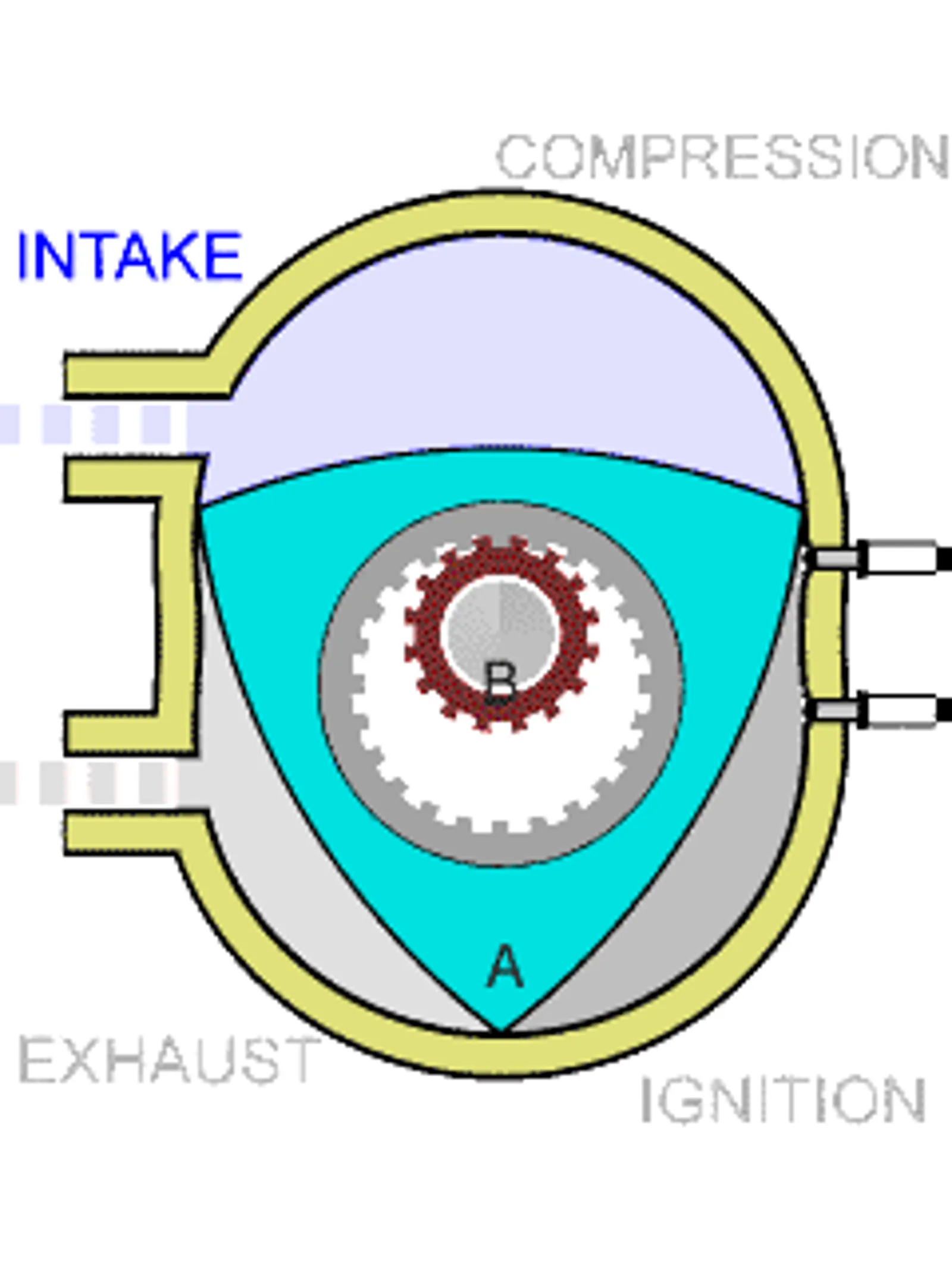
A Wankel engine is an internal combustion engine that turns combustion pressure into rotation directly, with no pistons shuttling up and down. A rounded triangle, shaped something like a Reuleaux triangle with flatter sides, spins inside a housing that looks like a figure eight with a pinched waist. Gas pressure pushes on the faces of the triangle, and that push turns an output shaft.
Think of a hula hoop circling a hip. In the production version of the engine, called the KKM, the rotor circles an eccentric lobe on the output shaft while also spinning on its own axis, so the rotor makes one complete turn for every three turns of the shaft. The gear on the rotor carries one and a half times as many teeth as the gear fixed to the housing, a 2:3 ratio that guides the whole motion.
Between rotor and housing sit three moving working chambers. The rotor never touches the housing wall; seals at its three tips, called apex seals, press outward to stop pressure leaking. Each of the three faces runs through intake, compression, expansion and exhaust, which makes every practical Wankel a four-stroke Otto-cycle engine. A two-stroke rotary is possible in theory but impractical, because intake and exhaust gas cannot be properly separated, and the diesel cycle cannot be used at all, so rotaries rely on a high-voltage spark.
The reward for this arrangement is smoothness. A Wankel has a lower moment of inertia and a more uniform torque delivery than a piston engine, and a two-rotor example runs with more than double the smoothness of a four-cylinder. The output shaft has none of the stress-related contours of a crankshaft. Advocates also point to compact size, lower weight and fewer parts. In racing, rotaries have been run at up to 10,000 rpm, while aircraft versions stay at 6500 or 7500 rpm. The price is lower thermal efficiency and higher exhaust emissions in basic petrol form than a four-stroke piston engine, which limited the engine's use after its debut in the 1960s.
A two-rotor Wankel runs more than twice as smoothly as a four-cylinder piston engine.
Who invented the Wankel engine?
Working in the city of Lahr during the 1920s, the German engineer Felix Wankel designed a rotary compressor, and his first patent covering a rotary engine followed in 1934. He realised that adding intake and exhaust ports to the compressor's triangular rotor would make an internal combustion engine. In 1951 he began working at NSU Motorenwerke, where he built a rotary supercharger for a 50 cc two-stroke motorcycle engine that made 13.5 PS at 12,000 rpm.
NSU agreed in 1954 to develop a full rotary engine with him. Wankel had a reputation as a difficult colleague, so the work on his design, the DKM, happened at his private bureau in Lindau. In the DKM an outer rotor and an inner rotor both turned, around a stationary centre shaft. It ran first on 1 February 1957 and made 21 PS, but it was deemed impractical: cooling was a particular problem, and at very high revs the outer rotor distorted.
The fix came from NSU's development chief, Walter Froede, who adopted a design by Hanns-Dieter Paschke in which the housing stays still and the shaft carries an eccentric lobe. This KKM was easier to adapt to a conventional drivetrain, with accessible spark plugs and a simpler cooling layout. Wankel disliked it, because the rotor's motion was no longer a pure circle, and he said his race horse had become a plough horse. NSU could not fund both, and chose the KKM. Wankel obtained US patent 2,988,065 for it on 13 June 1961.
From prototype to production
| Engine | First run or year | Size | Output |
|---|---|---|---|
| DKM 54 | 1 February 1957 | Early prototype | 21 PS (15 kW) |
| Second DKM prototype | Soon after DKM 54 | 125 cc chamber volume | 21 kW (29 PS) at 17,000 rpm |
| KKM 125 | 1 July 1958 | 125 cc, 17 kg | 26 PS (19 kW) at 11,000 rpm |
| KKM 502 | 1963 | 996 cm3, single rotor | 40 kW (54 hp) at 6,000 rpm |
The KKM 502 became the first series-production Wankel for a car, installed in the NSU Spider, a sports car built in a run of about 2,000. It had teething troubles, but it also had decent potential, smooth running and low noise at high engine speeds.
Why did early rotary engines have so many problems?
Most of the trouble came from the seals and from heat. Researchers in the 1950s and 1960s met scratches in the housing that they called chatter marks and devil's scratch, which chipped the chrome coating. The cause was apex seals vibrating at a resonant frequency. Thinner, lighter seals and better-matched materials solved it. Kenichi Yamamoto lightened seals experimentally by drilling holes in them, which pointed to weight as the main culprit and led Mazda to adopt aluminium-impregnated carbon apex seals in its early production engines. Later, a chrome surface applied to a steel jacket in the aluminium housing let Mazda go back to metal seals 3 mm thick and eventually 2 mm thick.
Heat is the other issue. In a piston engine all four strokes happen in one chamber, so the cold of intake and the heat of exhaust average out. In a Wankel they take place at fixed spots around the housing, giving it a very uneven thermal load. Cracks appeared near the spark plug hole until engineers fitted the plugs in a separate copper insert. Toyota found that glow plugs in place of leading spark plugs improved fuel consumption at low revs and partial load by 7%.
Emissions need their own fix. Mazda's 12A has a long, thin combustion chamber with a large surface area for its volume, so combustion runs cool and produces few oxides of nitrogen. The burn is incomplete, however, which leaves carbon monoxide and unburned or half-burned hydrocarbons. The exhaust runs hot enough for that to keep burning, and an engine-driven pump feeds fresh air into a thermal reactor where a normal car would have its exhaust manifold.
What made the Mazda RX-7 a cult car?
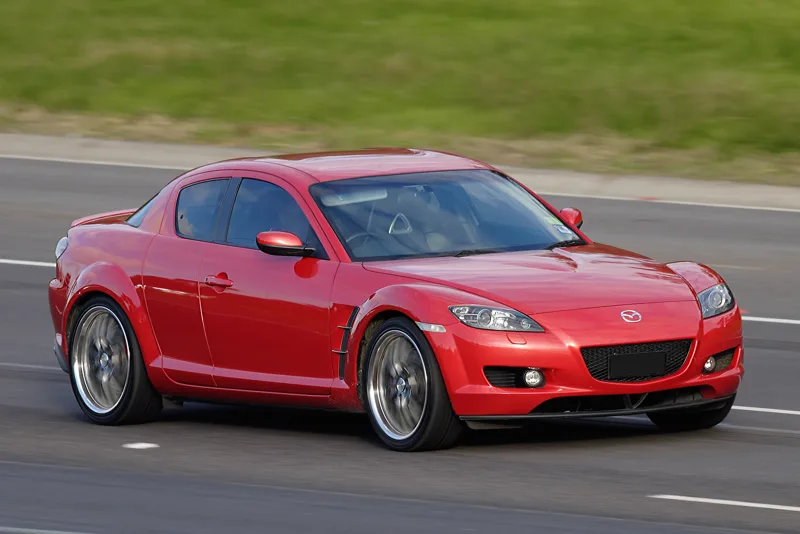
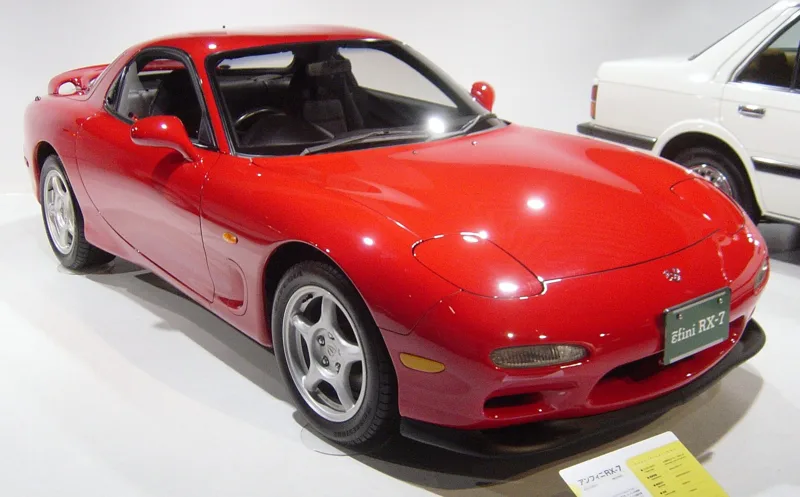
The Mazda RX-7 was a sports car built from 1978 to 2002 over three generations, with its engine in the front half of the car, power going to the rear wheels and a compact, lightweight rotary. More than 800,000 were made. The first, coded SA and later FB, was a two-seat hatchback coupe with a 12A engine, with a fuel-injected 13B offered in later years. The second, the FC, used a 13B in naturally aspirated or turbocharged form and came as a coupe, a convertible and, in some markets, a 2+2. The third, the FD, had a sequentially turbocharged 13B REW.
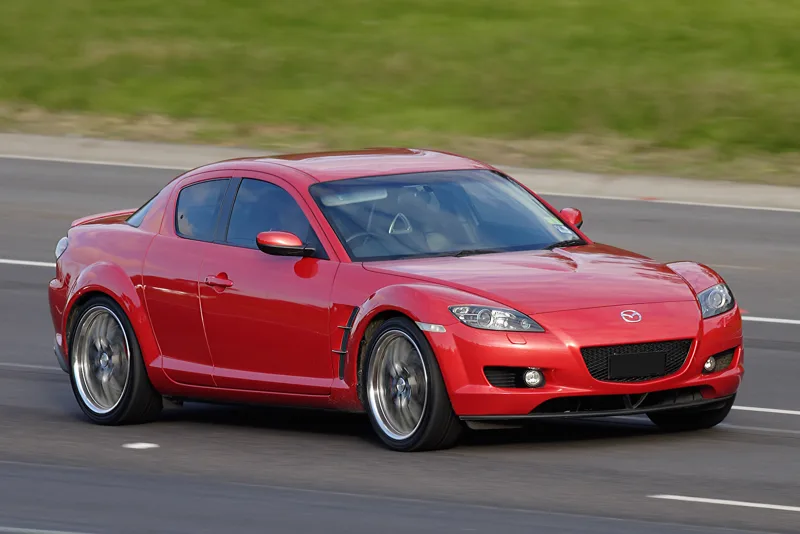
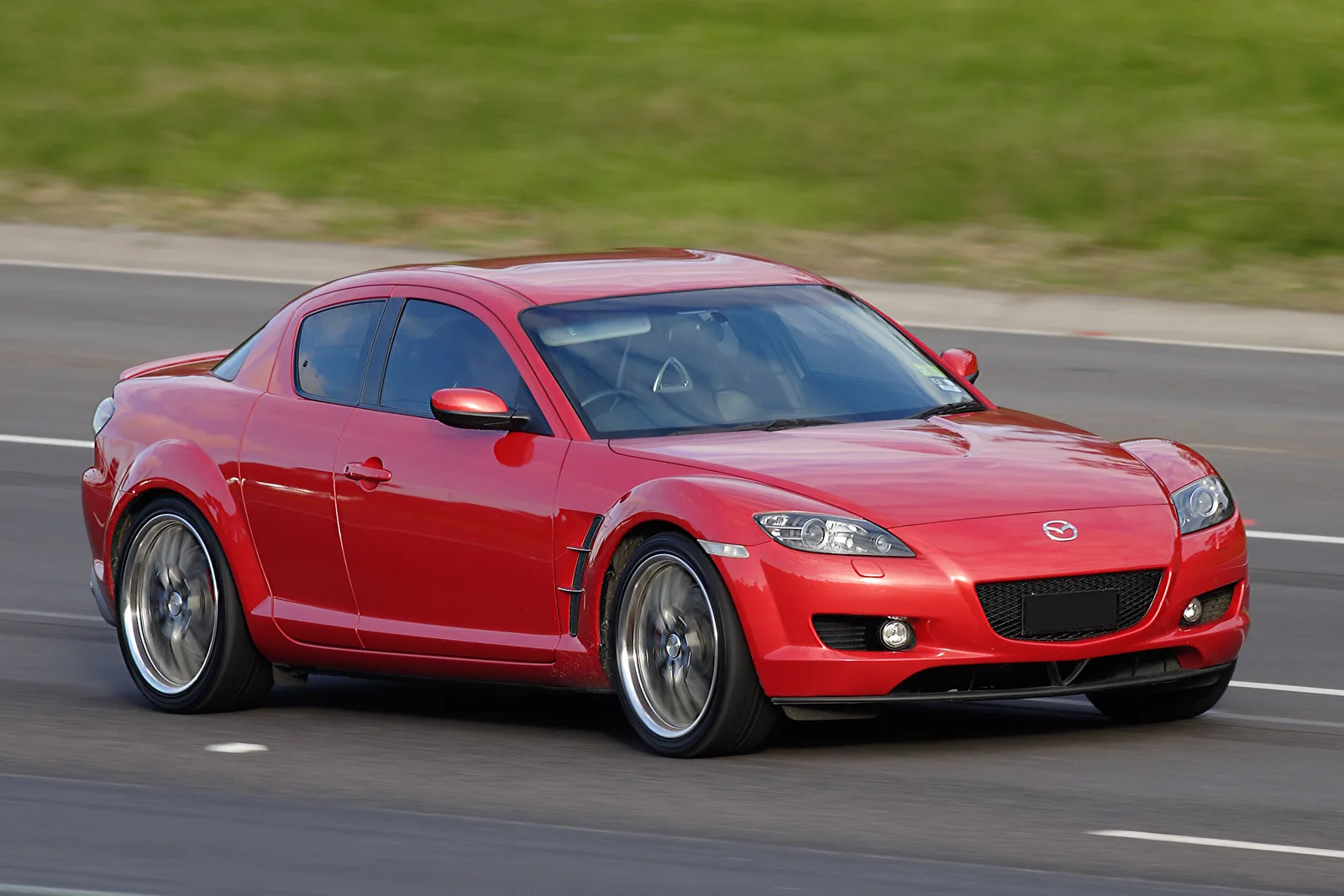
The first car launched in Japan in March 1978, replacing the Savanna RX-3. Its lead designer was Matasaburo Maeda, whose son Ikuo later designed the Demio and then the RX-8, which replaced the RX-7. The small, light rotary sat behind the front axle, which gave a low centre of gravity and a 50:50 weight split, and the car weighed under 1,100 kg (2,425 lb), the lightest of the three generations. In North America the 12A made 100 hp (75 kW; 101 PS) at 6,000 rpm, enough for more than 190 km/h (120 mph) and 0-97 km/h (60 mph) in 9.2 seconds. Because the engine stayed so smooth at speed, a buzzer on the tachometer warned the driver as the 7,000 rpm redline approached.
Sales were strong. Mazda built 471,018 first-generation cars, and between 332,850 and 367,878 of them, seventy to eighty percent, went to buyers in the United States. A 12A turbo followed in Japan in September 1983 with 165 PS (121 kW), and the second generation went further, adding independent rear suspension, rack and pinion steering and a passive rear-steer system called DTSS. The Turbo II used a twin-scroll turbocharger and initially made 25 percent more power than the naturally aspirated car, with 185 PS (136 kW) in Japan. Mazda also built Infini editions for Japan, limited to 600 cars a year from Series I in 1987 to Series IV in 1990, and the line was regarded as the peak of the RX-7 until the third generation arrived.
How did a rotary engine win Le Mans?
The Mazda 787 and its derivative, the 787B, were Group C prototypes built for 1990 and 1991, and they were the final rotary-engined cars to race in the World and Japanese championships. They used Mazda's R26B engine, which had three spark plugs per rotor, ceramic apex seals and variable-length intake trumpets. Designer Nigel Stroud built a carbon and Kevlar monocoque in Britain. Two 787s were made in 1990, and three newer 787Bs followed in 1991.
Mazda held the R26B below its peak output at Le Mans, favouring durability and fuel efficiency over outright power. The 787B had a continuously variable intake and 608 N m (448 lb ft) of torque at 6,500 rpm, plus Mazda's first set of carbon ceramic brakes on a racing car.
The car lacked the single-lap speed of Mercedes-Benz, Jaguar and Porsche, but it was reliable. In 1990 both 787s retired from Le Mans, one with an oil leak and the other with an electrical failure and fire. In 1991, Jacky Ickx advised the team, and Mazda was allowed to race at 830 kg (1,830 lb) rather than the 1,000 kg (2,205 lb) normal for its class. The 787Bs started 19th, 23rd and 30th for a race Mazda was not favoured to win. Team manager Ohashi ordered the No. 55 crew to treat the race as a short sprint, after tests had shown the car's reliability and exceptional fuel economy. Johnny Herbert, Volker Weidler and Bertrand Gachot won. It was the first Le Mans victory by a Japanese manufacturer, and the next one came from Toyota in 2018.
What is the Mazda rotary comeback?
Mazda presented the Iconic SP concept at the Japan Mobility Show in October 2023. Its design draws on the FD RX-7, and it uses a two-rotor Rotary-EV system, in which a rotary engine that can burn a range of fuels, hydrogen among them, supplies electricity. The arrangement is described as virtually carbon neutral, and it can also supply power to outside equipment. Placing the engine nearer the middle of the car gives a low bonnet, a low centre of gravity and even front-to-rear weight balance. It also has pop-up headlights.
The concept fits a wider pattern. Beyond sports cars, the Wankel's compact shape, smoothness, low weight and few parts suit chainsaws, auxiliary power units, aircraft, personal watercraft, snowmobiles, motorcycles and automotive range extenders. It is still a concept and not yet a product.
What does this mean for someone buying or driving a rotary?
Expect a different kind of engine. Wankels are capable of high-speed running, which means they do not need big torque to make big power. The second-generation RX-7 shows how that played out in the market: Japan received only the turbocharged engine, at 185 PS, and the naturally aspirated version went to select export markets, partly because insurers in many Western countries penalised turbocharged cars.
If you are looking at an RX-7, ask which generation and series it is. The first was a purer sports car and the lightest of the three, while the second moved toward the gentler sport-tourer fashion of its day, with sharper handling and more precise steering. The third added sequential turbocharging.