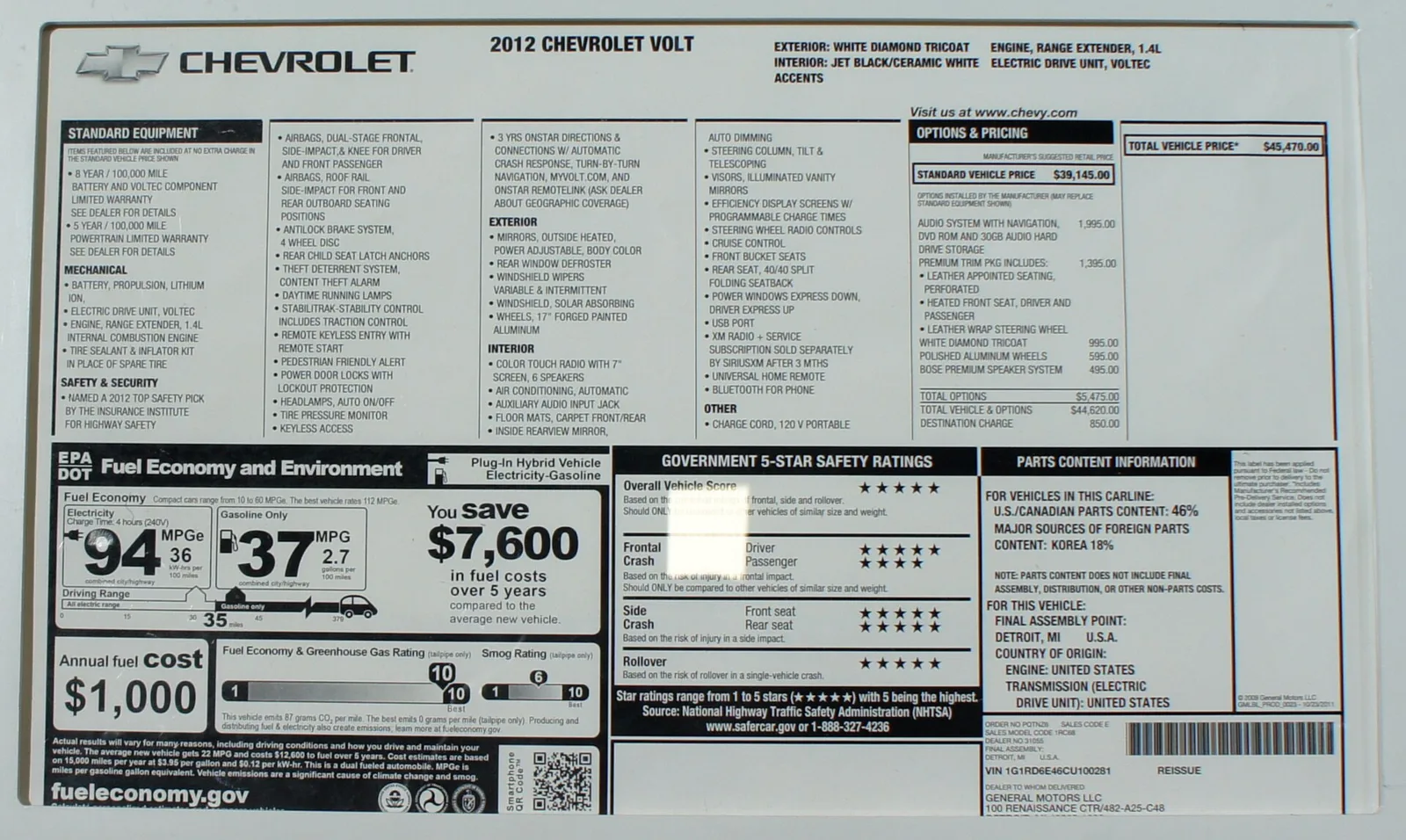
A 1958 law put price, options and fuel ratings on every new American car, while the 1975 CAFE rules measure fuel economy a different way.
The Monroney sticker is the label US law requires on every new car, naming price, equipment, fuel economy and crash ratings. Senator Mike Monroney's 1958 act created it. Its fuel figures are separate from CAFE, a 1975 regime that averages a maker's whole fleet.
A new American car that reaches a showroom without its window label can cost its maker up to US$1,000 per vehicle in fines, and only the buyer may legally peel that label off. It is the Monroney sticker. Its price lines date from 1958, while its fuel figures come from a separate set of rules that count fuel economy in a different way.
What is a Monroney sticker?
The Monroney sticker, also called the window sticker, is the label that United States law requires on every new car. It carries official details about that particular vehicle, from its price to its safety ratings. It takes its name from Almer Stillwell "Mike" Monroney, the Oklahoma senator who sponsored the bill that made it compulsory.
The maker has to fix it to a side window or the windshield before the car ships to the dealer. After that it belongs to the buyer: under Title 15 of the United States Code, the consumer alone can remove it. Shipping a car without one is penalised, and illegally altering one can lead to further fees and penalties, imprisonment included.
The law carves out heavier vehicles. The 1958 Automobile Information Disclosure Act does not reach anything with a gross vehicle weight rating above 8,500 pounds (3,856 kg).
The CAFE figure and the number on the window are two different measurements of the same car.
Why did a senator force dealers to print a price?
In 1955 Monroney led a Senate subcommittee working under the Interstate and Foreign Commerce Committee. It began by hearing complaints from dealerships about the way manufacturers treated them. It then turned the other way and started looking at what the dealerships themselves were doing to customers.
The trouble was that a new car carried no price at all. A dealer could name a manufacturer's suggested retail price far above what the car was worth, then "discount" it so the buyer felt they had won something. The same inflated figure could make a trade-in look generously valued. Fees and optional extras got added with little explanation, and shoppers had no list of options or of the destination charge to check against.
Monroney's answer was the Automobile Information Disclosure Act of 1958. It forced disclosure of the car, its equipment and its pricing, on the vehicle itself, where no salesperson could talk around it.
What must a window sticker list?
The statute spells out what goes on the label. Most of it is a plain inventory of the car and its price, and the fuel and crash lines were bolted on later by amendment.
- The car's make, model, trim level and serial number
- The price the maker suggests, known as the MSRP
- What the engine and transmission are
- Which equipment is standard, plus warranty terms
- Each optional extra, with its price
- The transportation charge for shipping the car to the dealer
- Fuel economy ratings for city and highway driving, worked out by the Environmental Protection Agency (EPA)
- Crash test ratings from the National Highway Traffic Safety Administration (NHTSA), a requirement as of September 2007
Read in that order, the sticker works like a receipt written before the sale. The base price, the options and the freight charge are all in print on the car, which answers the complaint that shoppers once had no such figures to check.
How did the fuel economy panel come to look the way it does?
Fuel figures were already on the label by the mid-1970s, supplied by the EPA. The panel was rebuilt twice. The 2007 Energy Independence and Security Act (EISA) demanded more on fuel efficiency, plus ratings for greenhouse gas emissions and other air pollutants, and the new content applied from the 2008 model year for cars and light-duty trucks.
The bigger overhaul followed because electric cars and plug-in hybrids were arriving. A single miles-per-gallon number means little for a car that runs on a battery, so the EPA and NHTSA ran a series of studies on how to let a buyer compare a battery electric car, a plug-in hybrid and a petrol or diesel model on one page.
The unit buyers actually understood
EPA focus groups were shown several ways of expressing electricity use. People did not grasp the kilowatt-hour, even though it is the unit on their own power bills. They preferred miles per gallon of gasoline equivalent, or MPGe, because it echoes the figure they already use for petrol cars. They also found kilowatt-hours per 100 miles more confusing than miles per kilowatt-hour.
The label that resulted carries MPG, MPGe, gallons per 100 miles and kilowatt-hours per 100 miles. A "gallon of gasoline equivalent" is the amount of electricity in kilowatt-hours, compressed natural gas in cubic feet or hydrogen in kilograms that holds the same energy as a gallon of petrol.
The A to D grades that never reached showrooms
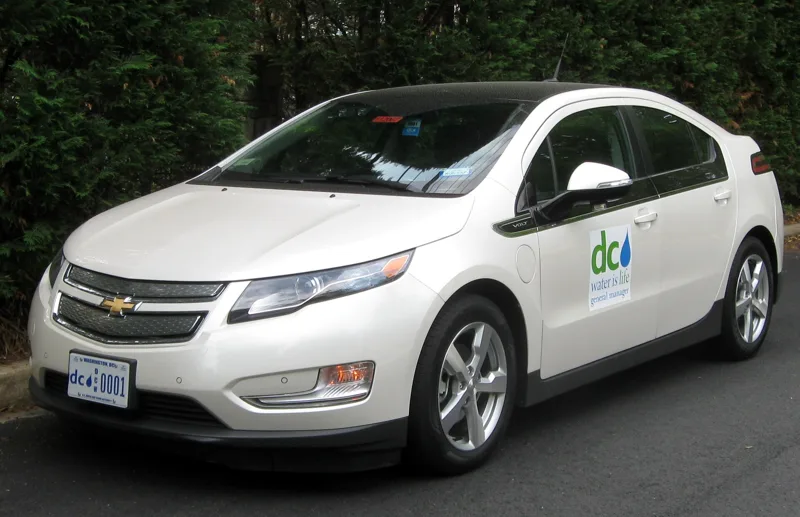
Two designs went out to a 60-day public consultation in 2010. Both put MPGe and kilowatt-hours per 100 miles on plug-in cars, and in one of them MPGe and annual electricity cost were the most prominent items. The other would have graded each car from A to D, comparing its fuel economy and air pollution with the whole new-car fleet. Carmakers opposed the letter grades, and the idea was dropped after the consultation. In November 2010 the EPA put MPGe on the sticker of the Nissan Leaf and the Chevrolet Volt.
What is on the 2013 fuel economy and environment label?
In May 2011 the two agencies, NHTSA and the EPA, issued a joint final rule. The new label became compulsory for all new passenger cars and trucks from the 2013 model year, although makers could adopt it a year early. It added panels for plug-in hybrids, electric cars, flexible-fuel cars, hydrogen fuel cell cars and natural gas vehicles.
For the first time the label estimated the fuel or electricity needed to cover 100 miles (160 km). That is fuel consumption per distance, the style of figure used in many other countries, and the EPA chose it to dodge what it calls the "MPG illusion". The illusion is that miles per gallon can mislead when buyers weigh improvements against each other.
The same label brought several other firsts:
- A greenhouse gas rating that compares the model's tailpipe carbon dioxide with every other model, with a note that power-station emissions behind electricity are not counted
- A smog rating built on nitrogen oxides and particulates
- An estimate of what a typical driver will save or spend on fuel over five years compared with the average new vehicle
- Electric driving range and charging time for plug-ins and electric cars
- A QR code that opens an online tool, with local petrol and electricity prices and a way to enter your own commute for a sharper fuel cost estimate
What is the CAFE standard?
CAFE stands for corporate average fuel economy. Congress first enacted these standards in 1975, after the Arab oil embargo of 1973-74, to lift the typical mileage of the cars and light trucks built for the American market. The term light trucks covers trucks, vans and sport utility vehicles.
The rules do not hand buyers a bonus for choosing an efficient car, and they do not touch fuel prices. They act on the maker instead. If a manufacturer's yearly fleet falls short, it must either spend CAFE credits to cover the gap or pay a penalty, set at $14 for each 0.1 mpg below the standard multiplied by its total production for the American market. That makes thirsty cars expensive to build, and the cost, in theory, shows up in what is on offer.
NHTSA administers the standards on behalf of the Secretary of Transportation, while the EPA measures the vehicles' fuel efficiency. Congress told the department to set each year's level at the "maximum feasible" with four things in mind: technological feasibility, economic practicality, the effect of other standards on fuel economy and the nation's need to conserve energy. Federal law also stops any state or local government from adopting its own fuel economy rules.
A separate Gas Guzzler Tax falls on individual passenger car models that manage under 22.5 mpg (10.5 L/100 km). It does not apply to trucks, vans, minivans or SUVs.
How is a fleet average calculated?
CAFE is not an ordinary average. The figure is a production-weighted harmonic mean, which is the reciprocal of the average of the reciprocals of each model's economy. The reason lies in what the number is meant to capture. A harmonic mean describes driving every car in the fleet the same number of miles, while an arithmetic mean describes driving each one on the same amount of petrol.
Take a fleet of four vehicles that manage 15, 13, 17 and 100 mpg. Its CAFE is slightly under 19 mpg, whereas the plain arithmetic mean is just over 36 mpg. The difference is that one gallon takes the 13 mpg car only 13 miles and the 100 mpg car 100 miles, and a single hyper-efficient model cannot rescue a lineup of gas-guzzlers.
Each vehicle's own figure comes from a weighted harmonic average of two laboratory cycles, a city test known as FTP-75 and a highway test known as HWFET.
Domestic and foreign fleets
A maker's output is split in two. The domestic fleet holds vehicles built with over 75 percent content from the United States, Canada or, after NAFTA, Mexico, and the foreign fleet is everything else. Each must meet the requirement on its own. The United Automobile Workers lobbied for the two-fleet rule as a way to protect American jobs, and it still advocates it. For light trucks the two-fleet rule was removed in 1996.
Cars and light trucks are judged apart
Passenger cars and light trucks have separate standards, even though most light trucks are used as passenger vehicles. The light-truck share of the market grew from 9.7% in 1979 to 47% in 2001 and stayed around half up to 2011. Heavier vehicles have been drawn in over time, with medium-duty trucks covered from 2012 and heavy-duty commercial trucks from 2014.
How does vehicle size change the target?
Since 2011 the targets are mathematical functions of a vehicle's footprint, which is its wheelbase multiplied by its average track width. A complicated formula used in 2011 was replaced from 2012 by a simpler inverse-linear one with cutoff values. A larger footprint carries a lower fuel economy requirement, so a big truck is not held to a small hatchback's figure.
| Vehicle | Footprint | CAFE target | Published equivalent |
|---|---|---|---|
| 2012 Honda Fit | 40 sq ft (3.7 m2) | 36 mpg (6.5 L/100 km) | 27 mpg (8.7 L/100 km) |
| Ford F-150 | 65-75 sq ft (6.0-7.0 m2) | 22 mpg (11 L/100 km) | 17 mpg (14 L/100 km) |
No single car has to hit its own target. The standard is enforced across the fleet, so a maker can sell some models below the line if others sit above it.
Why do the CAFE figures and the sticker figures differ?
They are not the same number. The CAFE figure for a vehicle has for decades run higher than what drivers actually see, and as of the 2022 model year real-world economy is typically 76 percent of it. The Monroney window sticker value, which is the consumer information, is a different figure again. The Honda Fit shows the gap: its CAFE target is 36 mpg while its published equivalent is 27 mpg.
Electric and alternative-fuel cars get special treatment in the compliance maths. Each gallon of alternative fuel is treated as holding just 15% fuel, roughly the petrol content of a gallon of E85. For a dual-fuel car, the alternative-fuel rating is divided by 0.15, which is the same as multiplying by 6.666, and then averaged with the petrol rating. An E85-capable car returning 15 mpg on E85 and 25 mpg on petrol might sensibly be rated at 20 mpg, yet for CAFE purposes it counts as 100 mpg and 25 mpg, giving 62.5 mpg. The total lift a manufacturer can claim from dual-fuel vehicles is capped at 1.2 mpg, and Section 32906 cut that lift to zero through 2020. Electric vehicles also use the 0.15 divisor but are not held to the 1.2 mpg cap.
On the compliance test cycles a 2016 target of 34.0 mpg at a 44 sq ft footprint compares with 70.7 mpg for the 2012 Prius hybrid, 69.8 MPGe for the plug-in Prius and 141.7 MPGe for the Leaf.
Did CAFE actually save fuel?
A 2002 National Academy of Sciences panel concluded that without CAFE, and with nothing else in its place, fuel use by road vehicles would have been about 14 percent higher in 2002. The same report said the standards had raised vehicle costs and, by shifting the types and weights of cars sold, may have contributed to an estimated 1,300 to 2,600 extra deaths in 1993 alone. Some committee members dissented on that second finding.
That safety worry shaped the politics for years. The EPA tended to push buyers toward efficient vehicles, whereas NHTSA feared that smaller cars meant more fatalities. In the mid-2000s the safety of small cars improved and the poor record of light trucks became clearer, which started to weaken the link.
Fuel prices matter as much as the rules. Economy rose from 1979 to 1982 when the standard climbed and petrol got dearer, then again from 1984 to 1986 as the standard rose while prices fell. In 2008 North American fleets averaged 25 mpg (9.4 L/100 km), against 45 mpg (5.2 L/100 km) in the European Union.
What does this mean when you read a sticker?
For the price block, the sticker is the baseline for any negotiation: the MSRP, each priced option and the freight charge are all printed, and only the buyer may take the label off. For the fuel block, the numbers are designed for comparing cars rather than for forecasting your own bills. The five-year cost line is set against the average new vehicle, and the QR code lets you swap in your local energy prices and your own commute.
For electric and plug-in cars, MPGe is the bridge. It converts the energy a car uses into the amount a gallon of petrol holds, so a battery car and a petrol car can sit side by side. The greenhouse gas rating counts tailpipe carbon dioxide only, so an electric car's power-station emissions do not appear in it.
What has changed for CAFE and the sticker lately?
The CAFE regime itself has changed in recent years. In 2025 fines for violating the standards were largely eliminated, though the standards are still administered by NHTSA, and a study found that tough CAFE rules together with government incentives for efficient vehicles should speed up demand for electric cars. The window sticker, meanwhile, remains a fixture of the American showroom, with the same inventory of price, equipment and fuel ratings that the 1958 act began.