The small sports car whose American backer walked away, and the air-cooled twin that took the top three places on the 1961 Monte Carlo Rally.
The Panhard Dyna Junior was a small roadster and cabriolet built from 1952 to 1956, with slightly over 4,700 made. The PL 17 was a facelifted Dyna Z saloon range made from 1959 to 1965, with around 166,000 built, and a Monte Carlo Rally winner in 1961.
The man who commissioned the Panhard Dyna Junior pulled out after seeing pictures of the first prototype, and the little sports car went on to sell slightly over 4,700 anyway. Its story, and that of the PL 17 saloon that followed Panhard's small cars into the 1960s, runs from a spartan roadster of 1952 to a rally winner and the end of Panhard as an independent carmaker.
What was the Panhard Dyna Junior?
The Dyna Junior was Panhard's small sports car, built between 1952 and 1956. It began as a roadster and was later offered as a cabriolet, and a little over 4,700 found buyers. It was built on the chassis and front-wheel-drive layout of the Dyna X, with a boxer twin-cylinder engine.
The idea came in early 1951 from Joseph Bell Ferguson, the brother of Harry Ferguson. He had emigrated to the United States and was running Fergus Motors in New York, importing European cars including Panhards, and he proposed a compact sports car aimed at American buyers. Panhard took the project on with his financial backing and borrowed the Dyna X's chassis and drivetrain to save time and design cost.
In 1961, a PL 17 won the Monte Carlo Rally, with PL 17s second and third.
How did the Panhard Dyna Junior come to be built?
Panhard hired the body maker Di Rosa, known mainly for trucks and buses, and its chief designer Albert Lemaitre to style the car and build a prototype. Within a few months they had an aluminium-bodied car that had one door, on the driver's side, and a windscreen that folded flat.
Jean Panhard reviewed it and asked for extensive changes. Ferguson, who had been sent pictures, withdrew. A second prototype followed quickly, Panhard approved it and ten pre-production examples were ordered. The company originally meant to build only 500, but demand pushed it to raise the figure, and to cut costs at higher volumes it replaced aluminium with steel, which made the car more than 100 kg (220.5 lb) heavier.
The Dyna Junior was first seen at the Paris Motor Show in October 1951, and it went officially on sale early the next year. Di Rosa could not keep pace, so Panhard moved assembly to its own plant in Orleans. Di Rosa closed soon afterwards.
What was the Panhard Dyna Junior like?
Simplicity was the point. Brightwork was limited to the Dyna X's grille. The doors were hinged at the rear, suicide-style, with exposed hinges and no external handles, so opening one meant reaching through the sliding plastic side window to find the latch inside. There was no boot lid either: luggage went behind the folding backrest of the two-seat bench.
Inside, a single dial in the centre of the dashboard served as speedometer, and the gear lever rose from the dash as in the Dyna X. With just 25.7 kW (34.5 hp) it was no powerhouse, yet performance, handling, economy and a low price made the Junior popular with young buyers.
What engines did the Panhard Dyna Junior use?
The engine was an air-cooled two-cylinder overhead-valve boxer designed by Louis Delagarde. The first cars used the 745 cc GM750 SS3, which produced 24.3 kW (32.6 hp) at 5,000 rpm and gave a top speed of 120 km/h (74.6 mph). A Sprint version of the same displacement, with 26.5 kW (35.5 hp), was optional.
- April 1952: the 851 cc GM850 arrived with 27.9 kW (37.4 hp), lifting top speed to 125 km/h (77.7 mph). A Sprint version made 30.9 kW (41.4 hp) at 5000 rpm.
- February 1953: a cabriolet joined the roadster, with outside door handles and glass windows that wound up and down instead of plastic sliders. In March it moved to the X87 chassis of the Dyna X 130, and a three-seat bench was fitted.
- 1954: the Dyna X grille gave way to a simpler oval opening with an aluminium crosspiece, like the Dyna Z, and the instruments went from one dial to two. Bumpers changed in March, and the 745 cc versions were dropped in June.
- 1955: an optional MAG supercharger lifted power to 60 hp and top speed to 145 km/h. The roadster left the line-up in March, and production ended in April 1956.
Underneath, the earliest cars sat on the X86 chassis of the Dyna X 120. The wheelbase was 2,127 mm (83.7 in) and the tracks 1,220 mm (48.0 in) at both ends. Independent front suspension used upper and lower transverse leaf springs, with a rigid trailing axle on torsion bars behind. Houdaille hydraulic dampers, nine-inch drum brakes on all four wheels and 145 x 400 tyres completed the package, and the four-speed manual transaxle was the Dyna X's.
What specials were built on the Dyna Junior?
The Junior and the Dyna X were both used as the basis for limited-production cars. Pichon-Parat built about thirty fixed-head coupes that closely followed the original's looks, and designed a more streamlined body for either chassis. About 60 of those, called Dolomites, were built until 1956.
Others included the Panhard Rafale, an alloy-bodied coupe designed by Carmetall and sold through Dijon Tourisme, and a one-off by Howard "Dutch" Darrin for the US importer Robert Perreau, displayed on the Panhard stand in Los Angeles in October 1953 and then shipped to France, where it was not put into production. Ghia-Aigle of Lugano built a single alloy-bodied coupe for the 1954 Geneva show, and Albert D'Ieteren made one custom coupe for Brussels the same year.
In America, Don Racine raced his cycle-fendered "Aardvark" in SCCA events from the mid-1950s, and Murray Nichols built a series of specials in Southern California. Jerry Fairchild's special, with a Nichols body, used the Junior's engine block and suspension on a custom chassis, with fuel injection, twin overhead camshafts and at some point a supercharger. Some Devin Panhards also used part of the Junior's subframe.
Did the Panhard Dyna Junior race?
It did. A Dyna Junior finished 14th in the 1953 Tour de France Auto, and Georges Trouis and Jacques Blanchet placed 22nd in the 1953 1000 km of Nurburgring. Through the late 1950s, Juniors and cars derived from them turned up at races on both sides of the Atlantic.
The Fairchild special took the H-Modified class of the California Sports Car Club's Pacific Coast Championship twice, in 1958 and 1959, and was runner-up in the SCCA's H-Modified class in 1958.
What was the Panhard PL 17?
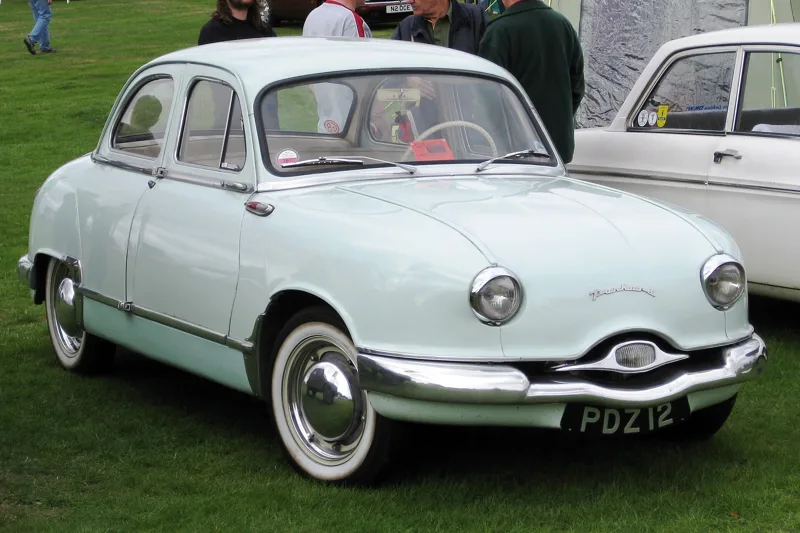
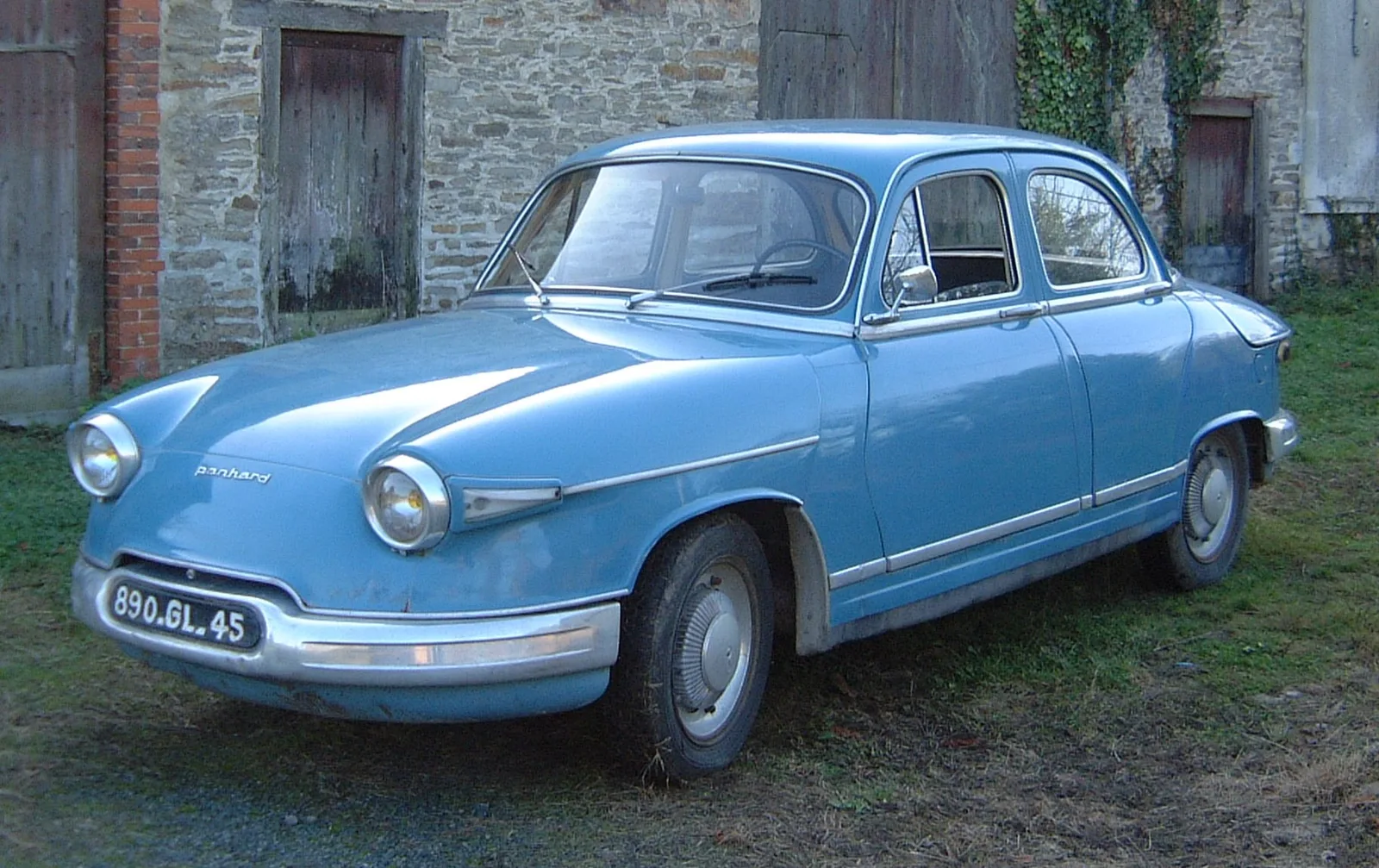
Panhard made the PL 17 from 1959 until 1965. It was shown on 29 June 1959 as the Dyna Z's successor, and was a facelifted Dyna Z at heart. The four-door saloon, with pickup and van versions, was joined by a Cabriolet in 1961 and by the five-door Break in April 1963.
The Break came from the Italian firm Pan Auto, and rode on a longer wheelbase while matching the saloon's overall length. In all around 166,000 PL 17s were built: 136,000 regular saloons, 23,500 with the Tigre engine, 398 convertibles, 2,998 Breaks and 3,191 Utilitaires, the commercial models.
Why is it called the PL 17?
PL stands for Panhard et Levassor, the company's original name. The 17 came from a sum of 5+6+6: 5 CV of fiscal horsepower, 6 for the six seats and 6 for the fuel economy of 6 L/100 km (47 mpg imperial). Citroen closely supervised its development, so it is no coincidence that 17 is a smaller number than the DS 19.
What was the Panhard PL 17 cabriolet?
A two-door Cabriolet appeared in March 1960, sold only in the United States. It was not a runaway success: only 47 of this export-only model were built. A version for Europe was shown at the 1960 Paris Salon and became available in 1961, with trim equal to the top-of-the-line Grand Standing saloon.
The 1963 model year Cabriolet took the new engine, and 125 of that version were built. It never sold strongly, so it was discontinued later in 1963, and its production line was used to build the new PL 17 Break.
How did the Panhard PL 17 change over its life?
A light facelift in 1961 touched the whole range. Front doors now hinged at the front, which ended the suicide doors of the original car, and the indicators moved from low on the A-pillar to sit either side of the headlamps.
For the 1964 model year the PL letters vanished, around the time Citroen finished taking the company over. Other designations shifted slightly too: Berline gained a B and the Tigre became the BT. The luxurious Grand Standing was replaced by the Relmax, and a slight facelift removed the chrome unibrow from the front.
What engine did the Panhard PL 17 have?
The PL 17 began with the Dyna Z's two 851 cc engines: a standard one giving 42 hp (31 kW) DIN and the Tigre with 50 hp (37 kW). Both were air-cooled boxer twins, mounted with the gearbox at the rear and the two exhausts at the front.
From July 1960 capacity shrank to 848 cc, to fit under the 850 cc tax threshold used in many markets, and output stayed the same. Claimed SAE figures were 50 hp (37 kW) and 60 hp (45 kW). A column-shifted four-speed gearbox drove the front wheels, with synchromesh on third, second and top. At the front, two transverse leaf springs supported the car, and at the back three torsion bars on each side.
An ordinary PL 17 weighed roughly 805 kg (1,775 lb), the Tigre 830 kg (1,830 lb). Light weight and streamlining, with a drag coefficient said to be 0.26, allowed top speeds of 130 km/h (81 mph) for standard saloons and 145 km/h (90 mph) for the Tigre.
Taking out the rear bench enlarged the already large luggage space to 527 litres (18.6 cu ft). From the 1964 model year the spare wheel was shifted out of the luggage area and under the bonnet, wrapped around the air filter. The trick works since the wheels have no centre section; the finned aluminium brake drums form it instead.
How did the Panhard PL 17 compare with the Simca Aronde?
Panhards built after the Citroen takeover were not priced aggressively. In 1962 the standard saloon came in five versions and cost between 6,990 and 8,240 francs in France, against 6,340 to 7,450 francs for the similarly sized Simca Aronde.
| 1962 saloon | Engine | Power | Price in France |
|---|---|---|---|
| Panhard PL 17 | 850 cc | 42 hp (31 kW) to 50 hp (37 kW) | 6,990 to 8,240 francs |
| Simca Aronde | 1300 cc | 42 hp (31 kW) to 70 hp (51 kW) | 6,340 to 7,450 francs |
Being a little longer and wider than its rival left the Panhard's dealers struggling to explain why an 850 cc car should cost more than a 1300 cc one. Connoisseurs, many of them taxi owners, valued the PL 17's superior roadholding, fuel economy and wider cabin. They liked less the awkward gearbox, still without synchromesh on first, and steering that was heavy at low speeds.
The top 50 hp Tigre was helped by the lighter body, although the weight advantage had shrunk over the previous decade as aluminium grew more expensive and light-metal panels were swapped for steel in places. The pricing may explain why PL 17 sales never reached the volumes of the Aronde.
What was the Panhard PL 17 Break?
Pan Auto in Trento developed the Break with the idea of assembling it in Italy. Its prototype had a more conventional front, with two large headlamps flanking a plain grille of horizontal ribbons, and taillights borrowed from the contemporary Fiat 1800. In the end the Break was built in France, taking over from the Cabriolet on the line from May 1963. It was built in small numbers, 2,998 in all.
What were the Panhard PL 17 vans and pickups?
October 1958 saw Panhard present the Dyna Z Commerciale D65, a pickup and van based on the Dyna Z, whose name referred to a payload of 650 kg (1,433 lb). A panel van and a chassis cab joined the original pickups in April 1959. With only ten months of life, because the Dyna Z became the PL 17 within a year, 1,735 were built.
The D65 then received the PL 17's new front and went on sale with the saloon, as the Panhard F65. A glazed van was added to price lists in July 1959. In November 1959 a lighter F50, with a 500 kg (1,102 lb) payload, appeared to avoid the parking time limits in the newly introduced Zones Bleues, or Blue Zones, around major French cities. It cost nearly the same, and its only visible difference was slightly smaller tyres.
The commercial models took the same cosmetic changes as the rest of the range in 1961, and in 1963 they gained the modified 848 cc engine. A further facelift for 1964 brought less chrome and trapezoidal turn signals.
Did the Panhard PL 17 win the Monte Carlo Rally?
It did, in 1961. A PL 17 won outright, and two more of the cars finished second and third.
There was a sporting offshoot as well. Arista built a fibreglass two-door coupe on the Dyna Z from 1956, called the Passy and later the Sport, with the Tigre engine. For 1963 it produced a new design based on the PL 17, the Arista JD, named after its designer Jacques Durand. Lighter and faster than a regular PL 17 but rather expensive, it found few buyers, and only six were made.
How did the Panhard PL 17 end?
Citroen had acquired a 25 percent minority interest in Panhard in 1955. A decade on, in 1965, the car side of Panhard was swallowed completely, and PL 17 production stopped that same year. The 24 model kept the Panhard name for two further years, and after that only military transport wore it, because the military division was the part of the business Citroen did not own.