From a 2019 parts unit to an alliance whose cars passed 1,500,000 deliveries in 53 months: how Huawei works with Chery, BAIC, Seres, JAC and SAIC.
Huawei entered carmaking without building cars. Its Yinwang unit supplies parts and software, while the HIMA alliance with Seres, Chery, BAIC, JAC and SAIC designs, markets and sells the vehicles, including the Luxeed R7 and Stelato S9. HIMA passed 1,500,000 deliveries in August 2026.
Huawei does not build cars, and yet vehicles sold through its car alliance passed 1,500,000 deliveries in August 2026, after just 53 months. The alliance reached its first million in October 2025, after 43 months. That pace is the fastest recorded among Chinese new-force automotive brands, according to the alliance, and it was reached by a company that makes phones and network equipment rather than metal bodies and engines.
Four names explain how that happened. Yinwang is the company that holds Huawei's car business. HIMA is the alliance that sells the cars. Luxeed and Stelato are two of the partner brands, and their R7 and S9 models show what a Huawei-assisted car looks like.
Yinwang, the company behind Huawei's car business
Yinwang's full name is Shenzhen Yinwang Intelligent Technology Co., Ltd. It supplies parts and hardware and software solutions to carmakers, and it was formerly Huawei Intelligent Automotive Solution, or HIAS, Huawei's automobile business unit. In April 2019, at the Shanghai Auto Show, Huawei announced that unit with the aim of selling auto parts and technical solutions to vehicle makers.
In January 2024 Huawei decided to run the unit independently and created a fully owned subsidiary with registered initial capital of 1 billion yuan. In April 2024, ahead of the Beijing auto show, Jin Yuzhi, the unit's CEO, announced its first brand, Qiankun. In August 2024 Avatr Technology and Seres Group said they would each invest in Yinwang, taking 10% apiece for 11.5 billion yuan, which put Yinwang's valuation at 115 billion yuan. SAIC Motor signed a cooperation agreement with Huawei in Shanghai in February 2025.
Yinwang sells its help in tiers. At the top is HIMA, where Huawei supplies a complete vehicle solution and the manufacturer builds the car. Beneath it sits Huawei Inside Plus, in which the automaker stays in charge of research, development and sales while Huawei takes a deep part in each of them. Next is Huawei Inside, where Huawei provides a full driving system and smart cockpit but plays no part in design, development or marketing. At the base is plain parts supply: lidar, electric motors, cameras and power management.
Real cars sit in each tier. Arcfox launched the Alpha S in May 2022 as the first vehicle developed under the Huawei Inside mode. Dongfeng Nissan signed an agreement in November 2024 that made it the first Sino-foreign joint venture to work with Huawei, and GAC Toyota is upgrading to the same mode, with two new models set to arrive in 2027. In the Plus tier, GAC set up Huawang Automotive in March 2025 and launched the Qijing brand in September, while a Dongfeng joint venture launched the Yijing brand in November 2025.
Huawei does not build the cars, yet its alliance passed 1,500,000 deliveries in 53 months.
HIMA, the Huawei alliance behind the car brands
The Harmony Intelligent Mobility Alliance, known as HIMA, is an automotive alliance and sales network led by Huawei. It operates only in mainland China. Its members are AITO from Seres Group, Luxeed from Chery, Stelato from BAIC BluePark, Maextro from JAC Group and the SAIC brand from SAIC Motor. Huawei does not manufacture the vehicles. It contributes product planning, design, marketing, user experience, quality control, software and hardware, and each partner takes a different vehicle category so that the line-ups never overlap.
The story began with AITO. In December 2021 Huawei announced the brand and its first car, the AITO M5, built with Seres on the platform of the Seres SF5 SUV. At that stage Seres managed the full life of the car, from development to manufacturing and after-sales, while Huawei handled product definition, development and sales channels. In 2023 Huawei took on after-sales and deliveries as well.
Brand ownership became awkward. Huawei briefly rebranded AITO as Huawei AITO in March 2023, then reversed it, and bought the Chinese-language AITO trademark in June 2023. Chinese rules require a car brand to be owned by its manufacturer, so in July 2024 Huawei returned the AITO trademarks and related patents to Seres for 2.5 billion yuan.
The formal alliance arrived on 9 November 2023, at the pre-sale event for the Luxeed S7, when Huawei said it would upgrade its ZhixuanCars business to HIMA. The aim was a more connected electric vehicle ecosystem built around Huawei's HarmonyOS, with closer joint development across manufacturers. Stelato trademarks passed to BAIC BluePark in December 2023, Maextro was introduced in August 2024 with the JAC Group, and in April 2025 the SAIC brand became the fifth to be unveiled.
Huawei's partners also sell through a shared retail network. It planned around 800 new HIMA stores by 2024 and 1,000 by 2025, and by 2023 HIMA had already opened franchise outlets, called user centres, in 78 cities, each offering sales, delivery and after-sales service. Existing AITO outlets were rebranded as HIMA as they began to sell Luxeed, Stelato and Maextro cars. The Chinese names of all five brands end in the character jie: Wenjie for AITO, Zhijie for Luxeed, Xiangjie for Stelato, Zunjie for Maextro and Shangjie for SAIC.
The sales numbers carry a caveat. China's government does not consider HIMA a car manufacturer, so each brand's sales are counted again under its partner manufacturer. A joint announcement from HIMA and AITO in September 2026 handed AITO responsibility for much of what Huawei had done, from development and design to marketing, sales and service, with Huawei staying in only part of the development work. It is described as a major change to the cooperation model since the alliance began.
The technology Huawei brings: ADS and HarmonySpace
Huawei's driver-assistance system, ADS, can reach Level 2+ autonomy and is trained on real driving data. It handles tight turns, gives way to pedestrians, avoids irregular obstacles and animals, and parks the car, including valet parking. According to Huawei, ADS 2.0 was priced at 36,000 yuan, about US$5200, per vehicle when sold to a partner manufacturer. In January 2026 the company upgraded to ADS 4.1, adding an anti-sandwich feature intended to prevent rear-end collisions.
The cabin side is HarmonySpace, the vehicle operating system Huawei launched on 21 December 2021. HarmonySpace 5 followed on 22 April 2025 alongside Qiankun ADS 4.0, with support for the DeepSeek and Pangu AI models. On 20 January 2026 Huawei announced Qiankun ADS 5.0 and HarmonySpace 6, which was planned for launch in April 2026.
The Luxeed R7 and its 2027 update
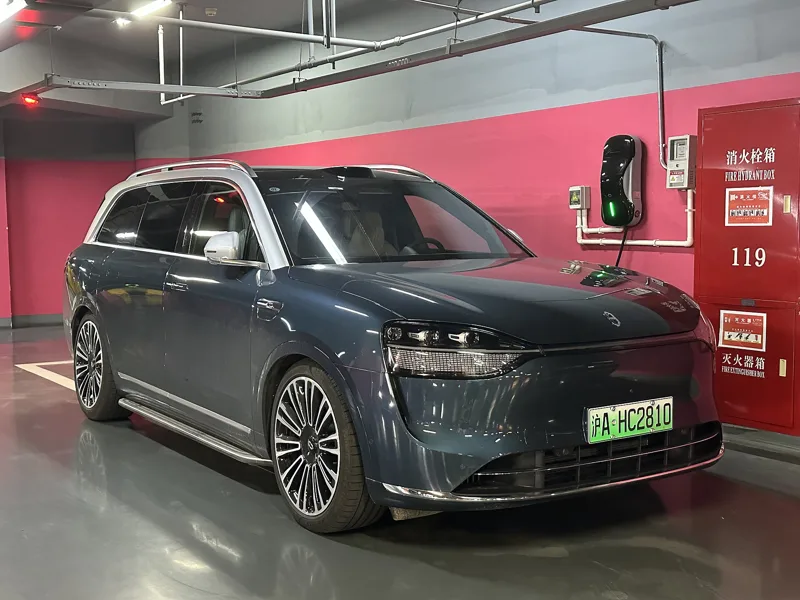
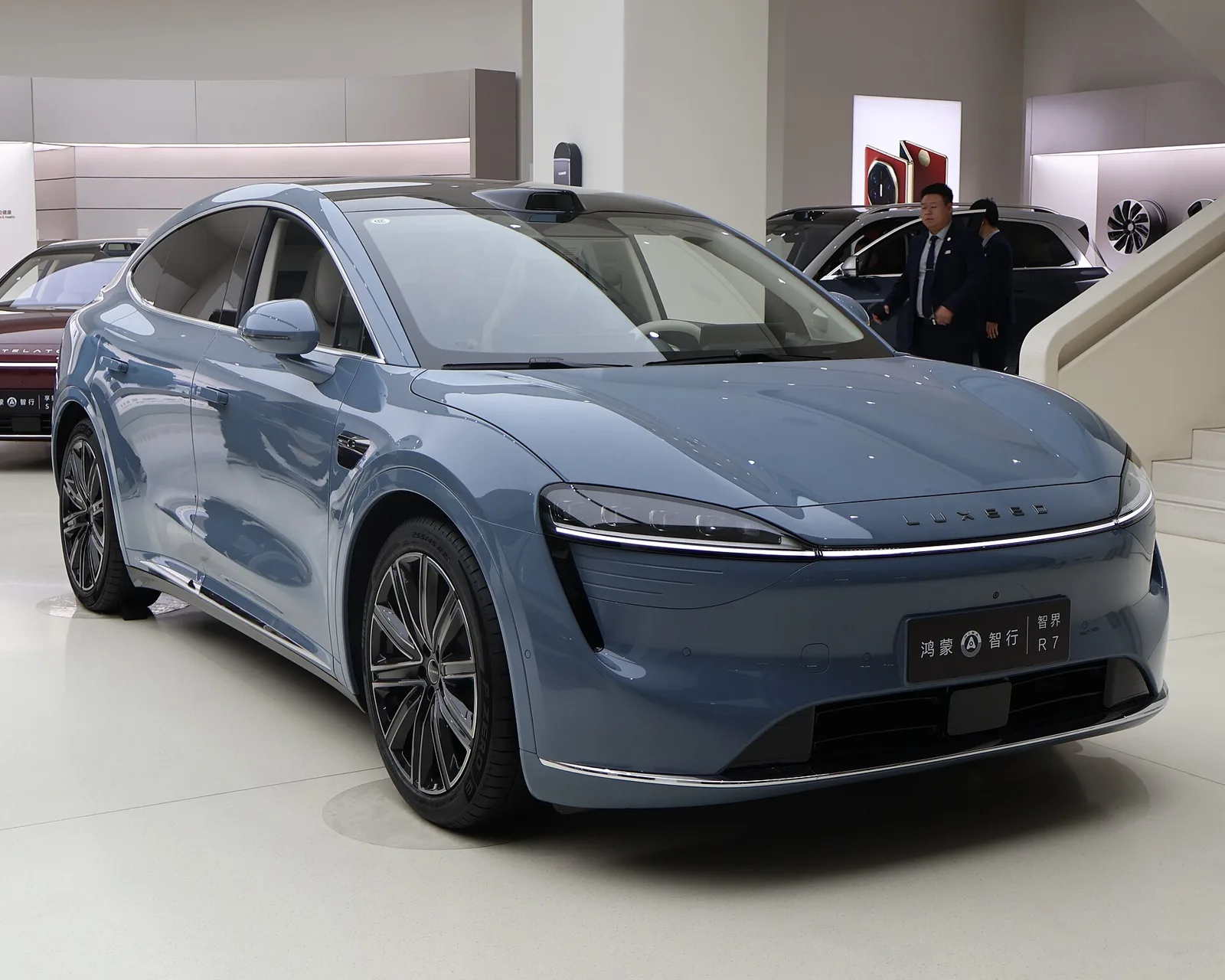
The Luxeed R7 is a mid-size crossover with a coupe-style roof, offered as a battery electric car and with a range extender, produced by Chery under the Luxeed brand in collaboration with HIMA. Production began in 2024, and it shares a platform with the Exeed Sterra ET. It followed the larger S7 sedan as the second Luxeed model. The R7 has rounded wheel arches, a gently sloping roofline, a wide light bar joining the oval lamps, retractable door handles and a glass roof. Inside, there is an oval steering wheel, a 12.3-inch digital instrument cluster, and a 15.6-inch touchscreen running Huawei's HarmonyOS with a Huawei Sound system.
The base electric version has an 82kWh battery and a 288 hp (215 kW; 292 PS) rear motor, for 667 km (414 mi) on the CLTC test cycle. The top version has a 100 kWh pack and a 489 hp (365 kW; 496 PS) dual-motor all-wheel-drive system rated at 855 km (531 mi). The architecture runs at 800 volts with fast charging.
Two updates followed. The first facelift was revealed on 1 August 2025 with new headlights, the new Luxeed logo and an Aurora Green colour. The second came on 28 September 2026 as the 2027 model year, and Luxeed says it invested 500 million yuan in it. Door handles became pocket-style, replacing the electronic flush type, and two new colours, Space Titanium Silver and Star Rose Pink, arrived. The dashboard now has two 17.2-inch touchscreens, one for the passenger, a smaller 8.88-inch cluster and an optional 26-inch head-up display. USB-C output rises from 66 watts to 100 watts, and a household 220 V outlet is added. The roof-mounted lidar moves from 192 lines to 896 lines with Qiankun ADS 5, and the batteries and motors are updated for longer range. The company announced that cumulative R7 deliveries had passed 120,000 on 28 September 2026.
Luxeed was established in November 2023, the month of the S7 pre-sale.
The Stelato S9, a Huawei-assisted luxury sedan
The Stelato S9 is a full-size luxury sedan, and also a station wagon in S9T form, built by BAIC BluePark with HIMA. It is available as a battery electric or range-extender car. The S9 was announced on 31 May 2024 at the launch of the AITO M7 Ultra facelift, and its price was announced on 6 August 2024 at a Huawei launch, with Max and Ultra versions. Pre-sales of the range-extender began on 20 March 2025 from 318,000 yuan, and that version launched on 16 April 2025.
The sedan is 5,160 mm (203.1 in) long on a 3,050 mm (120.1 in) wheelbase, built on Huawei's Turing platform and BAIC's BE22 platform. Stelato claims that versions with digital side mirrors have the lowest drag coefficient of any luxury executive sedan, 0.193 Cd. Rear passengers get a 13.2-inch control tablet and a 32-inch retracting ceiling projector, and the front passenger seat can fold flat as a footrest. The boot holds 378 litres (13.3 cu ft) with another 38 litres (1.3 cu ft) under the bonnet. Air suspension and continuous damping control come as standard, and the S9 was the first car with Huawei's ADS 3.0, using four lidars and five 4D millimetre-wave radars.
Every model has a 227 kW (304 hp; 309 PS) rear motor. Dual-motor cars add a 158 kW (212 hp; 215 PS) front induction motor for a total of 385 kW (516 hp; 523 PS) and a 0-100 km/h time of 3.9 seconds. The pure-electric cars use a 100 kWh battery developed with CATL that gives 816 km (507 mi) of CLTC range with rear drive and 721 km (448 mi) with all-wheel drive. The 800-volt system is said to recharge 816 km of range in five minutes on a DC fast charger.
The range-extender uses a BAIC 1.5-litre turbocharged four-cylinder petrol engine with 158 hp (118 kW; 160 PS) that does not drive the wheels directly. Buyers choose a 37 kWh pack for 256 km (159 mi) of electric range or a 53.4 kWh pack for 365 km (227 mi). It is rear-drive only, tops out at 204 km/h (127 mph), and uses a 400-volt system.
The S9 facelift was revealed on 7 November 2025 and launched on 20 November, with a new Universe Star logo, Nebula-design taillights and 36 sensors including four lidars. The S9T wagon, HIMA's first, was first revealed on 14 July 2025 and opened pre-orders on 18 August. Demand was strong. The S9 collected 2,500 firm orders within 24 hours of its 6 August 2024 launch, and the S9T received over 10,000 orders in the first hour of pre-sales.
HIMA's five brands side by side
| Brand | Manufacturer | Established | Models listed |
|---|---|---|---|
| AITO | Seres Group | December 2021 | M5, M6, M7, M8, M9 |
| Luxeed | Chery | November 2023 | S7, R7, RX, V9 |
| Stelato | BAIC BluePark | December 2023 | S9, S9T, G9 |
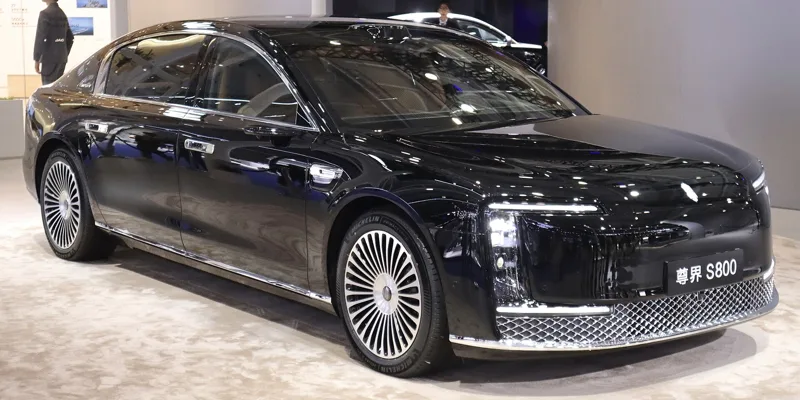
| Maextro | JAC Group | November 2024 | S800, V800/V680 |
| SAIC | SAIC Motor | April 2025 | H5, Z7/Z7T |
What changes at HIMA from September 2026?
The biggest change is already announced: from September 2026 AITO takes the lead on the work Huawei used to do, and Huawei will join in only part of the development. On the technology side, Huawei planned HarmonySpace 6 for April 2026 following the announcement of Qiankun ADS 5.0 in January 2026. In the broader Yinwang line, GAC Toyota has two models set to arrive in 2027 under the Huawei Inside mode.