From baby-carriage blockades and motorway parties to bollards and cameras, the car-free movement has changed how some streets are used, and studies link low traffic neighbourhoods to large falls in injuries.
The car-free movement wants places where motor vehicles are greatly reduced. Its tools include car-free days, Reclaim the Streets direct action and, in Britain, low traffic neighbourhoods that use bollards or cameras to stop through-traffic. Studies link them to fewer injuries inside, though critics dispute fairness and consultation.
A study of 113 London low traffic neighbourhoods, published in June 2025, found 35 per cent fewer road injuries inside them and 37 per cent fewer deaths and serious injuries. Yet a 2023 review commissioned by the Department for Transport found that 45 per cent of residents in trial areas backed such schemes, 21 per cent opposed them and 58 per cent did not know they lived in one.
That gap between results and public awareness runs through the whole story of the push to take streets back from cars, a story that runs from mothers blocking American roads with baby carriages to party-goers planting trees in the tarmac of a London motorway.
What the car-free movement wants
The car-free movement is a loose, emerging network of activists, planners, transport engineers and environmentalists who share a belief that large or fast motor vehicles have become too dominant in modern life, especially in cities and suburbs. Its aim is places where motor use is greatly reduced or eliminated, by handing road and parking space over to other public purposes and rebuilding dense neighbourhoods where most destinations can be reached on foot, by bike, by public transport or by newer options such as personal transporters and mobility as a service.
In practice that means a ladder of measures. Car-free zones are parts of a town where cars are prohibited or heavily restricted, usually enforced with fixed or movable bollards. Car-free cities go further, applying the idea to a whole city or at least its inner part. Living streets and complete streets rank the needs of everyone using the street above those of drivers, and are meant for pedestrians, playing children, cyclists and slow vehicles alike. New urbanism, an American design movement from the early 1980s, aims for walkable neighbourhoods with a mix of housing and jobs. London's World Squares for All scheme set out to remove much of the traffic from Trafalgar Square and Parliament Square.
Deliveries, parking and bikes
Supporters have thought about the awkward details. Distribution centres on the edge of a city can hand goods to small trucks, electric vehicles or cargo bikes for the last mile, which cuts blind-spot risk, noise and fumes and saves companies the time that large tractor units lose in traffic. Underground car parks near ring roads, with park-and-ride stops, can keep cars out of centres if they are placed far enough from the core not to attract extra traffic. The first successful community bicycle scheme appeared in Amsterdam in the 1960s, and Paris introduced 20,000 bicycles in 2007.
The evidence on safety is strong; the argument over consultation and fairness is not settled.
How the car took the street
Before the twentieth century, towns were compact, with narrow streets full of activity. Early in the century many were adapted for the car, with wider roads, more parking and lower densities. Los Angeles passed a traffic ordinance in 1925, the first in an American city, that put pedestrians below motor vehicles in the pecking order, and the rest of the country copied it. The word jaywalker was coined in the 1920s and shifted responsibility for pedestrian safety from drivers to people on foot.
Resistance came early. In 1924 a writer in the New York Times called the automobile a far more destructive piece of machinery than the machine gun. Pedestrian groups formed in Los Angeles in 1922 and 1924, in Baltimore in 1927 and in Chicago in 1930, though none lasted or spread beyond its region. David H. Keller's 1928 story The Revolt of the Pedestrian imagined a future in which walkers are hunted by motorists with withered legs. Ray Bradbury's 1949 story The Pedestrian grew out of a night walk in Los Angeles that ended with a police officer questioning him.
Meanwhile the profession of traffic engineer was being built. The Studebaker company in 1925, and the American Automobile Association in the 1930s, helped to establish it, and by the 1950s every American city above 500,000 people had a full-time traffic engineer. Police figures from 1956 show where blame fell: in Detroit 19,765 pedestrians were arrested for jaywalking against 8,662 drivers for failing to give way, and Portland, Oregon, recorded 25,119 jaywalking arrests against 857 for drivers.
From the 1940s and 1950s, mostly women in American cities and suburbs protested, carrying signs, sitting across streets in folding chairs and bringing children and prams, which the press called baby carriage blockades. The protests stayed local, faded as suburbs grew, and were not joined into a national movement. In 1961 Jane Jacobs published Death and Life of Great American Cities, a critique of 1950s planning that stressed planning for pedestrians.
Car-free days: how a day without cars spread
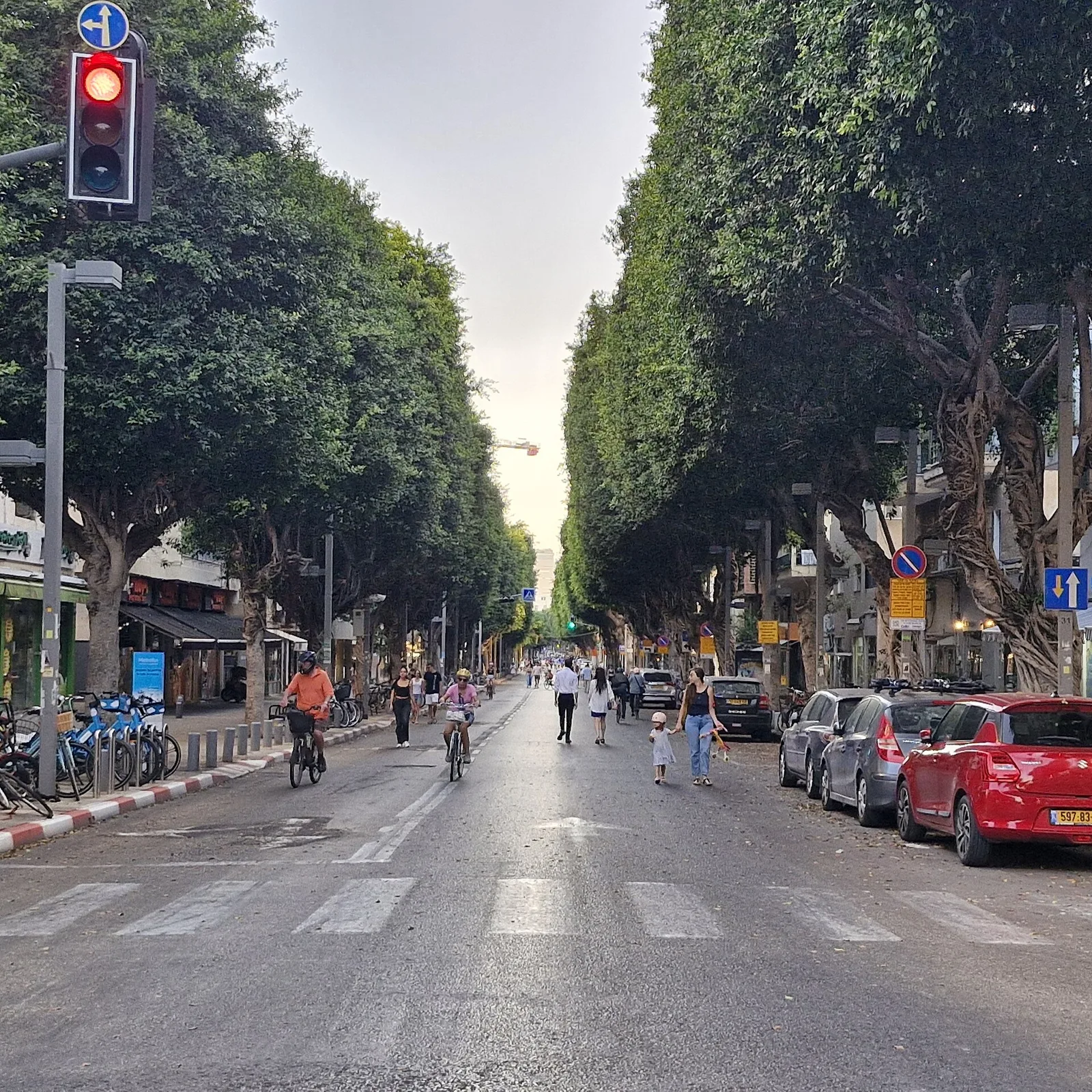
On a car-free day, state policy or social consensus steers people towards getting around some way other than driving. Jakarta and Tehran have weekly versions, and others are annual. Tel Aviv has marked Yom Kippur that way since 1935, although vehicles were used on the holy day before the 1930s, and in Israel the holiday is treated as car-free through consensus rather than official policy.
Oil and politics prompted the first national efforts. The Suez crisis brought car-free Sundays to the Netherlands and Belgium from 25 November 1956 to 20 January 1957. Denmark held them from 25 November 1973 to 10 February 1974 during the oil crisis, Switzerland organised four in early 1974, and East Germany staged its first in 1981.
The structured movement began on 14 October 1994, when Eric Britton issued a call in a keynote speech at the Accessible Cities conference in Toledo, Spain. Within two years Reykjavik, Bath and La Rochelle held the first days, and the Environmental Transport Association launched the first national campaign in Britain in 1997. France followed in 1998 with the slogan In town, without my car!, taken up by 34 French cities. In September 1999, 66 French towns and 92 Italian towns joined a pilot day.
The European Commission made it a Europe-wide initiative in 2000. On 22 September 2000, its sponsors reported, 760 European towns took part in the first pan-European day, and it later broadened the programme into a full European Mobility Week. The same year Carbusters, now the World Carfree Network, launched a global World Carfree Day. Chengdu ran China's first on 14 October 2000, Fremantle Australia's first on 23 November 2000, and Toronto became the first North American city to host an official one on 22 September 2001. Montreal in 2003 became the first Canadian city to close a major downtown to cars on a weekday.
Bogota and the Dutch street actions
Bogota's Thursday event on 24 February 2000 was the first large-scale weekday version in the world. Voters approved a car-free referendum on 29 October 2000, and today the city holds the world's largest weekday event covering the whole city.
The Netherlands took a more confrontational route. In 1996 the action group Pippi Autoloze Zondag began monthly illegal street takeovers, with parties, picnics, children's games and roller-skating on the motorway, which police broke up with arrests. Pippi also lobbied every Dutch national parliament politician and sent proposals to every major city government. Two years of this wore councils down, and several began to hold car-free days. Advocates put the numbers at more than 100 million people across 1,500 cities, each marking International Car-Free Day in their own way.
Reclaim the Streets: parties on motorways
Reclaim the Streets, or RTS, is a collective built around community ownership of public space. Participants see it as resistance to corporate power in globalisation and to the car's grip on how people travel. Its events involve non-violent direct action, such as taking over a major road for a party with sand pits for children, free food and music. The group's reasoning is that vehicles, not people on foot, are what obstruct the road, so occupying it opens up public space. Its origins are traced both to Earth First! and to a group formed in London in 1991.
The first big action took over Camden High Street on 14 May 1995. Around 500 people closed it to traffic for an afternoon, with free food from tables in the road, a bicycle-powered sound system and a climbing frame at a crossroads. On 23 July 1995 three thousand people partied at a busy junction in Upper Street, Islington. In Birmingham on 6 August 1995 around 200 turned up, and the procession ended at a pub to discourage riot tactics from police.
The most dramatic action came on 13 July 1996 on the M41 at Shepherd's Bush. Playing cat and mouse with the police, 6,000 protesters took over part of the elevated motorway. Sound systems played, one on a truck parked on the hard shoulder, and activists hidden under dancers on stilts wearing wide dresses drilled holes in the road and planted trees. The party ran into the next morning. On 6 June 1998 two parties, in Brixton Road and High Road, Seven Sisters, drew an estimated 5,000 people each.
The idea travelled. A Global Street Party in May 1998 listed events in cities from Bogota and Berlin to Toronto, Prague, Stockholm and Vancouver, and a global day of action on 18 June 1999 reached London, Barcelona, Los Angeles and New York. Later gatherings include Brussels in 2012, where 3,000 people held a picnic to reclaim the streets, and a series in Sydney from 2014 onward that included protests against the WestConnex motorway.
Low traffic neighbourhoods: bollards, cameras and a lot of argument
A low traffic neighbourhood, or LTN, is a British term for a residential area that uses filtered permeability and traffic calming to cut through-traffic. Many appeared in spring 2020, though London has used the same principles since the 1970s. Barriers can be bollards, boom barriers or planters, or the filter can be virtual, using automatic number-plate recognition cameras and signs that let residents and emergency services in while barring unrelated through traffic.
They were not new in 2020. Britain had at least 25,000 modal filters in place before 2020, and LTNs had been a standard tool in new towns since the 1960s. After two children died on the roads in the 1960s, Primrose Hill closed the Regent's Park Road railway bridge to vehicles with bollards. Exeter closed Sandford Walk and East John Walk in 1970. One of the best known, in De Beauvoir Town, Hackney, was designed by the architect and local resident Graham Parsey and run as an experiment from 8 April 1974, then made permanent in April 1975.
In 2020 and 2021, under emergency legislation, 72 LTNs were rolled out across London, covering around 300,000 people. Waltham Forest had already introduced several, including Walthamstow Village.
What the evidence shows
| Study | Measure | Inside the zone | Boundary roads |
|---|---|---|---|
| Islington, 3 LTNs (2022) | Traffic against control sites | 58.2% decrease | 13.4% decrease, statistically insignificant |
| Islington, 3 LTNs (2022) | Nitrogen dioxide | 5.7% lower | 8.9% lower |
| 46 London LTNs, 11 boroughs | Car traffic | Almost halved | Almost no effect |
| 113 London LTNs (2025) | All injuries | 35% reduction | No observable change |
| Oxford (2026) | Collisions with casualties | More than 64% fall | 25% fall |
Traffic results vary by scheme. In Walthamstow Village in Waltham Forest, roads inside saw an average 44.1 per cent reduction while surrounding roads such as Shernhall Street saw increases. In three Southwark LTNs traffic speeds fell and walking and cycling counts held steady. London traffic on side roads had risen by over 100 per cent since 2008 before the pandemic.
Safety results are the strongest. Two London LTNs introduced between 2015 and 2019 after long consultation and substantial engineering reduced both the number of injuries and the injury risk for each trip by about 70 per cent for walkers, cyclists and car occupants. The 72 introduced in 2020, with less engineering, halved injury rates inside, especially for pedestrians, and neither group changed injuries on boundary roads. In Oxford, the study estimated about 69 casualties prevented and savings of more than 2 million pounds in the Cowley area.
Other findings point the same way. Street crime fell by 18 per cent after three years in LTN areas, with larger falls for violent crime and sexual assaults, and bicycle theft the only category that rose. Residents of LTNs became less inclined to own a car, and in Waltham Forest cars and vans fell in the mini-Holland areas. Emergency response was not slowed: a 2020 study of Waltham Forest and a 2021 study of the 72 London schemes found no effect on fire brigade times, even though fire crews perceived traffic calming as a cause of delays.
Why low traffic neighbourhoods are contested
Critics raise fairness. Green campaigners including John Stewart and Rosamund Kissi-Debrah argue that the schemes push traffic and pollution onto neighbouring main roads, with Stewart calling them "inherently unfair" and Kissi-Debrah arguing that affluent areas gain while deprived ones absorb the displacement. The data on who gets them is less one-sided: in London people in the most deprived quarter are likelier to have a newly opened LTN nearby than those in the least deprived quarter, and ethnic minorities likelier than White residents.
Cost and consultation are the other targets. A motoring magazine called the schemes a waste of money, others point to high fines, and the Department for Transport's 2023 review said they can work where they are supported but that too often local people lack information and a say. The High Court ruled a Lambeth Council scheme in Dulwich unlawful in 2024, citing flaws in the consultation. Protests have taken place in Oxford and Croydon, and the Institute for Strategic Dialogue has described LTNs as a lightning rod for broader culture-war disputes.
At the ballot box the picture is mixed. A candidate who pledged to remove all modal filtering in the 2021 London mayoral election won 1.9 per cent of first-round votes, an anti-LTN candidate in a Hoxton East and Shoreditch by-election got fewer than 8 per cent, and one in Islington's St Peter's Ward took 318 of 4,395 votes (7.2 per cent). Yet Lutfur Rahman won re-election in Tower Hamlets in May 2022 after campaigning against the borough's LTN plans, even though the Metropolitan Police had urged him not to dismantle one in Bethnal Green.
What this means for anyone driving
For drivers the most practical change is a closed street that used to be a short cut. In a camera-enforced neighbourhood, a vehicle that is not a resident's or an emergency service's can be barred from through-travel on those streets, and fines have been one of the complaints about the schemes. Boundary roads are where traffic tends to concentrate, though studies of the largest London samples found almost no effect on them. A car-free day, by contrast, is a temporary event, and in cities such as Jakarta and Tehran a weekly one.
Mobility Week and new studies keep the debate open
The European Commission treats Car-Free Day as one part of the wider European Mobility Week, which is now the Commission's major focus. New research keeps arriving, including the London study of 113 schemes in June 2025 and the Oxford study of January 2026, while the Department for Transport's 2023 review found that local people too often lack information and a say.