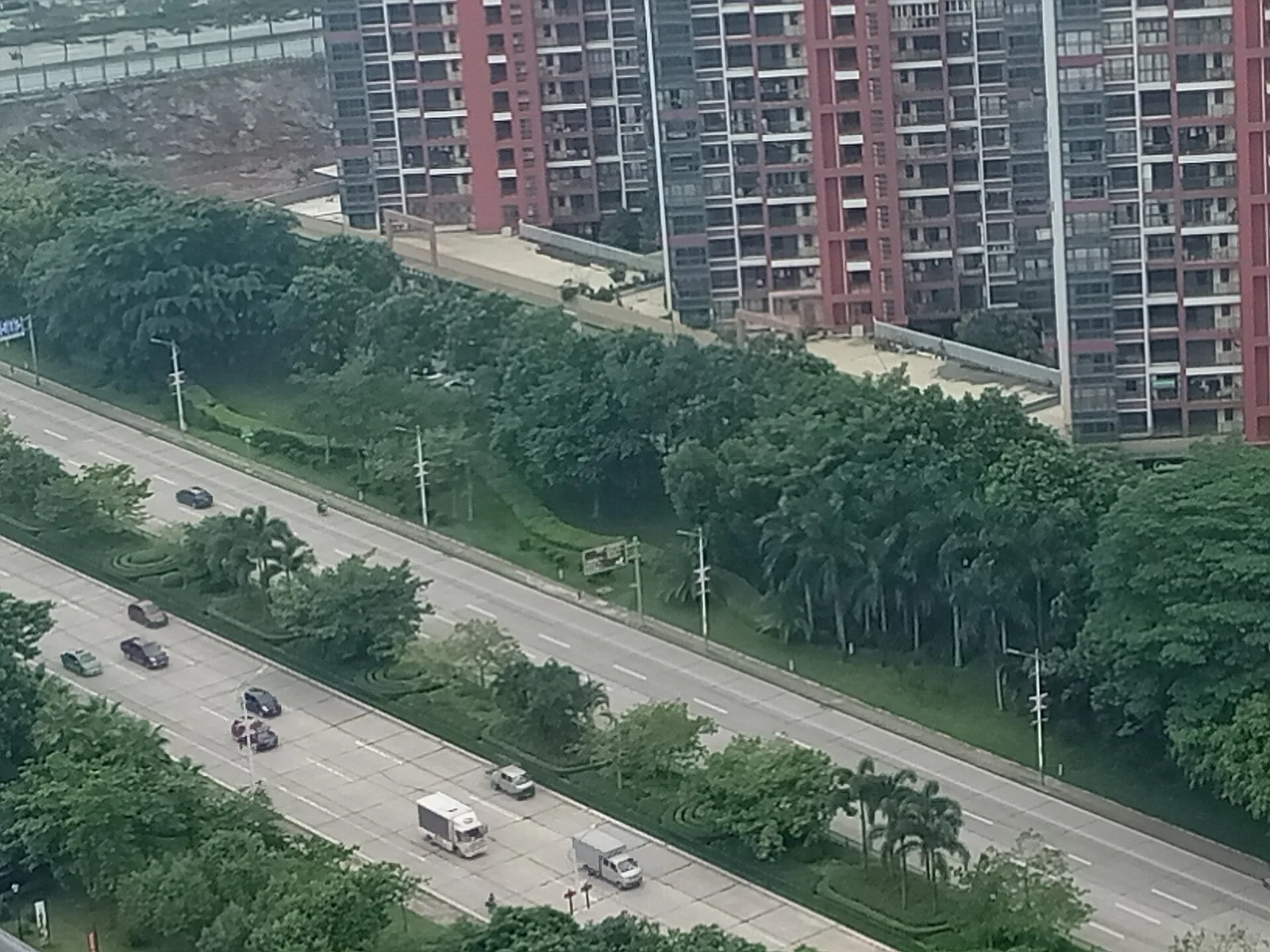
Steel ropes that stretch, concrete that does not, medians wide enough to hold a farm and short posts that can stop a truck: how roads separate cars from what they should not hit.
Cable barriers use steel ropes on weak posts to catch and redirect cars. Median strips separate opposing traffic, guardrails with energy-absorbing end terminals shield roadside hazards, and bollards block vehicles from pedestrian space. Each trades stiffness against forgiveness, and the barriers and bollards are crash tested to published standards.
A cable barrier is a row of steel wire ropes on posts that are deliberately weak, and the weakness is the point. When a car hits one, the ropes stretch and the posts give, which soaks up the crash energy and pushes it sideways instead of straight through the people inside. It is a comparatively cheap answer to a hard problem, keeping vehicles away from things they should not hit, and it sits at one end of a range that runs from stiff concrete to short posts in a pedestrian street.
What is a cable barrier and how does it work?
A cable barrier, also known as guard cable or a wire rope safety barrier, is a roadside or median guard made of steel ropes on weak posts. Like any roadside barrier, it aims to stop a vehicle leaving the carriageway and striking a fixed object or an unforgiving piece of terrain, and it does so by capturing the car or redirecting it.
Because the whole system flexes, impact energy is soaked up and spread sideways, which lowers the forces felt by the people inside. It is gentler than the old concrete (Jersey) or steel barriers and still works on a slope. Use is spreading worldwide, since the barriers cost relatively little to install and maintain compared with concrete step barriers and are very good at catching vehicles.
By far the most popular use is down the middle of divided highways. With traffic flowing in opposite directions, crossover crashes are particularly severe, and median width alone does not eliminate them. Quite often the median has to be shielded, and cable barriers are a cost-effective way to do it.
The idea is old. Cable barriers have been in use since the 1920s and median versions since the 1960s, but it was the mid-1990s before many US departments of transportation began fitting them regularly.
Because the whole system flexes, impact energy is soaked up and spread sideways, which lowers the forces felt by the people inside.
What is the difference between low-tension and high-tension cable barrier?
| Feature | Low-tension | High-tension |
|---|---|---|
| Cables | Tensed only enough to remove sag, with large springs at the ends | Three or four pre-stretched cables, tightened according to temperature |
| Tension | Very low | Roughly 2,000 to 9,000 lb (9,000 to 40,000 newtons) |
| Movement on impact | Up to 3.7 m (12 ft) | As little as 2.4 m (8 ft) |
| Length of a run | Limited to 600 m (2,000 ft), anchored at each end | Indefinite, stopped only by median openings or bridge columns |
| After a crash | Cables tend to lie on the ground, leaving the whole run useless until repaired | Cables stay strung even if several posts are lost |
| Cost | Lower initial cost | Higher initial cost, lower long-term maintenance |
| Supply | Called the generic system, not made by one producer | All systems proprietary |
Low-tension cable was specified almost exclusively as use spread in the 1980s and 1990s. Thousands of miles of it remain in service across the world, and until recently it was arguably the workhorse of the industry. High-tension looks much the same but behaves very differently. In general, it costs more at the outset and less to keep up.
How are barriers crash tested?
In the United States a roadside safety feature must pass rigorous testing before it goes on the National Highway System, and most states apply the same criteria elsewhere. The yardstick is NCHRP 350, a 1993 report from the National Cooperative Highway Research Program, which looks at three things.
Structural adequacy means the system must hold and redirect the car without it riding under, over or through. Occupant risk means no fragments may enter the passenger compartment, the vehicle must stay upright and the people inside must not be subjected to harsh impact or deceleration. Vehicle trajectory means that afterwards the vehicle should not intrude into neighbouring lanes or leave the system at more than 60% of its entry angle.
NCHRP 350 has six test levels covering different vehicles, angles and speeds. Test level three, probably the most common, sets criteria for small cars and pickups at 97 km/h (60 mph), the category that accounts for most traffic in the country. It crashes an 820 kg (1,800 lb) car at 20 degrees and a 2,000 kg (4,400 lb) pickup at 25 degrees. Test level four adds an 8,000 kg (17,600 lb) single-unit truck at 80 km/h (50 mph) and 25 degrees. Every cable barrier on sale is approved at level three or four, and there is plenty of anecdotal evidence of systems stopping heavy semi-trailers.
Where do cable barriers struggle?
Terrain is one limit. Cable barrier is meant for slopes of 1 vertical to 6 horizontal, a requirement based on computer modelling and full-scale crash tests, yet in practice slopes that flat are often the exception. Three level-four systems work as level three on slopes as steep as 1 to 4.
Clearance is another. Rigid concrete and semi-rigid steel guardrail deflect between 0 and 4 ft (1.2 m) in a crash, while flexible cable moves 2.4 to 3.7 m (8 to 12 ft). With that much movement, cable barrier is not usually thought suitable for shielding fixed objects within 2.4 m (8 ft) of the travelled way, and even where there is room, the public seems to trust a sturdier barrier more.
Motorcyclists are the third. Many European Union countries do not allow cable barrier along highways because it is seen as especially hazardous for riders. A study of rider injuries, though, found that fatal and severe harm was no more common with cable than with W-beam barriers. Both were much worse than concrete, but better than nothing at all.
Installation is the fourth. A barrier set below grade, especially around slopes or dips, can let a car jump over the top and into a crossover collision. In Arizona, where the state transport agency is alleged to have skipped proper installation procedures, a wrongful death suit ended in a one million dollar settlement. Many letters of complaint about installation also reached the Department of Transportation in Washington state.
What is a median strip?
A median strip is the reserved ground between opposing lanes on a divided road, and it goes by many names: central reservation, roadway median, traffic median. It may be bare paving, but it often carries landscaping, trees, a barrier or a rail line.
The words vary by place. North American and Antipodean English favour median and median strip, British English prefers central reservation, New Orleans has the neutral ground, Vancouver says boulevard and Australians coined central nature strip. North Americans call the lanes nearest the centre "inner" where Britons say "outer," so passing, fast or overtaking lanes is clearer.
Medians double as transport corridors. Parts of the Chicago 'L' run down expressway medians, and bus rapid transit uses central lanes in Istanbul, Los Angeles and Bogota, where it avoids conflicts with parked cars and pedestrians. Urban medians are often raised central islands, in their simplest form just concrete kerbs, sometimes planted or decorated. In California a highway median can be nothing more than a marked strip between two sets of double yellow lines, a double-double yellow line, which vehicles may not cross. It is cheap, though research indicates such narrow medians may offer minimal safety benefit compared with none.
How wide is a central reservation?
In the UK and other crowded European countries the central reservation is rarely wider than one lane. Terrain changes that. On the M5 south of Bristol the carriageways climb the Gordano Valley at different levels, on the M6 between Shap and Tebay a local road runs between them, and on the M62 the highest stretch through the Pennines splits wide enough to hold a farm. The Aston Expressway, the A38(M), is a single carriageway of seven lanes whose middle lane switches direction with the traffic, a system called tidal flow.
Mainly on safety grounds, the UK Highways Agency has specified high containment concrete step barriers for the median of every new motorway scheme since January 2005. Existing motorways will get them during upgrades and replacements, and other routes continue to use steel barriers. The policy covers the median of high-speed roads, not barriers at the verge.
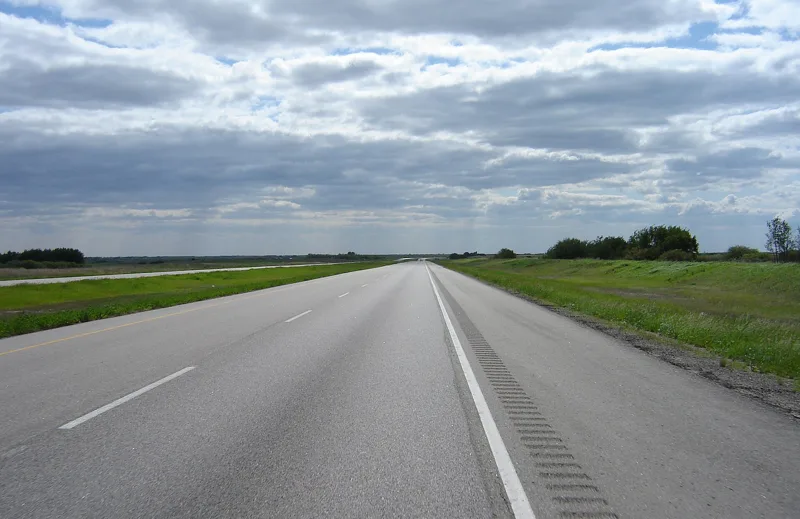
North America runs to extremes. Near Ernfold, Saskatchewan, the eastbound and westbound lanes of the Trans-Canada Highway can lie as much as 5 kilometres (3.1 mi) apart, though they close up to a lane's width in suburbs and cities. In Dedham, Massachusetts, a 502-bed state prison, the Norfolk County Correctional Center, sits entirely inside the wide median of Route 128.
How wide does a median need to be to improve safety?
A US Federal Highway Administration study from August 1993 linked median width to fewer head-on crashes and fewer severe injuries. It found that a median without a barrier needs to be more than 9.1 m (30 ft) wide to affect safety at all, and the benefit keeps growing up to 18.3 to 24.4 m (60 to 80 ft). The corollary is that squeezing a median from 9.1 m to 6.1 m (20 ft) to add lanes may leave a highway less safe. The study did not work out figures for medians that have barriers.
What is the ET-Plus guardrail?
The ET-Plus is a guardrail end terminal made by Trinity Highway Products of Dallas, Texas, and designed at the Texas A&M Transportation Institute. On impact, the terminal's cap absorbs the force, the wooden posts break, the rail collapses and the terminal slides along, shoving the rail to one side.
It grew out of the ET-2000, developed in the 1980s, which squeezed the metal rail through an extrusion throat so that it bent away from the car instead of spearing into it. Federal highway officials accepted that design in 1989, and it first saw successful use on Interstate 35 near Buda, Texas. The institute began on the ET-Plus in 1999, with a larger impact plate for more kinds of vehicle and a lighter head to ease crash severity, and the Federal Highway Administration approved it by letter on 18 January 2000.
The original had 5-inch (13 cm) guide channels. Institute engineers recommended narrowing them to 4 inches (10 cm) for better alignment, and in 2005 Trinity used the narrower version in the tests required for new 31-inch (79 cm) guardrail heights. Approval followed on 2 September 2005, though it later emerged that the agency had not been told about the change. The ET-Plus stayed eligible for federal-aid reimbursement until 31 December 2017, when it failed the newer criteria of the Manual for Assessing Safety Hardware.
Why did the ET-Plus end up in court?
In March 2012 Joshua Harman, a Virginia guardrail engineer who co-owned a Trinity competitor, filed a whistleblower suit accusing the company of never telling federal officials that the end piece had shrunk from five inches to four. The change allegedly saved $2 per terminal. Testimony revealed that five crash tests in 2005 and 2006 had shown failures, with a vehicle speared or flipped. Trinity answered that those tests used an experimental system and that the guardrails on the road are safe, and later tests have shown the guardrails act as they should.
The fallout was wide. Trinity stopped sales in November 2014 pending retests, and by January 2015, 40 states had suspended new installations, with 200,000 terminals already in place. Eight crash tests released in February 2015 were followed in March by federal measurements of more than 1,000 units that found no systematic variation in dimensions. The US Justice Department opened a criminal investigation in April 2015.
In June 2015 a district court jury returned a $663 million verdict against Trinity Industries, finding it had defrauded the Federal Highway Administration, with Harman awarded a share of $199 million. In September 2017 the Fifth Circuit Court of Appeals reversed that finding and gave judgment to Trinity. A separate class action by Missouri counties, the city of St. Louis and the state's transportation authority, filed in November 2015, was settled for $56 million in 2022.
What is a traffic bollard?
Traffic bollards are short posts, up to 48 inches tall, that block roads for traffic control and pedestrian safety. They narrow the space available and so can slow traffic, and they act as a defence against ramming attacks. Set 32 to 36 inches apart, they stop ordinary cars and trucks yet let bicycles, wheelchairs and pedestrians through.
The word probably comes from bole, a tree trunk, and the Oxford English Dictionary first records a traffic bollard in 1925. The idea is far older: wooden posts managed traffic in the 17th century, such as the "postes and rales" put up in 1671 on the High Street of Old Brentford, and old cannon buried muzzle-down once served as bollards.
What types of bollard are there?
Some stay put for life, while others are removable or retractable, lowered by a key, a hydraulic pump or an electric actuator. Illuminated bollards have marked traffic islands in the United Kingdom and Ireland since the 1930s, with the working parts buried so a collision does not wreck them, and most new UK ones collapse and spring back. Reflective ones need no power.
Flexible bollards, made of stiff plastic or rubber, bend under a car and stand up again, and are mainly used for traffic calming, in bicycle lanes and on residential streets. Israel's Transportation Research Institute found that putting them in the gore of highway exit ramps cut accidents.
Security bollards guard buildings and people against ramming and accidents. High-security versions are crash tested to ratings such as PAS 68 in the UK, IWA-14 internationally and ASTM F2656-07 or F3016 in the US. They only work if deployed and kept up: in a serious 2025 New Orleans truck attack, the attacker exploited the removal of bollards for repair, when portable gates and parked vehicles stood in and proved ineffective. US fire codes also require bollard designs that can be removed or collapsed quickly for first responders.
What does this mean for someone driving?
These devices all trade stiffness against forgiveness. Concrete barely moves, steel guardrail moves a little, and cable gives up to 3.7 m (12 ft). New British motorway schemes use concrete step barriers in the median, while cable is the cost-effective choice that keeps spreading in the medians of divided highways. On local streets a flexible bollard is meant to bend and recover when hit, and in a city centre a crash-rated one is meant not to budge.
Barrier trends and the ET-Plus outcome
Cable barrier use is described as increasingly common worldwide, and the UK is replacing steel median barriers on motorways with concrete as upgrades happen. For the ET-Plus, the Fifth Circuit reversed the 2015 verdict in September 2017, and its federal-aid eligibility ended on 31 December 2017.