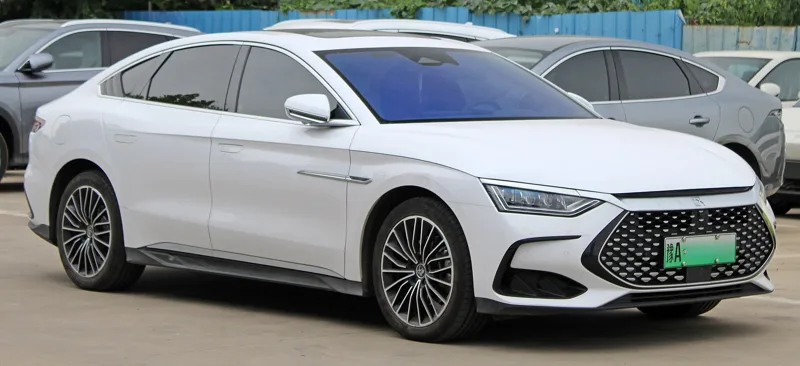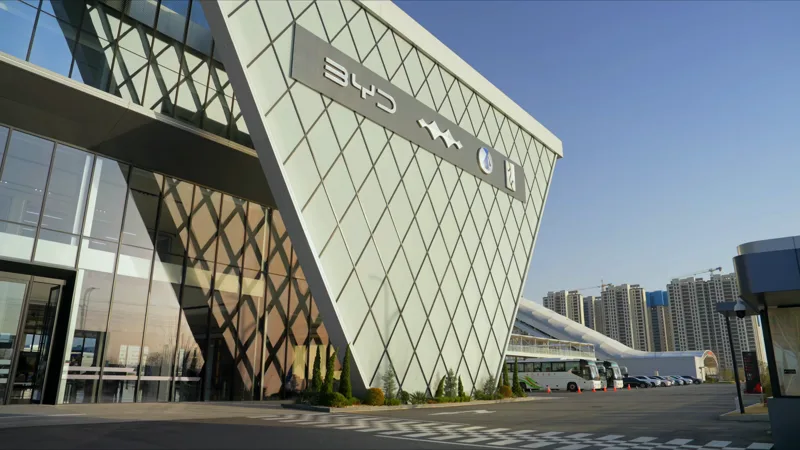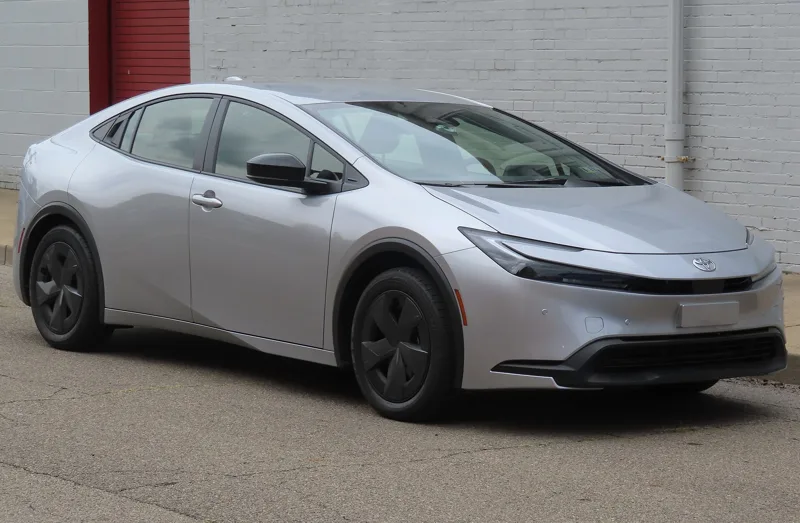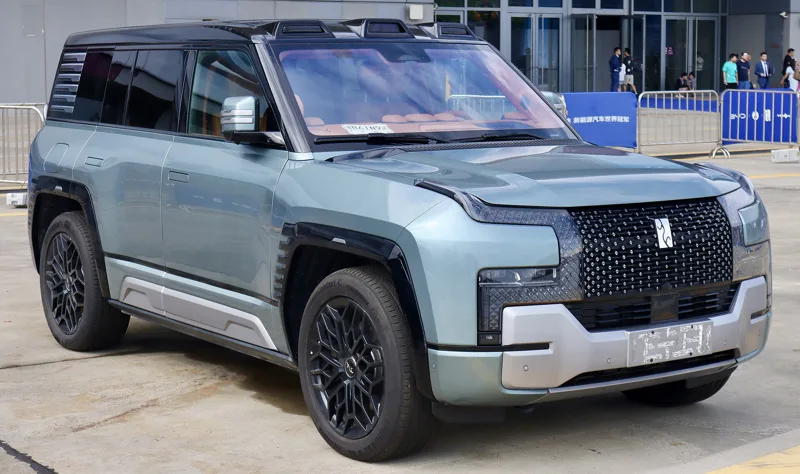
A best-selling petrol compact, a plug-in hybrid that sold 48 cars in a year and a battery that Toyota now buys: three steps in BYD's story.
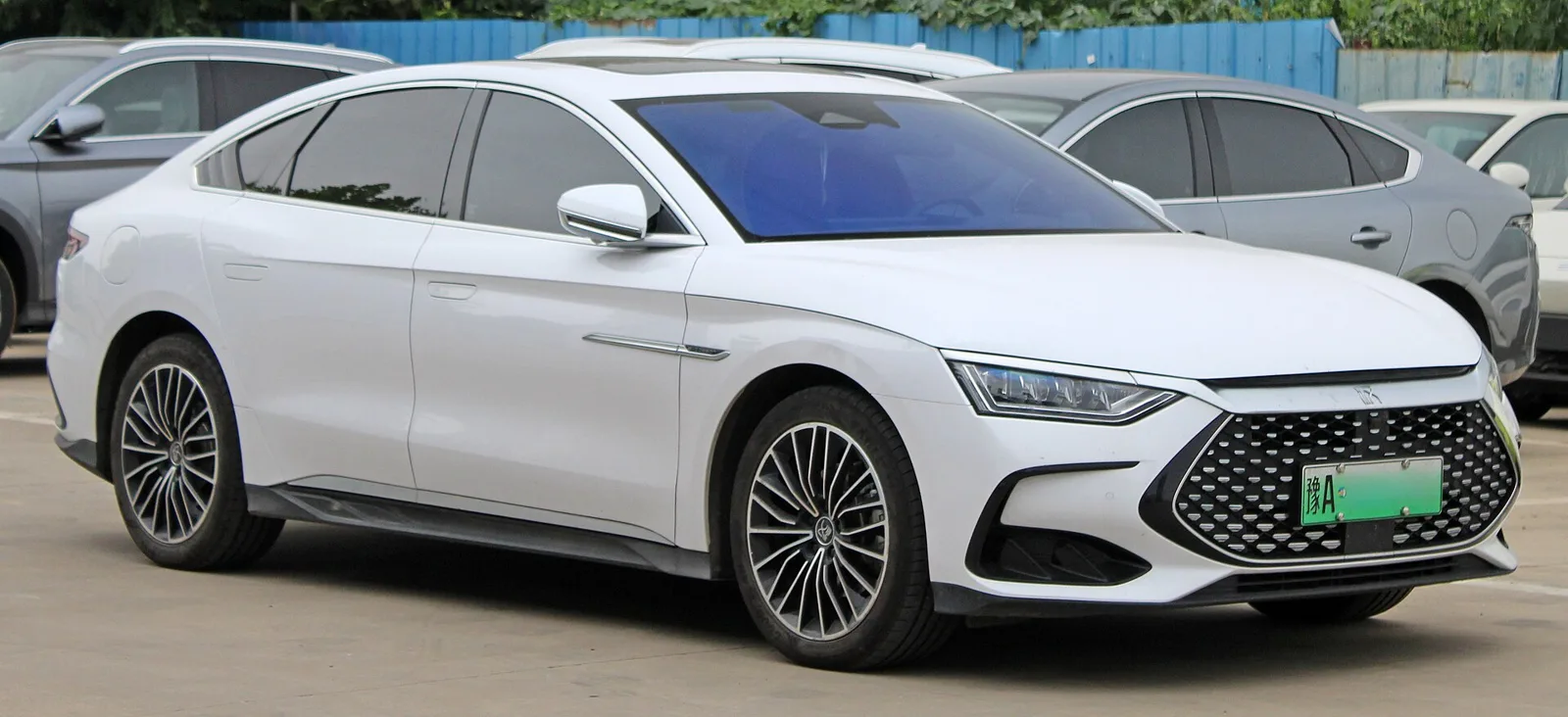
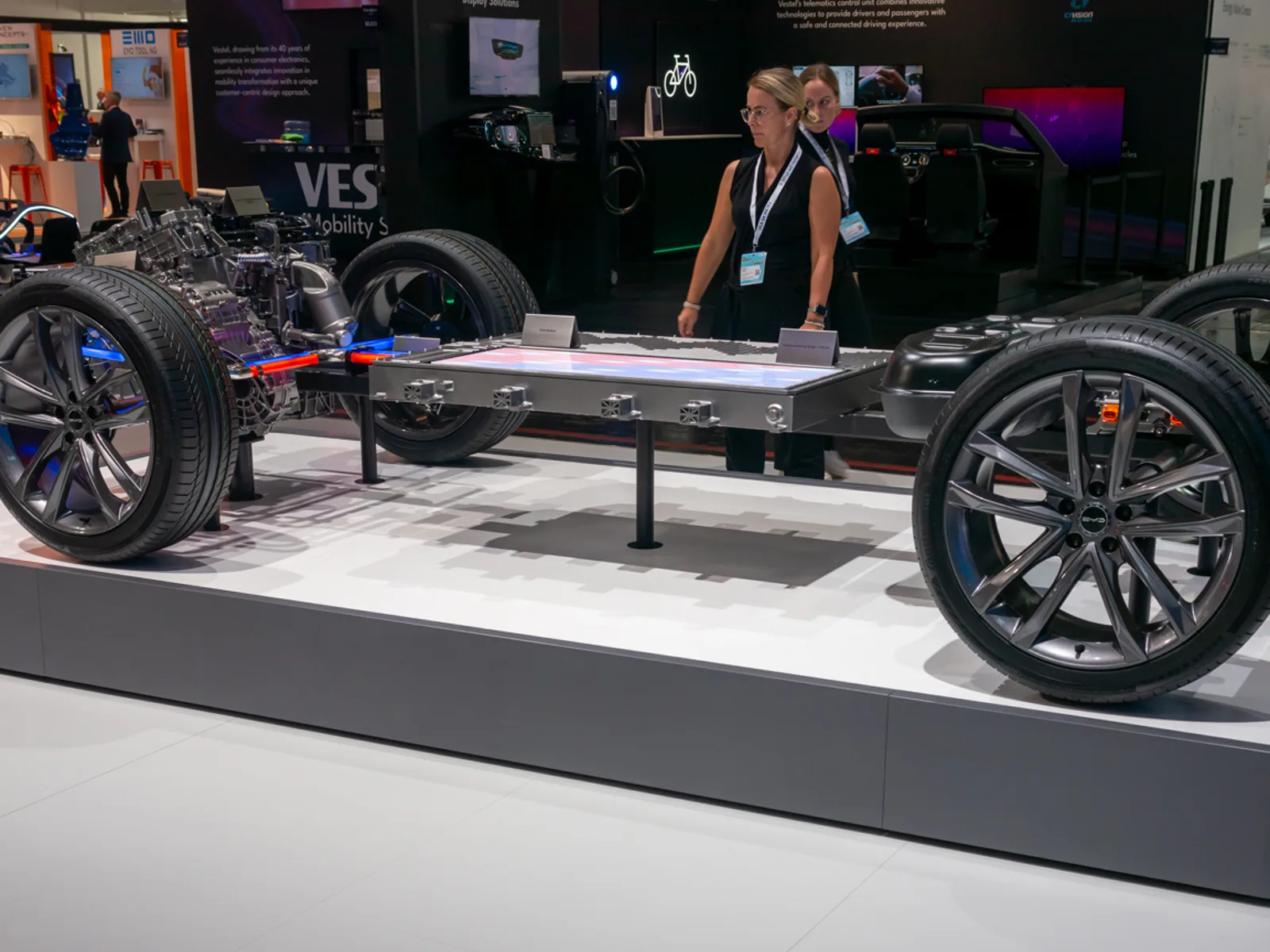
The BYD F3 was BYD's first own-design compact car, built from 2005 to 2021. The F3DM was a plug-in hybrid version that went on sale in 2008. The Blade battery is BYD's lithium iron phosphate cell, announced in 2020 and first fitted to the Han EV.
In its first year on sale, the world's first mass-produced plug-in hybrid found just 48 buyers. Its maker, BYD, now supplies batteries to Toyota. The distance between those two facts runs through three products: the F3 compact car, the F3DM plug-in and the Blade battery.
What was the BYD F3?
The BYD F3 was a compact car built by the Chinese manufacturer from 2005 to 2021. It was the first BYD vehicle of the company's own design, with first-generation production starting in September 2005. Variants included the F3DM plug-in hybrid and the larger, more premium G3 and L3.
The first cars used Mitsubishi's 4G-series four-cylinder engines. The 1.5-litre Orion unit, the 4G15S, made 78 kW (105 hp) and was rated at about 4.7 L/100 km (60 mpg-imp; 50 mpg-US), with Bosch ignition and fuel injection and Euro 4 emissions. A 1.6-litre 4G18 made 73.5 kW (99 hp) and about 5 L/100 km (56 mpg-imp; 47 mpg-US). From 2011 BYD's own engines replaced the Mitsubishi ones. Three-point belts, power steering, alloy wheels with 195/60 R15 tyres and four-wheel disc brakes with ABS came standard, and buyers chose among GL-i, GL-X and GL-Xi trims.
The F3 also travelled. Between 2011 and 2013 it was assembled in Russia at the TagAZ factory. The derivatives grew to include the F3R hatchback, the L3 and the slightly larger G3, introduced in 2009 as an upgraded compact, although the F3 stayed on sale at home.
Why the F3 mattered at home
The F3 was BYD's sales engine. In 2009 BYD sold 290,963 petrol F3s, starting at 59,800 yuan, and the car was China's best-selling model. That figure sits next to the F3DM's problem: the plug-in hybrid version cost nearly double.
Facelifts and a second generation
In March 2014 the first-generation car was facelifted, with a new grille, lights, bumpers, wheels and mirrors. It ran on a 1.5-litre four called the BYD473QE, making 107 horsepower, a signature F3 engine since 2011. A turbocharged 1.5, the BYD476ZQA, made 151 horsepower until it was dropped in mid-2015. Transmissions were a five-speed or six-speed manual, or a six-speed automatic. A further facelift for the 2016 model year lifted the same engine to 109 hp and was rebadged as the BYD L3 in foreign markets. The first generation even made a return in 2019 for the 2020 model year, as a single Classic trim with the BYD473QF engine and a five-speed manual.
The second generation, the F3 Plus or Surui, was launched at the April 2012 Beijing Auto Show as a more premium alternative. In 2013 the L3 appeared in several export markets as the New F3. A February 2015 facelift, called the third-generation F3, added new lights, bumpers and a dashboard, with prices from 55,900 to 77,900 yuan. As late as 2019 the F3 was still sold alongside the Surui and the E5, in four trims called Classic, Fashion, Elite and Exclusive. Only the Exclusive had the automatic.
The Surui also led to the more upmarket BYD Qin, which eventually took its place and fits in with the rest of BYD's Dynasty series. The F3 itself was discontinued in late 2021 because of falling sales and BYD's switch of focus to electric vehicles.
The first mass-produced plug-in hybrid sold 48 cars in a year; its maker went on to supply Toyota with batteries.
What was the BYD F3DM?
The BYD F3DM, where DM stands for dual-mode, was a plug-in hybrid compact sedan, the first mass-produced plug-in hybrid in the world. It went on sale to government agencies and companies in China on 15 December 2008 and offered an electric range of 60 kilometres (37 mi), with a hybrid system adding another 480 kilometres (300 mi).
It was introduced at the 2008 Geneva Motor Show, after the F6DM concept appeared at the North American International Auto Show in January 2008.
How the dual-mode system works
Think of it as a car with two personalities. In electric mode two AC motors do all the work, a 50-kilowatt main motor driving the wheels and a 25-kilowatt helper that can add power or turn braking energy back into electricity. They carry the car until the battery falls to 20%. Then the F3DM switches itself to hybrid mode, and a 1-litre three-cylinder engine starts up to bring the charge back to about 30%. That arrangement extends range in the same way as the Chevrolet Volt.
The petrol engine also has a direct mechanical link to the wheels, useful for joining a highway, much as in the Prius. Under heavy load, the 68 horsepower engine combines with the motors for a total of 168 horsepower (125 kW). The driver can also choose manually between all-electric and plug-in hybrid running, which is why BYD calls it dual-mode. The estimated fuel economy was 30 mpg-US (7.8 L/100 km; 36 mpg-imp).
Batteries and the range puzzle
The battery was a 16 kWh lithium iron phosphate (LiFePO4) pack, made up of 100 cells of 3.3 volts stored under the cabin. BYD called this chemistry inherently safe because it is more chemically stable. The trade-off is lower energy per cell, at 100 Wh/kg, against 150 to 200 Wh/kg for the more usual lithium-cobalt oxide cells. A large solar panel on the roof could run accessories such as the radio and climate control.
The quoted range varies. One figure puts the all-electric range at 60 kilometres (37 mi), while BYD itself has said 100 kilometres (60 mi), a figure that assumes a constant 50 km/h and is unlikely to reflect real-world driving. In the Los Angeles trial, the cars managed 40 to 60 miles (64 to 97 km) on electricity alone.
The sales story
| Period | F3DM units sold |
|---|---|
| First year from December 2008 | 48 |
| 2010 | 417 |
| 2011 | 613 |
| 2012 | 1,201 |
| 2013 (first ten months) | 1,005 |
| Cumulative to October 2013 | 3,284 |
On 15 December 2008 the F3DM was priced at 149,800 yuan (about USD 21,900). The 2010 car with solar panels cost up to 169,800 yuan (US$25,792). BYD pointed to the premium price and a lack of government subsidies as the main reasons for slow early sales, while others cited poor quality and crude transitions between electric and petrol power. In 2009, the same company sold 290,963 petrol F3s from 59,800 yuan, just over a third of the plug-in's price.
Sales to the general public began in Shenzhen on 29 March 2010, but only 28 cars sold in the first three months, all to the local government. Other reasons cited were the lack of charging infrastructure, the high cost of batteries and reports that they were unreliable. On 1 June 2010 the Chinese government announced a trial incentive of up to 50,000 yuan (about US$7,320) for plug-in hybrids, covering residents of Shanghai, Shenzhen, Hangzhou, Hefei and Changchun. Even after the subsidy, the car would cost almost US$5,900 more than the petrol F3. In 2010 BYD claimed it could not build enough batteries to meet demand.
Outside China, only 11 units sold in Europe through October 2012. In Spain the car went on sale in August 2011 at 27,585 euros; 8 units sold in 2011 and two more in 2012.
The Los Angeles trial
A US test program began in December 2010 in Los Angeles, where the city's housing authority leased ten F3DMs at US$400 a month for a year. The cars could be charged overnight in under 7 hours from standard 220VAC outlets. By April 2011 the fleet had covered 14,430 mi (23,220 km), about 72.3 percent of it on electricity alone, for an average equivalent of 88 miles per US gallon (2.7 L/100 km).
Retail sales were due in the US in 2012 at US$28,800 before incentives. BYD opened its Los Angeles headquarters in October 2011, a year late, and said retail sales would wait because there was too little charging infrastructure.
In April 2012 BYD said the F3DM would be replaced by the Qin plug-in hybrid, shown at the 2012 Beijing show, because of low sales. Production was over by May 2013, the remaining stock sold by October 2013, and Qin deliveries in China began in mid-December 2013.
What is the BYD Blade battery?
The BYD Blade battery is a lithium iron phosphate (LFP) battery developed and made by FinDreams Battery, a BYD subsidiary, and publicly announced in 2020. Its blade-shaped cells are designed to improve space use, structural strength and safety compared with cylindrical, pouch and conventional block prismatic cells.
How the blade shape works
Picture books standing side by side on a shelf, rather than a jumble of loose tins. A Blade cell is usually 96 centimetres (37.8 in) long and 9 centimetres (3.5 in) wide, and cells line up in an array before being slid into the pack. Lengths and thicknesses vary. Space use in the pack rises by over 50% compared with most conventional LFP block batteries.
LFP has lower energy density than lithium-nickel-manganese-cobalt (Li-NMC) cells. The cell-to-pack arrangement claws it back through packaging efficiency: a BYD Han EV with a 77 kWh Blade pack achieves up to 605 km on the CLTC cycle. The long flat surface also touches thermal management plates over a large area, helping heat and cool the cell, and BYD says the pack keeps more than 90% of its capacity at -20 C (-4 F), helped by AI-based thermal control.
From announcement to everyday use
On 11 January 2020 Wang Chuanfu told the China Electric Vehicle 100 Forum that the battery was close to ready for production. At a summit the same day, BYD's head of international cooperation said it held over 300 core patents. The formal launch followed on 29 March 2020, broadcast live by Shenzhen Television. Production started at the Chongqing FinDreams Battery plant, which broke ground in February 2019 and was complete in about a year, with a planned initial capacity of 20 GWh, eight production lines and a 10 billion yuan investment.
The BYD Han EV, on sale from June 2020, was the first production car to carry it. Wang said BYD aimed to remove spontaneous combustion from the vocabulary of new energy vehicles. BYD says the concept came from its own engineers and that it holds all the patents. After a 2024 Bloomberg report alleged a collaboration with Apple around 2017, BYD stated that Apple owns none of the technology.
On 7 April 2021 BYD said that all of its pure electric models would carry the Blade as standard and that nail-penetration testing would become a mandatory quality standard. Four new models with the cell arrived the same day: the 2021 Tang EV, Qin Plus EV, Song Plus EV and 2021 e2. In a demonstration, a fully loaded 46-tonne truck was driven over a Blade pack, which was reported to show no deformation, leakage or smoke.
BYD also developed a Short Blade variant for its plug-in DM-i hybrid platform, which debuted with the Qin Plus DM-i in January 2021. It is a power-type cell, with self-heating and direct-cooling thermal management, and is smaller in capacity, typically 8.3 to 21.5 kWh.
Rivals take it up
BYD opened supply to other carmakers. The Toyota bZ3, developed through the BYD Toyota EV Technology joint venture with FAW Toyota, debuted in China in October 2022 and officially launched in April 2023 with a Blade Battery and a BYD motor. FAW Group's Hongqi E-QM5 and Bestune NAT appeared in China's recommended catalogue of new energy vehicles with cells from Chongqing FinDreams. In February 2024 BYD agreed with US supplier BorgWarner that FinDreams would be its sole supplier of Blade cells and would license related intellectual property.
Safety claims and a disputed crash
In BYD's nail-penetration test the cell emitted no smoke or fire, and the surface warmed to just 30 to 60 C (86 to 140 F). It also passed crushing, bending, heating in a furnace to 300 C (572 F) and overcharging by 260 percent, with no fire or explosion, according to BYD.
Not every test went well. In July 2021 a Chinese car-to-car crash test pitted a Blade-equipped BYD Han EV against an Arcfox Alpha-S. About 48 hours later the Han was producing smoke and allegedly caught fire. BYD argued that the fire stemmed from misuse of battery coolant: the red coolant used was electrically conductive, where the standard coolant in the Han is purple and is not. It also called the test not mainstream and not within industry standards.
What is the second-generation Blade Battery?
At a Shenzhen event on 5 March 2026, BYD revealed a second-generation cell together with its Flash Charging network. Wang announced a record for production vehicle charging: 10% to 70% in five minutes, and 10% to 97% in nine minutes, on BYD's 1,500 kW Flash chargers.
The new battery comes in two cell formats. The Short Blade, roughly 450 to 580 mm, handles an 8C peak charge and a 16C peak discharge. The Long Blade has a cell-level energy density of about 190 to 210 Wh/kg, more than 5% better than before, which supports CLTC ranges above 1,000 km (620 mi) in some cars: 1,036 km (644 mi) in the Denza Z9 GT and 1,006 km (625 mi) in the Yangwang U7. An updated Cell-to-Body 2.0 design is reported to lift volumetric space use to 76%.
Cold weather matters less than before. At -30 C (-22 F), a 20% to 97% charge takes about 12 minutes, just three minutes longer than in a warm room. BYD also announced a lifetime warranty on these cells and said one passed a nail test after more than 500 rapid charges, including one carried out mid-charge.
What did each one mean for BYD?
The F3 was BYD's first own-design car and its best seller in 2009, and its decline in 2021 coincided with the company's pivot to electric cars. The F3DM put the first mass-produced plug-in hybrid on the road, but its price, thin charging network and subsidy gaps kept volumes small, and the Qin took its place. The Blade Battery then turned BYD into a cell supplier as well as a carmaker, with Toyota and BorgWarner among its customers.
What comes next for Blade Battery 2.0 and Flash Charging?
BYD says the second-generation battery will arrive first in ten models, among them the Yangwang U7 and the Denza Z9 GT. The company also plans 20,000 Flash Charging Stations across China by the end of 2026, with 4,239 already running when it made the announcement, and wants to start a global rollout by the end of that year.
BYD had not officially confirmed the cathode chemistry as of early 2026. Its patents, the energy density gains and mentions of a 3.8 V operating voltage have led analysts to suggest lithium manganese iron phosphate (LMFP), which would raise the voltage from the 3.2 V typical of LFP. Yet regulatory filings for the first car with the new cell, the 2026 Yangwang U7, call the battery LFP, and BYD stopped short of confirming LMFP at the launch.