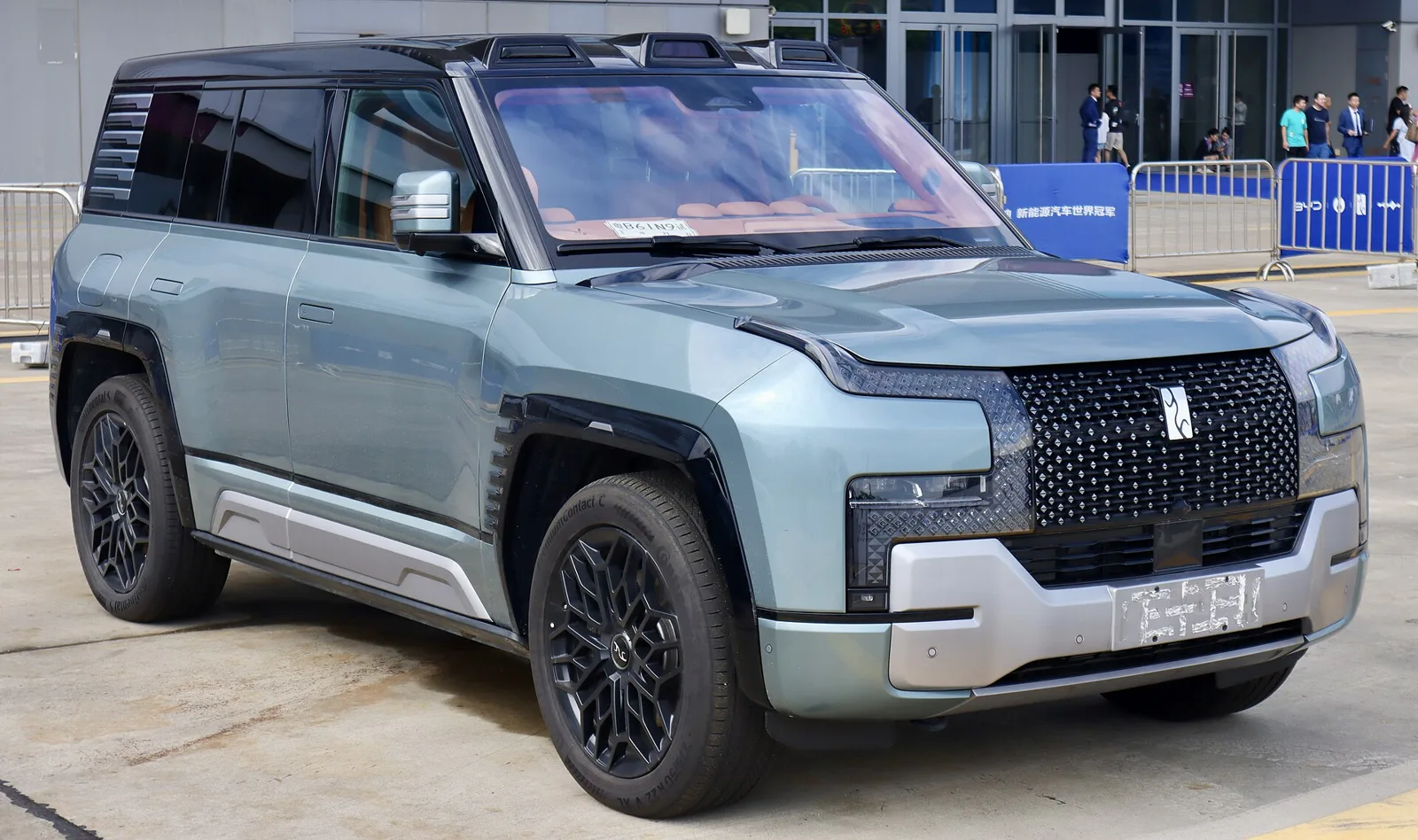
A premium minivan brand that began with Mercedes and an SUV that can float, a four-motor sedan and a trademark fight in Indonesia.
Denza is BYD's luxury brand, founded in 2010 with Daimler and fully BYD-owned since 2024, while Yangwang makes extreme flagships. The Denza D9 is a minivan, the Yangwang U8 an 880 kW range-extended SUV, and the U7 a sedan with up to 1,000 kW.
The Yangwang U8 can float. If its sensors detect water deeper than its wading limit, the SUV switches off its petrol engine, closes the windows, raises the suspension and opens the sunroof as an exit, then stays afloat for 30 minutes at 3 km/h.
That party trick comes from one of the two premium brands BYD has built above its mainstream range, Yangwang, while the other, Denza, started life as a joint venture with Daimler. Denza is the brand to know for the D9 people carrier, Yangwang for the U8 off-roader and the U7 sedan, and the way they differ says a lot about where BYD wants to go.
How do Denza and Yangwang fit into BYD?
Denza is described as a luxury plug-in electric brand owned by BYD Auto. Yangwang is the second of the group's premium labels, and Fangchengbao is the third luxury subsidiary. They also overlap abroad: export versions of Yangwang and Fangchengbao vehicles are sold under the Denza name, so one badge carries cars from three different Chinese ranges.
The two brands target different jobs. Denza sells large family vehicles, among them the D9 minivan, the N8L and N9 SUVs, and the Z9 GT, a fastback. Yangwang's cars are more extreme, including an off-road SUV with a motor at every wheel and a sedan rated at close to 1,000 kW.
One badge carries cars from three different Chinese ranges.
Where did Denza come from?
Denza began as a pairing of BYD and Daimler, now Mercedes-Benz Group. They signed a memorandum on 1 March 2010 to develop electric vehicles together, set up an equal-ownership company, Shenzhen BYD Daimler New Technology, and formally established it on 27 May that year. The Denza name arrived in March 2012. It is an invented word built from the Chinese Tengshi, and it roughly means rising power and momentum.
At the launch, BYD chairman Wang Chuanfu said his company brought battery technology, electric drive systems and experience of running electric vehicles on Chinese roads. Daimler supplied premium design, expertise in electric architecture and safety, and a history stretching back more than 125 years. A first concept car followed at the Auto China show in Beijing in April 2012, and by September 2014 the partners had put in over 300 million euros.
The first car, the Denza EV, appeared in December 2014 after a delay from September, and was sold at first only in selected Chinese cities. Subsidies mattered then. Buyers qualified for RMB 78,000, with a ceiling of RMB 120,000 depending on the location, and either skipped Beijing's licence-plate lottery or got their plates free in Shanghai and Shenzhen. In 2018 the car was restyled and renamed the Denza 500, and in November 2019 a second model, derived from BYD's second-generation Tang, appeared with Mercedes-Benz designers responsible for the styling inside and out. It went on sale as the Denza X at the end of 2020, in China only.
Why did Mercedes-Benz leave Denza?
In February 2021 the German business paper Handelsblatt reported that relations between the owners were in crisis because sales had fallen short of Daimler's hopes. That was denied. In December 2021 a new structure was announced anyway. The Denza X was dropped, the venture was renamed Shenzhen Denza New Energy Vehicle, and Mercedes-Benz cut its stake from 50 per cent to 10, leaving BYD with 90. In September 2024 Mercedes transferred its last 10 per cent to BYD, and Denza has been a wholly owned BYD subsidiary since.
Leadership shows the same change. Hans-Ulrich Maik, Arno van der Merwe and Hubertus Troska led the company in turn until 2021, when Wang Chuanfu himself took over for a year. Zhao Changjiang followed from 2022 to 2025, and Lian Yubo has led since.
What is the Denza D9?
The D9 is a minivan, offered as a plug-in hybrid or a battery-electric car, and it was the first Denza model after the restructuring. It was introduced on 16 May 2022, went on sale on 23 August and reached its first customers on 25 October, with seven trim levels split between four plug-in hybrid versions and three electric ones. The plug-in hybrid uses BYD's DM-i platform and the electric car its e-Platform 3.0.
Inside, the top version has seven screens, including a 10.25-inch instrument panel, a 15.6-inch central display and a head-up display, as well as a fridge between the front seats that second-row passengers can reach. The second-row captain's chairs adjust ten ways and offer footrests, heating, ventilation and a ten-point massage. The D9 made its global debut at the 44th Bangkok International Motor Show in March 2023.
The plug-in version pairs a 1.5-litre turbo petrol engine with an electric motor, and its listed range is 945 to 1,040 km (587 to 646 mi), 190 km (118 mi) of it electric, with fuel consumption of 6.2 l/100 km. The electric D9 has a 103 kWh LFP battery, a range of 620 km (385 mi) and charges at up to 166 kW through ports on both rear quarter panels, which lets slower chargers be paired up to reach that peak.
Orders came fast. The D9 took 3,000 pre-orders in 30 minutes and 5,679 within 24 hours, and by July 2022 there were 30,000. The 100,000th car was built on 24 September 2023, eleven months after the first, and on 10 June 2025 the 250,000th left the line, which Denza says is a world first for a new-energy MPV. Updates came in March 2024, with soft-closing doors and physical steering-wheel buttons, and in December 2024, when every trim gained a lidar sensor and BYD's God's Eye driver-assistance system.
Denza D9 and the rest of the line-up abroad
Denza began exporting in 2024, starting in Southeast Asia, and in 2025 added Brazil, Europe and the Middle East. The D9 was the pioneer. It went on sale in Hong Kong on 24 June 2024, the first right-hand-drive market and Denza's first overseas operation. Cambodia took deliveries on 14 July 2024 as the first ASEAN country, and Singapore followed on 10 October and Thailand on 1 November. In 2025 came Indonesia on 22 January and Malaysia on 20 February. Brunei followed on 13 January 2026, the Philippines on 27 February with a plug-in hybrid using a 40.06 kWh battery, and Australia on 2 March, where it was Denza's third model.
Europe was announced in April 2025 at a launch event in Milan, with the Z9 GT first. In August 2025 two off-road SUVs, the B5 and B8, went to the Middle East, rebadged from the Fangchengbao Bao 5 and Bao 8. In December 2025 Denza announced its entry into Brazil with the B5 and Z9 GT. In March 2026 actor Daniel Craig became its global ambassador for the year.
Why is Denza called Danza in Indonesia?
A trademark fight. The Indonesian firm Worcas Nusantara Abadi registered the Denza name on 3 July 2023, more than a year before BYD filed its own application on 8 August 2024. Worcas sued BYD on 3 January 2025, and BYD countersued over ownership. In April 2025 the Central Jakarta Commercial Court threw out BYD's claim, and the Supreme Court dismissed its appeal, finding that ownership had passed to another party, Raden Reza Adi.
BYD had already applied for the Danza name on 11 August 2025. BYD Motor Indonesia confirmed on 1 October 2026 that the brand would be sold there as Danza, and dealer signs and social media were changed. The D9 became the Danza D9.
Yangwang U8: the SUV that spins on the spot
The U8 is a full-size luxury SUV and Yangwang's first car. It drives electrically, with a petrol engine added only to extend its range. Its debut is dated two ways. One timeline has it first presented on 5 January 2023, with sales opening in China on 18 April and pricing announced on 20 September 2023, while another places the introduction in January 2024. At 1,098,000 RMB the Premium Edition was then the priciest electric car that any Chinese maker built in volume, until the U9 supercar passed it in February 2024 at 1,680,000 RMB.
The key is BYD's e4 individual wheel drive: four motors, each turning a single wheel. The software can redistribute torque to keep the car stable after a puncture at speed, and it can make the left and right wheels spin in opposite directions for a tank turn of up to 359 degrees. At the early-2023 media event Wang Chuanfu drove a Mecanum-wheeled demonstration vehicle on to the stage, travelling sideways. According to the developers, it reacts 100 times quicker than a conventional all-wheel-drive layout.
Off-road numbers back the claim. Disus-P active suspension raises the body by 15 cm (5.9 in). The Premium Edition wades to 1,000 mm (39 in), and the Off-road Master Edition with a snorkel manages 1,400 mm (55 in). Approach, departure and breakover angles are 36.5, 35.4 and 25.5 degrees. The float mode is for emergencies only, such as flash floods, and BYD discourages owners from trying it, requiring a service-centre inspection afterwards.
Inside, three screens span the dashboard, a 23.6-inch panel for the driver, a vertical 12.8-inch touchscreen in the centre and another 23.6-inch display for the front passenger. A 70-inch head-up display and 22 Dynaudio speakers complete the picture, and the console holds a fridge, a freezer and a heater that covers temperatures from minus 6 to 50 degrees Celsius.
The powertrain is unusual. A 2.0-litre turbo petrol engine that has no mechanical link to the wheels charges a 49.05 kWh battery, which feeds four 220 kW (295 hp; 299 PS) motors for a total of 880 kW (1,180 hp; 1,196 PS). BYD lists a maximum range of 1,000 km (620 mi) on the CLTC cycle with a full 75-litre tank and full battery. Top speed is limited to 200 km/h (124 mph) and 0-100 km/h takes 3.6 seconds, according to BYD. DC charging peaks at 110 kW, and the company claims 30 to 80 per cent in 18 minutes.
A longer U8L was introduced at Auto Shanghai in April 2025 with three rows for six passengers and a wheelbase 200 mm (7.9 in) longer. The body grows by 81 mm (3.2 in) on paper, but dropping the spare tyre means the real increase is greater. It went on sale on 12 September 2025 from 1,280,000 RMB, in Obsidian Black and Sunstone Gold paint with 24-karat gold badges. Second-row seats come with an 18-point massage function and a zero-gravity mode.
The U8 has since travelled. It had about 4,000 orders in China by 6 October 2023, BYD Australia confirmed its introduction there, and it premiered in Europe at the Geneva International Motor Show in 2024, although European availability has not been confirmed. It was also shown at the 2025 Seoul Mobility Show.
Yangwang U7: a sedan with four motors and a flat-four
The U7 is a full-size luxury sedan, available as an electric car or a plug-in hybrid. The electric version was unveiled in January 2024, pre-sales began at Auto Guangzhou in November 2024 and both versions went on sale in March 2025, with deliveries from June 2025.
Its e4 system adds four-wheel steering to four motors that originally produced 239 kW each, for a total of 960 kW (1,287 hp; 1,305 PS) and 1,680 N m of torque. At the 2025 Guangzhou show the rear motors were upgraded to 260 kW, which took the total to 1,000 kW (1,341 hp; 1,360 PS). With 20 degrees of rear-wheel steering the turning radius is 4.85 metres. DiSus-Z suspension reacts in 10 ms and recovers energy, the drag coefficient is 0.195 Cd, and the top speed is 270 km/h (168 mph).
The electric U7 has a 135.5 kWh LFP Blade battery that accepts a peak of 500 kW through two charging ports, enough for 30 to 80 per cent in 20 minutes, and a CLTC range of 720 km (447 mi). The pack weighs 903 kg, and the car's kerb weight is 3,095 kg. The plug-in hybrid uses a 2.0-litre turbocharged flat-four, which is BYD's first flat engine. Its low height of 420 mm, against around 700 mm for a conventional inline engine, lets it sit under a low bonnet, and it also offers a lower centre of gravity and less noise and vibration. It makes 203 kW (272 hp), runs with a 52.4 kWh battery that charges from 30 to 80 per cent in 10 minutes, and does 0-100 km/h in 2.9 seconds. Combined range is 1,000 km with a 60 L tank.
| Model | Brand | Body | Powertrain | Output | Range |
|---|---|---|---|---|---|
| D9 | Denza | Minivan | PHEV or EV (103 kWh) | - | 945 to 1,040 km PHEV; 620 km EV |
| U8 | Yangwang | Full-size SUV | Range extender, four motors | 880 kW (1,180 hp) | 1,000 km CLTC |
| U7 | Yangwang | Full-size sedan | EV (135.5 kWh) or PHEV flat-four | 960 kW (1,287 hp), later 1,000 kW | 720 km EV; 1,000 km PHEV |
What is coming from Yangwang and Denza
For the U7, filings with China's MIIT in December 2025 showed an update coming. A new 150.01 kWh LFP Blade battery would give 860 to 1,006 km (534 to 625 mi) of CLTC range, while the existing pack would be rated at up to 800 km (497 mi) and the plug-in hybrid at 220 km (137 mi) electric. The new battery weighs 926 kg, giving 162 Wh/kg against 150 Wh/kg for the old 903 kg pack. A shooting-brake U7, unofficially known as the U7 GT, was spotted in camouflage in August 2025.
Denza plans product lines whose names begin with the letters D, E, N, Z and A. The Denza N8 SUV is listed as upcoming, and the Z9S and a Z sports car arrive in 2026, along with the export-only B3, a rebadged Fangchengbao Tai 3.