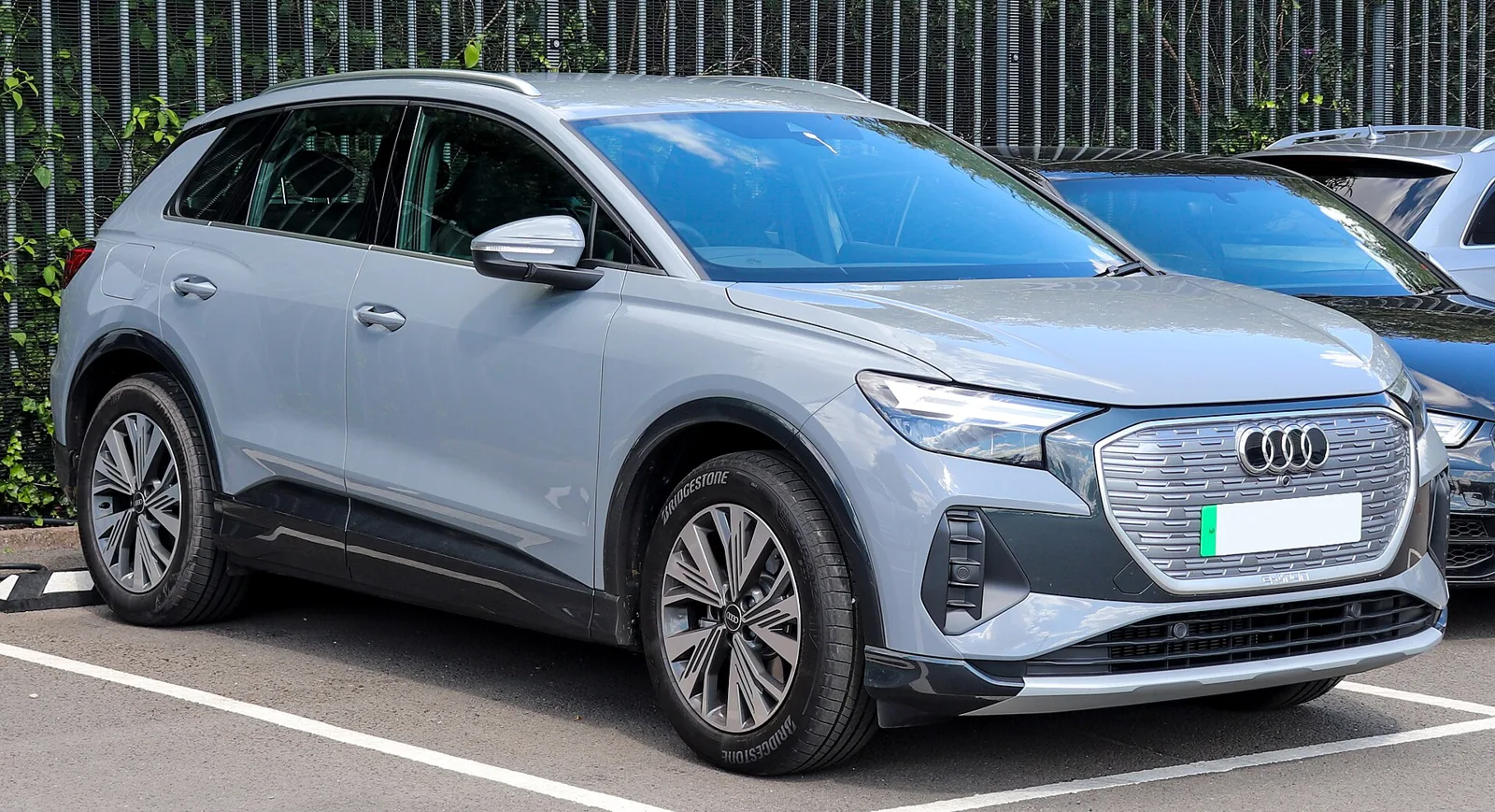
A compact crossover on the MEB platform and a PPE executive car with 270 kW charging, set out in drive units, batteries, prices and markets.
The Audi Q4 e-tron is a compact electric crossover built on the MEB platform since March 2021. The A6 e-tron is an electric executive car on the PPE platform, revealed on 31 July 2024, with an 800-volt 100 kWh battery and liftback or wagon bodies.
The Audi Q4 e-tron was the first Audi built in Zwickau since before the war. That matters because Zwickau is where both Audi and Horch were founded, before the two were merged into Auto Union in 1932, so an electric crossover on a Volkswagen Group platform marked a homecoming of sorts when production began in March 2021. Three years later the brand revealed something bigger, lower and more technical: the A6 e-tron.
What is the Audi Q4 e-tron?
Audi's Q4 e-tron is a compact luxury crossover that runs on a battery alone, and it is the fourth fully electric model in Audi's e-tron series after the Q8 e-tron, the e-tron GT and the Q2L e-tron. It sits on the Volkswagen Group's MEB platform. Audi showed a near-series concept at the 2019 Geneva Motor Show, unveiled the production version in April 2021 and had started building cars a month earlier.
Audi places it in what it calls the heart of the market. At 4.58 m (180 in) the Q4 e-tron is a touch shorter than the Q5, though Audi says the cabin is comparable. Short front overhangs, just 86 cm (34 in), leave room for a 2.76 m (109 in) wheelbase. The spoilers ahead of the front wheel arches, the rear spoiler and the bars below the headlights were all added with airflow in mind. The Sportback records a drag coefficient of 0.26; the regular roofline manages 0.28.
Wheels run from 19 to 21 inches. Buyers can add a head-up display that uses augmented reality, and an 11.6 in (29 cm) infotainment screen that can be run by voice. The regular car has a 520 L boot, growing to 1,490 L with the 40:20:40 split rear seat folded, while Sportback versions offer 535 L and 1,460 L.
Short front overhangs, a fixed-ratio gearbox and a motor that stays idle until needed: the Q4 e-tron is built around efficiency.
How does the Q4 e-tron drive?
Rear-wheel-drive cars use a water-cooled, permanently excited synchronous motor on the rear axle. It makes up to 150 kW (201 hp) and 310 N m (229 lb ft), and spins at up to 16,000 rpm through a single-speed gearbox with a fixed 13:1 ratio. Audi quotes an efficiency of substantially more than 90 percent. Motor, gearbox and power electronics together form a drive unit weighing around 90 kg (200 lb).
The quattro adds a second, asynchronous motor on the front axle, good for up to 75 kW (101 hp) at 14,000 rpm. Think of it as a spare pair of hands: in most driving it stays idle, because running one motor wastes less energy than running two. When it is needed, it works through a fixed 10:1 gear, while the rear motor in these cars uses 11.5:1.
Braking recovers energy too. Rear-drive cars harvest it at up to 0.15 g and all-wheel-drive cars at up to 0.3 g, which equates to as much as 145 kW (194 hp). By default the car coasts when the driver lifts off, with recuperation of up to 0.15 g as an option. The rotor and stator come from Volkswagen Group Components in Salzgitter, and the gearbox and final motor assembly are in Kassel; for China the electric drive parts are made in Tianjin. Underneath sit a MacPherson front axle and a five-link rear. Rear-drive cars can tow 1,000 kg (2,205 lb) braked, and all-wheel-drive cars 1,200 kg (2,646 lb), with the optional hitch.
Audi Q4 e-tron battery, range and charging
The liquid-cooled lithium-ion pack comes in an aluminium case and holds either 10 or 12 modules. The smaller version is listed at 55/52 kWh and weighs 350 kg (772 lb); the larger is listed at 82/77 kWh and weighs 500 kg (1,102 lb). Volkswagen Group plants assemble the pack, while the nickel-manganese-cobalt cells come from suppliers including LG Energy Solution and CATL. For Zwickau, LG's Wroclaw plant pre-assembles the cells into modules, and a train carries them to Braunschweig to be built into batteries.
On a 125 kW public DC fast charger in ideal conditions, Audi claims the 82/77 kWh pack goes from 5 to 80 percent in 38 minutes. In the United States the EPA estimated 241 miles (388 km) for the dual-motor Q4 50, with a combined rating of 95 MPGe.
Audi Q4 e-tron price and where it is sold
European sales began in June 2021. In Germany the Q4 35 e-tron started at 41,900 euros, the 40 at 47,500 euros and the Q4 50 e-tron quattro at 52,900 euros. A less powerful all-wheel-drive 45 e-tron quattro joined in July 2021, Sportback bodies cost around 2,000 euros more, and two Edition models in blue or grey paint added 6,195 euros to any drive variant.
The United States got the car for the 2022 model year with prices from under $45,000. Only the larger 77 kWh pack was offered there, so the entry model was the Q4 40 e-tron. For China, FAW-Volkswagen assembles it in Foshan, where Sportback production began in November 2023.
Audi presented a facelifted Q4 e-tron on 27 April 2026. It has a sportier front with new grilles, a third display inside, new trim and greater range, and the Sportback was updated alongside it.
The company also leans on sustainability in its marketing. According to Audi, Zwickau production for Europe and the US runs on exclusively "eco-electricity", and unavoidable emissions are offset, which is why it describes cars handed to European and American customers as net zero carbon. The Dinamica microfibre and Puls fabric interiors contain 45 and 50 percent recycled material respectively. In December 2022 Bloomberg named the car a strong alternative to the Tesla Model Y for buyers put off by Elon Musk.
Audi A6 e-tron: a lower, longer electric executive car
The A6 e-tron is a battery electric executive car on the PPE platform, revealed on 31 July 2024, and it comes as a liftback or a station wagon. Audi calls those bodies Sportback and Avant. The groundwork was the A6 e-tron Concept, shown at Auto Shanghai and Milan Design Week in 2021 with a Sportback body, 22-inch wheels and a 100 kWh battery. An Avant concept followed in March 2022 with a drag coefficient of 0.24 and bigger diffuser tunnels.
Preorders for the production cars opened in September 2024, with deliveries expected from February 2025. Both the standard A6 and the high-performance S6 were available from the start. Audi regards the A6 e-tron as the low-floor counterpart to the Q6 e-tron, since the two share a platform and are closely related.
The nose has a body-colour grille inside a black mask that hides the driver-assistance sensors, with low-set headlights split from the daytime running lights above them. At the back a light bar of 450 pixels can show selectable animations or vehicle-to-X signals. Audi claims the Sportback's drag coefficient of 0.21 was the best in its class at launch, and the Avant records 0.24. Air curtain vents in the bumper, active grille flaps, a smooth flat underfloor, aerodynamically tuned wheels and optional virtual side mirrors all contribute.
Inside the Audi A6 e-tron
An 11.9-inch OLED screen serves as the instrument cluster, next to a 14.5-inch OLED touchscreen whose voice commands are assisted by ChatGPT. A 10.9-inch passenger screen with a switchable privacy filter is optional, as is a head-up display that shows navigation and road signs. A touch-sensitive panel in the driver's door handles headlights, locking and mirrors.
The cabin is entirely leather-free, with fabric surfaces and contrast stitching on the dashboard and door panels, some of it from recycled materials. Options include a panoramic roof with a liquid crystal sunshade that can be closed to the front or the rear, a 20-speaker Bang & Olufsen system with two speakers in each front headrest, and four-zone climate control.
Steel springs are standard, air suspension is optional on the A6, and the S6 gets adaptive air suspension as standard. A 27 L (0.95 cu ft) front boot opens when the key fob is held over the front of the bonnet, and the tailgate opens with a kick, guided by a light that marks the sensor. There are two charging ports, both able to take AC, with the driver's side also accepting DC fast charging. The A6 and S6 can tow an unbraked 750 kg (1,650 lb) trailer or 2,100 kg (4,600 lb) on a 12% slope, and can carry 100 kg (220 lb) on the roof.
Audi A6 e-tron power, battery and charging speed
The A6 e-tron comes with four powertrains. The standard car is the only one with the smaller 83 kWh pack, and its single motor makes 210 kW (282 hp; 286 PS), rising to 240 kW (322 hp; 326 PS) with launch control. The performance rear-drive model uses a permanent magnet synchronous motor producing 270 kW (362 hp; 367 PS) and 565 N m (417 lb ft), which can reach 280 kW (375 hp; 381 PS) in launch mode. The quattro is slightly rear-biased and makes 315 kW (422 hp; 428 PS), or 340 kW (456 hp; 462 PS) with the boost.
The S6 e-tron pairs an asynchronous motor on the front axle with a permanent magnet motor on the rear, for 370 kW (496 hp; 503 PS) and a temporary 405 kW (543 hp; 551 PS). Its top speed is 240 km/h (149 mph), against 210 km/h (130 mph) for the A6.
The 100 kWh pack (94.4 kWh usable) is built from twelve modules of 15 prismatic NMC cells wired in series, 180 cells in all. Its 800-volt architecture accepts up to 270 kW at the peak, and Audi claims 10 to 80 percent in 21 minutes. On a 400-volt charger the pack splits into two banks, each taking up to 135 kW; it is a little like filling one tank through two narrower pipes instead of a single wide one. The onboard AC charger is rated at 11 kW in Europe and 9.6 kW in the US, with a 22 kW option mentioned for the future.
The motors use bar-wound hairpin windings and the inverter uses silicon carbide semiconductors. The single-speed reduction gearbox has a dry sump with an electric oil pump. Regenerative braking recovers up to 220 kW, and the driver can pick regen-free coasting or something close to one-pedal driving. The smaller 83 kWh pack has ten modules, uses the same 800-volt architecture and takes up to 225 kW at its peak. It reached Europe in late October 2024.
Audi A6 e-tron markets and rules
In Europe the A6 e-tron was first offered only with rear-wheel drive and the 100 kWh pack, with the S6 the one route to all-wheel drive. The 83 kWh battery and quattro variants followed in late October 2024. American buyers can choose rear-drive or quattro, while Canada gets only the quattro. Neither country receives the Avant, and local regulations rule out the camera-based virtual mirrors and the elaborate turn signal animations, which are replaced by conventional mirrors and simpler signals. Adaptive matrix LED headlights and the illuminated grille logo are available in Canada but not in the US. American pricing appeared on 12 March 2025, with sales expected that summer.
China will get a long-wheelbase A6L e-tron, due at Auto Shanghai 2025.
Audi Q4 e-tron and A6 e-tron compared
| Detail | Q4 e-tron | A6 e-tron |
|---|---|---|
| Type | Compact luxury crossover SUV | Executive car |
| Platform | Volkswagen Group MEB | PPE |
| Bodies | SUV and Sportback | Sportback liftback and Avant wagon |
| Debut | Production version April 2021 | Revealed 31 July 2024 |
| Drag coefficient | 0.26 Sportback, 0.28 regular | 0.21 Sportback, 0.24 Avant |
| Battery | 55/52 kWh or 82/77 kWh | 83 kWh or 100 kWh gross |
| Fast charging | 5 to 80 percent in 38 minutes at 125 kW | 10 to 80 percent in 21 minutes at up to 270 kW |
| Cabin screens | 11.6 in infotainment (optional) | 11.9 in cluster and 14.5 in touchscreen |
What the Audi electric pair mean for a buyer
The Q4 e-tron is the more compact of the two, shorter than a Q5 yet claiming similar space, with German pricing that began at 41,900 euros. The A6 e-tron moves to an 800-volt system, a leather-free interior, an optional passenger screen and a power range that climbs from 210 kW to the S6's 370 kW. Both offer a choice of battery and drive layout, and in North America the A6 range on sale is narrower than the European one.