How the device that logs speed, distance and driver activity grew from railway trackers into the analogue discs and encrypted digital cards of today's trucking rules.
A tachograph records a vehicle's speed and distance, plus the driver's activity, so authorities can check working hours and rest breaks. Analogue units trace onto wax discs, while digital units store encrypted data. EU rules made them mandatory from 1986.
A tachograph is a unit installed in a vehicle that logs speed and distance without intervention, together with the driver's activity, chosen from a set of modes. It switches to drive mode whenever the vehicle moves, and modern heads usually fall back to other work when the vehicle stops. Rest and availability are set by hand while stationary. Its records are the evidence used to check whether drivers have kept within their legal working hours.
Where did tachographs come from?
The tachograph was first introduced for railways so that companies could document irregularities more reliably. Its inventor was Max Maria von Weber, a civil servant, engineer and author. Railway operators had known the Daniel Tachometer since 1844, and the Hasler Event recorder followed in the 1920s.
A tachograph is a small machine with a long memory, and every turn of its disc or every encrypted record can end up as evidence.
Why do drivers have to use one?
Many jurisdictions limit the working hours of drivers of buses and trucks for reasons of public safety. A tachograph monitors those limits and shows whether the required breaks were taken. Fleet management systems also use the data for driver scoring, to analyse performance and encourage safer habits.
Drivers and their employers must record activities accurately, keep the records, and produce them on demand to the transport authorities who enforce the rules. Both the files read from a unit's internal memory and those taken from driver cards must be kept. The same kind of recording is also used in shipping, for example through the Central Commission for Navigation on the Rhine.
Which vehicles must carry one?
Germany was an early mover. A law of 19 December 1952 made tachographs mandatory for commercial vehicles weighing over 7.5 tonnes, and new commercial vehicles and buses had to be equipped from 1953. German firms keep such records for one year, or two years where they serve as evidence of working time under the work time regulations.
Russia tightened its rules over the following decade. An order of 13 February 2013 required tachographs on buses with more than 8 seats and on trucks above 3.5 tons. Fines for buses and dangerous goods carriers without one began on 1 April 2014, and heavier intercity freight was brought in step by step over the following year. Russian units use a cryptographic protection tool, which is set by the same order.
How do the EU rules fit together?
Regulation 3821/85 made tachographs mandatory throughout the European Economic Community from 29 September 1986, having taken effect on 20 December 1985. The AETR agreement on the work of driving staff in international traffic had come into force on 31 July 1985. Regulation 561/2006, adopted on 11 April 2007, set the driving and rest times that employers, police and other authorities check using the tachograph.
Regulation (EU) 165/2014 of 4 February 2014 repealed 3821/85 and introduced the "smart" tachograph. It records the vehicle's position automatically by satellite navigation where the daily working period starts and ends, and at every three hours of accumulated driving.
What do the symbols on the chart mean?
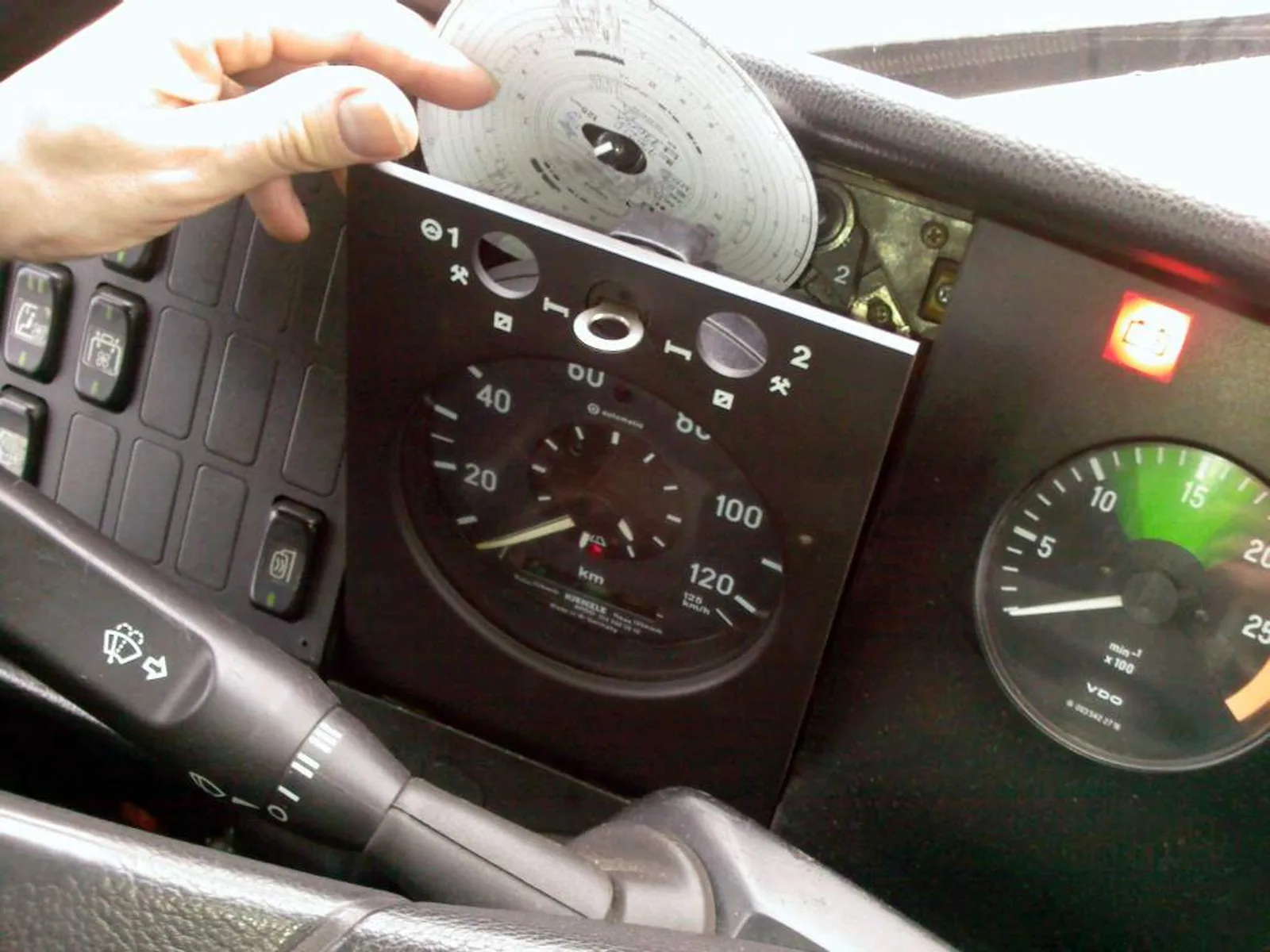
Before departure the driver inserts the disc or card and sets the activity symbol. A steering wheel means driving, though it cannot be set on automatic tachographs. Crossed hammers mark other work such as loading, unloading, repairs and washing. A square with a diagonal line means ready for work or waiting, including time spent as a passenger. A bed symbol marks breaks and rest periods when the vehicle is stationary and the driver can use the time freely.
How does an analogue chart work?
Most tachographs built before 1 May 2006 were analogue. Their heads use styli to trace lines on a wax-coated paper disc that turns once every 24 hours. Leaving a disc in the head for longer than it was designed for breaks EU Regulation 561/2006, and analogue heads give the driver no warning that a disc needs changing. Traces overlap if the disc is left in, which makes the activity band hard to read.
A chart must be EU type-approved, and the approval country is printed on the back, so a mark of E11 shows UK approval. The centre field holds handwritten details such as the driver's name, the dates, the start and end odometer readings and the registration. A pear-shaped aperture stops the chart going in the wrong way round, although the printing can still be inserted back to front.
| Trace | What it records | How to read it |
|---|---|---|
| Distance | Distance travelled | A zig-zag V pattern; each complete deflection is 5 kilometres, so each V is 10 kilometres |
| Mode | Driver activity | Drive, other work, availability or rest; on automatic heads the drive trace is the thickest |
| Speed | Vehicle speed | Read against a preprinted scale; Vmax must match the head |
Manual heads showed the activity as a thin line in one of four tracks, selected with the mode switch. Automatic heads succeeded them, always showing drive while the vehicle is moving, so drive can no longer be selected by hand. On an automatic chart the activity appears as blocks of differing thickness, with rest as a thin line and drive as the thickest.
How do digital tachographs differ?
Digital units store their data in internal memory and on driver cards, and they send signals in encrypted form, which makes tampering much harder. The data can be downloaded into a file with a .ddd extension and imported into analysis software, often as part of a fleet system. EU Regulation 1360/2002 made digital tachographs mandatory on the vehicles covered by the rules and manufactured after 1 August 2005, and they were required on all new vehicles from 1 May 2006.
Digital units have been used in Mexico since 1994, although that was never a federal rule. Recent Mexican units add GPS mapping, altitude and video triggered by location.
Why are tachograph records used after a crash?
Tachographs are not used only for enforcing working hours. In Germany they have been used to investigate and punish speeding, a practice the high regional court approved in the 1990s. After an accident, discs are often examined under a microscope to reconstruct what happened at the collision site.
How are tachographs tampered with?
There are many ways to interfere with a tachograph. The marker can be twisted slightly, the arm blocked with rubber or foam, or the unit short-circuited for brief periods. A magnet can stop the gear movement from being detected, and the power to an analogue unit can be cut with a blown fuse. Forgetting to insert the chart at the start of duty is another trick. Swapping discs and discarding one so that some driving is forgotten is well known throughout Europe. Ghosting enters false details for a second driver on a second chart, so a long run looks as though two people shared it.