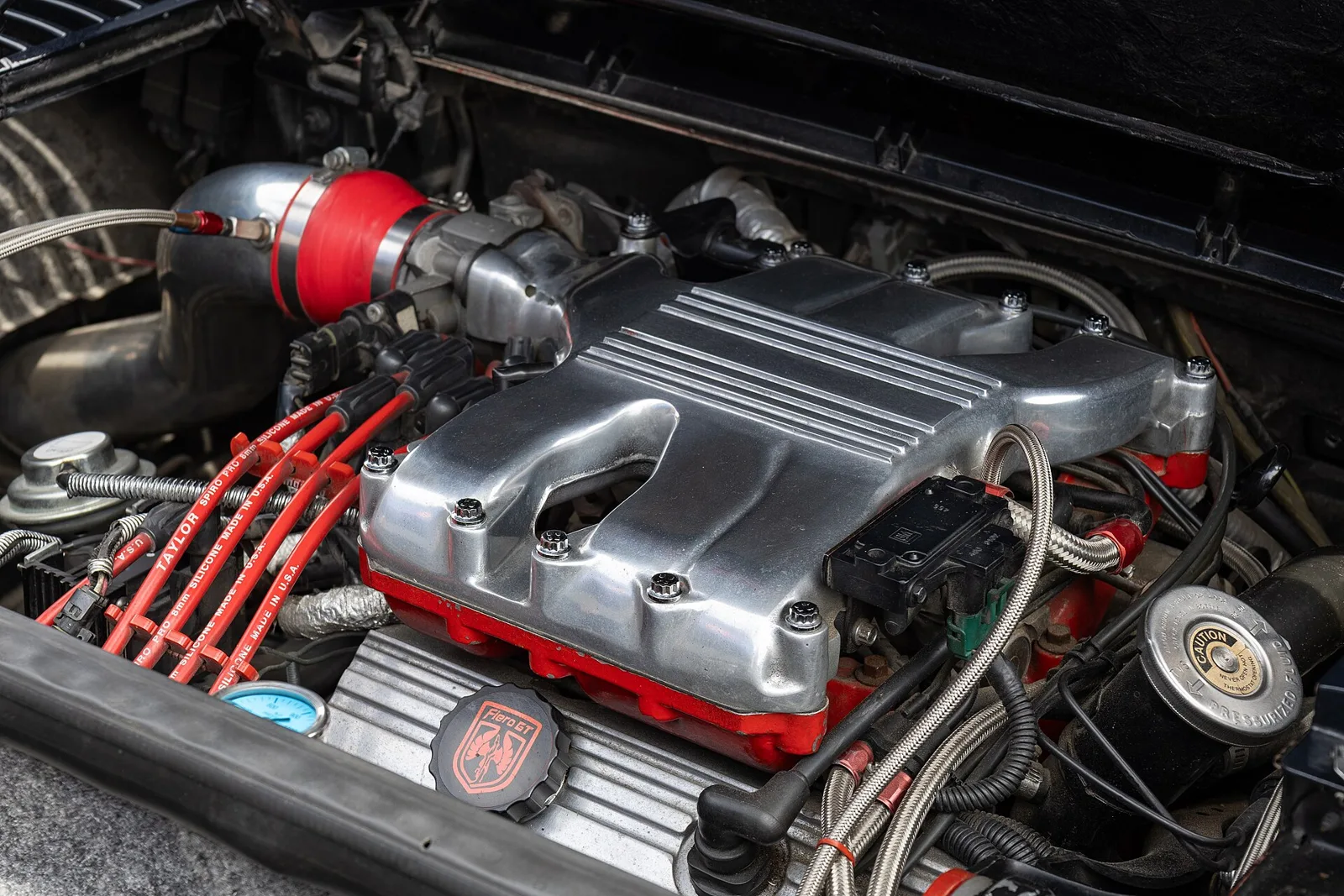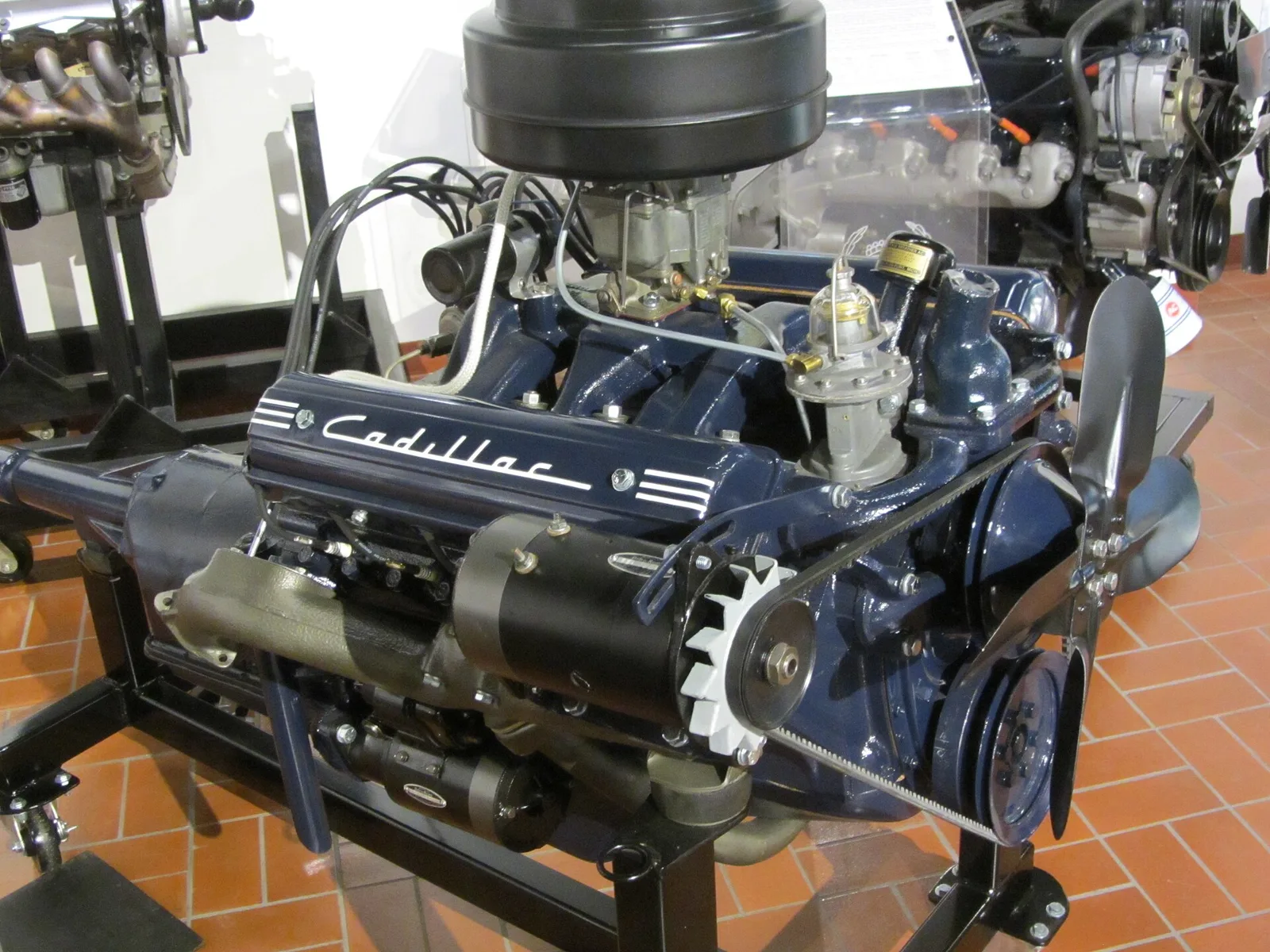
Cadillac's V8 line began as a water-cooled L-head in 1914, passed through big blocks and a cylinder-deactivation experiment, and peaked with a supercharged 668 hp sedan engine.
The Cadillac V8 family began with the 1914 Type 51 L-head and later included the 500 cu in big block, the 1981 V8-6-4 and the 1992 Northstar. The line peaked with the 668 hp supercharged LT4 in the CT5-V Blackwing.
The Cadillac V8 family began as a water-cooled L-head engine in 1914 and reached its latest peak with the supercharged LT4 in the CT5-V Blackwing. In between came overhead valve big blocks from 331 to 500 cu in, a short-lived cylinder deactivation experiment, the Northstar DOHC family and a 4.2-litre twin-turbo.
Which Cadillac V8 came first?
The first Cadillac V8 was the Type 51, introduced in 1914 as the standard engine for 1915 Cadillac models. It was a water-cooled 90-degree L-head with 314 cu in (5.1 L) and 70 hp (52 kW), designed under chief engineer D'Orsay McCall White, a Scottish-born engineer whom Henry Leland had hired for his V-engine experience.
White had earlier been chief engineer at Napier, and the Type 51 used a bore of 79.4 mm and a stroke of 130.2 mm (3.125 in x 5.125 in).
The engine was refined for 1923 with a crossplane crankshaft that gave each pair of cylinders the now-standard 90-degree offset. That improved balance and smoothness and lifted output to 83.5 hp (62.3 kW). The L-head design was later placed on Ward's 10 Best Engines of the 20th century list.
A line that started as a sidevalve L-head in 1914 and finished the modern era with a 668 hp supercharged sedan engine.
How did the Cadillac V8 move to monobloc and overhead valve designs?
The sidevalve layout gave way to new designs through the late 1920s and 1930s. A 341 cu in (5.6 L) V8 arrived for 1928 with 90 hp (67 kW), followed by a 353 cu in (5.8 L) version from 1930 to 1935 and a 322 cu in (5.3 L) monobloc for the 1936 Series 60, whose cylinders and crankcase were cast as one unit.
The monobloc also brought hydraulic valve lifters for durability and let Cadillac build a mid-priced line. A 346 cu in (5.7 L) monobloc followed from 1936 to 1948, and it was used in dual form in tanks such as the M5 Stuart and the M24 Chaffee. Cadillacs gained the Hydramatic automatic transmission in 1941, and the LaSalle nameplate was phased out that year.
The overhead valve era arrived in 1949 with the 331 cu in (5.4 L) V8. Its 96.8 mm x 92.1 mm bore and stroke suited a clean, lighter block, and Oldsmobile introduced its own 303 at the same time. Buick had pioneered the overhead valve layout, and Cadillac's version kept the basic pattern for the big blocks that followed.
What were the 365, 390 and 429 engines?
The 365 arrived in 1956 with a 4-inch bore, and its base version made 285 hp in its first year. Output rose to 300 hp in 1957 and 310 hp in 1958, while the 1958 Eldorado with three two-barrel carburettors reached 335 hp (250 kW). These engines set the stage for the larger capacities that followed.
The 390 arrived in 1959 with a longer 3.875 in (98.4 mm) stroke, giving 389.6 cu in (6.4 L) and 325 hp (242 kW). Eldorado Tri-power reached 345 hp (257 kW). For 1963 Cadillac redesigned the engine, making the new unit 52 lb (24 kg) lighter than its predecessor for a dry weight of 595 lb (270 kg). The output stayed at 325 hp and 430 lb ft (583 N m).
The 429 arrived in 1964 with a bore of 4.13 in (105 mm) and a stroke of 4 in (102 mm), producing 340 hp (254 kW) and 480 lb ft (651 N m) of torque. It also brought the first emission control system on a Cadillac V8, a positive crankcase ventilation unit. The 429 ran until the 1967 model year.
What did the 1963 redesign of the 390 change?
The 1963 redesign kept the same layout but used shorter connecting rods, and the engine ended up 1 in lower, 4 in narrower and 1.25 in shorter than its predecessor. The accessories moved onto a die-cast aluminium housing at the front of the engine, which made them easier to reach, and an alternator replaced the old generator.
The crankshaft was cored out to make it lighter and stronger at the same time. The bore and stroke stayed unchanged, so displacement held at 390 cu in (6.4 L) and power stayed at its earlier level.
How big was the 472 and the 500 big block?
The 472 was a new engine for 1968, designed with room for a 500 cubic inch version. It had a 4.3 in x 4.06 in (109.2 mm x 103.1 mm) bore and stroke and made 375 hp (280 kW) at 4400 rpm, with 525 lb ft (712 N m) of torque at 3000 rpm. Cadillac said the redesign used 10% fewer parts and 25% fewer gasketed joints than the engine it replaced.
For 1970 Cadillac fitted a longer stroke of 4.304 in (109.3 mm), which took the engine to 500.02 cu in (8.2 L). When it arrived it was listed at 400 hp (298 kW) on the SAE gross scale, with 550 lb ft (746 N m) of torque. The 500 was exclusive to the Eldorado, and its rating fell as emissions controls tightened. By the 1976 final year it was down to 190 hp (142 kW), although a Bendix electronic fuel injection option lifted it to 215 hp (160 kW).
The 472 family did not last long in its original form. Cadillac built the 472 until 1974, and the company then turned to a smaller set of engines that made better use of the emissions and fuel economy rules of the period.
What were the 425 and the 368?
The 425 cu in (7.0 L) V8 arrived in 1977, based on the 472 architecture. Its bore was narrowed to 4.082 in (103.7 mm), while the stroke matched the 472 at 4.06 in (103.1 mm). It was 100 lb (45 kg) lighter than the 472. The L33 version used a four-barrel carburettor for 180 hp (134 kW) at 4000 rpm, while the L35 with electronic multi-port fuel injection made 195 hp (145 kW).
In 1980 the 425 gave way to the L61, a de-bored 368 cu in (6.0 L) engine with a 3.8 in (97 mm) bore. The change was largely driven by CAFE fuel economy targets. Throttle-body fuel injection was standard on Eldorado and Seville models, and Cadillac called the system Digital Fuel Injection (DFI). The DFI version made 145 hp (108 kW) in front-wheel-drive cars and 150 hp (112 kW) with the Quadrajet carburettor in rear-wheel-drive models.
What were the key Cadillac V8 specifications?
| Engine | Introduced | Displacement | Bore x stroke | Peak output |
|---|---|---|---|---|
| Type 51 | 1914 | 314 cu in (5.1 L) | 79.4 mm x 130.2 mm (3.125 in x 5.125 in) | 70 hp (52 kW) |
| 390 (redesign of 1963) | 1959 | 389.6 cu in (6.4 L) | 101.6 mm x 98.4 mm (4 in x 3.875 in) | 325 hp (242 kW) |
| 472 | 1968 | 472 cu in (7.7 L) | 109.2 mm x 103.1 mm (4.3 in x 4.06 in) | 375 hp (280 kW) |
| 425 (L33) | 1977 | 425 cu in (7.0 L) | 103.7 mm x 103.1 mm (4.082 in x 4.06 in) | 180 hp (134 kW) |
| 368 (DFI) | 1980 | 368 cu in (6.0 L) | 97 mm x 103.1 mm (3.8 in x 4.06 in) | 145 hp (108 kW) |
What was the V8-6-4 and why did it fail?
The V8-6-4, coded L62, arrived in 1981 with 140 hp (104 kW). Cadillac and Eaton Corporation developed a system called Modulated Displacement, which shut off two or four cylinders in light load conditions and reactivated them when more power was needed. Cadillac hailed it as a technological masterpiece and made it standard across its range.
The system struggled because the engine control module did not have the robustness or processing speed to manage the switching under every load. A back-pressure EGR valve also caused pinging on the four cylinders working hardest. Cadillac issued thirteen updated PROM chips, but dealers often disabled the function, leaving the cars running on eight cylinders. The V8-6-4 was dropped from most passenger cars after 1981.
What changed with the Northstar?
The Northstar debuted in 1992 as a 4.6-litre DOHC four-valve V8, and at the time it was Cadillac's most technologically advanced engine. A 275 hp (205 kW) version went into the Seville SLS and Eldorado ESC, while a 300 hp (224 kW) version went into the Allante, Seville STS and Eldorado ETC. By 1996 the engine was standard across the front-drive Cadillac range.
Other GM divisions later borrowed the Northstar architecture for their own V8 and V6 engines. The series ended production in 2010, and it was the last proprietary V8 design at GM. Cadillac's V-series then used a supercharged 4.4 L version of the engine, with the STS-V making 469 hp (350 kW) and 439 lb ft (595 N m). The 2006 to 2008 XLR-V used the same supercharged unit, but its output dropped to 443 hp (330 kW) and 414 lb ft (561 N m) because it had less room under the bonnet.
What is the LTA and how is it different?
The 4.2-litre LTA is a DOHC twin-turbo V8 built for Cadillac luxury vehicles. It was a clean-sheet design and Cadillac's first twin-turbo V8, and it launched in the 2019 CT6. It was a deliberate break from the pushrod heritage that had defined the line since 1914.
Which modern Cadillac V8 is the most powerful?
The CT5-V Blackwing uses a supercharged 6.2-litre LT4 that makes 668 hp (498 kW), the most powerful Cadillac sedan in history. Earlier CTS-V models climbed from 400 hp (298 kW) with the LS6 in 2004 to 556 hp (415 kW) from the supercharged LSA of 2009 to 2015, and to 640 hp (477 kW) with the supercharged LT4 from 2016 to 2019.