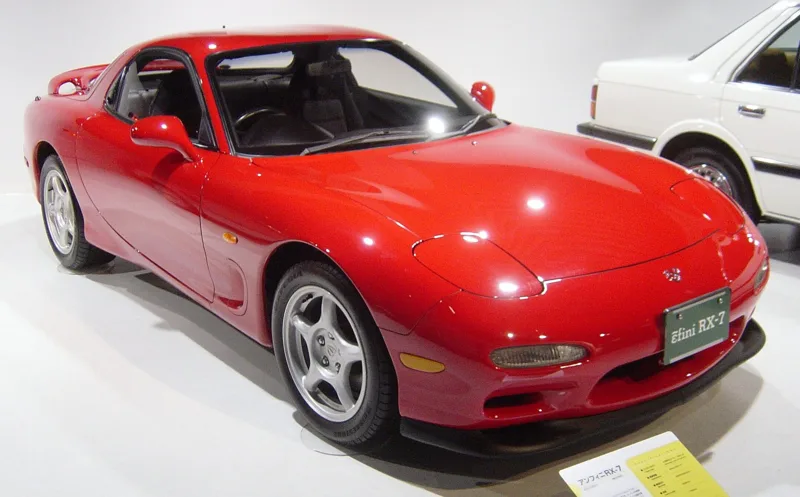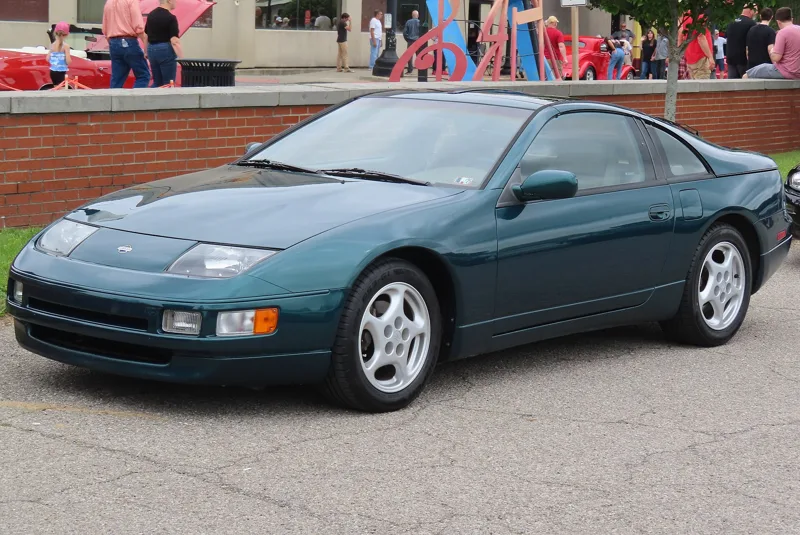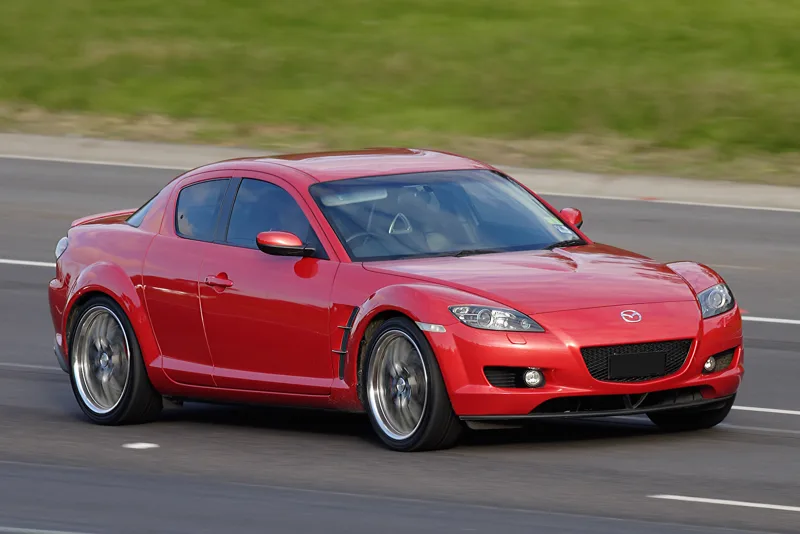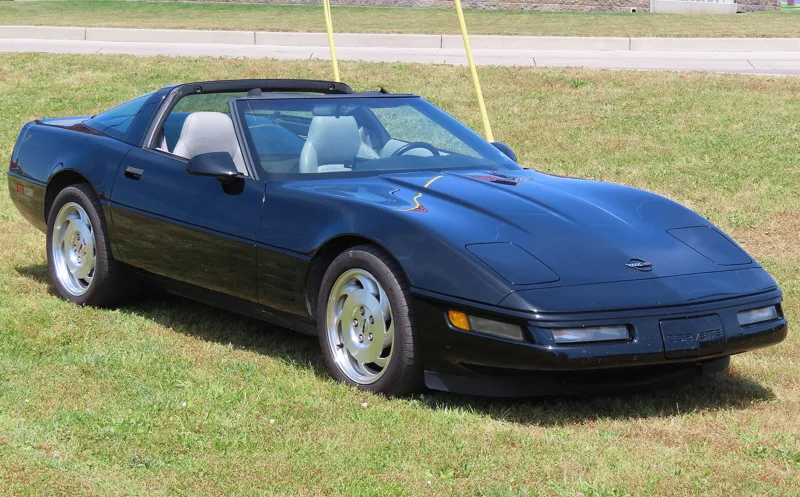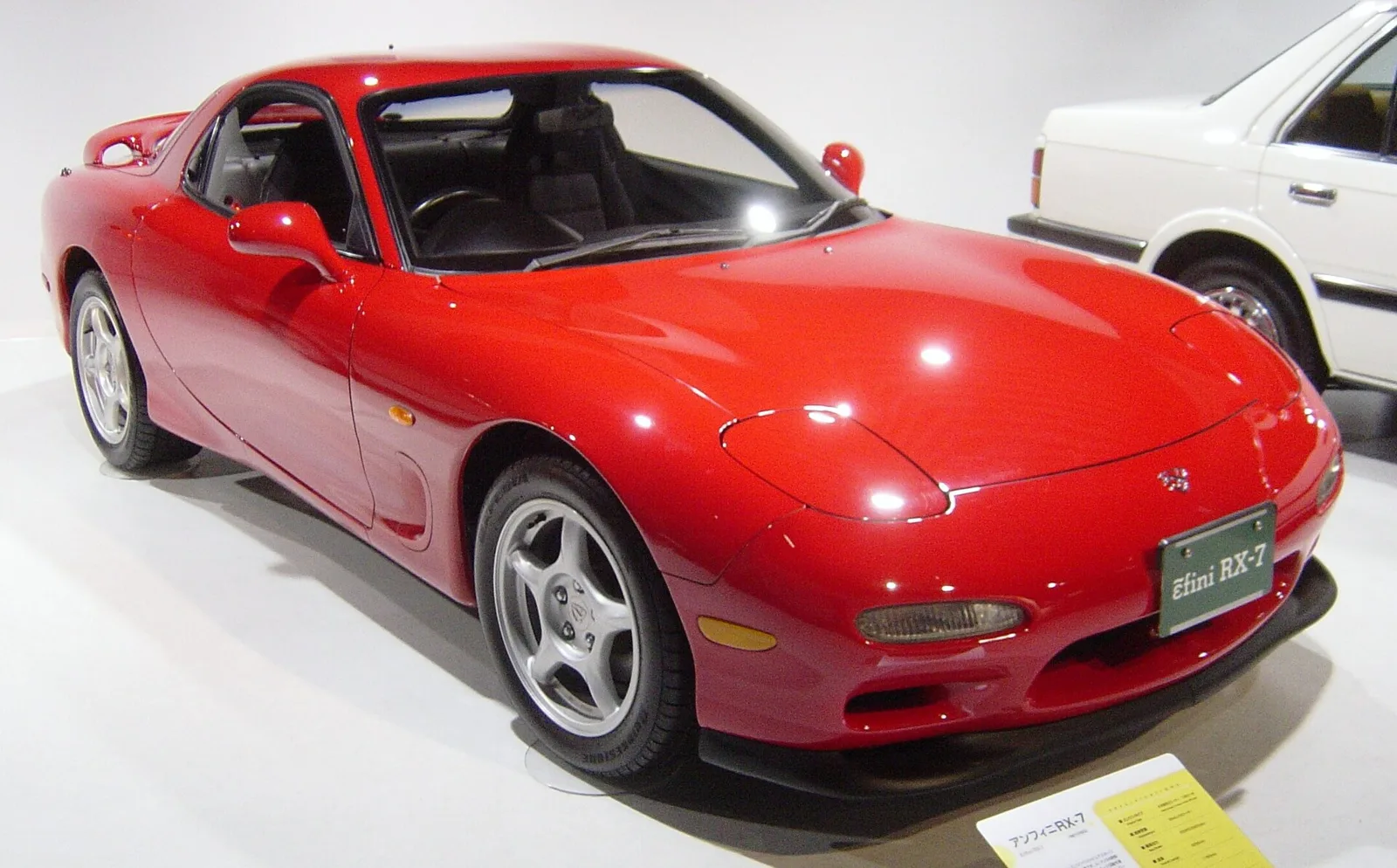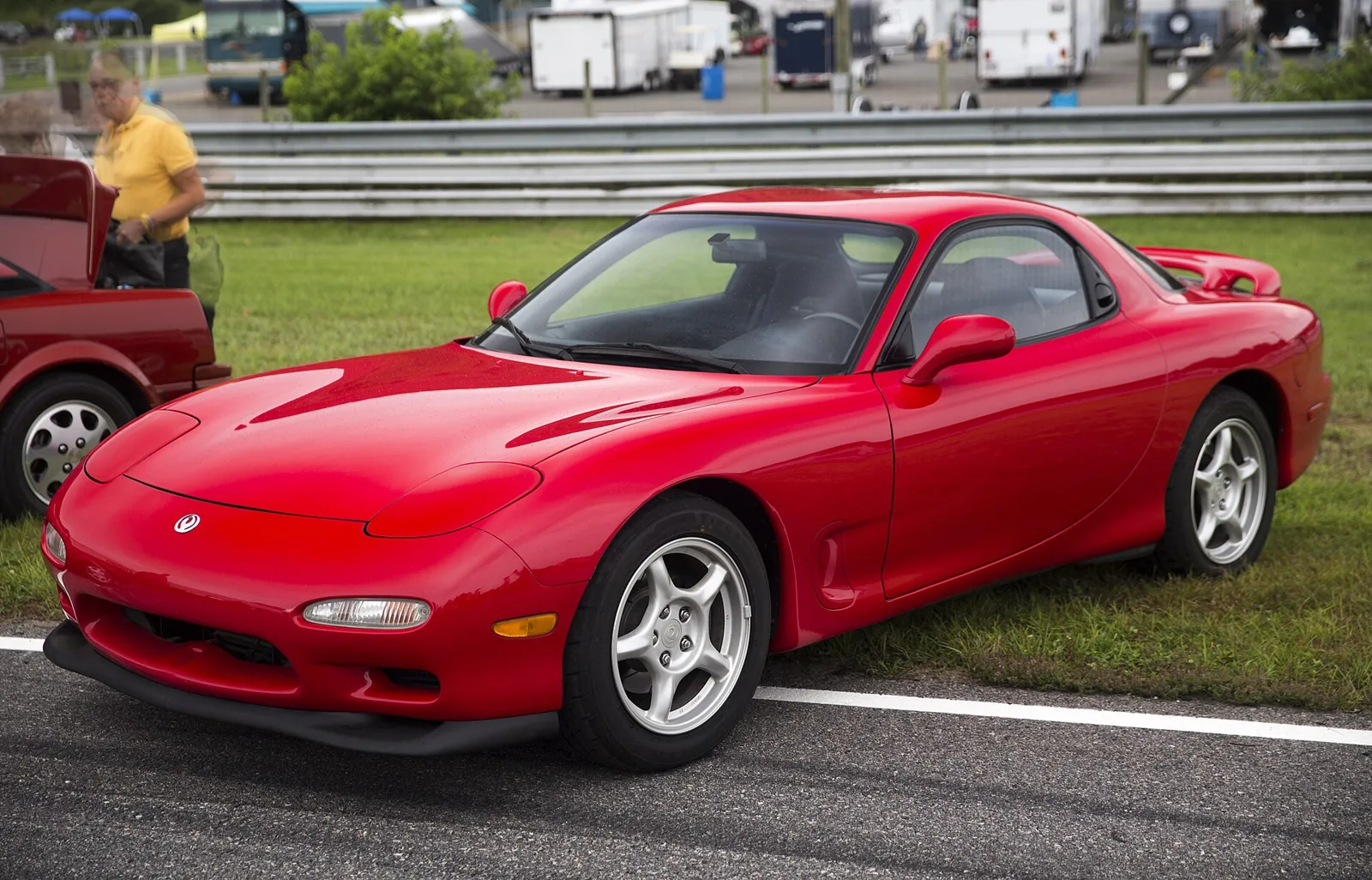
A rotary-engined Mazda with a light, balanced chassis and a Nissan grand tourer with a V6 and turbo range, both chasing the same American sports car buyer.
The Mazda RX-7 and Nissan 300ZX were contemporary Japanese sports cars, with the RX-7 built around a Wankel rotary and the 300ZX around a V6 with turbo options. Both sold strongly in North America, and both changed character across their production runs.
The Mazda RX-7 and the Nissan 300ZX were both Japanese sports cars of the 1980s, but they reached their goals by different means. The RX-7 relied on a compact Wankel rotary and a light, balanced chassis, while the 300ZX used a V6 with a turbo option and a larger grand-tourer feel.
Both were sold in large numbers in North America, and both changed their character across their lifetimes. The RX-7 moved from a pure sports car to a softer sport-tourer, and the 300ZX went up-market as its price rose each model year.
Were the RX-7 and 300ZX rivals?
They were direct contemporaries that aimed at similar buyers in the same American market. The second-generation RX-7 was restyled much like the sports cars of its era, including the Nissan 300ZX, and North America was the main market for the 300ZX from its introduction.
Their rivalry was a matter of market position as much as performance. The RX-7's American sales were the largest part of its first-generation output, and the 300ZX's North American volume was its main reason for being.
A rotary sports car with a light, balanced chassis and a six-cylinder grand tourer, both built for the same American buyer.
How did the RX-7's rotary engine work?
The first-generation RX-7 used a 12A carbureted rotary of 1,146 cc (1.1 L), rated at 100 hp (75 kW; 101 PS) at 6,000 rpm in North America. A 13B rotary with electronic fuel injection became available in later years, and the 1984 GSL-SE used a 1,308 cc (1.3 L) 13B rated at 135 hp (101 kW; 137 PS).
Because the Wankel is smooth, the engineers fitted a buzzer to the tachometer that warned the driver as the 7,000 rpm redline approached. The rotary's long, thin combustion chamber produced cool combustion with few oxides of nitrogen, but it left partly burned fuel in the exhaust, which an engine-driven pump then air-fed to complete.
How did the 300ZX's engines compare?
The first-generation 300ZX, the Z31, offered five engine options in total. The naturally aspirated VG30E was a 3.0 L V6 that gave 160 hp (119 kW) in North America, while the turbocharged VG30ET was rated at 200 hp (149 kW) there.
From 1988 to 1989 North American engines were revised, lifting output to 165 hp (123 kW) naturally aspirated and 205 hp (153 kW) turbocharged. A low-inertia turbocharger did most of the work, where the earlier turbo cars had used a Garrett unit.
The Z31 also offered a 2.0 L turbocharged straight-six, the RB20DET, which was used in the 200ZR that Japan sold from 1985. Japan's first mass-produced V6 gave the 300ZX its character, and the VG family was Japan's first 60-degree V6.
Specifications side by side
| Specification | Mazda RX-7 (first generation) | Nissan 300ZX (Z31) |
|---|---|---|
| Production | 1978 to 2002 across three generations | Japan 1983 to 2000; US 1984 to 1996 |
| Layout | Front mid-engine, rear-wheel drive, rotary | Rear-wheel drive, six-cylinder |
| Base engine | 1,146 cc (1.1 L) 12A rotary, 100 hp (75 kW; 101 PS) in North America | 3.0 L VG30E V6, 160 hp (119 kW) in North America |
| Top engine | 1.3 L 13B GSL-SE, 135 hp (101 kW; 137 PS) | VG30ET turbo V6, 200 hp (149 kW) in North America |
| Torque | 133 lb ft (180 N m) for the GSL-SE | No figure given |
| 0-60 mph | 9.2 seconds for the 12A (97 km/h) | No figure given |
| 0-80 km/h (50 mph) | 6.3 seconds, 1984 GSL, Mazda figure | No figure given |
| Top speed | Over 190 km/h (120 mph) | 153 mph (246 km/h), Shiro Special in a Motor Trend test |
| Weight | Under 1,100 kg (2,425 lb), the lightest generation | No figure given |
| Handling | 0.779 g on a skid pad (12A) | No figure given |
| Rear suspension | Live axle with four links and Watt's linkage | MacPherson strut front, semi-trailing arm rear |
| Transmission | Four-speed manual, with the three-speed automatic option | Five-speed manual or optional four-speed automatic |
| Sales | 471,018 first-generation cars, between 332,850 and 367,878 sold in the US | Over 70,000 sold in North America in 1985 alone |
| Awards | No figure given | Ten Best list for seven consecutive years; 1990 Import Car of the Year |
Which RX-7 generations were built?
The RX-7 ran in three generations: the first codenamed SA (early) and FB (late), the second with the internal code FC, and the third with the code FD. The second generation was offered as a two-seat coupe, with a 2+2 option in some markets, and also as a convertible.
The third generation was a two-seat coupe, with a 2+2 version offered as an option for the Japanese market. It used a sequentially turbocharged 13B REW engine, and across its lifetime more than 800,000 RX-7s were manufactured.
What changed in the first RX-7 series?
The first series, produced from 1978 to 1980, is known as the SA22C from the first characters of its vehicle identification number. Mazda's project number for the car was X605, and it replaced the Savanna RX-3 in Japan in March 1978.
The lead designer was Matasaburo Maeda, whose son Ikuo later designed the Mazda Demio and the RX-7's successor, the RX-8. The rotary sat behind the front axle, which helped balance the front and rear weight and gave the car a low centre of gravity.
What was the Leathersport?
Mazda introduced the Leathersport, or LS, in 1980 as a limited North American model. It was an uprated GS with brown leather upholstery, gold anodised wheels and a leather-wrapped steering wheel and shift knob, and it came in only three colours.
The LS had exposed steel bumpers and a high-mounted indentation for the rear licence plate, which Road and Track's Werner Buhler called a Baroque depression. Some sources put production at 2,500 cars, while others say the figure is unknown.
How did the Series 2 RX-7 improve?
The Series 2, produced from 1981 to 1983 and known in North America as the FB, had integrated plastic-covered bumpers and wraparound taillights. It was 61 kg (135 lb) lighter in federalised trim, and the four-speed manual option was dropped for 1981.
In 1983 the 209 km/h (130 mph) speedometer returned, and the GSL package added four-wheel disc brakes on some markets. European cars gained a power increase from 77 kW (105 PS) to 85 kW (115 PS), and the four-wheel disc brakes became standard there.
How did the Series 3 RX-7 differ?
The Series 3, built in 1984 and 1985, had an updated lower front fascia and a different instrument cluster in North America. Mazda added the GSL-SE, with a fuel-injected 1.3 L 13B producing 135 hp (101 kW; 137 PS) and 180 Nm (133 lb ft) of torque.
The GSL-SE also had larger brake rotors, a new 4x114.3 mm bolt pattern and stiffer suspension. The external oil cooler returned after its 1983 removal, and a Mazda figure put the 1984 GSL at 6.3 seconds to 80 km/h (50 mph).
The RX-7 Finale arrived in Australia in 1985 as the last of the Series 3 cars. It was sold in limited numbers, carried a brass plaque reading Last of a legend, and had special stickers and blacked-out trim between the window and rear hatch.
What did the 12A models deliver?
The 12A-powered cars took 9.2 seconds to reach 97 km/h (60 mph), and they turned 0.779 g on a skid pad. The car was the lightest of the first generation, weighing under 1,100 kg (2,425 lb), and it reached over 190 km/h (120 mph) with the 100 hp rotary.
The rotary's 7,000 rpm redline was flagged by the buzzer on the tachometer, and the car carried a 50:50 weight distribution. Its live axle used four links and Watt's linkage, a layout that kept the rear end simple and light.
How did the 300ZX's name and generations develop?
The 300ZX was sold in Japan from 1983 to 2000 and in the United States from 1984 to 1996. Its name followed the numbering started by the Fairlady Z (S30), which was sold in the US as the 240Z, and the X came over from the 280ZX to mark extra luxury.
The second-generation 300ZX, the Z32, was driven further up-market. It was faster and more technical, but its price rose each model year, and sales dwindled. Nissan stopped selling new Z-cars in the US after the 1996 model year.
What was the Z31's chassis like?
The Z31 chassis was based on the 280ZX, with the same wheelbase and MacPherson strut front suspension with a semi-trailing arm at the rear. It handled and accelerated better than the car it replaced, and Turbo models had three-way electronically adjustable shock absorbers.
Its drag coefficient was 0.30, and the car was designed by Kazumasu Takagi and his team. Its body used black polypropylene bumper covers and side mouldings, and every car came with a T-top roof.
How did the Z31 change through its run?
The 1986 facelift added side skirts, flared fenders and 16-inch wheels on turbo models, and many black trim pieces were painted to match the body. The hood scoop was removed at the same time, and the Z31 stayed on sale until 1989.
The 1987 makeover brought 9004 bulb-based headlamps, fog lamps set into the front air dam and an LED third brake light, which was the first of its kind in history. Cars from 1984 to 1985 are known as Zenki models, and those from 1987 to 1989 as Kouki.
Which 300ZX special editions were made?
Nissan built two special editions of the Z31. The 50th Anniversary Edition of 1984 marked the company's semi-centennial, with a digital dash, mirrored T-tops and Bodysonic speakers in the seats. For the US market it came to 5,148 cars, and 300 went to Canada.
The Shiro Special arrived in 1988 with pearl white paint, stiffer springs and a viscous limited-slip differential. A total of 1,002 were produced for the US market between January and March that year, and Motor Trend tested one at 153 mph (246 km/h) with the electronic limiter disabled.
How did the RX-7 second generation handle?
The second-generation RX-7, the FC, improved handling and cut back on the oversteer of its predecessor. Its rear end moved from the SA22's live axle to an independent layout, and its steering changed from recirculating ball to rack and pinion.
The FC also introduced the Dynamic Tracking Suspension System and the Auto Adjusting Suspension. Its design team, led by Akio Uchiyama, focused on the American market, where most first-generation cars had been sold.
Which buyer suits each car?
The RX-7 suits a buyer who wants a light, balanced two-seater with a rotary engine, a rev limit and a clear sporting purpose. The 300ZX suits a buyer who wants a six-cylinder grand tourer with a choice of turbo power and the Z31's larger body.
Practicality is only partly covered. Neither car's luggage space or running costs are compared here, and the second-generation RX-7's rear seat is noted only as an option in some markets.
How did the RX-7 and 300ZX sell in the US?
The first-generation RX-7 sold 471,018 cars in total, of which between 332,850 and 367,878 went to the United States. The 300ZX passed 70,000 units in North America in 1985 alone, which made it the main Z-car market for Nissan. North America was the central market for both cars.
The 300ZX's wider success was recognised with a Car and Driver Ten Best list placing for seven consecutive years, plus Motor Trend's 1990 Import Car of the Year award. The RX-7's sales success rested more on its first-generation run than on any single award.