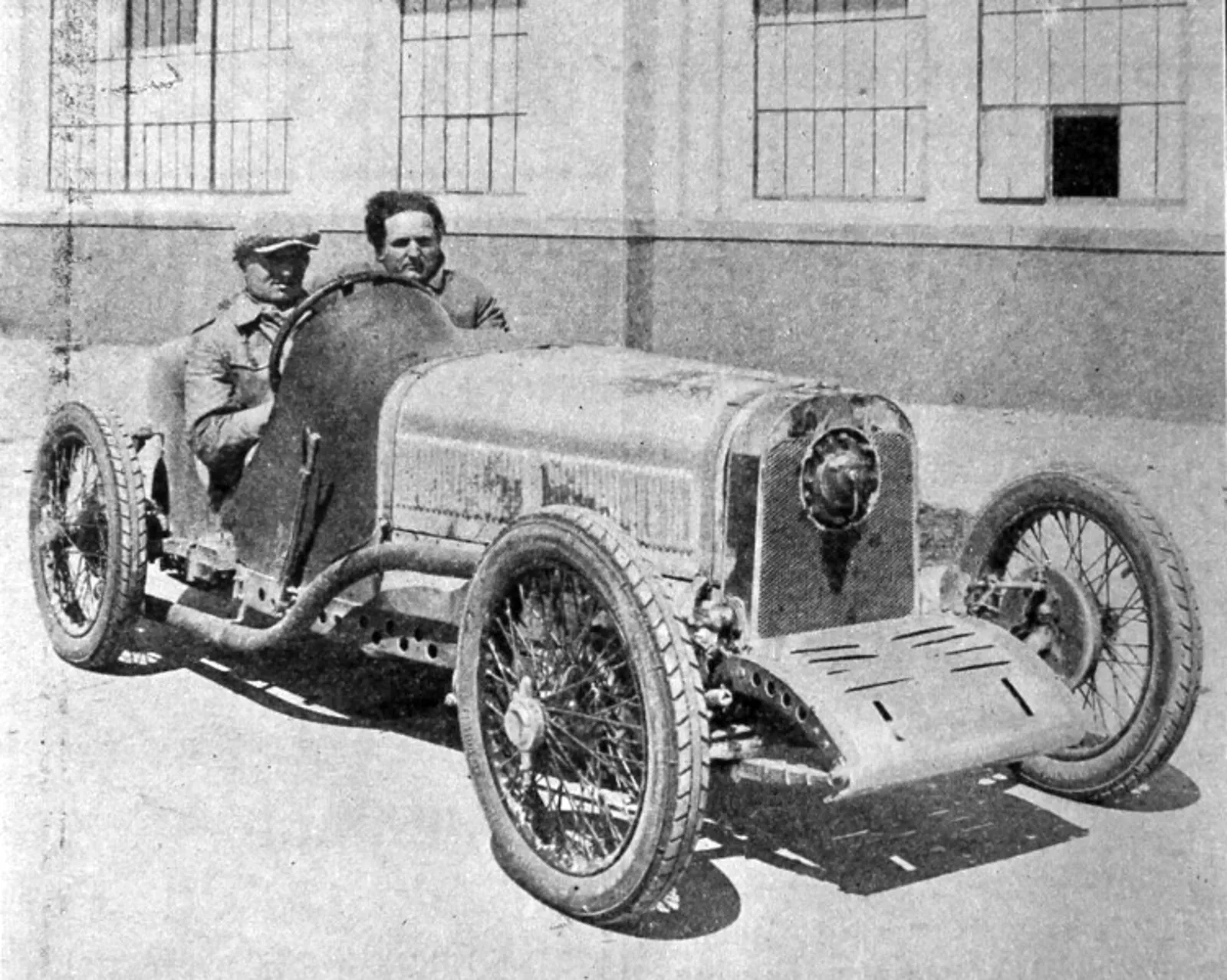
A Brno-built sports-racing car from 1927 to 1929 with a 1,085 cc two-stroke six, two supercharger designs and a racing record that ended with its designer's departure.
The Zbrojovka Z 6V was a Brno-built sports-racing car from 1927 to 1929 with a supercharged 1,085 cc two-stroke six. It was the first Czechoslovak car with a supercharger, and its engine troubles, along with the fatal crash of racer Bedrich Soffer, ended the project after 1929.
The Zbrojovka Z 6V was a sports-racing car built in Brno from 1927 to 1929. It was the first Czechoslovak car fitted with a supercharger, and its supercharged two-stroke six earned it the nickname the Inferno. Its engine was powerful but unreliable, and the project ended after a fatal test crash and a disappointing race at the Nurburgring.
What was the Zbrojovka Z 6V?
The Zbrojovka Z 6V was a two-seat sports-racing car produced by the Brno company Zbrojovka between 1927 and 1929. It had rear-wheel drive and a supercharged two-stroke engine at the front, and it was the first car made in Czechoslovakia to carry a supercharger. Its roar and plumes of smoke gave it the Inferno nickname.
The car was born out of a racing success. The Brno-based Zbrojovka Z 18 Sport had won its class at the Praded circuit near Karlova Studanky on 19 June 1927, and the company wanted a faster car to build on that result. The Z 6V was the answer to that goal.
The Z 6V was not a production car in the usual sense. It was a racing special, and the company sold its prototypes to private owners once the programme ended.
A supercharged two-stroke six from Brno that roared like an inferno and won its class before its engine let it down.
Who designed the Z 6V's engine?
The engine was developed by engineer Frantisek Mackrle, a graduate of Brno Technical University, who set out to build a real racing engine after the 1927 victory. He turned to Ing. Josef Kozousek of Brno technology, who helped build the new unit.
The outcome was an inline six with two-stroke working, counter-rotating pistons and forced induction. Similar engines had been produced by other makers, including the German company Junkers,, and the Zbrojovka unit was developed for its own racing car.
Early testing looked encouraging. The car could approach 175 km/h (109 mph) and accelerated strongly, but the engine also had a serious weakness that shaped the whole programme.
How did the Z 6V's engine work?
The engine had no cylinder head. Its block carried two crankshafts linked by a toothed gear, and the pistons themselves controlled the intake and exhaust by their edges, with a small offset between them. At top dead centre the pistons defined the combustion space against each other.
Ignition came from twelve Champion spark plugs fed by two Scintilla aviation magnetos mounted across the flywheel. Two Zenith TD 30 carburettors, each with three diffusers, mixed the fuel, and coolant was pumped round the engine by forced circulation.
Supercharging came from two-vane compressors on either end of the upper crankshaft. The first units were Zoller vane compressors, but a later conversion replaced them with two Roots compressors. The oversized Zoller unit ran through the front of the car and protruded in front of the radiator, which made it a distinctive feature of the early car.
How fast was the Z 6V and how reliable was it?
Output stood at 55 kW (75 hp), reached at 5,500 rpm, and the car used a three-speed gearbox with reverse. Those figures gave a top speed of 175 to 180 km/h (109 to 112 mph).
Reliability was the difficulty. The spark plugs and pistons were slow to cool, and the pistons often burned out after a time. The car therefore raced mostly on short tracks, because it was unsuitable for long and demanding events.
Later changes, including copper-lined pistons in the 1929 rework, were aimed at the same heat problem.
How was the chassis and body built?
The body was made of aluminium sheet on a wooden frame. The chassis was a rectangular ladder frame riveted from pressed-steel U-sections.
A solid axle carried the car, sprung on longitudinal leaf springs with Hartford friction dampers. It ran Rudge and Whitworth wire wheels, with 4.95x28 tyres, and its brakes were mechanical drums with a balancer.
How did Bedrich Soffer's death change the project?
The racer Bedrich Soffer had been expected to help solve the car's reliability problems. He was testing the Z 6V before the Ecce Homo race on 16 September 1928 when he crashed during a test drive on 5 September and died.
Mackrle took the death personally. He had already been embittered by the accident of his friend Cenek Junko the summer before at the Nurburgring. The loss of Soffer led Mackrle to resign as chief designer at Zbrojovka.
Mackrle went to the Skoda Works in Plzen, where he worked until the occupation. Vladimir Soucek arrived at the firm after Mackrle had left.
How did the Z 6V race in 1927 and 1928?
According to unconfirmed reports, the engine first ran in competition during the second year of the Praded circuit on 19 June 1927. The Zbrojovka team started with three cars, and Rychard Muttermuller won the up to 1.1 litre class over 10 laps, or 224 km (139 mi), in 3:06:15.7 hours.
Bedrich Soffer finished sixth in the same race, although his car used the Z 2 unit, a 1,085 cc two-stroke six known internally as M2. He set the fastest lap of the class at 18:10.9 minutes, despite a tyre burst and a three-lap delay after a collision.
The car's first confirmed start came at the club race to the Brno-Sobesice hill on 13 May 1928. Zbrojovka cars won three categories there, and Soffer took his class and set a new track record of 2:53.6 minutes for it.
At the third Praded race on 3 June 1928, Karl Stohanzl was leading his class until his car broke down. Leo Karger set the fastest lap in the Z 6V with 16:03.7 minutes at 82.2 km/h (51.1 mph), which earned an honorary award from the Ministry of National Defence.
On 17 June 1928, Josef Mamula won the Schober hill race in a Z 6V in 3:15.6 minutes, and on 24 June Soffer won the Knovizz-Olsany race in 2:37.4 minutes. In the sports class Josef Mamula broke a 1927 record that Soffer had set.
What happened at the 1929 Nurburgring race?
Engineer Vladimir Soucek joined Zbrojovka on 1 January 1929 and was asked to rework the Z 6V for the Grand Prix of Sports Car Nations at the Nurburgring on 14 July 1929. The body sat lower, the engine sat a little further back so the compressor stopped poking out of the radiator, and the axle suspension and brakes were redesigned.
Soucek also fitted dual Bosch magneto ignition and new Roots superchargers, and the stressed pistons received a copper cooling liner. The race lasted 18 laps, or 508.77 km (316.14 mi). Karl Stohanzl held his class lead for nearly the whole race before his pistons failed again on the penultimate lap.
Josef Mamula finished second in his category with a dislocated gimbal bearing, which stopped him from changing gear, but he came in after the time limit and was not classified. Karel Divisek finished third in a Z 4V, but a defect also put him outside the time limit.
What became of the Z 6V after 1929?
After the failure at the Nurburgring and Soffer's death, Zbrojovka halted work on the Z 6V, Z 2 and Z 4V programme and passed the prototypes to private owners. Karel Divisek won the up to 1,100 cm3 class at the Ecce Homo race on 22 September 1929 in a blue Z 4V and set a track record for that category.
Divisek also pushed for later Zbrojovka racing cars from 1930, built around engineer Vladimir Soucek's M8 and M15 engines. The factory's later cars, the Z-S30 and the Z13 or Z 14, grew from that work.
The engineless Z 6V was sold to Antonin Beranek, who installed six different engines in it over time. It raced on circuits and in hill climbs without much success. It was later converted to BZV6 and fitted with a Vauxhall K14 engine and others, before a built-in Bugatti engine gave Beranek his best result.
That result was second in the under 1,500 cc class and sixth in the racing-car category at the 1936 Ecce Homo hill race. E. Laufka finished second among racing cars at the 17th Ecce Homo, held in Sternberg, on 5 September 1937, driving the same car.
What are the Zbrojovka Z 6V specifications?
The Z 6V used a 1,085 cc two-stroke inline six with counter-rotating pistons and rear-wheel drive. Its three-speed gearbox with reverse fed the rear wheels, and the table lists the engine, chassis and brake details.
| Specification | Detail |
|---|---|
| Built | 1927 to 1929, Zbrojovka Brno |
| Body type | Two-seat sports-racing car |
| Engine | 1,085 cc two-stroke inline six, counter-rotating pistons, no cylinder head |
| Ignition | Twelve Champion spark plugs, two Scintilla aviation magnetos |
| Carburation | Two Zenith TD 30 triple-diffuser carburettors |
| Supercharging | Two-vane compressors; later two Roots compressors |
| Power | 55 kW (75 hp), peaking at 5,500 rpm |
| Gearbox | Three-speed with reverse |
| Top speed | 175 to 180 km/h |
| Drive | Rear-wheel drive |
| Chassis | Ladder frame of pressed-steel U-sections |
| Suspension | Solid axle, longitudinal leaf springs, Hartford friction dampers |
| Brakes | Mechanical drums with balancer |
| Tyres | 4.95x28 |