A type 7L sport utility vehicle that shared a platform with the Porsche Cayenne, grew from a 220 PS V6 to a 450 PS W12 and was even pitched to the army.
The VW Touareg I, type 7L, was a Volkswagen SUV launched in August 2002 on a platform developed with Porsche. It offered V6, V8, V10 and W12 engines, 4MOTION all-wheel drive and a 3.5-tonne braked towing capacity, and it was built in Bratislava, Kaluga and Sarajevo.
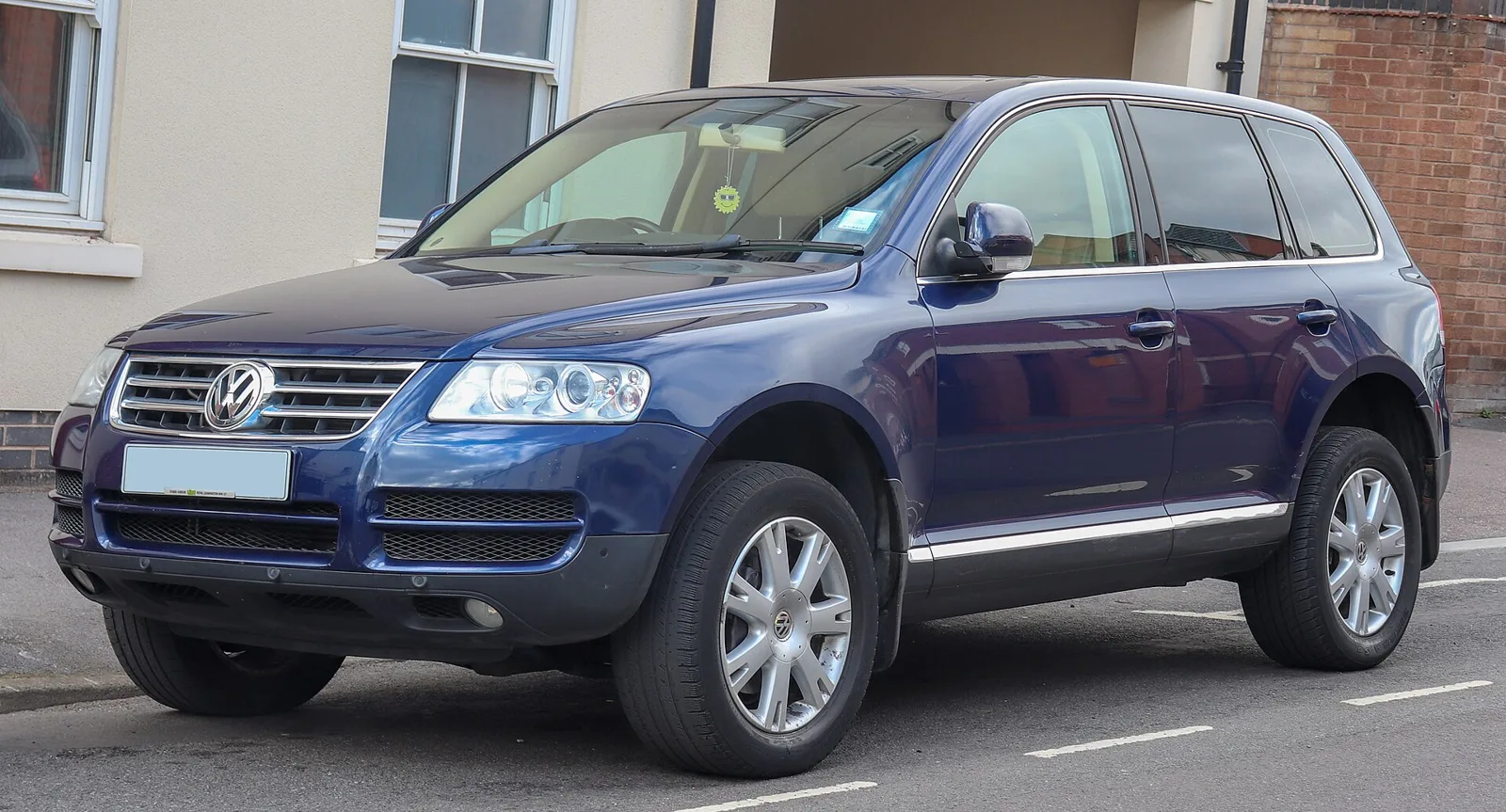
The VW Touareg, type 7L, was a sport utility vehicle from Volkswagen that went on sale in August 2002. Its platform was developed together with Porsche, and it also underpinned the Porsche Cayenne and, from autumn 2005, the Audi Q7. The range started with a V6 at 162 kW (220 PS; 217 hp) and grew to include a 331 kW (450 PS; 444 hp) W12 by 2004.
Where was the Touareg built?
Production began at the Bratislava plant of Volkswagen Slovakia on 23 July 2002. Volkswagen unveiled the car publicly on 26 September 2002 at the Paris Motor Show. Further production took place at Kaluga, where Volkswagen Group Rus built it, and at Volkswagen Sarajevo in Bosnia and Herzegovina.
The list price began at about 39,000 euros for the basic equipment, on the model fitted with the five-cylinder R5 TDI engine of 128 kW (174 PS; 172 hp).
The Touareg started with a platform developed with Porsche and ended up with a 450 PS W12 and a military prototype.
Why is the Touareg tied to Porsche?
Volkswagen developed the Touareg's platform in partnership with Porsche. The same architecture carried the Porsche Cayenne, presented at the same time, and from autumn 2005 it also underpinned the Audi Q7. Volkswagen and Porsche therefore worked from one platform for the Touareg and the Cayenne.
Engine timeline, 2002 to 2009
| Introduced | Engine | Output |
|---|---|---|
| October 2002 | V6 petrol | 162 kW (220 PS; 217 hp) |
| October 2002 | V10 TDI | 230 kW (313 PS; 308 hp) |
| Weeks later, 2002 | R5 TDI diesel | 128 kW (174 PS; 172 hp) |
| Weeks later, 2002 | V8 petrol | 228 kW (310 PS; 306 hp) |
| August 2004 | W12 Sport | 331 kW (450 PS; 444 hp) |
| November 2004 | V6 petrol, uprated | 177 kW (241 PS; 237 hp) |
| November 2004 | V6 TDI diesel | 165 kW (225 PS; 221 hp) |
| October 2005 | 3.6-litre FSI V6 | 206 kW (280 PS; 276 hp) |
| June 2006 | V8 FSI petrol | 257 kW (350 PS; 345 hp) |
| Summer 2007 | R50 diesel | 258 kW (351 PS; 346 hp) |
| November 2007 | V6 TDI, revised | 177 kW (240 PS; 237 hp) |
The V8 with 228 kW was replaced in June 2006 by the V8 FSI, and the W12 came from the VW Phaeton, where it powered that saloon. Output climbed over the years, and in summer 2007 the R50 became the strongest diesel in the line-up.
The automatic gearbox was optional on the 3.2 V6, the 2.5 TDI and the V6 TDI, and standard on the other models. From model year 2007 every diesel sold in Germany came with a diesel particulate filter as standard, whereas models abroad could still be had without a catalytic converter.
What did the 2006 facelift change?
The autumn 2006 facelift is most visible at the front, where the Touareg gained the brand's characteristic crest grille. The front end and the tail lamps were changed, and all models received new seats and some extra options. Technically more than 2,000 components were replaced or improved.
In November 2007 the V6 TDI was also revised, and it delivered 177 kW (240 PS; 237 hp).
The line-up then narrowed. In November 2009 only one model remained, with a V6 petrol engine and a V6 diesel, offered in three equipment variants. The second generation was presented on 10 February 2010.
Which safety and comfort options could buyers add?
Several safety and comfort features were available at extra cost. The list included the following:
- Automatic distance control ACC with Front Assist, new with the facelift
- Side Assist lane-change assistant, also new with the facelift
- Rear Assist reversing camera
- ABS plus, adding a control mode for loose ground, fitted as standard on every model
- Power tailgate, with a manually opened rear window as standard, and optional soft-close help or remote control
- Keyless Access, with keyless entry, engine start and memory settings for each key
- Bi-xenon headlamps, with separate bulbs for dipped and main beam and optional cornering lights
- Hard-disk satnav with a 3D map view, a drive for video and audio discs and a disc changer
- Bluetooth car phone link using the SIM Access Profile, offered ex works only from 2007
- Air suspension with level control, selectable ride comfort and variable ground clearance of 160 to 300 mm
What were the W12 variants?
The W12 engine came from the VW Phaeton. The first W12 model, the Sport, arrived in August 2004 for model year 2005 and was capped at 500 cars. Sport Edition and Executive variants followed from November 2005, and the November 2006 facelift replaced both with the W12 Individual and W12 R-Line.
Air suspension came as standard on all W12 variants, and each car had an exhaust with paired round tailpipes. The comfort versions, the Executive and Individual, could be told apart from other Touaregs only by that exhaust. The sporting versions, W12 Sport, Sport Edition and R-Line, also had modified bumpers, wider wheel arches on all but the R-Line, 20-inch alloy wheels and sports seats.
Was there a BlueMotion version?
From April to November 2009 Volkswagen offered a BlueMotion Technology package for the Touareg with the V6 3.0 TDI rated at 165 kW (225 PS; 221 hp). It used adapted engine management, different automatic shift points, a longer final drive, a more efficient alternator and a sports chassis that lowered the body by about 25 mm.
The car also carried lower-rolling-resistance tyres and electronic energy management, which charged the starter battery during overrun phases to relieve the engine. According to the maker, combined consumption on the NEDC cycle fell by about one litre per 100 km compared with the 176 kW (240 PS; 236 hp) Touareg.
How did the four-wheel drive work?
Every Touareg I came with 4MOTION, a permanently engaged all-wheel system that varies how power is split. In normal running a computer-controlled centre differential shared the drive, using a multi-plate lock to send power to both axles, with the front axle fed through a transfer case. Under the definition used, the Touareg counts as an off-road vehicle (Gelaendewagen), though real capability depends on engine and equipment.
A reduction gear, which the driver could engage by switch, gave maximum drive force for rough terrain, snow or unpaved tracks at low speed. The centre differential could also be locked permanently, so the drive could follow grip rather than sit at a fixed 50:50 split.
How much could the Touareg tow and wade?
In every engine variant the maximum braked towing capacity was 3.5 tonnes on a 12 per cent gradient. Until November 2009 the Touareg I was also waterproof to a wading depth of about 590 mm, the manufacturer's figure for air suspension, thanks to double-lipped door seals and an air intake set at 900 mm in the engine bay.
Did Volkswagen build a military Touareg?
It did. As part of the German Armed Forces' tender for protected command and function vehicles, Class 1, Volkswagen entered a modified Touareg, its first military development since the VW Iltis. Internally the vehicle was called the VW Frettchen, and some outside media used the name VW Touareg Military.
Unlike the production car, the 5.3-tonne military version carried a heavy-duty chassis from Farmington Automotive GmbH, protection against small arms and mines, and room for a weapon station. The armour was fitted from inside, which hid it from view but noticeably reduced interior space. The test vehicle used the 3.0-litre V6 TDI rated at 165 kW (224 PS; 221 hp) and reached 160 km/h (99 mph).
Early testing showed the vehicle fell short of the requirements, so Volkswagen dropped out of the selection in November 2007. One prototype is on display at the Wehrtechnische Studiensammlung Koblenz.
Special editions
The Touareg Kong, Touareg Kong SUN and AIR special models were launched. To mark 250,000 Touaregs produced, an Exclusive Edition was released in a worldwide limit of 999 examples. Most recently the North Sails edition was available with all engines, with a special interior and various logos and lettering from the sailmaker.