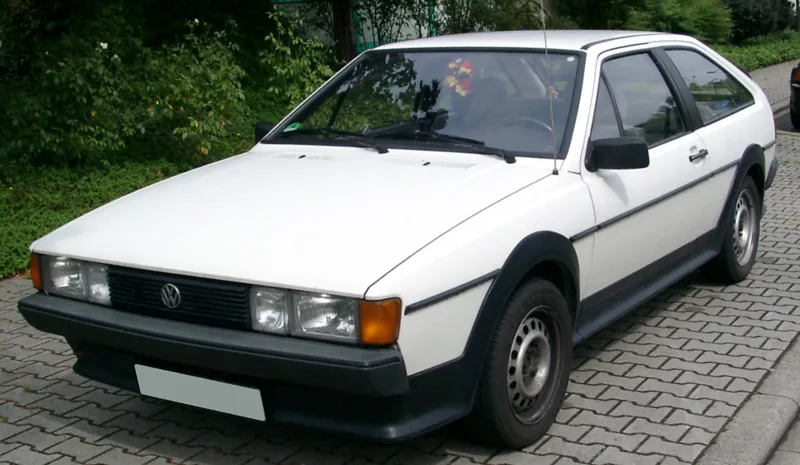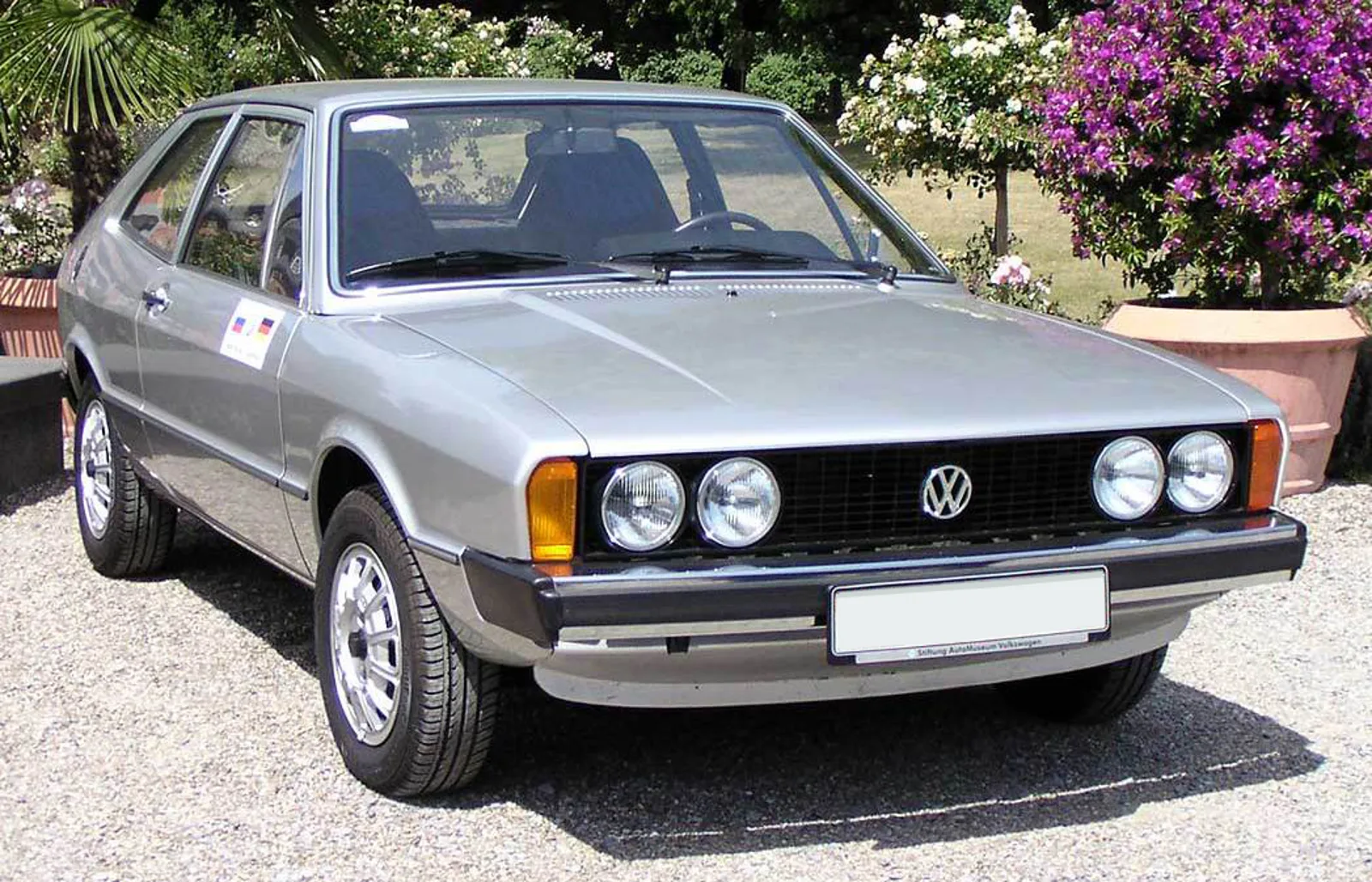
Golf I underpinnings, a Giugiaro body and a production run that ended in March 1981 after 504,153 cars.
The Scirocco I was a Volkswagen coupe on the Golf I platform, sold from spring 1974 until Karmann in Osnabruck finished building it in March 1981. Its engines ran from 1.1 to 1.6 litres, and the most powerful series unit was the GTI's 81 kW engine.
The VW Scirocco I was a sports coupe built on the Golf I platform. It replaced the Karmann-Ghia in February 1974 and reached the market before the Golf did. Giorgio Giugiaro drew its body, and Karmann in Osnabruck built it until March 1981.
Volkswagen saw the coupe as part of something larger. Together with the Golf, Passat and Polo, the Scirocco made up the model offensive that brought water-cooled, front-wheel-drive cars into the range. That push helped the company climb out of a dangerous sales slump.
Where did the Scirocco I come from?
Volkswagen product planning settled on a reasonably priced coupe in autumn 1971, building on development order EA 337. Karmann in Osnabruck received the job under the code EA 398, and Giorgio Giugiaro drew the body. Measured against the Golf I, the Scirocco sat roughly 10 cm (3.9 in) lower.
The idea reached back to the end of the 1960s, when the Volkswagenwerk began looking for a successor to the Karmann-Ghia coupe, which had been in production since 1955. The car was first presented to the press in Wolfsburg, then shown at the Geneva motor show in March 1974. From mid-April, advertisements ran under the slogan 'A sports coupe in top form'.
A sports coupe on Golf underpinnings that reached showrooms before the Golf itself.
How was the Scirocco I engineered?
The Scirocco used a transversely mounted inline four-cylinder engine with an overhead camshaft, and its four-speed gearbox shared a housing with the differential. The front wheels were guided by MacPherson struts with lower wishbones, and the rear used a compound-link axle. Discs were fitted at the front and drums at the rear.
The camshaft was driven by a toothed belt, and the front wheels had rack-and-pinion steering. Valve gear differed by engine: the EA827 used bucket tappets, while the smaller units up to 1.3 litres used finger followers. Until August 1975 every Scirocco carried two front wipers, and after that only one large wiper arm remained.
For the 1978 model year, the chassis and styling were revised in August 1977. Black plastic bumpers now wrapped around the corners, the front indicators were larger and easier to spot from the side, and the B-pillars were painted black. The radiator grille gained a decorative frame, the strut mountings were reinforced, and steering and engine mounts were improved.
Regular updates continued for the rest of the production run, both inside and underneath. Later cars received 1.3- and 1.6-litre engines, five-speed gearboxes or 4+E, and electronic ignition systems.
Which engines came with which models?
The Scirocco was built only with four-cylinder inline engines. The 1.1-litre car made 37 kW (50 PS; 50 hp), the 1.3-litre unit 44 kW (60 PS; 59 hp), and the 1.5-litre 51 kW (70 PS; 68 hp). A 1.5-litre engine with 63 kW (85 PS; 84 hp) powered the TS until July 1975.
From August 1975 the 1.6-litre engine came in two outputs: 55 kW (75 PS; 74 hp) and 63 kW (85 PS; 84 hp) for the GT.
Did the GTI change the Scirocco?
The Scirocco GTI arrived in June 1976 with a 1.6-litre (97.6 cu in) engine producing 81 kW (110 PS; 109 hp) through mechanical K-Jetronic injection from Bosch. Its higher output called for modified water radiators, suspension and dampers, plus extra anti-roll bars, an oil cooler, ventilated front discs, wider rims and tyres with a higher speed rating.
That K-Jetronic engine had first appeared in the Audi 80 GTE in 1975, without a separate oil cooler. Shortages of K-Jetronic units held back the Golf GTI, which could only be delivered in sufficient numbers from spring 1977. The more comfortably equipped Scirocco GLi came in August 1976, straight after the factory holidays.
How many Scirocco Is were built?
Between February 1974 and March 1981, Karmann in Osnabruck built 504,153 examples of the first Scirocco, the entire first-generation total. Production ended with running chassis number 27500 of model year 1981, and one further car was made for the museum in April 1981.
That museum car already carried the new black type plate and bears the running number 27501. Internally it was logged as number 50000, and production was then finally concluded.
How well did the Scirocco I sell?
The first sales year brought 24,555 Sciroccos, and 1975 added 58,942, which was 6,000 more than planned. The strongest years came in 1977 and 1978, when more than 87,000 cars a year found buyers. That peak was never matched again.
Did the Scirocco I sell in Great Britain?
It was rather uncommon there, since high selling prices kept the Scirocco scarce in Great Britain during the 1970s. The British market knew it as the Scirocco MkI, or Mark One, and in Britain today the Storm special model is a sought-after collector's item.
The Storm special model was comparable to the GTI limited edition and came with leather trim. Today it is a sought-after collector's item in Britain.
What were the Scirocco I trim levels?
The letters L, T, GL and GT describe the equipment, while S and i describe engine output, with the i marking the 81 kW engine that used K-Jetronic injection. The L version added a silver-coloured instrument cluster, a trip odometer, carpeting and a lockable fuel cap.
GL and GLi cars had tinted glass, height-adjustable front seats and covers in Genuacord or imitation leather. The GT and GTi came with front seats that had separate headrests, in Schottenkaro check or plain imitation leather. Both upper grades were recognisable by trim strips along the waistline, a front spoiler and twin halogen H1 headlights, while base and L models kept wide-band headlights.
In autumn 1980 the special models CL and SL followed.
Were there Scirocco I estates and pick-ups?
Artz offered the Scirocco I as an estate, called the Sciwago, in a small run of 52 units. Other conversions ranged from T-roof and gullwing-door cars to pick-ups built on either Scirocco generation.
Were there convertible Sciroccos?
Several convertible variants of the Scirocco I appeared before the first VW Golf Cabriolet went into production in 1979. They were built in small series, including the Tempest, made by a garage in Westerham, UK, and the Artz Speedster, made by a Hanover dealership.
Market success stayed out of reach for these exotics in view of the Golf Cabrio. Volkswagen's model was nicknamed the strawberry basket because of its roll bar.
The idea returned with the tuning boom at the end of the 1980s. An enthusiast magazine pointed to convertible conversions by a tuning firm in Darmstadt and by a second firm in 1989, and a 1994 issue presented a conversion from Philippsburg. Most convertibles probably came from home builds using commercial conversion kits, so there is no reliable count of how many were made or how many survive.
How are German registration figures counted?
The Federal Motor Transport Authority (KBA) publishes stock figures for the Scirocco I by manufacturer and type key number, but it leaves out any type with fewer than 100 vehicles. Until 2007 the stock also counted temporary deregistrations, and since 2008 it has covered only vehicles in flowing traffic, including seasonal plates.
Scirocco I specifications
| Specification | Detail |
|---|---|
| Built | February 1974 to March 1981 |
| Platform | Golf I |
| Engines | Inline four-cylinder, 1.1 to 1.6 litres (67.1 to 97.6 cu in) |
| Output | 37 kW (50 PS; 50 hp) to 81 kW (110 PS; 109 hp) |
| Gearbox | Four-speed; five-speed on later cars |
| Length and height | 15 cm (5.9 in) longer and about 10 cm (3.9 in) lower than the Golf I |
| Total production | 504,153 |
| Peak sales | More than 87,000 a year in 1977 and 1978 |
| Turbocharged export special | 90 kW (122 PS; 121 hp); never reached series production |