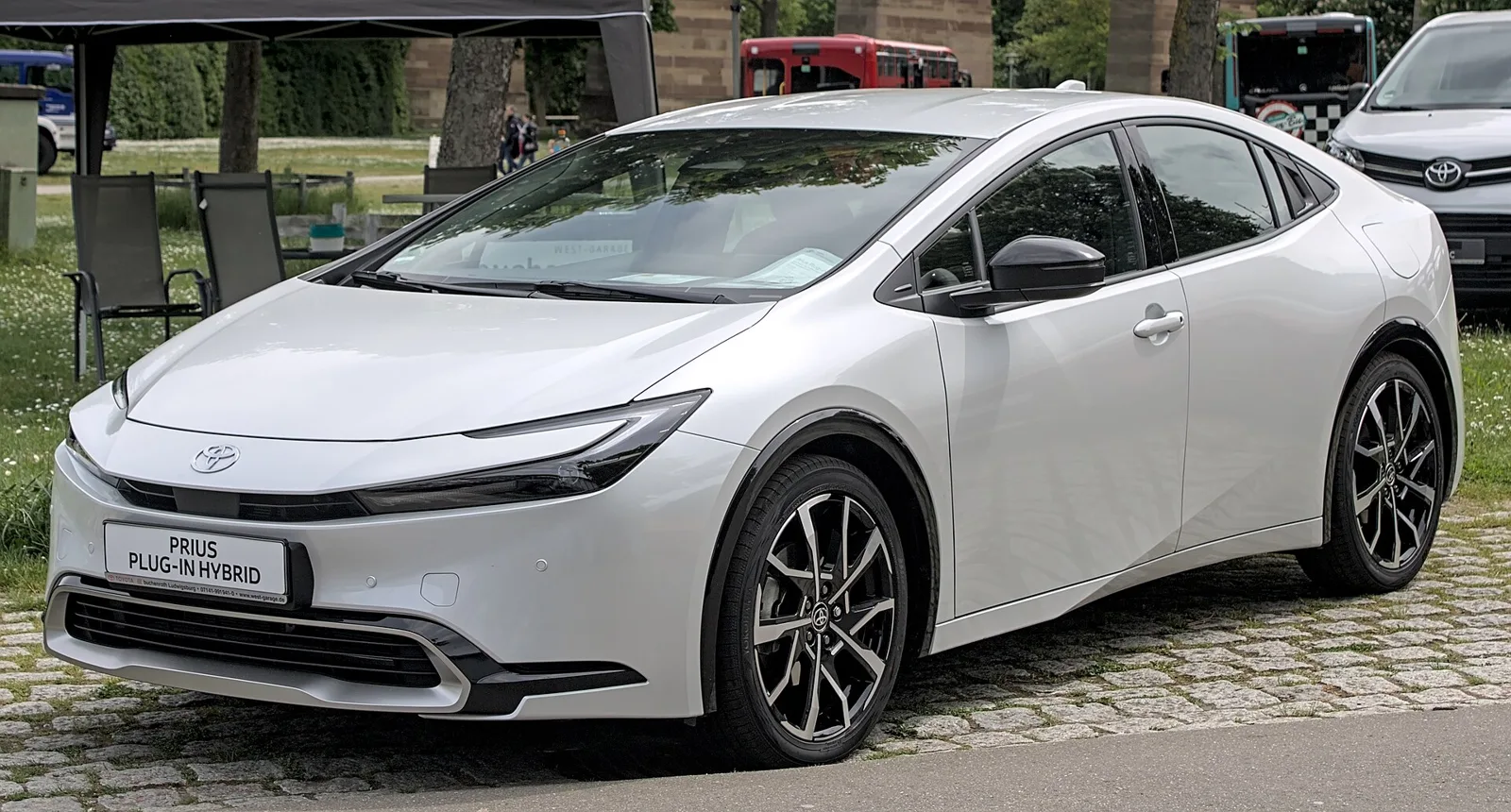
From a 2012 battery upgrade of the Prius to the 2023 third generation, the plug-in version added electric-only range, a new battery and a long run of demonstration cars.
Built in three generations since 2012, the Prius Plug-in Hybrid grew its battery from 4.4 kWh to 13.6 kWh, and its first two generations sold 209,000 units.
The Toyota Prius Plug-in Hybrid is a plug-in hybrid liftback that Toyota built in three generations, beginning in 2012. It was called the Prius Prime in North America, South Korea and New Zealand between 2016 and 2024, and it is often abbreviated as the Prius PHV or PHEV. Cumulative sales of both early generations reached 209,000 by December 2019.
When did the Prius Plug-in Hybrid go on sale?
The first generation was built from 2012 to 2016, and the second generation has been produced since 2016. Production of the third generation began in 2023. The first-generation car was based on the third-generation Toyota Prius, model XW30, with an added battery pack.
In 2012 the car ranked second among plug-in electric cars for sales. It became the third-best seller of all time in December 2014, but sales declined after production ended, and it fell to fifth place in the global ranking by November 2015.
The production version was unveiled at the September 2011 Frankfurt Motor Show. Japanese customers received cars from January 2012, American buyers from late February, and European buyers by late June that year.
A plug-in Prius that brought electric-only driving to a mainstream hybrid body, and then grew a third generation.
How was the plug-in developed before production?
The Prius Plug-In Hybrid Concept was exhibited at the Frankfurt, Tokyo and Los Angeles motor shows in 2009. It was based on the XW30 Prius but carried larger lithium-ion batteries. Those batteries were the minimum capacity needed to qualify for the US federal tax credit.
A global demonstration program followed. Toyota built 600 pre-production test cars, which were leased to fleet and government customers from late 2009. All demonstrators carried data trackers so that Toyota could monitor how they were used.
The demonstration cars were delivered in several regions. Japan received 230, the US 125 and Europe 200 in spring 2010. Australia used five demonstrators with government agencies, which covered a smaller share of the fleet but still gave Toyota useful data.
Where did the demonstration cars go?
Canada launched its demonstration program in March 2010 with five demonstrators in partnership with academic institutions, hydro-electric producers and government agencies. The program involved 15 partners across four provinces, and the country's cold weather was used to test the effect on battery performance.
China signed an agreement in October 2010 to run field trials of the demonstrator plug-ins with China's automotive research centre. The program in Strasbourg began in April 2010 with 70 demonstrators over three years, and it set up more than 150 charging points.
The German program ran ten demonstrators in Baden-Wurttemberg, and the UK trial began in June 2010 with 20 demonstrators, alongside a number of charging bays in London. In the United States, Boulder in Colorado hosted an early regional program, and Zipcar received eight Prius plug-in hybrids in January 2011.
Japan leased about 230 demonstrators to government ministries, local governments and corporations. The city of Goto in Nagasaki offered short-term rental from July 2010, with fees of 8,400 yen (US$96) for up to six hours.
What did the European fleet show?
After about a year, the European fleet had driven 800,000 km (497,100 mi). Two-thirds of commute trips covered less than 20.1 km (12.5 mi), which matched the expected all-electric range, and more than a third of participants made trips over 100 km (62 mi) at least once a week.
The demonstrator vehicles used 36 percent less fuel than the comparable best-in-class diesel, and almost 50 percent less than the best-in-class gasoline vehicle.
What did UK and US drivers find?
In the UK, the 20 demonstrators leased to EDF Energy drove in electric-only mode for one-third of their distance. The average trip was 11.7 km (7.3 miles), and 59 percent of journeys covered between 5 and 20 km. Twenty-two percent of drivers went further than the official 20.1 km range in EV mode.
US testers reported a mixed picture. Motor Trend tested a demonstrator for 32 days and recorded average CO2 emissions of 80 g/km, an average all-electric range of 18.8 km (11.7 miles) and combined consumption of 3.34 L/100 km (70.4 mpg-US) over 3,030 km (1,880 mi).
Across 160 US consumers, Toyota found that people charged the vehicle about ten times a week, more often than expected. Electricity cost was lower than testers had thought, at about US$150 for a six-week trial.
How did the first-generation Prius Plug-in Hybrid perform?
The first generation used a 4.4 kWh lithium-ion battery co-developed with Panasonic, and it was based on the XW30 Prius. The EPA rated its blended all-electric range at 11 miles (18 km), and it rated the electric-only mode at 95 mpg-e. In hybrid mode the car matched the conventional Prius at 50 mpg-US, or 4.7 L/100 km.
The production car had a maximum electric-only speed of 100 km/h (62 mph) in the United States. European models were limited to 85 km/h. Toyota expected the European rating to be 2.10 L/100 km with CO2 emissions of 49 g/km.
The drivetrain used a 1.8-litre 2ZR-FXE engine producing 73 kW (98 hp), together with two motor-generators. The 60 kW MG2 powered the transaxle, while the 42 kW MG1 generated power during braking and started the engine. The maximum motor drive voltage was 650 V DC.
The car could reach 100 km/h from rest in 9.8 seconds, with a top speed of 180 km/h (112 mph). It weighed about 1,420 kg (3,130 lb), which made it only 50 kg (110 lb) heavier than the regular Prius. The EV mode was user-selectable, and a timer allowed charging during off-peak hours.
How long did the first-generation battery take to charge?
The lithium-ion pack took 180 minutes on a 120-volt supply, and 90 minutes on 240 volts. The 4.4 kWh battery weighed 80 kg (180 lb) and fitted under the rear cargo floor. The charge port sat on the right-rear fender, and the 7.3 m cable fitted in its own trunk compartment.
The first-generation car's battery was much heavier than the 1.3 kWh nickel-metal hydride pack of the third-generation Prius, which weighed 42 kg (93 lb). The plug-in version added roughly 50 kg overall, a trade-off that Toyota accepted to deliver electric-only range.
How was the Prius Plug-in Hybrid tested in a fire incident?
When Hurricane Sandy flooded the port in October 2012, one Prius Plug-in and 16 Fisker Karmas burned at Port Newark-Elizabeth Marine Terminal. In the Toyota lot, one Prius Plug-in burned. According to a Toyota spokeswoman, saltwater entering the electrical system was the probable cause.
She added that only three of the plug-in or hybrid models stored at the terminal were affected. The episode was one of the few safety stories attached to the first-generation car.
What changed in the second generation?
Japan and Europe used the Prius PHV label for the second generation, while other markets used the Prime name. It was first sold in late 2016 and is based on the fourth-generation Prius, model XW50. It has an 8.8 kWh battery and an EPA all-electric range of 40 km (25 mi), more than double the first generation.
The Prime's EPA fuel economy rating was 133 mpg-e in all-electric mode, and the car could run entirely on electricity in EV mode. Toyota raised the maximum all-electric speed from 100 km/h to 135 km/h (84 mph), and the electric motor system delivered up to 68 kW in EV mode.
Toyota also made the hybrid mode nearly as economical as the regular Prius, despite the heavier battery. The Prime's EPA combined rating in hybrid mode was 54 mpg-US, and the hood was made of aluminium to save weight.
The second-generation car's onboard charger was upgraded to 3.3 kW from 2.2 kW. In the 2020 refresh Toyota replaced the centre console between the rear seats with a seat, which allowed five passengers.
What is the third-generation Prius Plug-in Hybrid?
The third-generation car, model XW60, was unveiled on 16 November 2022. It uses a 2.0-litre M20A-FXS four-cylinder engine with the electric motor, giving a combined output of 164 kW (220 hp) and a 0 to 97 km/h time of 6.6 seconds.
The battery pack is 13.6 kWh, which is more than 50 percent greater than the previous generation. The car also carries Toyota Safety Sense 3.0, including Traffic Jam Assist, which allows the driver to go hands-free under 40 km/h (25 mph).
Japan offers the G and Z grades, with the M20A-FXS engine standard on all trims. In North America the Prime is offered as SE, XSE and XSE Premium, all with the same engine and front-wheel drive. The third-generation car took the Prius Plug-in Hybrid name in 2025.
How did sales develop across the markets?
Toyota's initial global goal was to sell more than 60,000 Prius PHVs a year. In its first year 27,279 were sold worldwide, which placed it second among plug-in electric cars for 2012. By December 2017 North America had sold 66,800 units, Japan 48,800 and Europe 13,100.
The US was the top country market with 65,703 units by the end of 2017. Toyota expected the second generation to sell up to 60,000 units a year globally, with Japan providing more than half of those sales.
In Canada the car was released in September 2012, and it was eligible for provincial rebates in several provinces. The Prius Plug-in was the top selling plug-in hybrid in the UK in 2012, and it held that title again in 2013 with 509 units sold.
What awards did the Prius Plug-in Hybrid win?
The Prius Plug-in was a finalist for the 2010 Green Car Vision Award. It won the 2012 Urban Green Vehicle of the Year Award, and it shared Green Car Report's Best Car to Buy 2012 with the Prius v.
The Prius Prime, which shares the Prius name, was named 2024 North American Car of the Year in January 2024.
What are the Prius Plug-in Hybrid specifications?
| Specification | First generation (2012) | Second generation (2016) | Third generation (2023) |
|---|---|---|---|
| Battery | 4.4 kWh lithium-ion | 8.8 kWh lithium-ion | 13.6 kWh lithium-ion |
| All-electric range | 18 km blended (EPA) | 40 km (25 mi, EPA) | n/a |
| Engine | 1.8-litre 2ZR-FXE, 73 kW (98 hp) | 1.8-litre 2ZR-FXE | 2.0-litre M20A-FXS |
| Combined output | 134 bhp system output | Up to 68 kW from the electric motor in EV mode | 164 kW (220 hp) |
| 0 to 100 km/h | 9.8 seconds | n/a | 6.6 seconds (0 to 97 km/h) |
| Maximum EV speed | 100 km/h (62 mph) | 135 km/h (84 mph) | n/a |