Toyota's first purely domestic high-grade sedan, engineered around taxi drivers, with double-opening doors and Japan's first automatic on a passenger car.
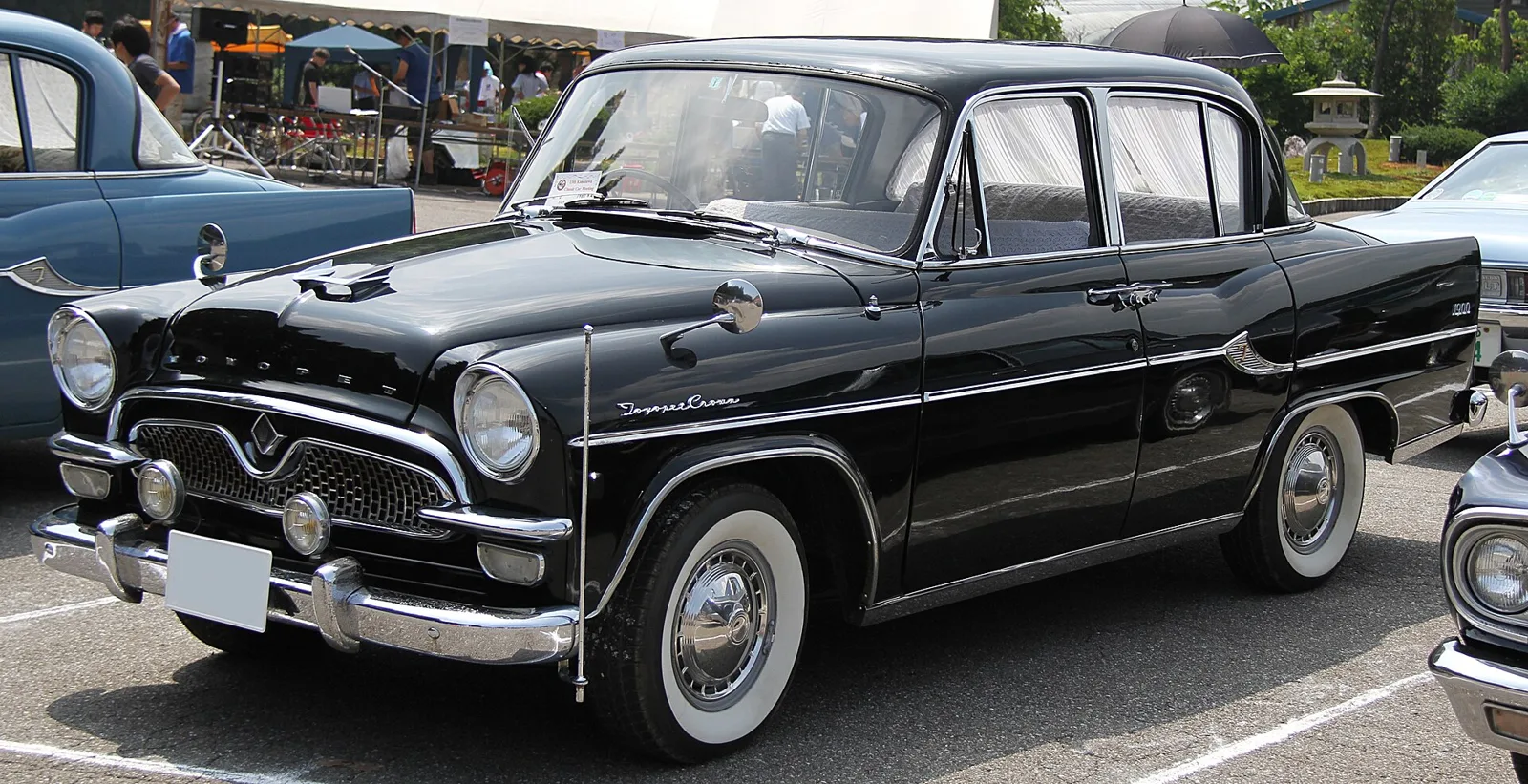
The first-generation Toyopet Crown was a 1955 to 1962 Toyota sedan, designed in Japan with taxi operators in mind. It introduced Toyoglide, Japan's first automatic on a passenger car, and offered double-opening doors, an R-type inline four and a diesel option from 1959.
The first-generation Toyopet Crown was a compact saloon from Toyota Motor Works, sold under its Toyopet brand between 1955 and 1962. Its double-opening doors earned it the nickname Kannon-biraki Crown, and it holds the distinction of being the first high-grade sedan designed entirely at home in Japan after the war.
Its price of 1.015 million yen equalled about twelve and a half times the average annual income of the day, and it sat well above the ministry's people's car plan for that year. Even so, the car became a cornerstone of domestic passenger-car production and helped kick off the postwar boom in what people called the new three sacred treasures: the car, the air conditioner and the colour television.
Why did Toyota design the Crown?
Toyota built the Crown because its own SA sedan had flopped and because dealers were bolting home-made bodies onto truck chassis, leaving the company unable to vouch for finished cars. The engineers aimed at taxi operators and private buyers, with rough-road toughness, a comfortable ride, a low price for taxi use and a 100 km/h (62 mph) top speed on the list.
The head office factory at Koromo had taken a bomb shortly before the war ended. After rebuilding, it turned to civilian trucks for a while. Under the occupation's rules it mostly delivered rolling chassis with engine, suspension and tyres fitted, and the bodies were added by dealers, which meant Toyota had no real grip on quality. That problem weighed heavily on the company.
Kiichiro Toyoda, under whom the engineers set new goals for a domestic passenger car, came up with the Crown name, but he died during development and never saw the finished car. Engineer Kenya Nakamura took charge of the programme. He had once been deputy head of the body works and was not a designer by specialty, but he had joined the company after admiring Kiichiro. Managing directors Eiji Toyoda and Shoichi Saito gave him the chief engineer post under the new system, which made him the first person to hold it.
Eiji believed the right chief engineer should be a commander able to direct every unit of the company, not simply a designer. In his view Nakamura had that ability, and that was why he was picked.
Against that background, the Crown's luxury feel, ride and handling stability were a strong match for wealthy private buyers and for taxis.
How did Nakamura research the market?
Nakamura went round dealerships and taxi companies before drawing anything, asking customers what they wanted. Taxi operators then made up half the market, so their views shaped the brief: an American look with a bright feel, a body at the small-car maximum, easy riding, cheap enough for taxi operators, sturdiness and a 100 km/h (62 mph) top speed.
He later looked back on that legwork as where he began, and the experience formed the basis of Toyota's passenger-car making.
How was the Crown styled?
Toyota's own studio produced four proposals that echoed the Kaiser Henry J, the Cadillac, the Nash and Britain's Ford Zephyr. Dai Iwata's third car became the base, and the production look blended American flair with a functional, European-leaning form suited to local conditions.
Car number two probably drew on the Cadillac because Toyota's preliminary survey found that model the most popular. Tatsuo Hasegawa, who had come from the former Tachikawa Aircraft, pitched a streamlined, rounded body with tail fins. Fins and chrome were used to stop such a small car looking cheap.
Iwata was off work with tuberculosis during development, so he never reshaped the car himself. Yet the front grille he later submitted went on to become the Crown's signature. Sixteen prototypes were built and tested before the design was close to final.
The grille's oval intake was borrowed from the de Havilland Comet, a British jet airliner. Staff gave it the unflattering nickname upside-down brassiere, but company president Taizo Ishida liked it and approved it. Curved glass at both ends and a slimmer roof with larger windows gave the car an airy feel, going against the fashion of the day.
What were the double-opening doors for?
The double-opening doors were chosen to make it easier for rear passengers to get in and out. Taxis of the time did not yet have automatic doors the driver could work from his seat, so a driver and an assistant opened them by hand. That structure had an unwanted side effect.
Some drivers got lazy about closing the doors. They pulled away, braked hard and let the wind pressure shut them. That bad habit is said to have sparked the development of automatic taxi doors.
The doors also resembled those of the AA-type passenger car. Aisin, then called Shinkawa Kogyo, built the pinion-type door lock. Designers used a bride's wedding hairstyle, the bunkin takashimada, as the yardstick for how easily passengers could get in and out, which kept weddings and similar trips in mind.
Turn signals were semaphore arms at first and became side flashers from October 1958. The fuel filler was hidden inside the left tail lamp and opened with a key.
What engine did the Crown use?
The Crown used an inline four-cylinder R-type petrol engine borrowed from the Toyopet Super of 1953. A two-barrel carburettor came in July 1959, and the enlarged 3R followed in October 1960. A diesel version joined the range in 1959.
The R unit was already proven. Its design let the cylinders be bored out at overhaul while the displacement stayed within the small-car bracket, and it allowed for machining tolerances and internal wear. Engine noise was modest for the era, but performance fell short for a car weighing over 1,200 kg (2,646 lb), so output was raised in steps.
The 1959 diesel was the first diesel passenger car sold in Japan by a domestic maker. Diesel development had been frozen as state policy before the war, and after it the authorities asked makers to stop producing and selling them. Toyota had kept going and launched the car regardless. Output stayed small, and it ended in March 1961. Its C-type diesel earned a product award from the Japan Society of Mechanical Engineers for fiscal 1958.
How did the Crown's gearbox work?
The standard gearbox was a three-speed manual with a column lever, synchromesh on second and third, and a hydraulic clutch. The top Crown Deluxe added overdrive. First gear was not synchronised at first, since it was mostly used for setting off, but later every gear received synchromesh.
The differential used hypoid bevel gears, a first for a Japanese car. They gave quieter, longer-lasting running and allowed a lower floor. Ground clearance was 210 mm, a real help on the many unpaved roads of the period. Toyota had a dedicated gear-cutting machine from America in place by May 1953.
What was Toyoglide?
Toyoglide was the first automatic transmission in a Japanese passenger car, a torque-converter unit with Drive and Low positions. Because the driver still worked the clutch to change ratios, it is strictly a semi-automatic. Toyota later fitted it to the Corona and to the 2000GT sports car.
Manual gearboxes of the period demanded double-declutching to line up engine and gear speeds. Toyoglide, built on the synchronised gearbox, made changes quicker and simpler. It used a planetary gear set with a control lever on the steering column, and its creep behaviour resembled that of a modern automatic.
Toyoglide was developed at home, but its mechanism might have stepped on a US gearbox maker's patents. The fix came in 1969, after the first Crown had left production. Three companies, including Aisin Seiki, formed a Japanese-American joint venture called Aisin-Warner, which later merged back into Aisin.
What are the Toyopet Crown specifications?
| Feature | Detail |
|---|---|
| Engine | Inline four-cylinder R type; 3R type from October 1960 |
| Diesel | Added 1959; built until March 1961 |
| Carburettor | Two-barrel from July 1959 |
| Manual gearbox | Three-speed, column shift, synchromesh on second and third; overdrive on the Deluxe |
| Automatic option | Toyoglide, with Drive and Low settings |
| Front suspension | Independent double wishbones with coil springs |
| Rear suspension | Rigid axle on a three-plate leaf spring |
| Brakes | Drum brakes on all four wheels |
| Ground clearance | 210 mm |
| Length | 4.3 m (14.1 ft) at most |
| Width | 1.6 m (5.2 ft) at most |
| Height | 2.0 m (6.6 ft) at most |
| Top speed | 140 km/h (87 mph) claimed, with the 1900 Deluxe of October 1960 |
How much did the Crown change the market?
Toyota's share of the domestic market, excluding kei cars, stood at 30 percent before the Crown and again after 1976. With the Crown and the Corona, it climbed past 40 percent between 1956 and 1958. The Crown sold 7,000 units in 1955, a year when Toyota's share of small passenger cars alone reached as much as 60 percent.
For the first time, private-car registrations outnumbered those for taxis and other commercial vehicles during this rise. Between 1951 and 1956 total output grew 3.26 times, while small car output grew 8.16 times. Government buying helped as well. A December 1954 cabinet decision required new ministry cars to be domestic, and the Ministry of International Trade and Industry ordered 20 Crowns straight after launch.
How did the Crown help start Japan's car boom?
The Crown helped push domestic passenger cars into a market that had long been dominated by imports, and it is tied to the postwar boom in the new three sacred treasures. The Jimmu boom spread electrical goods, and the Economic White Paper declared the postwar period at an end.
Against that background, the Crown's luxury feel, ride and handling stability were a strong match for wealthy private buyers and for taxis. Its stablemate, the Toyopet Master, was practical but rugged, and it was dropped quickly. Much of its press tooling was reused for body panels on Toyota's first Stout and on the early Corona, holding down the financial hit.
What came after the Crown?
The Prince Skyline appeared two years after the Crown and, like it, leaned on American styling at first. Its price was close to the Crown's. From the second generation Skyline became a sports sedan, leaving the luxury role to Nissan's Gloria.
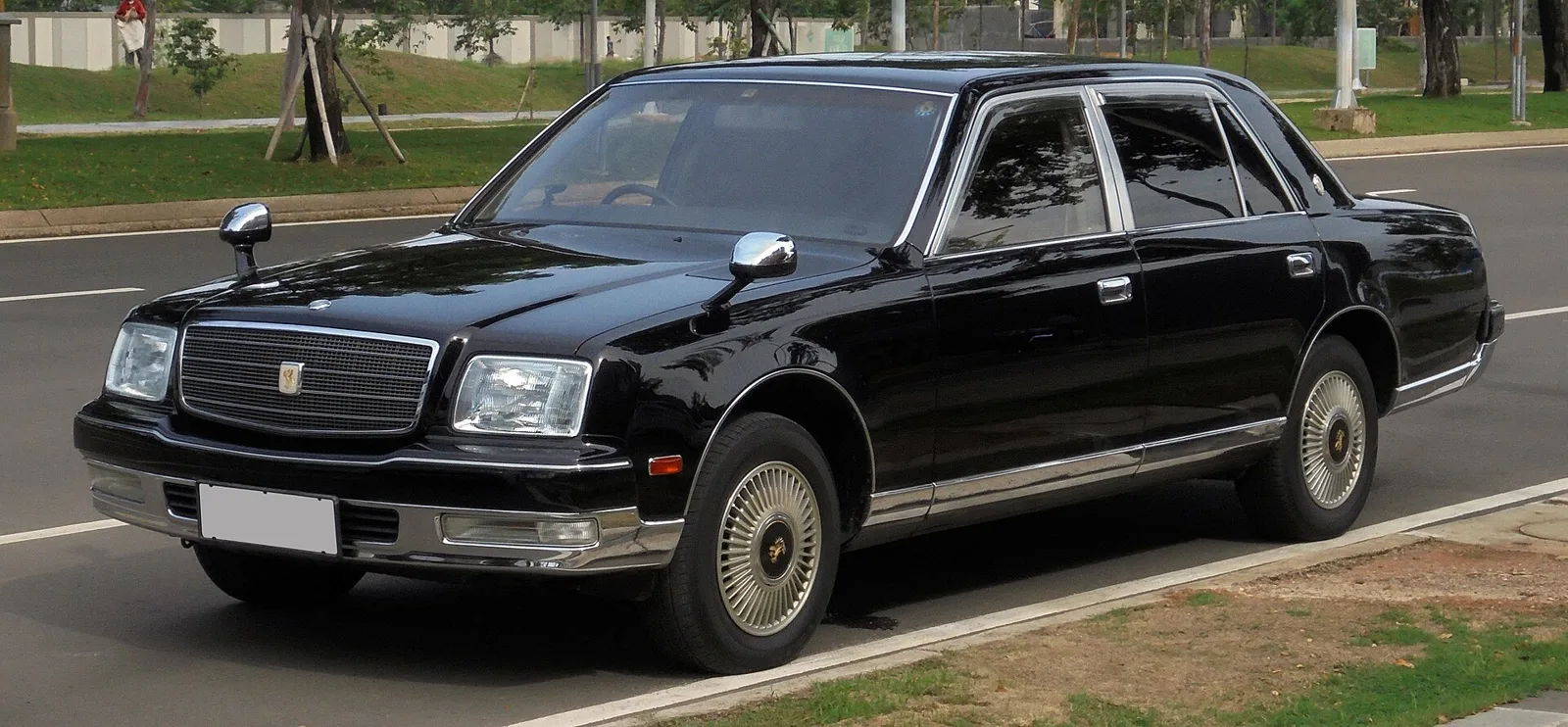
The second-generation Crown grew bigger and gained the more luxurious Crown Eight. When the third generation arrived, the luxury line was reborn as the Toyota Century. The Crown itself kept refining its quality and dependability, later became a name in the high-class car boom, and grew into a standard-bearer for Japanese luxury cars.
What was the Crown Deluxe?
The Crown Deluxe, coded RSD, arrived on 1 December 1955 with new trim inside and out and more power from tuning such as compression ratio changes. From October 1958 buyers could add an electric razor or a vacuum cleaner, which pitched the car at private owners.
Tyre and wheel sizes changed with each minor revision, and the wheels grew smaller in diameter over time.
In 1956 a Crown Deluxe finished the London-Tokyo 50,000 km Drive. An Asahi Shimbun reporter at the wheel wrote a serialised account of the real driving from 30 April to 30 December. The car stopped at the Koromo works the day before reaching Tokyo, and the trip led on to overseas exports and motor sport outings later.