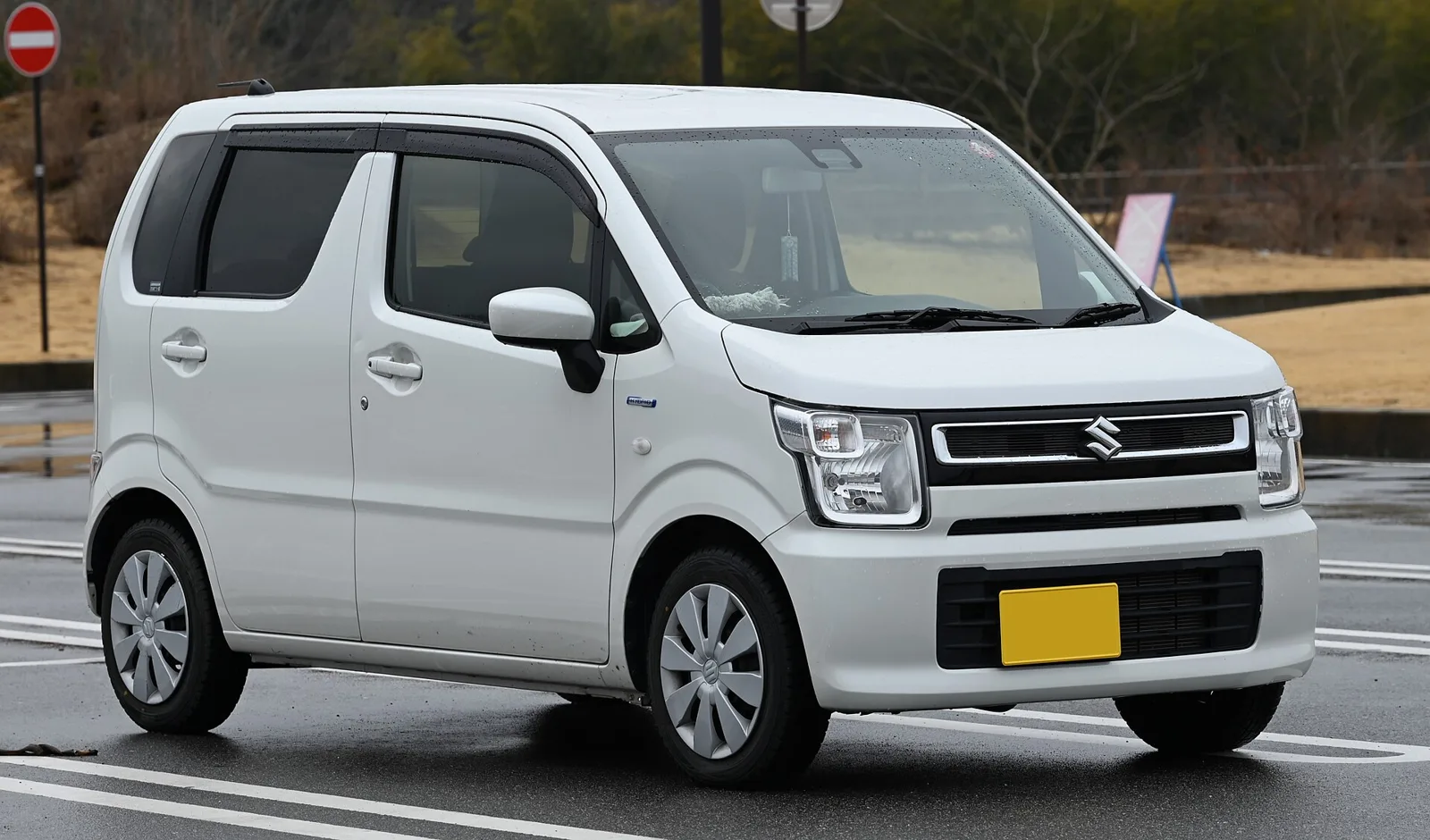
Suzuki's 2017 kei tall wagon rethought the first Wagon R's look, added the Stingray and Custom Z, and brought a head-up display to kei cars.
Introduced in 2017, this kei tall wagon rethinks the first Wagon R. It rides on the lightweight HEARTECT platform and offers mild-hybrid engines, a Stingray variant and, from 2022, the Custom Z. It was also the first kei car with a head-up display.
Suzuki's sixth-generation Wagon R is a kei tall wagon that the company has sold since its full model change in 2017. The generation reworked the look of the first Wagon R, moved to a new lightweight platform, and added the Custom Z alongside the Stingray, with the sliding-door Smile launched during the generation under a different model code.
What made the sixth-generation Wagon R different?
The sixth generation reinterpreted the first Wagon R in a modern way and moved onto the HEARTECT platform, a lightweight, high-rigidity structure. The wheelbase grew by 35 mm while the minimum turning radius stayed at the level of the fifth generation. Its engines and safety equipment were also overhauled.
The sixth generation adopted HEARTECT, a new kei-car platform, following the eighth-generation Alto. Suzuki combined weight reduction in the platform, body and suspension, so that the 2WD FA weighed 20 kg less than the fifth-generation model. That improved JC08 mode fuel economy on every grade except the mild-hybrid, NA and 4WD cars.
A modern take on the first Wagon R that brought kei-car firsts in head-up display, umbrella holders and lane change signalling.
What changed in the design and interior?
The new design looks back to the first model and updates it. Like the late fifth generation, the front end differs by grade, though every face is redrawn. The FA and HYBRID FX use a front mask built around squares.
The HYBRID FZ has a sporty two-tier design, with LED headlamps running from a horizontal line at the grille and a blue reflector in the upper tier. The Stingray takes a different approach. Its front grille gets chrome plating and black pearl paint, its LED headlamps are styled vertically and run toward the rear of the body, and its front bumper has a large opening. The wheels were largely carried over, with the Stingray HYBRID T the only model that gained a new 15-inch design. Most others carry existing wheels, while the FA and HYBRID FX keep 14-inch steel wheels with covers.
Inside, the FA uses beige trim, while the HYBRID FZ and the Stingray use black. The HYBRID FX can be ordered in beige or black. The instrument panel colour panel changes with the grade: white on the FA and HYBRID FX, dark blue on the HYBRID FZ and black pearl on the Stingray. The HYBRID FZ and Stingray also have air-conditioning louvre garnish, in satin silver on the FZ and with red accents on the Stingray.
The instrument cluster brought a centre meter, the first in the model's history. The sixth generation also made the rear quarter glass return for the first time since the third generation, improving visibility to the rear.
Visibility in general was a design goal. The A-pillars were slimmed, and the door mirrors were made smaller and set lower, which greatly improved the view when turning left or right. The rear combination lamps moved to the top edge of the rear bumper, recalling the first model, and that change widened the cargo opening by 100 mm compared with the fifth generation.
The key cylinder of the driver's door, which in the fourth and fifth generations sat inside the outer handle, moved to the lower left of the handle in the sixth. The rear wiper now sits directly below the high-mounted stop lamp.
Custom Z and the Stingray
The Custom Z was added during the generation as a variant with its own face. Its front grille, front bumper and LED headlamps are unique, and its interior is black with brown metallic trim on the instrument panel colour panel and the front door armrests. The name had a previous life: the first Spacia offered a Custom Z from December 2016 for about a year, until the second Spacia generation replaced it.
Roughly four years and eight months on, the name came back as a Wagon R model. Its logo therefore keeps exactly the lettering used on the Spacia.
The Stingray was the fourth-generation sporty variant carried into this generation. Partway through the model life, the lineup was consolidated into a single Wagon R range. The Stingray was later offered in turbo-engine form only, and the Custom Z then took its place in the lift-seat range.
How does the mild hybrid work?
At launch, only the Wagon R FA and the Stingray L came with a petrol engine and no idling stop system. Every other specification used a mild hybrid, apart from the lift-seat cars, which were all petrol-engine versions. That made the mild hybrid the default across the range, with the lift-seat cars the only exception.
The R06A engine came in a naturally aspirated (NA) version and a turbocharged version with an intercooler. Regardless of that difference, the engine alone is coded MH35S, and the hybrid version MH55S.
Suzuki evolved the S-Enecharge system used on some grades of the late fifth-generation car. The new version had a higher-output ISG, a motor-generator with motor function, and a 100 V lithium-ion battery with a larger capacity. When the car slows to about 13 km/h or less, with neither accelerator nor brake applied, the motor can creep the car for up to 10 seconds. The same applies after an idling stop when pulling away from a standstill.
The NA cars extended the ISG's motor-assist range to about 100 km/h, the same as the turbo cars. Cooling for the engine got better, belt tension on the accessories was eased to make room for the higher output, and the CVT's ratios were retuned for its auxiliary transmission.
The 2019 improvement replaced the NA engine with the R06D, which uses the dual injection system first used on the second-generation Hustler, plus a cooled EGR. The CVT became a new, lighter and more efficient unit. The NA mild hybrid got the same changes, but its electric motor changed to type WA04C, which removed the motor creep. The turbo engine and its mild-hybrid version stayed unchanged.
That engine swap changed the type designations as well. Cars with the R06D engine are coded MH85S, and the hybrid version of that engine is coded MH95S.
Key figures for the sixth generation
| Item | Detail |
|---|---|
| Full model change announced | 1 February 2017 |
| Wheelbase | 2,460 mm (96.9 in), 35 mm longer than the fifth generation |
| Turning radius | 4.6 m with 15-inch tyres (Stingray HYBRID T); 4.4 m for NA cars with 14-inch tyres |
| Rear cargo opening | Widened by 100 mm over the fifth generation |
| Weight saving | 20 kg on the 2WD FA against the fifth generation |
| Engines | R06A (NA and turbo); R06D replaced the NA engine in 2019 |
| Type codes | MH35S and MH55S; MH85S and MH95S after the 2019 change |
| Catalogue fuel economy, 5-speed manual FA against fifth-generation FX, 2WD | 25.8 km/L reduced to 25.6 km/L |
| Catalogue fuel economy, 5-speed manual FA against fifth-generation FX, 4WD | 24.2 km/L reduced to 23.4 km/L |
Which safety features came with the sixth generation?
Dual Sensor Brake Support arrived with this generation. It pairs a single camera with an infrared laser radar to reduce collision damage, a pairing Suzuki had first put into the fourth-generation Swift. The Wagon R also gained high beam assist, which automatically switches between low and high beam, in a Suzuki kei car for the first time.
In front of the driver, a head-up display projects forward collision warnings and braking status, lane departure alerts, speed and the selected gear. It was the first head-up display in any kei car. The partial change announced in December 2019 also made several systems standard on the HYBRID FX and HYBRID FZ, including the misstart suppression and the high beam assist.
Practical equipment was not forgotten. Both rear doors gained a holder for an umbrella that can be stored wet, the first such fitting in a kei car. A lane change indicator was also introduced, the first on a Suzuki kei car: a light press of the indicator lever toward the intended lane makes the turn lamp blink three times. Both features were standard on every grade.
What happened during the model's life?
The model changed frequently. The full model change was announced on 1 February 2017, with the catchphrase New, fun is R for the standard models and STRONG BEAUTY for the Stingray. Two actors were used as the commercial characters for the standard models.
On 20 April 2017 the lift-seat Wiz series moved from the fifth-generation Wagon R to a sixth-generation base. Its passenger seat had a large-button wireless remote as standard, and electric seat slide and reclining switches. The package also added a chest-restraint belt, a dedicated armrest and footrest, and a bumper cover and lashing belt for the folding wheelchair.
In August 2017 the manual returned. A five-speed manual was added to the FA on 23 August, after the manual had been dropped at the start of the generation. The manual version uses a floor shifter, a manual lever parking brake and separate front seats, and an instrument panel centre pocket fills the space left by the selector.
Later in 2017 the all-around monitor camera package replaced the memory navigation option, and both models won the 2017 Good Design Award. In July 2018 the Stingray's petrol-engine budget grade was discontinued, and the grade continued for lift-seat cars only. In August 2021 the derivative Wagon R Smile was added, and it carries a different model code from the Wagon R.
The Custom Z derivative of 2022
On 2 August 2022 Suzuki announced a new derivative, the Wagon R Custom Z, with a partial change to the model. It went on sale on 30 August 2022 as a third-stage model. The Custom Z came in two versions, one with the NA engine (HYBRID ZX) and one with the turbo (HYBRID ZT).
In the lift-seat range the Custom Z took over from the Stingray, which had by then become turbo-only, while the Wagon R and Stingray grade structures were tidied up. The model's standard equipment expanded with auto air conditioning, keyless push start and a driver's seat heater on all cars, and USB power sockets were fitted to every grade except the FX.
Safety was also upgraded. Braking support moved to a stereo camera setup, Dual Camera Brake Support. Every car except the FX and lift-seat versions gained adaptive cruise control with all-speed follow-up, along with lane departure suppression. Airbags increased to six, with front seat SRS side and SRS curtain units. A display audio with all-around monitor, compatible with the Suzuki Connect connected service, became a maker option.
The Wagon R's front grille and bumper were also redesigned. The Wagon R received a new colour, Foggy Blue Pearl Metallic, in exchange for Brisk Blue Metallic, Active Yellow and Fizz Blue Pearl Metallic. Terracotta Pink Metallic was added for the Wagon R, with a colour set for the third-generation Lapin and the Lapin LC, and Dusk Blue Metallic, a colour set for the ninth-generation Alto, was added as well.
How the sixth generation compares with the fifth
Compared with the fifth generation, the sixth has a longer wheelbase and a new platform. Its minimum turning radius nevertheless stayed at the fifth generation's level.
The 5-speed manual FA added on 23 August 2017 did not carry over the idling stop system that was standard on the fifth-generation FX, and its catalogue fuel economy fell slightly against that car. The 2WD version dropped from 25.8 km/L to 25.6 km/L, and the 4WD from 24.2 km/L to 23.4 km/L. On the fuel economy label it still matched the fifth-generation FX, with the 2WD meeting the Heisei 32 standard and the 4WD the Heisei 27 standard plus 10%.