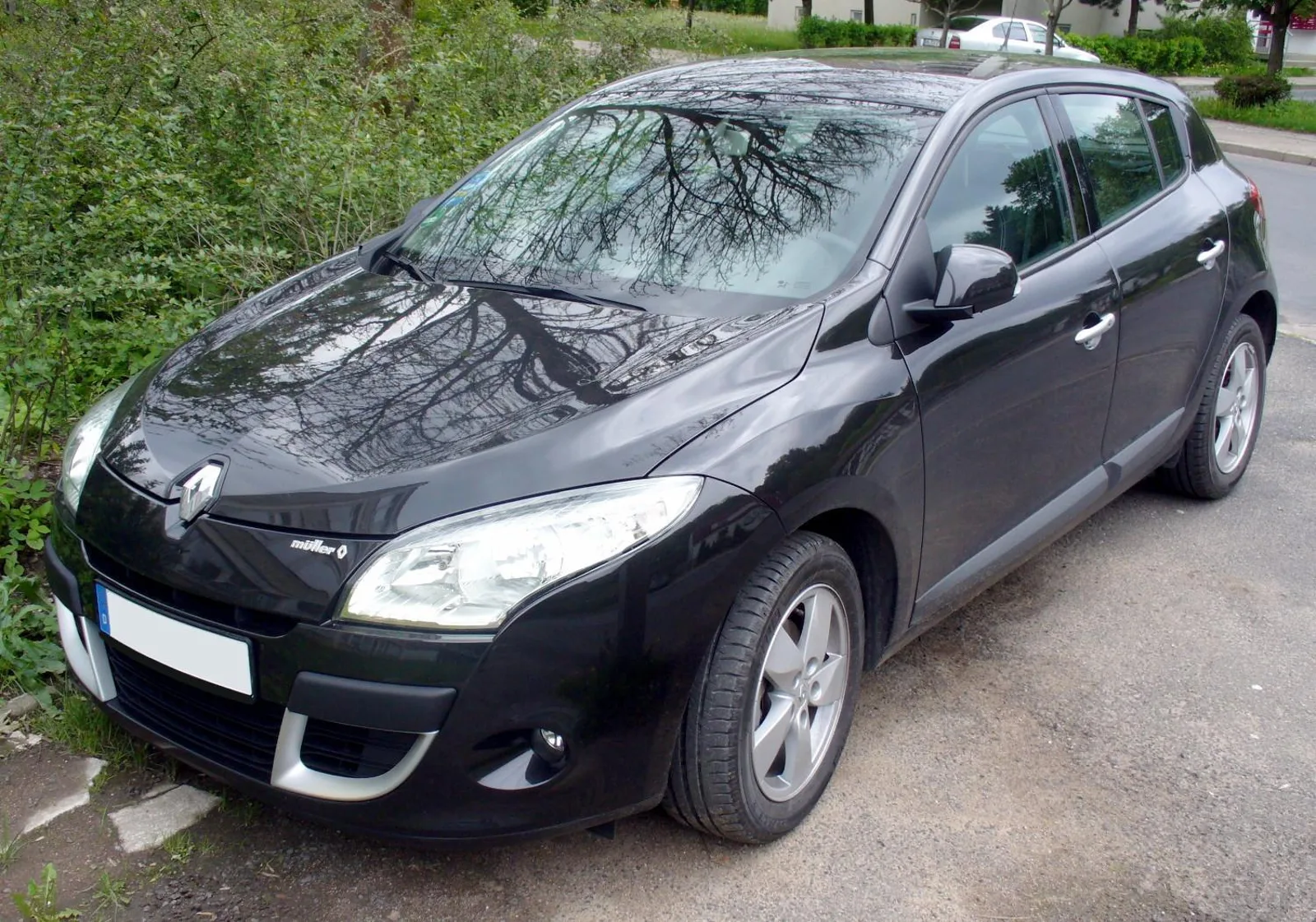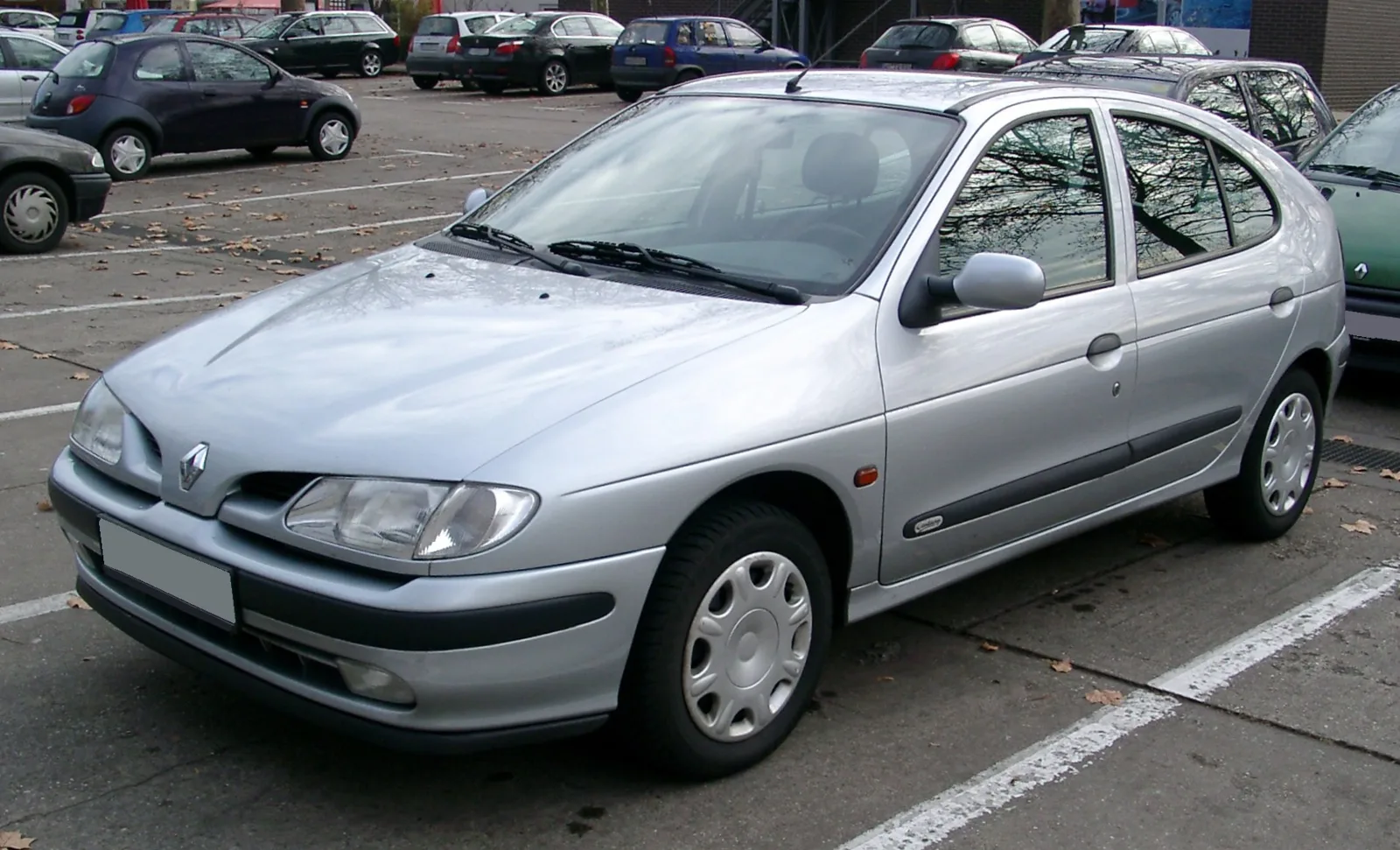
An oval-obsessed design, a shortened coupe and a people carrier so popular that customers waited six months for delivery.
The Renault Megane I was built from 1995 to 2003 on the mechanical base of the Renault 19. Its ellipse-based design came in saloon, coupe, Classic and Scenic forms, and the Scenic people carrier became a sales phenomenon that the rest of the range could not match.
The Renault Megane I was the first generation of the Megane, a lower-middle-range car that Renault built from 1995 to 2003. It rode on a mechanical base inherited from the Renault 19 and wore a body built around the ellipse. The people carrier spun off from the range became the family's biggest hit.
Where did the Megane come from?
Project X64 was meant to replace the Renault 19, and the Megane took its mechanical base from that car. Renault chose many body styles because new competitors from Japan and Korea were arriving in Europe, and the Megane made its debut at Frankfurt in September 1995.
Renault had no intention of launching one or two cars. The first plan named a people carrier alongside a coupe and a five-door saloon, and a convertible plus a four-door saloon came later. The people carrier was new ground for a European maker, and it took aim at the Mitsubishi Space Runner, whose public approval, though not outstanding, had nonetheless shown that a compact people carrier could find customers.
The money was on the same scale. The 14 billion francs committed to the programme compared with the 3.7 billion francs that the first generation of the Twingo had needed. Before the launch the specialist press guessed freely at the car's shape and engines, and early on it was referred to as the 19 second series, because the final name was still unclear in early 1995.
The Megane name came from a 1988 futuristic concept, which had nothing in common with the car that reached showrooms. At Frankfurt the new model was shown in two of its planned bodies, the saloon and the coupe, and the coupe carried the Coach badge in some places and Coupe in others.
Built around an ellipse, with a people carrier that outsold the rest of its own family, the Megane I turned a niche into a sales phenomenon.
What made the Megane's design stand out?
The Megane was styled around the ellipse, a motif repeated on the body, the logo, the cabin and the window line. The team led by Patrick Le Quement wanted something unusual, and the result was a body built around the ellipse, with the saloon expressing the idea more strongly than the coupe.
Along the flank the ellipse shaped both the body profile and the window line. The logo devised to identify the car in advertising was itself a kind of irregular ellipse.
At the rear the tail was almost truncated and stood upright, softened by light clusters that were rounder than the 19's. At the front the logo sat inside a bonnet extension that looked almost like a nose, with two air intakes on either side, and the headlamps seemed sliced by the edge of the bonnet for a sharper, more aggressive look.
The cabin was not avant-garde, but it did not look dated either, and interior space and finish were good. The dashboard was where the oval theme returned most strongly, with an oval frame around the centre console and oval housings for the climate and radio controls. The air vents and instrument cluster repeated the shape, and the multi-function steering wheel had four spokes that split its lower half into three ovals. The boot held 348 litres, in line with the rivals of the time.
What were the Megane's engines and chassis like?
The Megane offered few mechanical surprises. It used a MacPherson front with an interconnected rear layout, and its engines ranged from a 1.4 petrol to a 2.0 16v petrol, plus two 1.9 diesels. A five-speed manual was standard across the range, and the coupe received a shorter platform than the saloon.
| Engine | Capacity | Maximum power |
|---|---|---|
| 1.4 E7J petrol | 1,390 cc (84.8 cu in) | 75 PS (55 kW; 74 hp) |
| 1.6 K7M petrol | 1,598 cc (97.5 cu in) | 90 PS (66 kW; 89 hp), with a detuned 75 PS (55 kW; 74 hp) in some markets |
| 2.0i F3R petrol | 1,998 cc (121.9 cu in) | 114 PS (84 kW; 112 hp) |
| 2.0i 16v F7R petrol | 1,998 cc (121.9 cu in) | 150 PS (110 kW; 148 hp), Coach only (also quoted as 147 PS) |
| 1.9 D F8Q diesel | 1,870 cc (114.1 cu in), naturally aspirated | 64 PS (47 kW; 63 hp) |
| 1.9 dT F8Q diesel | 1,870 cc (114.1 cu in), turbocharged | 93 PS (68 kW; 92 hp) |
The coupe needed its own platform, shortened by 11.2 cm (4.4 in) to sharpen its handling when driven hard. Apart from the wheelbase it kept most of the saloon's mechanics, including rack-and-pinion steering. Most versions combined front discs with rear drums, while the most powerful models used four discs.
The suspension pairing was coil springs at the front and torsion bars at the rear. Engine development proceeded steadily: the 1997 1.9 dTi brought direct injection, though not yet common rail, and a 1999 2-litre direct-injection petrol followed as the first of its kind in Europe. In 2000 the 1.9 dCi brought common-rail turbodiesel power to Renault.
How did the Megane sell in its early years?
Selling began late in 1995 in France and some other European countries, while Italy and much of the continent had to wait until early 1996 for the car to reach dealers. For four months in 1998 the Megane topped Europe's mid-size saloon sales, moving 223,900 units.
Much of that success came from the Scenic. Customers embraced it so strongly that delivery waits had stretched to six months by late 1997, helped by the May closure of the Belgian Vilvoorde plant, which built the car. Competitors were forced to react quickly in a category that had barely existed before.
Why did the Scenic become a phenomenon?
The Scenic was a compact people carrier that kept the Megane family's looks at the front. It won the Car of the Year title in 1997 and, on its own, out-sold every other Megane body style combined. Buyers liked its practicality, comfort and roomy interior.
Its lines were fresher than those of the Mitsubishi Space Runner and the roomier Space Wagon, which were the main rivals it faced. Practicality and interior space did the rest, although the specialist press felt that some controls could have been better arranged.
Inside it seated five, and the space felt much larger than the outside suggested, especially in height. Its innovative idea was the basis of the award, and the car's sales eventually surpassed the production of all the other Megane variants.
The Scenic started life with four engines, three petrol units and a turbodiesel, all shared with the wider Megane range. Power came from a 1.4 at 75 PS (55 kW; 74 hp), a 1.6 at 90 PS (66 kW; 89 hp), a 2-litre at 114 PS (84 kW; 112 hp) and a 1.9 turbodiesel at 93 PS (68 kW; 92 hp). Renault left out the naturally aspirated diesel, judged too sluggish, and the twin-cam 2-litre, judged too lively, for a family vehicle.
In 1999 the Scenic split away from the Megane name and became a range of its own, with a restyle more marked than the rest of the family. The restyled car is regarded as the first generation of the Renault Scenic.
What was the Megane Coach?
The Coach was the Megane coupe, built on a platform 11.2 cm (4.4 in) shorter than the saloon's. It was a 2+2 under four metres long, aimed at rivals such as the Opel Tigra, with a 1.6 and a single-camshaft 2-litre at the base and a twin-cam 2-litre borrowed from the Clio Williams at the top.
Its rear was completely redrawn, with a truncated tail, new light clusters and a sloping roof that limited space for rear passengers. The twin-cam 2-litre was rated at 147 PS (108 kW; 145 hp), which gave very brisk performance.
In 1997 the Coach was offered with the 1.9 dTi, a direct-injection turbodiesel rated at 98 PS (72 kW; 97 hp). A diesel coupe was a real novelty for the period across the industry, not just for Renault. Renault had tried a similar pairing with the Fuego in the eighties, and enthusiasts were split. From 1998, buyers could choose the Proactive automatic, but only with the single-camshaft 2-litre.
The 1999 update brought the Coach the same styling changes as the rest of the range, except at the rear, where its changes were specific to the coupe. The Coach left the price lists in 2003 without an immediate heir, and talk of a coupe returned only with the third-generation car in that class.
What was the Megane Classic?
The Classic was the three-box, four-door Megane, heir to the 19 Chamade of 1989. It looked like the two-box saloon from the front to the centre pillar, but its rear was redesigned with a longer overhang that created a separate boot.
The Classic had been flagged in 1995, and its first official pictures appeared in summer 1996. After a showing at the Paris show that year it reached dealers in November, initially with the five engines already used by the hatchback, including the naturally aspirated 1.9 diesel rated at 64 PS (47 kW; 63 hp).
The Classic's rear lights were longer and horizontal, wrapping around the car and cut only by the boot-lid line. Its engine line-up tracked the five-door saloon, including the Proactive automatic from 1998, and the 1999 restyle added a chrome bar that joined its two light clusters.
Output of the Classic stopped in 2002, the same year as the five-door saloon, and until December both still sat on European price lists to shift leftover cars. The four-door Megane II, which arrived in 2003, took over the role.
How did the range grow after 1997?
The Megane Cabrio arrived in 1997 with a fabric hood on the Coach shell. In 1999 the Megane SW station wagon debuted as an alternative to the Scenic, and the Scenic itself dropped the Megane name to stand alone.
The 1999 restyle gave the front new almond-shaped light clusters and a semicircular grille built into the bonnet and split by the logo. The front bumper was thoroughly reworked, and the plastics of the rear light clusters were changed as well.
The engine changes were more substantial. The 1.4 and 1.6 units gained a new cylinder head with an extra camshaft, producing 95 PS (70 kW; 94 hp) for the 1.4 and 110 PS (81 kW; 108 hp) for the 1.6. The 1.4 16v replaced the former 1.6 8v, and the 1.6 16v inherited the job of the single-camshaft 2-litre, which had slipped in some markets, Germany among them, from 114 to 109 PS. The naturally aspirated 1.9 diesel left the range as common-rail units spread.
Late in 2000 the Megane SW received its own 116 PS (85 kW; 114 hp) 1.8 unit. That year's biggest engine story was the 1.9 dCi at 105 PS (77 kW; 104 hp), which marked Renault's entry into common-rail turbodiesels and took over from the 98 PS direct-injection diesel. That older unit stayed in production in a detuned 80 PS (59 kW; 79 hp) guise.
The 2001 updates mainly addressed safety, with electronic emergency brake assistance, while new interior fabrics were the other visible change. These were the last changes to the Megane I before the Megane II took over.