The 2000 second-generation Laguna, its Initiale-inspired styling, card-key entry, a low point in 2003 and a 2005 facelift.
The Renault Laguna II was a mid-size car from the French maker, built from autumn 2000 to 2007. It carried styling from the 1995 Initiale concept, launched with petrol and diesel engines from 1.6 to 3.0 litres, and became the first car to earn five Euro NCAP stars.
The Renault Laguna II was the second generation of Renault's mid-size Laguna, built from autumn 2000 to 2007. Its styling drew on the 1995 Initiale concept, and it became the first car in the world to earn five Euro NCAP stars after crash testing.
Where did the Laguna II's design come from?
The Laguna II's look owed much to a concept car. Renault showed the Initiale in 1995, a large car with a two-box body, and its styling elements were carried into the new generation. Project X74 began in 1996 and was the first to be developed at the Technocentre in Guyancourt.
The programme was more complicated than planned. The project managers wanted the new platform to serve other models as well, including the fourth-generation Espace and the successor to the Safrane. Renault and Nissan formed the Renault-Nissan group at the end of the decade, and under that alliance the platform was also shared with the new Primera, then in its third generation.
The project was organised to save time. Development took 41 months, against the 58 months needed for the X56 project of the previous car, and the finished car was presented in autumn 2000. Sales began early the following year.
A car drawn from a 1995 concept that became the first in the world to earn five Euro NCAP stars.
What did the Laguna II look like?
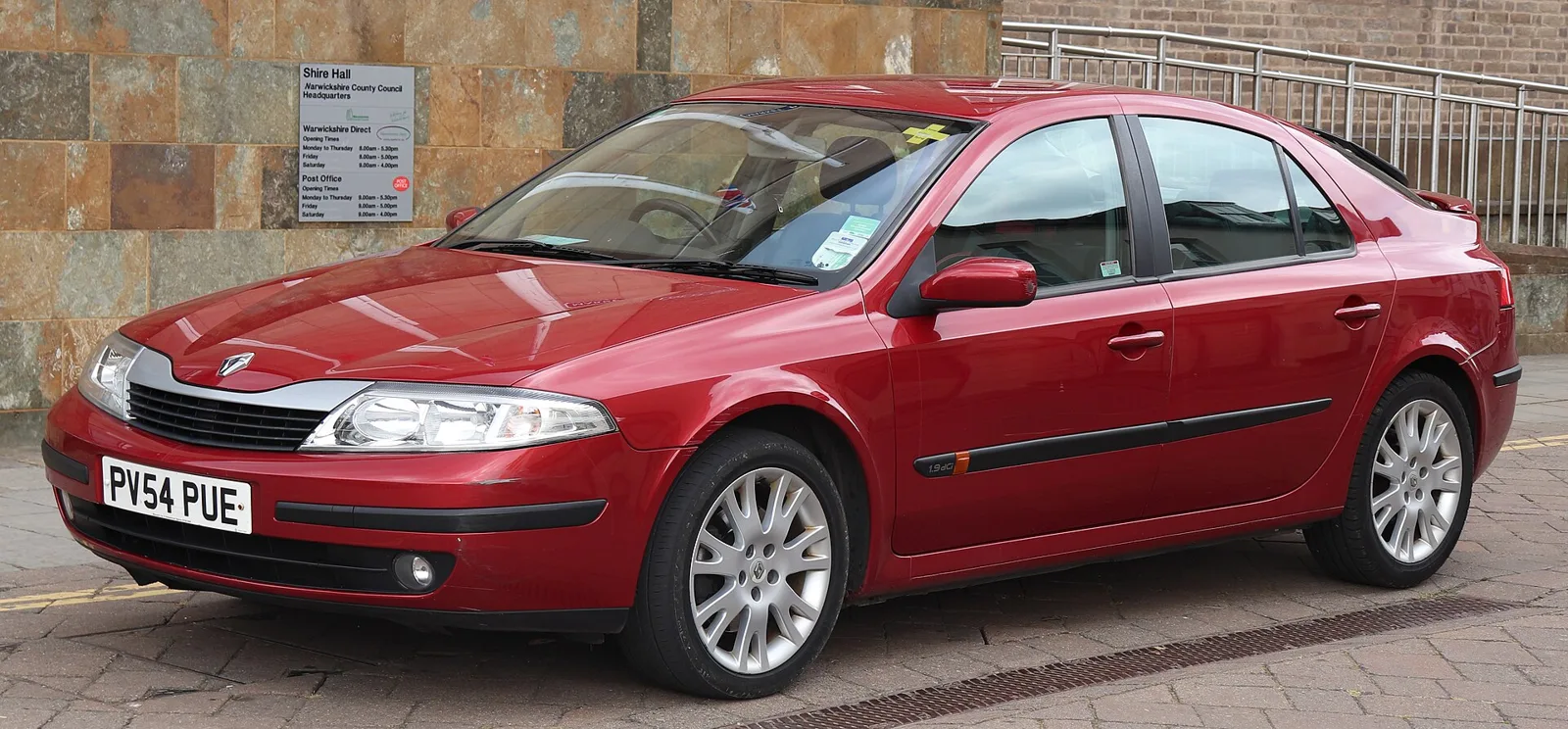
The second-generation Laguna took several styling cues from the Initiale and presented a far sharper, more aggressive line than the car it replaced. The body was angular, with a pointed nose and thin headlights that ran horizontally.
A step in the flank at belt-line height, with the body widening below it, was one of the features carried over from the concept. The side view gave the car a coupe-like character rather than a saloon's profile. The design team was led by Patrick Le Quement, and some sources even call the car a saloon-coupe, although it was a two-and-a-half-box body, if a particularly sleek one.
Black centre pillars blended into the windows to add a sporting look, while the rear pillars were larger and steeply raked. The rear window was drawn in a V-shape that dropped towards the cut-off tail, which carried large light clusters, again with a horizontal emphasis.
The longer wheelbase gave the cabin more room. The driver faced a dashboard with a display set high in the centre, and the centre console hid its controls under a cover. The specialist press praised the materials and finishes, and the boot held 430 litres, expandable to 1,300 by folding down the rear seat back.
How did the Laguna II's structure protect occupants?
The engineers concentrated on safety, and they built the structure to absorb impacts well. The shell used steels with a high elastic limit, which the company said gave two and a half times the rigidity of traditional steels. Impact zones were studied closely, and the deformation under a crash was optimised.
Even the placement of the engine, gearbox and other mechanical parts was arranged so that none of them would interfere with how the shell crumpled. Weight was still controlled: the wings were made from thermopolymer and the bonnet from aluminium.
Crash testing gave the car five Euro NCAP stars, a result that no car had matched before it. Credit went mainly to two programmed-deformation bars in the engine bay, each weighing 40 kg. Airbags and seat belts that varied their action with the severity of an impact added to the safety kit.
How was the Laguna II's chassis set up?
The Laguna II was built on a new platform, although mechanically it was largely an evolution of the previous car's. The wheelbase changed from 2.67 to 2.74 m, and the rear end kept interconnected wheels on torsion bars, revised to absorb the irregularities of the road surface better.
At the front the layout was an independent MacPherson system with coil springs. The four-disc brake arrangement, which the first Laguna had reserved for some engines, was extended to the whole range, with ventilated front discs. ABS was standard across the range.
Stability control was standard only on the top 3.0 V6. Lower engines could be ordered with it, but only at extra cost.
What engines did the Laguna II launch with?
At its debut the Laguna II was offered with four petrol engines and a diesel range built around the 1.9 dCi and 2.2 dCi. The petrol line-up began with the 1.6 16v, which used the K4M engine of 1,598 cc (97.5 cu in) with 110 PS (81 kW; 108 hp). The 1.8 16v used the F4PC, displacing 1,783 cc (108.8 cu in) and producing 120 PS (88 kW; 118 hp).
The 2.0 16v IDE was a direct-injection unit: 1,998 cc (121.9 cu in), 140 PS (103 kW; 138 hp). At the top, the 3.0 V6 24v used the L7X unit of 2,946 cc (179.8 cu in), good for 207 PS (152 kW; 204 hp).
Three of the diesels were based on the F9Q unit of 1,870 cc (114.1 cu in). These were common-rail turbodiesels with direct injection, offered at 100 PS (74 kW; 99 hp), 107 PS (79 kW; 106 hp) and 120 PS (88 kW; 118 hp). The 2.2 dCi was the common-rail evolution of the earlier 2.2, with 2,188 cc (133.5 cu in) and 150 PS (110 kW; 148 hp).
Most engines came with a five-speed manual. The 2.2 dCi and the two stronger 1.9 dCi had six speeds, and the 3.0 V6 used a four-speed Proactive automatic. That automatic could also be ordered with the 1.8 16v, where it cut the maximum output from 121 to 115 PS.
Which electronic features did the Laguna II carry?
One of the big innovations was a card that unlocked the doors automatically and started the engine. The driver kept the card in a pocket, and the locks released as they approached the car. Inside, the engine started when the card was inserted into a slot. The system, called the electronic key or Easy Access System, was later extended to other models in the Renault-Nissan group.
The Laguna II also brought back a talking electronic system, which Renault had tried on some models in the 1980s. A tyre pressure monitoring sensor system was fitted as well.
Not all of the technology proved reliable. The electronic key in particular became a source of trouble rather than comfort, with faults appearing more and more often. The year 2003 was the lowest point in the Laguna II's popularity.
How did the Laguna II estate differ from the saloon?
The Laguna II launched as a saloon and as an estate at the same time. The estate had different names depending on the market: Laguna Estate in France, GrandTour in Italy and Sport Tourer in other countries. It was designed as a more dynamic car than the old estate, rather than a load carrier, and it aimed at the premium estates in its market segment.
The estate offered a boot of 475 litres, which grew to 1,300 with the rear bench folded.
How did the Laguna II engine range change after launch?
In 2002 the 1.9 dCi with 100 PS reached Italy, and the 2.2 engine of the G family, already used in the previous Laguna, was fitted with common rail and raised to 150 PS at the top of the diesel range. A new 2-litre twin-cam engine with indirect injection and 135 PS completed the petrol line-up.
In 2003 a 2-litre turbo with 163 PS filled the gap between the 135 PS 2.0 and the 3.0 V6, while the direct-injection 2-litre dropped from the price list. In 2004 the 2.2 dCi could take the new five-speed Proactive automatic, but only after being detuned from 150 to 140 PS. The 1.9 dCi with 107 PS also disappeared that year.
In some markets a 92 PS version of the same 1.9 dCi replaced it for a single year. Its torque rose from 200 to 230 Nm, which was the main point of the rework.
What did the 2005 facelift change?
The mid-life restyling of 2005 updated the front, which became smoother and closer to other Renault models of the period. The light clusters, grille, central badge and bumper were redesigned, and the bonnet was slightly shortened.
Inside, the materials were improved and the dashboard was redesigned for a more rational layout. The basic 1.6 16v rose from 107 to 112 PS, and the 1.8 16v dropped out. The naturally aspirated 2-litre with 135 PS stayed the same, while the supercharged 2-litre split into 170 PS and 204 PS versions. The 3-litre V6 remained at 207 PS.
On the diesel side the 1.9 dCi was offered at 110 PS, with 120 and 130 PS variants above it, and a new 2-litre turbodiesel with 150 PS joined the range. The 2.2 dCi stayed at 150 PS, or 140 PS with the four-speed automatic.
When did the Laguna II leave production?
The Laguna II was retired towards the end of 2007 in favour of the third generation. The last updates came in 2006, when the 1.9 dCi with 120 PS was dropped, a 175 PS 2-litre dCi was added, and the 2.2 dCi was offered only as an automatic with 140 PS.
What were the Laguna II specifications?
| Specification | Detail |
|---|---|
| Wheelbase | 2.67 to 2.74 m |
| Boot | 430 litres, up to 1,300 with the rear seat folded |
| 1.6 16v | 1,598 cc (97.5 cu in), 110 PS (81 kW; 108 hp) |
| 1.8 16v | 1,783 cc (108.8 cu in), 120 PS (88 kW; 118 hp) |
| 2.0 16v IDE | 1,998 cc (121.9 cu in), 140 PS (103 kW; 138 hp) |
| 3.0 V6 24v | 2,946 cc (179.8 cu in), 207 PS (152 kW; 204 hp) |
| 1.9 dCi | 1,870 cc (114.1 cu in), 100 to 120 PS |
| 2.2 dCi | 2,188 cc (133.5 cu in), 150 PS (110 kW; 148 hp) |
| Transmission | Five-speed manual, six-speed on the 2.2 dCi, four-speed Proactive automatic on the 3.0 V6 |
| Safety | Five Euro NCAP stars |
| Production | Autumn 2000 to 2007 |