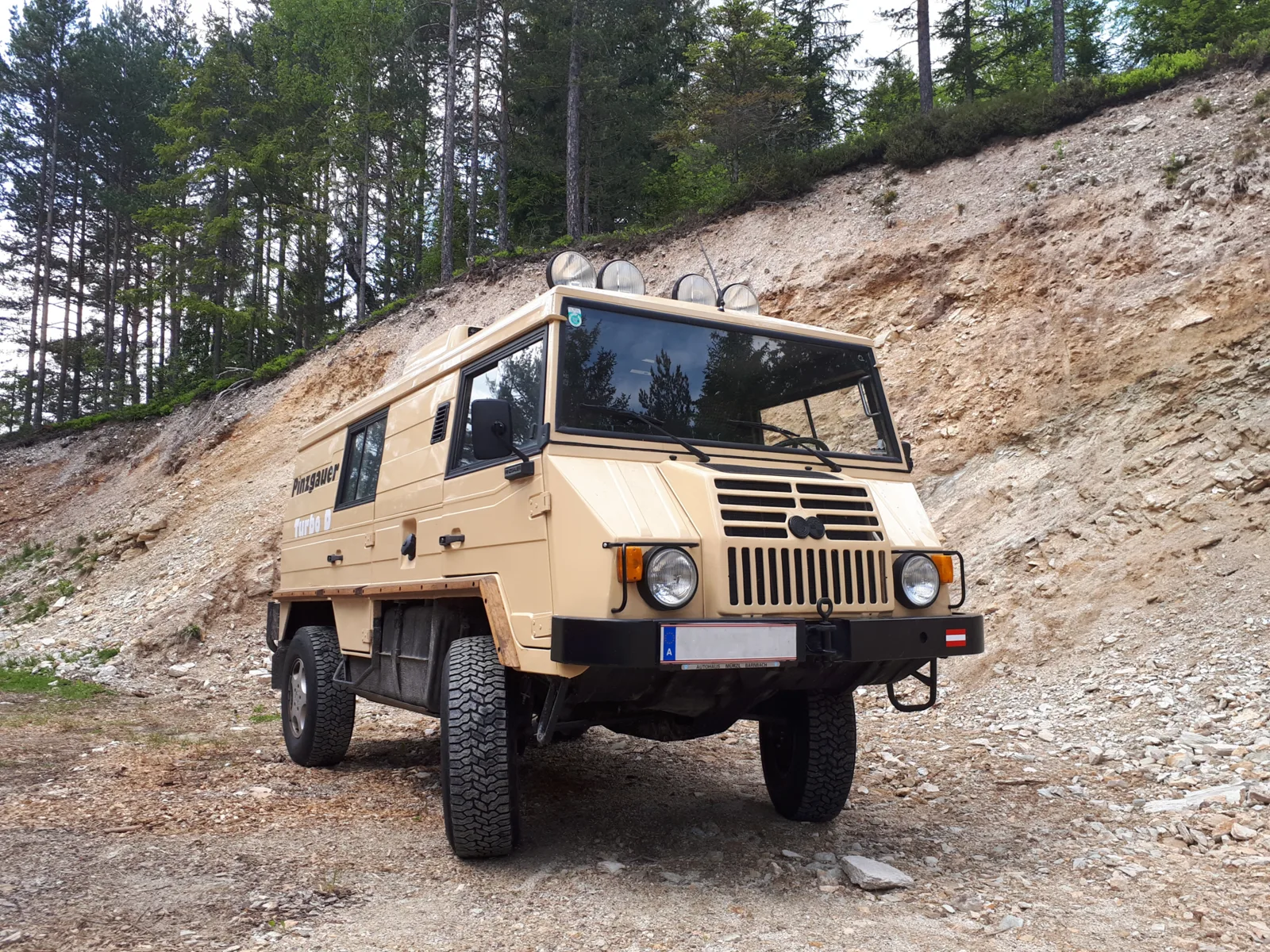
Designed in Graz and named after an Austrian breed of cattle, the Pinzgauer became one of the most capable utility vehicles ever built for military and civilian buyers.
The Steyr-Daimler-Puch Pinzgauer is an Austrian family of 4x4 and 6x6 military utility vehicles first produced in 1971. It used a 2.5 litre air-cooled four and was built in Graz, then at Guildford in England until production ended around 2009.
The Pinzgauer name covers a range of four-wheel-drive and six-wheel-drive military utility vehicles built for mobility. Steyr-Daimler-Puch developed it in Graz, Austria, from the late 1960s, and the vehicle was made until 2007 in its last full form, with British work ending around 2009.
Where did the Pinzgauer come from?
The Pinzgauer was developed around 1969 and entered production in 1971 as the successor to the Steyr-Daimler-Puch Haflinger 700 AP, a light military off-road vehicle. The name came from an Austrian breed of cattle, a nod to the rural and rugged character of the car.
Its design aimed at mobility and general utility rather than combat. The Pinzgauer was unarmed and unarmoured, and it was never intended for reconnaissance or fighting roles. Its strengths were carrying people and loads over rough ground.
A 1971 Austrian utility vehicle that became one of the most capable four-by-four and six-by-six designs of its era.
How did the Pinzgauer change hands?
Frank Stronach, the Austro-Canadian businessman, eventually took a controlling stake in the offroad side of Steyr-Daimler-Puch. The Pinzgauer rights then moved to Automotive Technik Ltd in the UK in 2000, and the company was acquired by Stewart and Stevenson in 2005.
Stewart and Stevenson became part of Armor Holdings in May 2006, and Armor Holdings was acquired by BAE Systems in 2007. BAE then ended UK production, after the vehicle proved too exposed to mines and roadside bombs in Afghanistan. A planned Pinzgauer II was studied by a BAE subsidiary in South Africa, but no vehicle was built.
Production in Graz had already finished in 2000, and the first-generation vehicle had been built by Steyr-Daimler-Puch until then. The UK plant at Guildford, Surrey, was the final home of the design.
How was the first-generation Pinzgauer built?
The first generation was produced in two body forms: the 710, a four-wheel-drive model, and the 712, a six-wheel-drive version. Both used a central-tube backbone chassis with a transaxle that kept the weight low and balanced, and the differentials were sealed units that needed little lubrication.
Portal axles, similar to those on the Unimog, lifted the axle line and gave the vehicle extra ground clearance. The 6x6 was designed for this layout from the start, and its rear suspension was built to deliver maximum traction in hard conditions.
Power came from an air-cooled 2.5 litre inline four with dual Zenith 36 mm NDIX carburettors. The engine was made for the vehicle, and it included more than one oil pump so that lubrication held however the car was tilted.
What were the Pinzgauer specifications?
The first-generation engine produced 65 kW (88 PS; 87 bhp) DIN, equivalent to 105 hp SAE, with 180 newton-metres (133 lbf ft) of torque. A five-speed manual gearbox drove the wheels through a two-speed transfer case, with hydraulic differential locks on the move.
| Model | Drive | Top speed | Payload | Towing (road) |
|---|---|---|---|---|
| 710 (first generation) | 4x4 | 110 km/h (68 mph) | 1000 kg | 5,000 kg |
| 712 (first generation) | 6x6 | 100 km/h (62 mph) | 1500 kg | 5,000 kg |
| 716 (second generation) | 4x4 | 125 km/h (78 mph) | Similar to the 712 | n/a |
| 718 (second generation) | 6x6 | 115 km/h (71 mph) | Higher than the 712 | n/a |
Full engine power was available at 4 km/h (2 mph) for the 710 and 712, which made the car effective at very low speeds on rough ground.
How capable was the Pinzgauer off-road?
It could manage approach and departure angles of 38 and 45 degrees, climb a 100 per cent slope until the tyres lost grip, and wade through 700 millimetres (27.6 in) of water. Its lowest point sat 335 millimetres (13.2 in) above the ground when fully loaded, and it could handle a 360 millimetres (14.2 in) drop.
Side-slope tolerance reached 43.5 degrees. Off-road towing was rated at 1,500 kg (4x4) and 1,800 kg (6x6), and the range on one tank exceeded 400 km (249 mi), or nearly 700 km (435 mi) with the larger 125-litre fuel option.
The Pinzgauer was not fast on the road. Its 110 km/h (68 mph) top speed was lower than a Humvee's, but it carried more troops and moved faster over broken trails. The M body type could carry 10 people in the 4x4 and 14 in the 6x6.
How did the second-generation Pinzgauer differ?
Steyr-Daimler-Puch began work on a second generation in 1980, and the first Pinzgauer II came off the line in 1986. The 4x4 became the 716 and the 6x6 became the 718, and both kept the same body-type letters as the original.
The second generation used a Volkswagen Group inline-six turbo diesel, the D24T, and a ZF four-speed automatic or a five-speed manual. It also had a slightly wider track, bigger tyres and disc brakes. The first cars were designated P80, followed by the P90 and P93 revisions. A TDI engine came in 2002 to meet Euro3 emissions rules.
Who bought the Pinzgauer?
The Pinzgauer was sold widely to military buyers, first to Austria and Switzerland. Its roles included general-purpose utility, command vehicle, troop carrier, ambulance and tow vehicle, with roles similar to those of the Land Rover, the Blazer and the Mercedes G-Class.
Yugoslavia acquired 3975 units from 1971, covering both 4x4 and 6x6 types. The New Zealand Army purchased 321 vehicles in eight variants for its light operational vehicle role. The Malaysian Army bought 168 716 gun tractors and 164 718 mortar transporters, which earned the nickname Piglet.
The US Army bought 20 turbo-diesel 718M vehicles in the early 1990s for a deep reconnaissance role with the Delta Force, and they saw action in the 1991 Gulf War and the 2003 Iraq campaign before they were phased out in 2010 and 2011. The British Army used the Pinzgauer as a light gun tractor in Royal Artillery units, and British soldiers knew it as the Pinz.
Which armies used the Pinzgauer?
The Pinzgauer found military buyers in Europe, Asia, Africa and the Americas. Recorded users have included Argentina, Austria, Bolivia, Saudi Arabia, Thailand, the United Kingdom and the United States. Its reach was wide for a utility vehicle of its era.
Other operators have included Croatia, Cyprus, Eswatini, Ghana, Jordan, Lebanon, Lithuania, Nigeria, Oman, Pakistan, Seychelles, Sudan, Tunisia and Venezuela. Former users also included Yugoslavia and the Kingdom of Swaziland, which shows how long the design stayed in service.
Where did civilian buyers use the Pinzgauer?
Civilian buyers turned the Pinzgauer into camper vans, agricultural trucks, ambulances, fire engines and rescue vehicles, and many worked as tourist transport. Operators in Africa, Australia, South America and Hawaii ran them for visitors, and energy companies bought them for oil exploration.
In Arizona, the Navajo Nation still keeps a few of them carrying visitors around Canyon de Chelly, with use recorded as late as 2024. Their large passenger capacity and stable platform made them a practical choice for guided trips over rough ground.
Its civilian appeal rested on capacity as well. The M body type seated up to 14 people in the 6x6 version, which suited tourist work on rough routes.
Why did the Vector fail?
A Vector variant with light armour briefly joined British Army service in early 2007. It was designed as a safer patrol vehicle for Afghanistan, with physical protection and electronic countermeasures, but it had unreliable suspension and wheel hubs and offered poor protection against improvised explosive devices.
Field commanders quickly lost confidence in the Vector, and it was withdrawn from service. The Pinzgauer also served as the basis for the Tactical Ground Station element of the ASTOR radar system, which used workstation vehicles and a mission support vehicle.