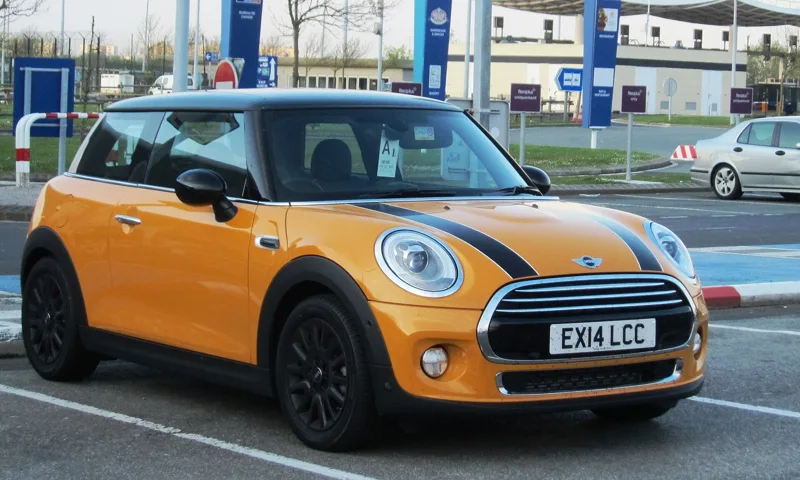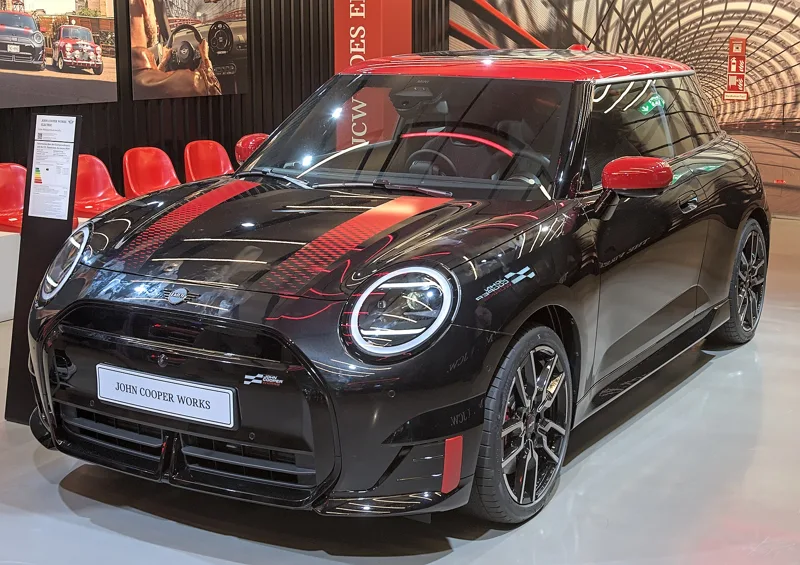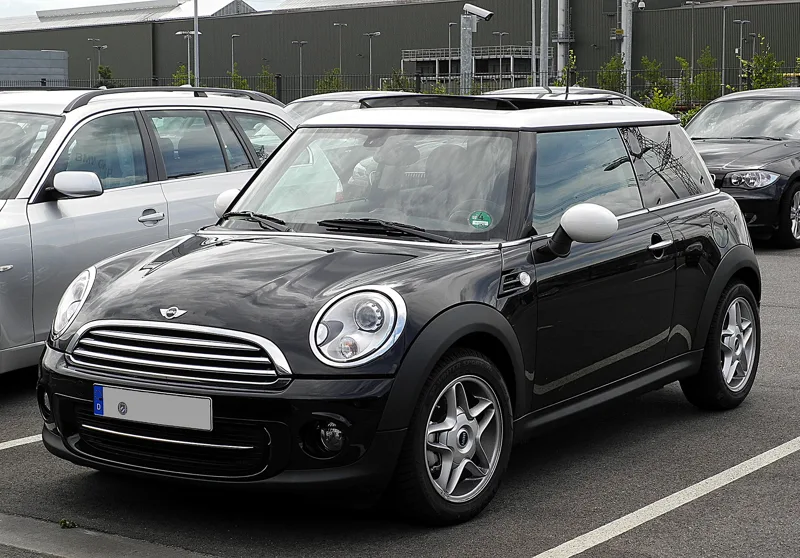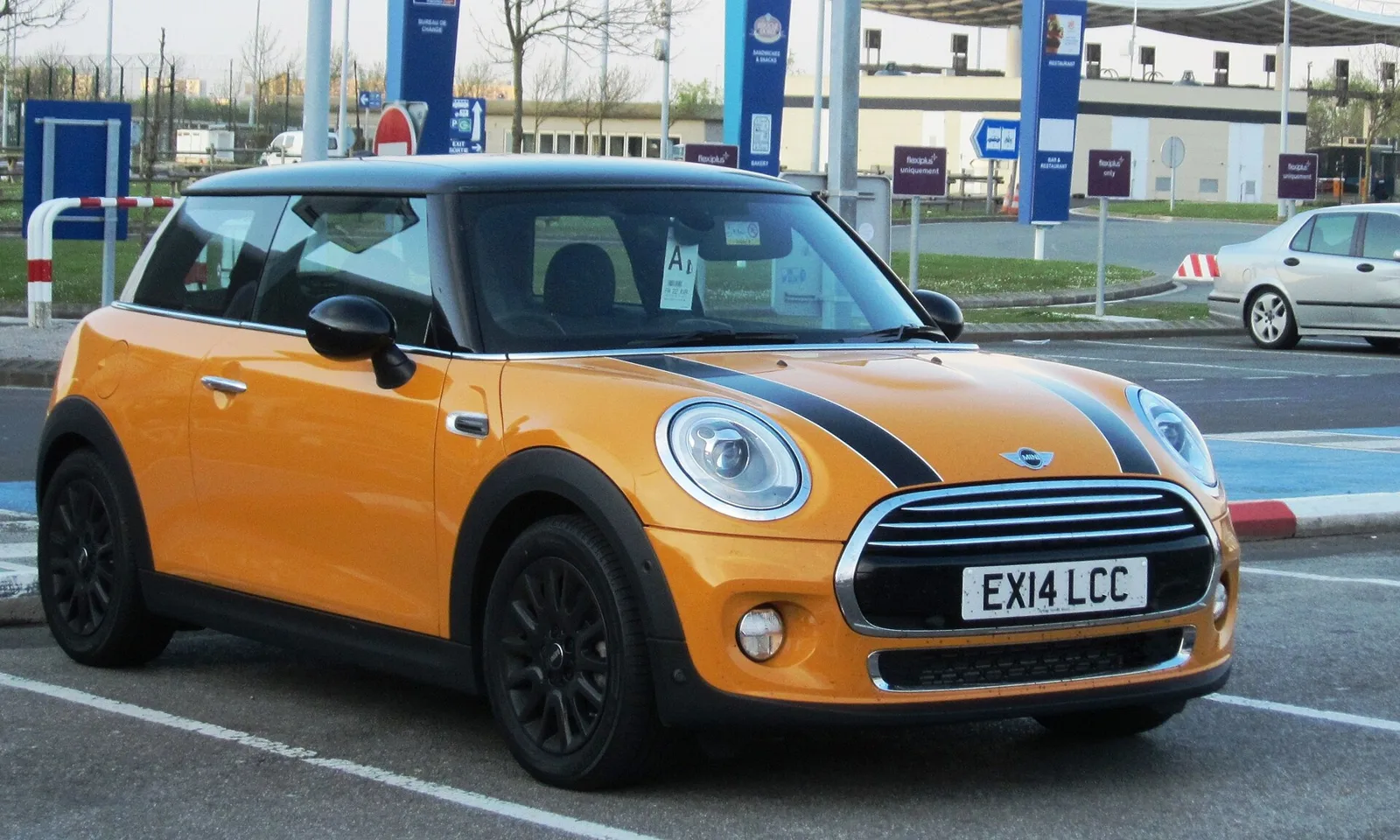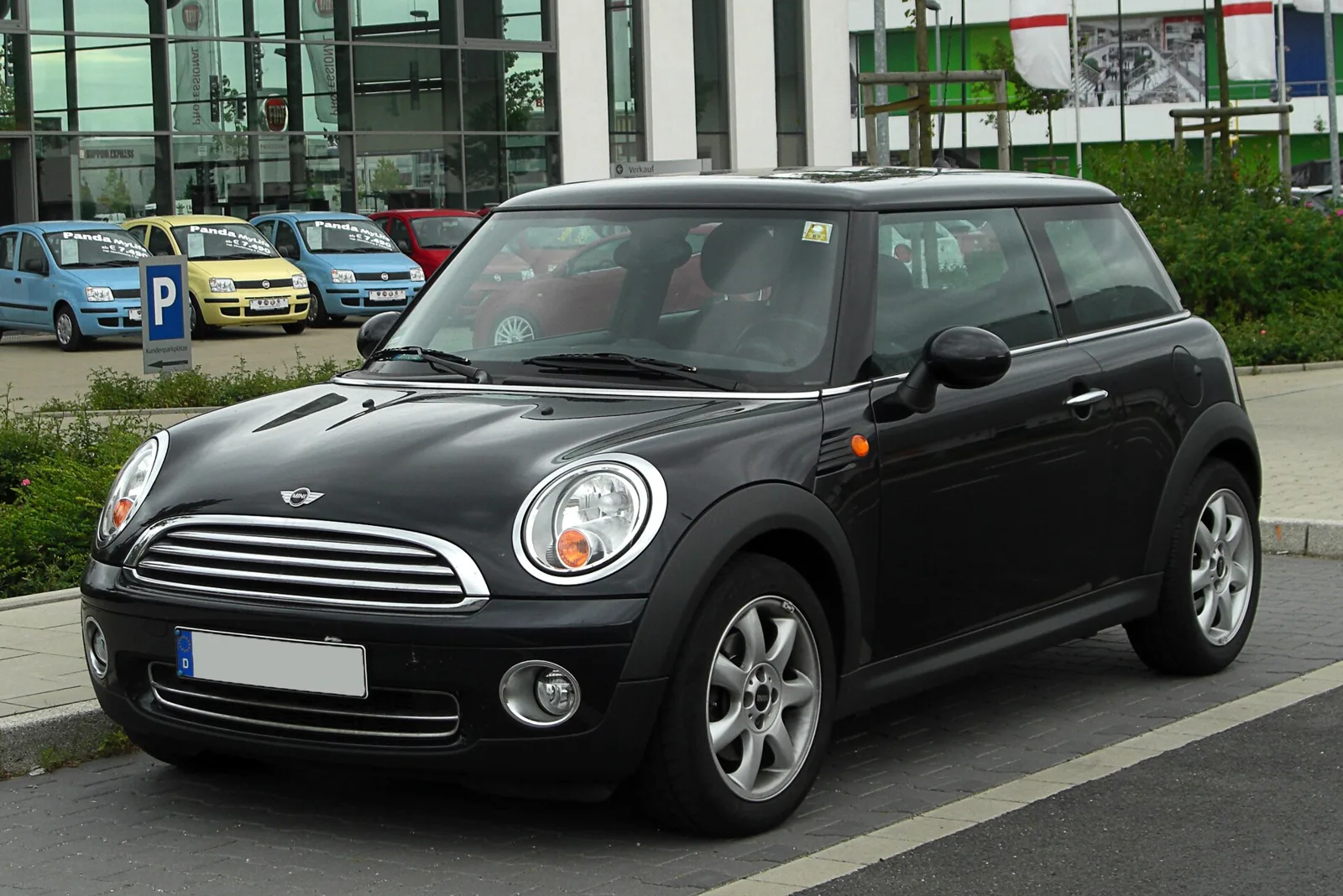
Hatchback, Clubman, convertible, coupe, roadster, SUVs and electric field-trial cars: the R55 to R61 Mini family, built between 2006 and 2016.
The second-generation Mini, codes R55 to R61, was built by BMW from 2006 to 2016 as a hatchback, Clubman, Cabrio, Coupe, Roadster and SUV family. Its launch variants had Cooper and Cooper S engines, and the family also covered the electric Mini E trial cars, whose production successor became the Cooper SE.
The second-generation Mini, known inside BMW by the codes R55 to R61, was a family of hatchbacks, a Clubman estate, a convertible, a coupe, a roadster and two SUVs. It was built between 2006 and 2016 and was presented to dealers on 18 November 2006 with a bonnet made slightly longer and higher for pedestrian protection. To keep the proportions, a plastic strip was added in front of the classically steep windscreen.
What changed when the second-generation Mini arrived?
The biggest changes were beneath the sheet metal. The petrol engines, developed with PSA Peugeot Citroen, were far more economical than before, and the Cooper S used a turbocharger to deliver its extra performance. Its engine collected the Engine of the Year title in its class eight times between 2007 and 2014. The equipment list grew as well, with a new Ambilight interior lighting system that gently tints elements such as the doors.
Interior choice widened considerably. The cabin offered nine trims in cloth, mixed cloth and leather, or full leather, and five different surfaces. Air conditioning and safety packages such as ASC+T or DSC 3 were not standard, but came in two equipment packages. Armrests and the knee rail could be chosen in five colours.
A family of hatchbacks, estates, convertibles and SUVs, with an electric Mini E field trial in 2009, years before the Cooper SE.
Which models launched in 2006 and 2007?
The range started in autumn 2006 with the Mini Cooper, at 88 kW (120 PS; 118 hp), and the Cooper S, at 128 kW (174 PS; 172 hp). Early in 2007 the One, at 70 kW (95 PS; 94 hp), and the Cooper D, at 80 kW (109 PS; 107 hp), joined them. The Clubman estate followed in November 2007, in Cooper, Cooper S and Cooper D forms with the same outputs.
In August 2008 the John Cooper Works and John Cooper Works Clubman arrived at 155 kW (211 PS; 208 hp). A new base engine, the One at 55 kW (75 PS; 74 hp), appeared at the beginning of 2009.
How did the Clubman differ from the hatchback?
The estate first appeared at the Frankfurt IAA show in September 2007. Its roots lie in the Mini Traveller concept that the IAA displayed in 2005. Measured against the basic car, the Clubman adds 24 cm of length and 8 cm of wheelbase. Above the B-pillar it is the same as the other models, apart from a roof that gives it the look of a shooting brake.
Two details set it apart. A door on the passenger side, the Clubdoor, eases access to the rear seats, while the Splitdoor is a two-leaf tailgate. Luggage space ranges from 260 to 930 litres, which is more than the Hatch at 160 to 680 litres, the Cabrio at 125, 170 or 660 litres, and the Coupe at 280 litres. Only the Countryman, at 350 to 1,170 litres, carries more. The rear bench can be split or folded flat, and the Clubman has six airbags as standard.
Named after a London district, the Clubman Hampton became the first limited edition from the Mini yours design range. It came with a choice of body colours including Reef Blue Metallic and Midnight Black Metallic, and with 17-inch Twin Spoke alloy wheels finished in black or silver.
What did the MINIMALISM package include?
From model year 2008 four Mini models, the One Minimalist 55 kW (74 hp), the One Minimalist 72 kW (97 hp), the One D and the Cooper D, carried BMW EfficientDynamics equipment under the brand name MINIMALISM. The kit combined a start-stop system, used in combination with the manual gearbox, with a shift point display, brake energy recovery, aluminium parts, a lightweight chassis and a new underbody that reduced drag and increased downforce.
The maker says these measures can cut consumption and emissions by as much as 20 per cent.
How efficient was the Cooper D?
The Mini Cooper D is quoted at 3.9 l/100 km (72.4 mpg-imp; 60.3 mpg-US) and 104 g CO2/km, and it used a PSA DV diesel engine. The diesel models were joined in April 2011 by the Cooper SD, a three-door hatchback with 105 kW (143 PS; 141 hp).
When did the convertible return?
The new Cabrio went on sale in spring 2009 with the saloons' technical updates. Its cabriolet line-up was the Cooper Cabriolet at 88 kW (120 PS; 118 hp), the Cooper S Cabriolet at 128 kW (174 PS; 172 hp) and the John Cooper Works Cabriolet at 155 kW (211 PS; 208 hp).
Its technical extra is the Always-open timer, a dial to the left of the rev counter that totals how long the crew drives with the roof open.
What did the Coupe and Roadster offer?
The Coupe went on sale in the United Kingdom from October 2011. It was based on the Cabriolet already in production, but it had only two seats and a larger boot. Its windscreen angle was changed, and a spoiler extends automatically at 80 km/h. Buyers could pick Cooper, Cooper S, Cooper SD or the flagship JCW, and the JCW version used a 1,598 cc (97.5 cu in) turbocharged four-cylinder engine.
The JCW reached 100 km/h from rest in 6.4 seconds and topped out at 240 km/h (149 mph). The Cooper SD carried a 2.0-litre (122.0 cu in) turbo diesel rated 105 kW (143 PS; 141 hp). Manual six-speed gearboxes were standard, and an automatic was available on every version except the JCW.
The Roadster was the convertible version of the Coupe, presented in early 2012. It had only two seats, and its fabric roof was worked by hand as standard. Without the electric roof and the rear seats, it weighed 120 kg less than the Mini Cabrio. There were three petrol units, each 1.6-litre (97.6 cu in), plus one 2.0-litre diesel, with outputs running from 90 kW (122 PS; 121 hp) to 155 kW (211 PS; 208 hp).
Production of the Roadster and the Coupe ended together in February 2015.
Who were the Countryman and Paceman for?
The Countryman, known as the R60, was the first SUV variant of the Mini and was introduced in September 2010. The Paceman (R61) debuted in 2012 as a coupe-style SUV and was introduced in 2013. Both were SUV variants added to the family after the hatchback, Clubman and convertible models.
What was the Mini E?
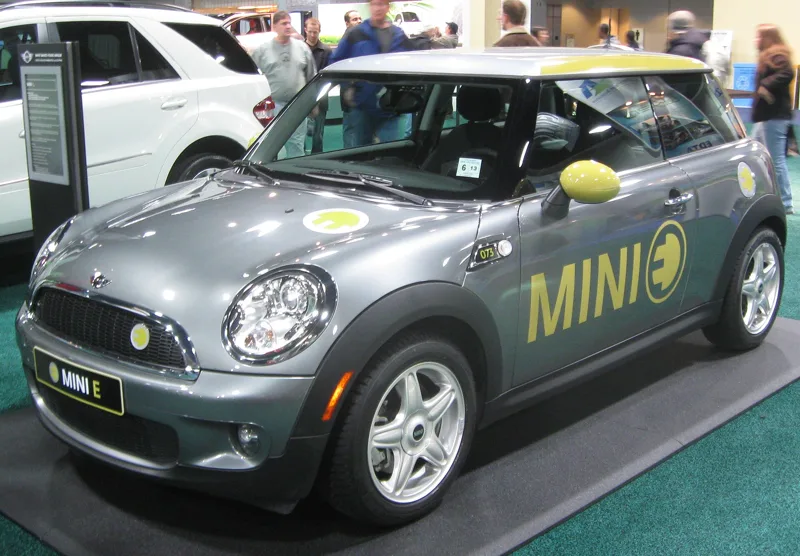
Field trials in 2009 put an electric Mini, based on the R56, through its paces in Berlin, Munich, London and America. In America, 500 of them went on one-year leases to individuals and firms. AC Propulsion supplied the motor and the lithium-ion battery.
Output was 150 kW (204 PS; 201 hp), enough for 8.5 s to 100 km/h, while electronic limiting held the top speed at 160 km/h (99 mph). The battery had 5,088 lithium-ion cells in 48 modules, some of them in place of the rear seats, which left only two seats. The modules also cut the luggage space to 60 litres. A charge gave 200 to 250 km, and a special charger took about 2 hours. Weighing 1,465 kg (3,230 lb) at the kerb, it carried 300 kg more than the petrol and diesel models.
How did the Mini Cooper SE follow the Mini E?
The series car built on the F56 platform arrived as the Mini Cooper SE, unveiled in July 2019. Oxford assembled it, while Dingolfing produced the drivetrain and battery. Showrooms received it from March 2020. Power comes from 184 PS (135 kW; 181 hp), the battery holds 32.6 kWh, and the claimed range reaches 270 km. Against a Cooper S with automatic gearbox, the extra mass is 145 kg.
What was the Mini E Race?
The Mini E Race was a race-spec adaptation of the road Mini E. The interior received a Recaro CFK Pro Racer seat with HANS, a three-inch six-point harness and a suede steering wheel 320 mm in diameter. The roll cage was a bolted lightweight CrMo4 structure of about 35 kg including fitting material.
Other changes included a mechanical multi-plate limited-slip differential with a 40/50 degree ramp angle and 55 Nm of preload, an adapted engine control system, and KW variant 3 threaded suspension tuned for the higher axle loads. Diffusers, a rear wing and carbon-fibre body parts were added, and a special race ABS and a differentiated emergency stop concept were integrated.
Which special editions did Mini and Rolls-Royce build?
In June 2009 Rolls-Royce presented the Mini Inspired by Goodwood to the world. Rolls-Royce reworked the car with beige leather and velour trim inside, a centre console in black piano lacquer, and an instrument panel in Rolls-Royce's own design. Only the steering wheel came from the Mini, with its emblem. It was produced for the Mini's 50th birthday, and a 2011 run capped at 1,000 cars cost 46,900 euros.
The JCW World Championship 50 Edition of 2009 was a limited series of 500 examples worldwide, 100 of them for the United Kingdom and 50 for the United States. The car wore a JCW bodykit and 18-inch wheels painted black, with two extra lamps in the grille, and it used a lot of carbon parts inside and out. It was created to honour the Constructors' World Championship title won by the Cooper team, and it sold for 40,000 euros.
How many JCW GP cars were made?
In November 2012 the Cooper John Cooper Works GP arrived as a special model limited to 2,000 vehicles. It was rated at 160 kW (218 PS; 215 hp).