BMW's second-generation Mini, from the turbocharged Cooper S to the Mini E test fleet and a run of one-off special editions.
Launched by BMW in November 2006, the Mini R56 introduced the Cooper and Cooper S, followed by new turbocharged and diesel engines, electric steering and a long list of special editions. The Mini E electric test fleet ran alongside it as a real-world trial.
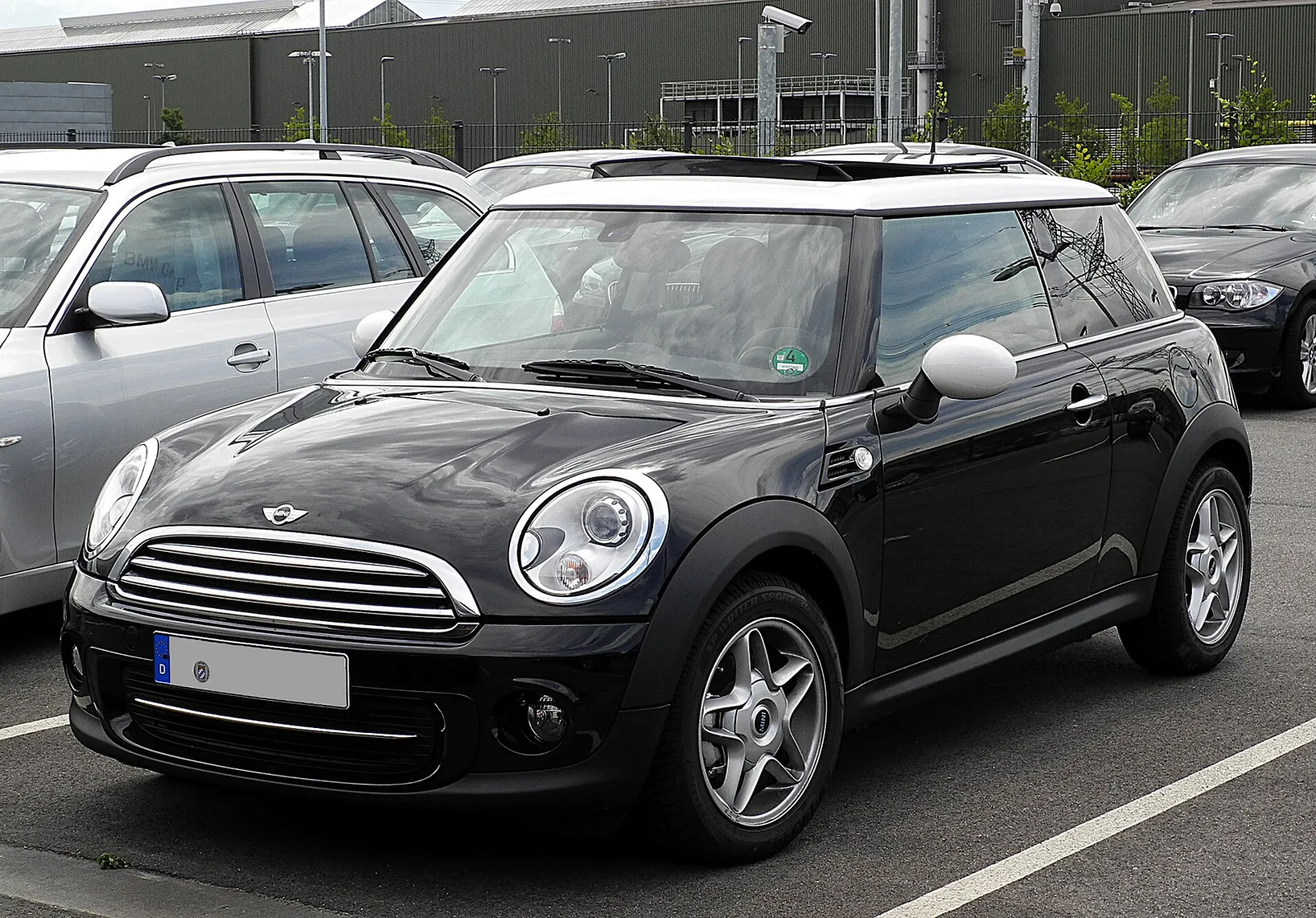
The Mini R56 is the third generation of Mini since 1959, and the second built under BMW, which took over the brand in 2000. Launched in November 2006, it kept the go-kart feel of the Mini 2 in the Cooper S while modernising its engines and steering. The Cooper and Cooper S came first, with the One and Cooper D following in early 2007.
What did BMW change when the R56 arrived?
BMW launched the R56 in November 2006 to modernise the engine side of the city car. Inside, the cabin evolved from the Mini 2, with a larger central speedometer and better materials. Rear headroom improved, although rear legroom stayed limited. The range was restyled in 2010.
Modernising the engines was the stated goal. The first versions were the Cooper, with 120 PS (88 kW; 118 hp), and the Cooper S, with 175 PS (129 kW; 173 hp). Early 2007 brought the One with 95 PS (70 kW; 94 hp) and the Cooper D with 110 PS (81 kW; 108 hp), and the John Cooper Works arrived in August 2008.
The convertible, the R57, went on sale in spring 2009 in Cooper, Cooper S and John Cooper Works forms. The R56's steering is entirely electric, supplied by JTEKT, which avoids the bulk and fluid upkeep of hydraulic systems.
Its engines were completely revised, yet the go-kart feel of the Mini 2 survived the change.
How much did the R56 share with the Mini 2?
Only the roof and the windscreen were reportedly identical to the Mini 2, so the R56 was a much more thorough revision than its look suggests. The bonnet air intake on the Cooper S survived, but it had become decorative and is now blocked off. Fuel use fell by roughly 20% on the Cooper and Cooper S.
That saving came from the new engines and from lighter unsprung masses, which matter a great deal for road holding. Part of the weight reduction came from partial use of aluminium parts. BMW also adapted its Efficient Dynamics technology on certain models, which added to the economy gains.
Which engines did the Cooper and Cooper S use?
The petrol engines of the Cooper and Cooper S were completely revised, although their capacity stayed the same. BMW built the body, while PSA made the engine at its Douvrin plant. The most powerful units were four-cylinder engines from the Prince family, fitted with a Twin Scroll turbocharger.
The sump-type oil pan and the variable-flow oil pump are usually found in high-end sports engines, and the water pump, which can disengage, points to BMW wanting a performance engine in the small Mini. Torque is particularly strong in the Cooper S, which lets it accelerate like a larger car. It is often compared with the Golf GTi or the Clio RS.
The Cooper's naturally aspirated 1.6 litre took a different route. It used BMW's Valvetronic intake in place of a throttle butterfly, variable timing on both camshafts and multipoint injection. Its maximum torque arrives at 4,250 rpm, against 1,600 rpm for the 175 PS Cooper S, so it lacks low-rev punch.
The Mini One's 1.6 litre produced 75 PS (55 kW; 74 hp) until January 2010, when a 1.4 litre from the economy Minimalism range took over, offered in 75 and 98 PS (72 kW; 97 hp) forms. The diesel Cooper rose from 88 PS (65 kW; 87 hp) to 110 PS (81 kW; 108 hp) and emitted 104 g/km of CO2, using a PSA 1.6 litre HDi chosen to replace a Toyota unit. The Cooper SD arrived in 2011 with a 2.0 litre BMW engine of 1,995 cc (121.7 cu in), producing 143 PS (105 kW; 141 hp) and 305 Nm (225 lb ft).
How did the Cooper S feel on the road?
The Cooper S was the sporty version, with a turbocharger in place of the supercharger used on the Mini 2 Cooper S. An overboost function lifts torque from 240 Nm (177 lb ft) to 260 Nm (192 lb ft) when the throttle is pressed hard, and its go-kart feel carried over from the earlier car.
The optional limited-slip differential is set at 25% and is torque-controlled, so the torque difference between the front half-shafts cannot exceed 75%. It can solve traction problems on the way out of corners, but it needs a steering correction to catch its effect.
A sport chassis with firmer suspension was available, along with a switchable option that firms up the steering and sharpens the throttle. The Getrag gearbox is well spaced, and sixth gear is tall enough to keep revs tolerable at 130 km/h on the motorway.
Some drivers felt the turbo ran out of steam after 5,500 rpm. The brakes lagged a notch behind, a recurring weak point at BMW, and lacked endurance under very hard use.
Mini R56 specifications by version
| Version | Power | Torque | Notes |
|---|---|---|---|
| Cooper | 120 PS (88 kW; 118 hp) | - | Launch version, November 2006 |
| Cooper S | 175 PS (129 kW; 173 hp) | 240 Nm (177 lb ft), 260 Nm (192 lb ft) with overboost | Turbocharged, Getrag gearbox |
| Cooper S 184 | 184 PS (135 kW; 181 hp) | Unchanged | Spring 2010, 6.8 L/100 on average |
| One | 75 PS (55 kW; 74 hp) | - | 1.6 litre, from 2007 |
| One | 75 PS (55 kW; 74 hp) or 98 PS (72 kW; 97 hp) | - | 1.4 litre, from January 2010 |
| Cooper D | 110 PS (81 kW; 108 hp) | - | 1.6 litre PSA HDi diesel, 104 g/km CO2 |
| One D | 90 PS (66 kW; 89 hp) | - | Relaunched in 2009 |
| Cooper SD | 143 PS (105 kW; 141 hp) | 305 Nm (225 lb ft) | 2.0 litre, 1,995 cc (121.7 cu in), from 2011 |
| John Cooper Works | 211 PS (155 kW; 208 hp) at 6,000 rpm | - | Redline 6,500 rpm, four-piston front brakes |
| Mini E | 204 PS (150 kW; 201 hp), electric | - | 259 kg (571 lb) battery, 237.1 km range |
What made the John Cooper Works version different?
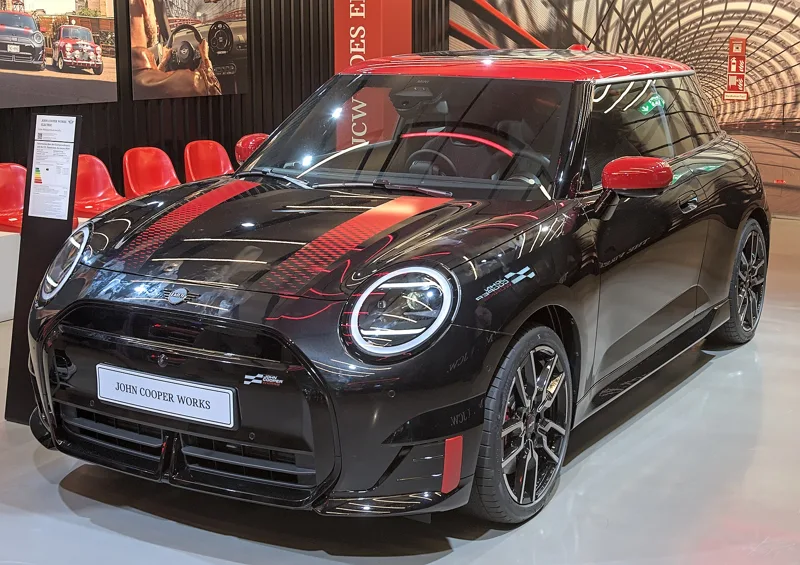
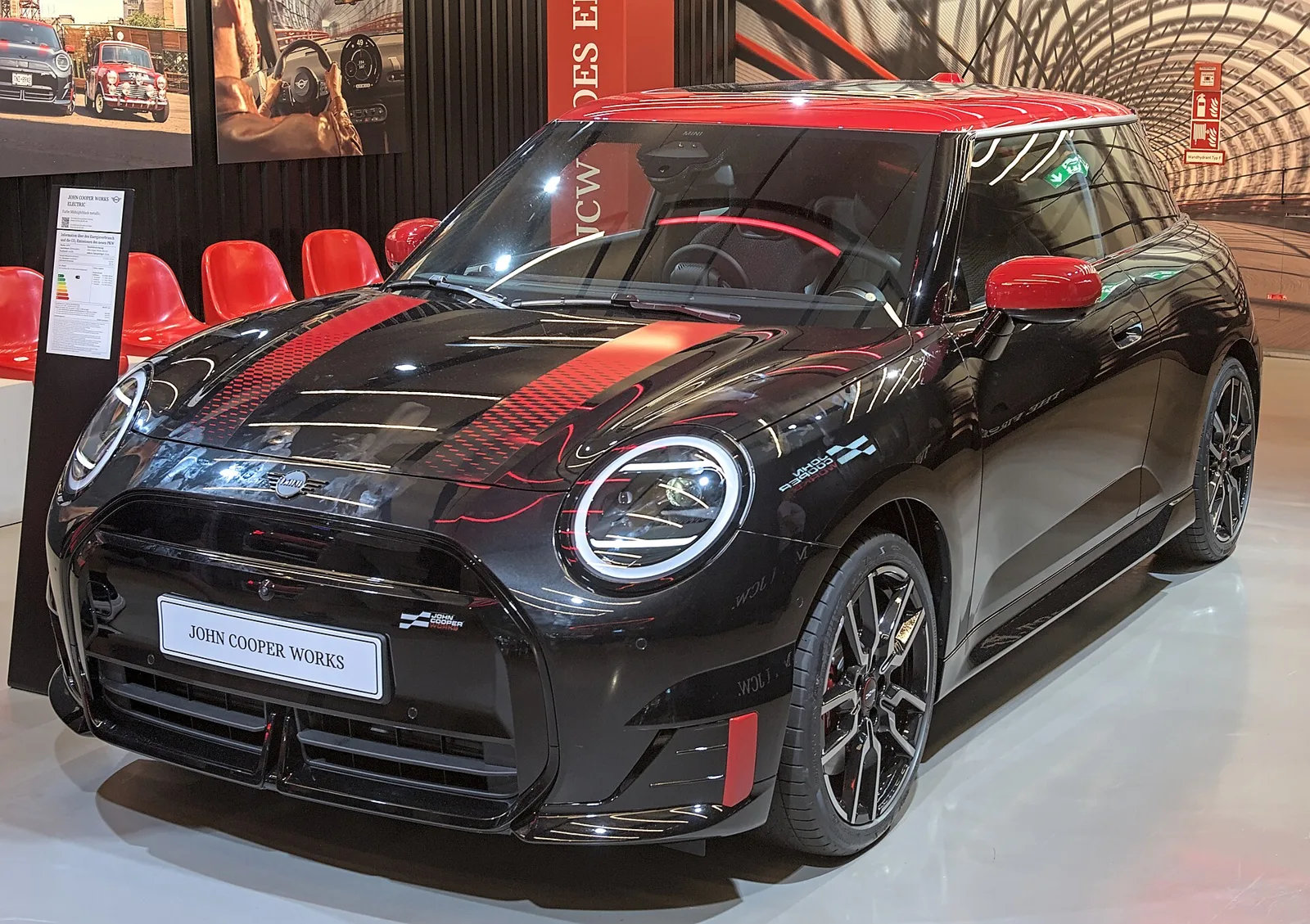
The John Cooper Works version, the in-house tuning shop's car, raised output to 211 PS (155 kW; 208 hp) at 6,000 rpm and extended the rev limit to 6,500 rpm. That removed, at least in part, the main criticism of the Cooper S.
Its front brakes were upgraded to four-piston fixed callipers with ventilated 316 x 22 mm discs, while the rear kept solid 280 x 10 mm discs. The brake kit was also sold as an accessory for the rest of the range.
The John Cooper Works suspension lowered the car by about 10 mm and used new dampers, springs and wider anti-roll bars at both ends. It was not standard. Buyers had to pick it from the accessories catalogue and have it fitted afterwards. The damping was almost identical to the Cooper S, with a choice between the original suspension and the optional sport suspension.
How did the Mini E electric test work?
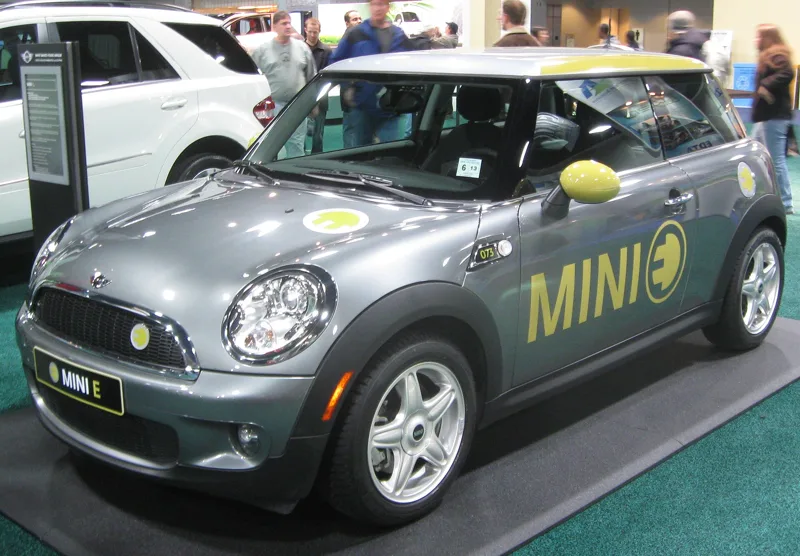
The Mini E was an electric test car, with a motor producing 204 PS (150 kW; 201 hp) on the front wheels. Its lithium-ion battery added 259 kg (571 lb) and removed the rear seats. A total of 500 Mini E were tested by private individuals.
A prototype was shown at the Los Angeles Auto Show at the end of 2008. From 2009, hand-picked customers used them on rental in Los Angeles and New York only, and British trials began in December 2009, running over two consecutive six-month periods.
The total included 170 cars in Germany and 10 in France, and a few also circulated in China and Japan in the same period. Every Mini E was painted Dark Silver with a fluorescent yellow roof and mirror caps. Its official range of 237.1 km under real conditions came from a competition held in Pennsylvania in May 2010.
Which special editions and one-offs were built?
The R56 generated a steady stream of special editions, from one-off cars sold for charity to limited runs marking the fiftieth anniversary of the Mini in 2009. Several were built for auction, and the designers involved gave them very different characters.
- Cooper Mario Testino (2007): a single car made for the Life Ball 2007, with a plastic firework film over Midnight Black paint, sold on an online auction for 24,550 euros.
- Cooper S Graham Knuttel (2007): a single car for Ireland, painted by an Irish artist, shown at the country's fifty dealerships before a charity auction.
- Cooper S George Harrison Edition (2009): one car in Chili Red with gold wheels, reproducing the psychedelic patterns of a Mini given to George Harrison in 1966.
- Cooper convertible Blonds (2009): a pink leopard-style film, black faux-fur upholstery and a starting bid of 10 euros on an online auction.
- Cooper S Diane von Furstenberg (2010): lipstick-mouth graphics across the body, designed by the Belgian-American designer.
- Cooper Paul Weller (2010): pink with brown stripes, estimated at 17,920 euros and sold in December 2010 for 20,250 euros.
- Cooper S Dsquared Red Mudder (2011): a rally-raid look with a spare wheel on the tailgate, a bull bar and a strict two-seat layout.
- One Trigger and One Abbey Road (2008, Italy): a sporty and a restrained series, with stripes or black-and-white upholstery respectively.
- Cooper Monte-Carlo (2008, Singapore): a limited series priced at 104,800 Singapore dollars, numbered 37 and inspired by the 1964 Monte Carlo Rally winner.
- One Ray (2009, Italy, then 2011 in Switzerland): 15,900 euros in Italy, 25,500 Australian dollars in Australia and 19,990 Swiss francs in Switzerland.
- Cooper, Cooper S and D 50 Mayfair (2009): available in Hot Chocolate brown, at 24,200 to 28,300 euros in France.
- Cooper, Cooper S and D 50 Camden (2009): a sportier take with a Harman Kardon radio, at 23,700 to 27,800 euros in France in 2012.
- JCW World Championship 50 Edition (2009): 500 cars worldwide, including 100 in Great Britain and 50 in the United States, sold for 40,000 euros.
How were the steering and brakes engineered?
The R56 used fully electric power steering from JTEKT, with assistance tied to vehicle speed and no hydraulic system to maintain. Its stability and braking aids included ASC+T, DSC, ABS and electronic brake force distribution.
Electric assistance avoids the vague feel of older systems on sporty cars. Certain strategies, active under conditions such as wheel speed or acceleration, bring the feel close to unassisted steering, and the column adjusts for height and reach.
ASC+T, short for automatic stability and traction control, is coupled with the ABS to reduce the effects of lost grip. DSC, BMW's form of ESP, corrects sudden deviations from the path by acting on the injection and the brakes. The ABS prevents wheel lock and is often combined with electronic brake force distribution, cornering brake control and an emergency braking assist.
Why did the R56 sell so well?
Its success came from a distinctive design, almost unlimited personalisation, targeted marketing and a steady run of special series. Those series kept the car in the news and kept buyers wanting one.
The handling is the car's lasting draw. The go-kart feel of the Mini 2 is well preserved in the Cooper S, which corners with great agility. Some criticism lingered, notably about the brakes and the turbo running out of pull after 5,500 rpm. The Mini E, meanwhile, ran as a real-world electric test alongside these models.
The Minimalism series, presented in 2009, was pitched on responsible manufacturing, efficient cars and social commitment.