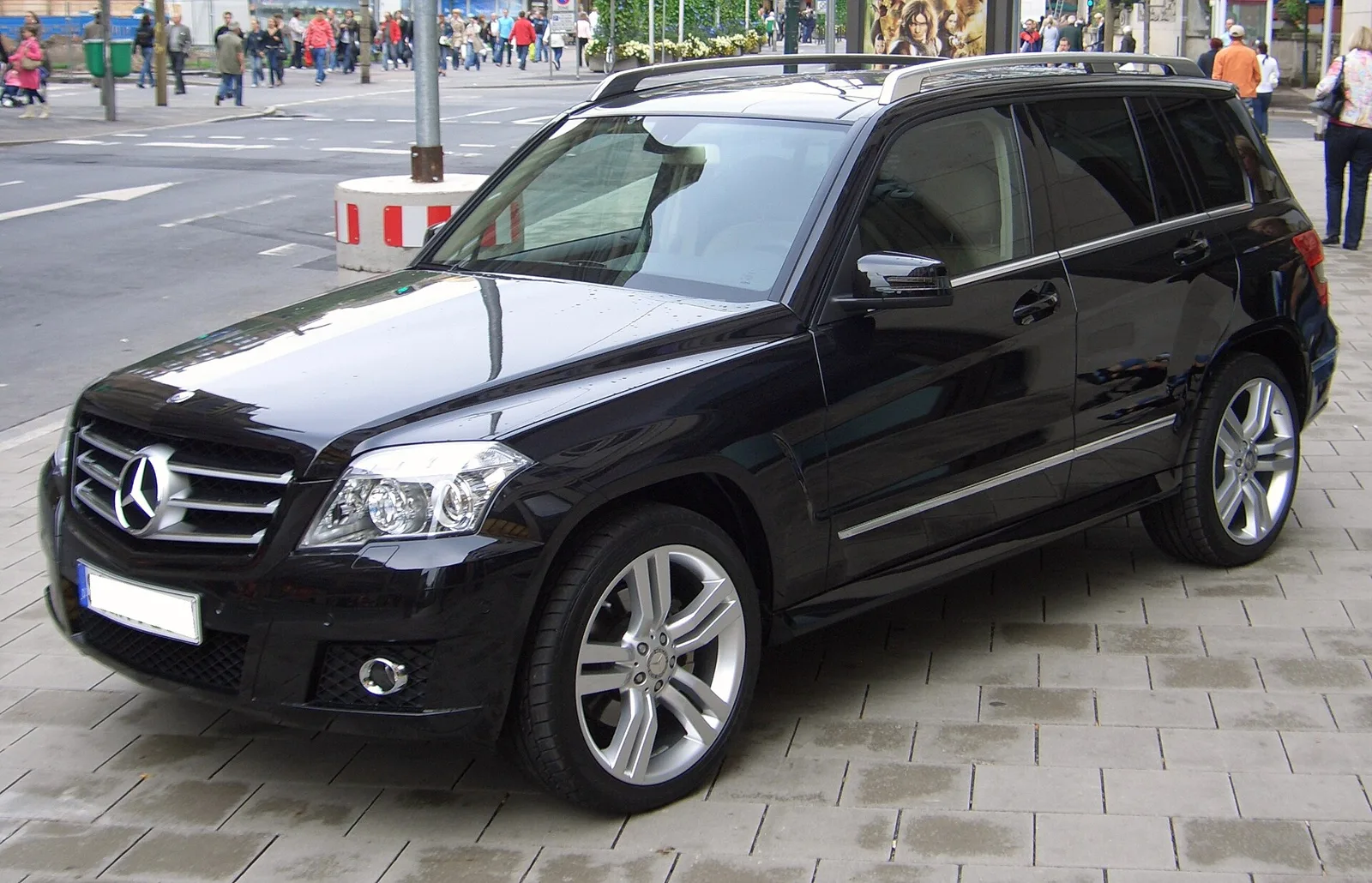
A boxy C-Class-based crossover that went on sale in 2008, spawned wild SEMA tuner builds and never reached right-hand-drive markets.
Mercedes-Benz built the GLK-Class, model code X204, between 2008 and 2015 as a compact luxury SUV on the C-Class platform. Shown first in Beijing, it sold in all-wheel drive only at the start and was never offered in right-hand-drive countries.
The Mercedes-Benz GLK-Class, known internally as the X204, was a compact luxury crossover SUV built from 2008 to 2015. It debuted at the 2008 Beijing Auto Show, borrowed its underpinnings from the C-Class and gave way to the GLC when the brand revised its naming scheme.
What is the Mercedes-Benz GLK-Class?
The GLK-Class is a compact luxury crossover SUV that Mercedes-Benz produced from 2008 to 2015, with the model code X204. It first appeared at the 2008 Beijing Auto Show and rides on the platform of the W204 C-Class. In 2015 the GLC replaced it under the brand's revised SUV naming.
The design was heavily influenced by the C-Class, and the platform is the W204 architecture it shares with the C-Class. Work on the car continued even after a similar project, the Smart Formore, came to an end. The car was unveiled at Auto China 2008, which is the show better known in English as the Beijing Auto Show.
Most of what makes the GLK interesting is the way it was launched. Mercedes-Benz showed concepts, courted tuners at a US trade show, built a dedicated website and ran an order book that filled quickly. The sections below follow that story, as well as the engines, the safety equipment and the places where the car was and was not sold.
A compact C-Class-based SUV that Beijing launched in 2008 and Beijing later built.
What does the GLK name stand for?
GLK is an acronym for Gelaendewagen Luxus Kompaktklasse. The name comes from the larger GL-Class, which was itself named after the G-Wagen, or Gelaendewagen. Put simply, the G is the original, the GL is its luxury-minded descendant, and the GLK shrinks the GL to a compact size.
The naming changed when the car was replaced in 2015. Under the revised scheme, SUVs begin with GL, and the following letter shows where the model sits in the Mercedes-Benz hierarchy. The G alludes to the long-running G-Wagen, which the German word describes as an off-road vehicle, and the L acts as a link to the letter C. The GLC is therefore the SUV equivalent of the C-Class.
What were the Vision GLK concepts?
Mercedes-Benz showed two concepts in 2008. The Vision GLK Freeside was designed for light off-road duty, while the Vision GLK Townside was intended exclusively for driving on the road. They showed two possible characters for the compact SUV before the production car arrived.
The Freeside blended design features of the original G-Class with typical elements of the contemporary Mercedes-Benz passenger-car range. Its engine was a 2.2-litre BlueTec four-cylinder diesel rated at 170 PS (125 kW; 168 hp), mated to the 7G-Tronic seven-speed automatic transmission and 4Matic all-wheel drive. It was unveiled at the 2008 Detroit Auto Show.
The equipment list read like a preview of the brand's technology. It included the anticipatory Pre-Safe safety concept, the Intelligent Light System, the Command APS infotainment centre and a rear-seat entertainment system with two screens. Thermotronic 3-zone automatic climate control and Agility Control suspension completed the specification.
What was the Vision GLK Bluetec Hybrid?
It was a 2008 concept that paired a four-cylinder Bluetec diesel engine with a hybrid module. The electric motor produced a maximum of 160 newton metres (118 lb ft), and Mercedes-Benz showed the car at the 2008 Geneva Motor Show.
Visually it stood apart from the other concepts. It wore Alubeam Blue paint and 20-inch light-alloy wheels, and the upper dashboard was trimmed in black leather. Inside, a Command APS central display and Agility Control suspension appeared again, so the hybrid concept shared a good deal of its equipment with the Freeside.
How did the production GLK reach the market?
European models went on sale on 30 June 2008, with deliveries beginning in the autumn of that year. The car was offered with all-wheel drive only in Germany and North America at launch, though a rear-wheel drive version joined the range afterwards.
Demand was strong from the outset. Orders reached 10,000 by the end of July 2008, and 1000 of them were for the Edition 1. As of 3 November 2008 the company had logged 25,000 orders in Western Europe, with delivery beginning on 18 October 2008.
Local production followed in China. In December 2011 the first locally built GLK came off the line at the Beijing plant of Beijing Benz Automotive Co., Ltd., usually shortened to BBAC. A car first shown to the world in Beijing therefore became a Beijing-built product within a few years.
Which engines did the early GLK use?
The early German line-up was the GLK 220 CDI 4Matic BlueEfficiency, the GLK 320 CDI 4Matic, the GLK 280 4Matic and the GLK 350 4Matic. Four more arrived in 2009: the 220 CDI BlueEfficiency, 220 CDI 4Matic BlueEfficiency, 300 4Matic and 250 CDI 4Matic BlueEfficiency.
The 2009 changes also reshuffled existing models. The GLK 280 4Matic and the GLK 320 CDI 4Matic were replaced by the GLK 300 4Matic and the GLK 350 CDI 4Matic respectively.
What was the GLK Edition 1?
The Edition 1 was a special launch version based on the V6 models. It added an exterior sports package, 20-inch wheels, an Easy-Pack tailgate and tinted privacy glass in a special colour for the rear compartment, and 1000 of the first 10,000 orders were for it.
Inside, buyers got an interior sports package, black and white nappa leather seats from the designo range, an AMG multifunction leather steering wheel and a black roof lining. The cabin was rounded out by special aluminium trim pieces and the Command APS system, and the body was finished in calcite white.
Why was the GLK not sold in Britain or Australia?
Right-hand-drive markets, among them the United Kingdom and Australia, never received the GLK. The cause was a driveshaft that sends power to the front wheels on the 4WD versions. In a right-hand-drive car it would sit exactly where the steering column needs to go.
Because of that conflict, the two configurations could not be made to work together. The mechanical layout that gave the car its all-wheel drive therefore ruled out a straightforward right-hand-drive version.
How safe was the GLK?
The GLK carries a comprehensive restraint system built around seatbelt tensioners and nine airbags. The airbags deploy selectively, depending on the type and severity of a collision, so that the forces on occupants are reduced. The vehicle structure was rated Good, and the strength-to-weight ratio was 6.41.
The selective deployment is the practical detail. Rather than firing every bag in every crash, the system chooses which ones to use according to the type of impact.
What were the four SEMA concepts?
Mercedes-Benz USA worked with four tuners on custom versions of the upcoming 2010 GLK-Class, as part of the US launch in 2009. They were the Urban Whip, the Brabus Widestar, the RennTech Rally Racer and the Four Corners Rock Crawler.
The vehicles were unveiled at the 2008 SEMA Show and then shown at the 2008 Los Angeles Auto Show. Visitors could vote for their favourite in a Tuner Challenge, and the winner was announced on 2 December.
What was the Urban Whip?
The Urban Whip was a white roadster built by Boulevard Customs and NBS Performance on the GLK 350 4Matic. It had a custom wide-body kit developed with RoBrady Design, and custom lowering springs brought the body closer to the ground.
The wheels were 26-inch Asanti AF 150 chrome units with black accents, wrapped in 295/25 ZR26 Pirelli Scorpion tyres. Brembo brake kits supplied the stopping power, with two-piece floating rotors and 8-pot callipers at the front and matching rotors with 4-piston callipers at the rear.
The audio system was just as extreme. A 5.7 kW stereo system fed eight HD amplifiers and six JL Audio 13TW5 flat subwoofers, which suggests the car was designed as much for the show floor as for the road.
What was the Brabus Widestar?
The Brabus Widestar used a 320 Bluetec engine from other models sold in the United States, along with a Widestar bodyshell, redesigned bumpers, LED daytime running lights, side skirts and a roof spoiler with LED position lights. Brabus lowered the ride height by 30 mm with its chassis kit.
Wheels were 21-inch units with 295/30 ZR 21 tyres, and the brakes were upgraded to a high-performance system. The ECOPowerXtra tuning kit lifted output to 258 PS (190 kW; 254 hp) and 610 newton metres (450 lb ft).
The cabin used semi-aniline leather with diagonal stitching on the seats, door panels and floor in cognac, black leather on the upper dashboard and door panels and piano black wood trim. A multimedia system in the front seat backs offered a DVD player and 7-inch monitors.
The kit did not stay a one-off. The ECO PowerXtra tuning also appeared in Brabus's GLK 320 CDI 4Matic upgrade kit, and the Widestar was later offered as a conversion kit for any X204 built before June 2012.
What was the RennTech Rally Racer?
The Rally Racer was a hybrid built by Renntech on the GLK 350 4Matic, taking its cue from the winged, unlimited-class rally cars that race up Pikes Peak. A special intake manifold, cams, cylinder heads, long-tube headers and Renntech software raised power to 350 PS (257 kW; 345 hp).
The hybrid system combined a 72 volt electric motor with 12 volt plug-in batteries. Custom KW coil-over suspension and an aerodynamically tuned body kit helped it look the part, and the Renntech brake combination used two-piece rotors with 8-piston callipers at the front and plain discs with 4-pot callipers at the rear.
The wheels were 20-inch three-piece, five-spoke Renntech Sniper Gray units. They carried Nitto tyres, 275/40 at the front and 315/35 at the rear, giving the car a wider rear footprint.
What was the Four Corners Rock Crawler?
The Rock Crawler was built by Legendary Motorcar Company on the GLK 350 4Matic. Its design grew from a plan to make the GLK an interactive snowboarding car, and the ride height was raised with custom spacers.
The kit included a tow winch driven by a petrol engine, a stainless steel bar roof with grinding rails that swing out from the sides and a Perspex panel in the roof. Spacers on the rear lower control arm and billet aluminium spacers up front produced the extra height. Jesse James Black-Widow rims in an 18-inch size carried Toyo Open Country AT mud tyres, and the interior stayed stock.
Season 9 of Dream Car Garage covered how the Rock Crawler was constructed, which gave the project television exposure beyond the show floor.
How did Mercedes-Benz market the GLK?
Before the 2008 Detroit Auto Show debut of the production car, a prototype GLK appeared in the film Sex and the City. The launch also included the website www.mercedes-glk.com, which offered an interactive music video that users could help design.
The site had a section called GLK Backstage, where visitors could discuss the car with the engineers who created it. Alongside the film placement and the tuner vote, it made the launch an unusually participatory campaign for a compact luxury SUV.
What changed in the 2012 update?
The updated car made its debut in New York in 2012, at the International Auto Show there. The first models mixed diesel and petrol variants, with names running from the GLK 200 CDI BlueEFFICIENCY to the GLK 350 4MATIC BlueEFFICIENCY, and including the GLK 220 BlueTEC 4MATIC and GLK 250 BlueTEC 4MATIC.
In the United States the early models were the GLK 350 and GLK 350 4MATIC BlueEFFICIENCY, sold as 2013 model-year cars from summer 2012. The GLK 250 BlueTEC 4MATIC followed in early 2013. The updated range gave every petrol engine direct fuel injection and an ECO start/stop function.
What are the Mercedes-Benz GLK-Class specifications?
| Specification | Detail |
|---|---|
| Model code | X204 |
| Type | Compact luxury crossover SUV |
| Production | 2008 to 2015 |
| Debut | 2008 Beijing Auto Show (Auto China 2008) |
| Platform | C-Class W204 |
| Drive | All-wheel drive at launch; rear-wheel drive added later |
| 2009 replacements | GLK 300 4Matic for the 280; GLK 350 CDI 4Matic for the 320 CDI |
| Edition 1 | V6 models, 20-inch wheels, Easy-Pack tailgate, calcite white |
| Safety | Nine airbags; structure rated Good |
| Orders | 10,000 by the end of July 2008; 25,000 in Western Europe by 3 November 2008 |
| Local production | Beijing, from December 2011 |
| Successor | GLC, from 2015 |