A seven-seat people carrier from 1999 with a Ford twin in Asia, a Wankel hydrogen prototype and a successor to the Mazda5 that never came.
The Mazda Premacy was a seven-seat minivan built by Mazda from 1999 to 2018. Sold as the Mazda5 abroad from 2005, it had a Ford twin in Asia, a hydrogen Wankel prototype and no successor when production ended.
The Mazda Premacy was a passenger minivan that Mazda built from 1999 to 2018. The first generation was made in Japan for Europe and Asia, and from the second generation onward the car sold abroad as the Mazda5. Ford sold a rebadged version in some Asian markets, and the company's Taiwanese arm later built its own version of the second generation.
What was the Mazda Premacy?
The Premacy was a people carrier with two or three rows of seats, offering five or seven passengers depending on the layout. Both generations had near-flat floors, a second row that could be folded or removed, and rear seats that folded flat, which made them practical load carriers as well as family cars.
The second generation gained a third row for up to six passengers in North American form and seven in the rest of the world. Mazda called the family a compact minivan, though it was later viewed in the United States as a mini-minivan.
A seven-seat people carrier from Mazda's Japanese plants that went abroad as the Mazda5.
How did the first generation Premacy launch?
Mazda unveiled the first generation at the Geneva Motor Show on 9 March 1999, and it went on sale in April. At the time it was one of the cheapest seven-seaters on the market. Buyers could choose front-wheel drive or all-wheel drive, and the car came with a four-speed automatic transmission.
Rows two and three could be taken out or folded flat, a common arrangement among minivans of the day. The first generation was also built by China's FAW Haima, which sold it as the Haima Freema until a second generation Freema on the same platform replaced it.
Why did Ford sell a Premacy twin as the Ixion?
Ford Lio Ho, the Taiwanese company that was controlled by Ford from 1998, developed a redesigned version of the first generation known as the Ford Ixion. Ford models could reach showrooms before equivalent Mazda models, and they could be priced more competitively with better equipment.
The Taiwanese Ixion MAV had its own front and rear styling, with Ford's design identity, and it arrived in Taiwan in 1999, two weeks before the local Premacy. The Halo Gold paint used on the Japanese Premacy was reserved for the MAV, which also offered a Panasonic AV800 audio system, satellite navigation and optional reverse cameras. Sales dropped behind the Mazda from the second month and never recovered.
The international Ixion had different grilles, bumpers and rear lights, and it adopted Ford's New Edge styling. It was built in Japan alongside the Premacy and was mechanically identical, so it was essentially a rebadged Mazda with minor differences. Two-row models were dropped in 2001, and Ford ended the production of its rebadged cars in Japan in 2003.
What engines did the first generation use?
The first generation offered two petrol sizes and two diesel options. The 1.8-litre FP-DE four-cylinder came in two outputs, 100 PS (74 kW; 99 hp) with 152 N-m of torque and 114 PS (84 kW; 112 hp) with 161 N-m. A 2.0-litre petrol four made 131 PS (96 kW; 129 hp) with 170 N-m, and the diesel versions produced 90 PS or 100 PS.
The Taiwanese Ixion MAV used a 1.8-litre 16-valve DOHC engine rated at 135 hp, with a four-speed automatic shared with the Ford Tierra. The MAV name stood for multiple activity vehicle, and the car was sold in two trim levels.
What changed for the Mazda5 in 2005?
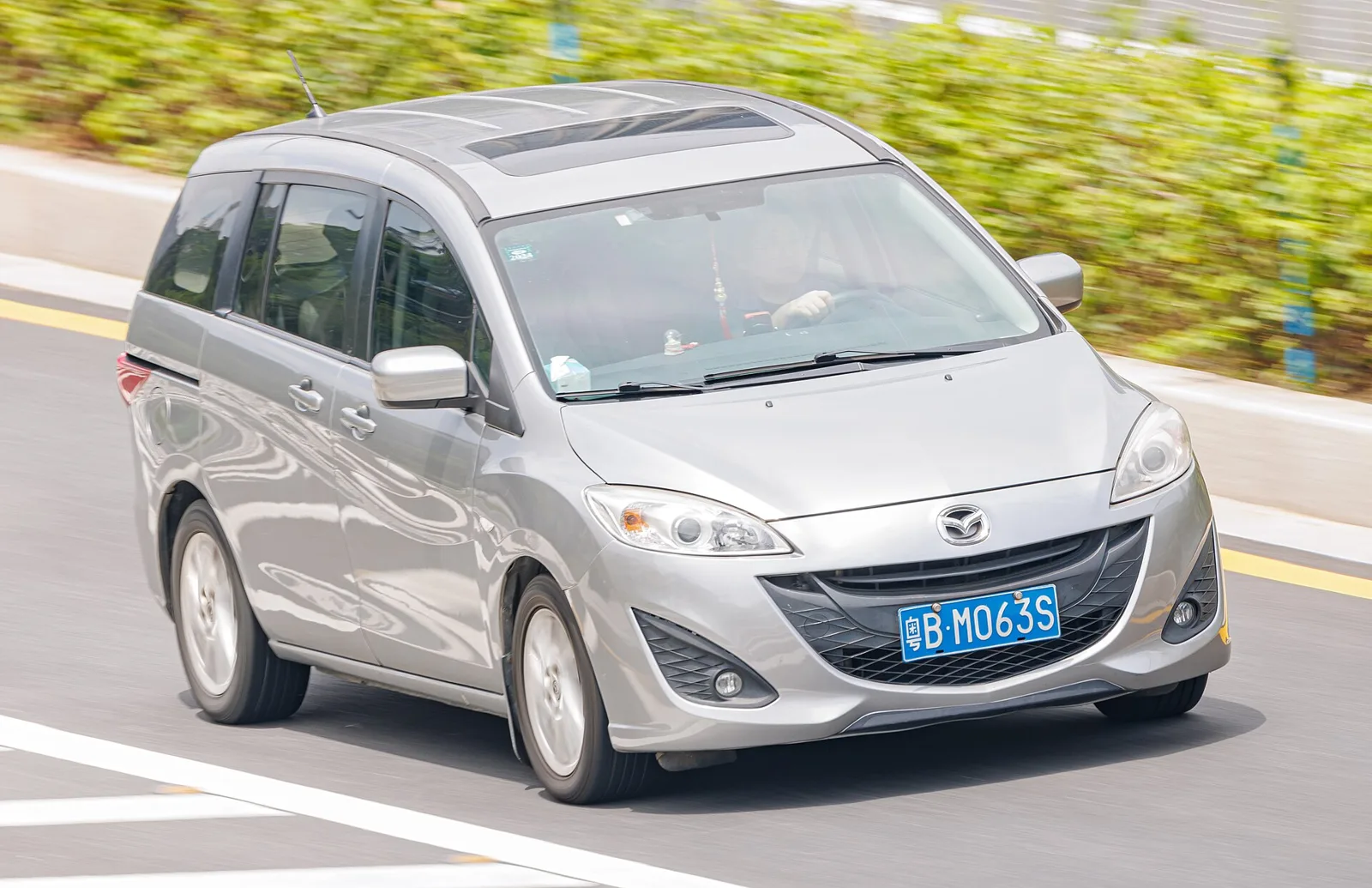
The second generation went on sale in Japan on 7 February 2005, with export markets following in mid-2005. It was bigger than the first generation in every respect, and it was sold as the Mazda5 everywhere except Japan. It replaced the Mazda MPV as the company's minivan in most export markets.
The car was built on Ford's global C1 platform, so it shared many parts with the Mazda3. It had first appeared as the MX-FLEXA concept at the 2004 Geneva Motor Show and was officially unveiled at the Paris Motor Show that autumn. In Asia it was sold as the Ford i-Max, and the Mazda5 became the first compact minivan on sale in the United States since the mid-1990s.
How did the Mazda5 seat seven people?
Outside North America the Mazda5 used the Karakuri Seating System, which gave three rows of two seats and a seventh fold-away jump seat in the centre of the middle row. The North American cars were limited to six passengers, because of local safety rules, with two seats in each of the three rows.
The middle row reclined, slid front to back and folded flat, and the rear row also folded flat. Three-point belts were fitted to all seven seats, which was a practical point for the family buyers Mazda was aiming at.
What were the second generation dimensions and engines?
The second generation had a wheelbase of 2,750 mm (108 in) and an overall length of 4,610 mm (181 in). Japanese cars were shorter, with the C and F models at 4,505 mm (177.4 in) and the S model at 4,565 mm (179.7 in). The engine range ran from the 1.8-litre MZR four at 85 kW (116 PS; 114 hp) to the 2.3-litre MZR at 117 or 119 kW.
The 2.0-litre MZR made 110 kW (150 PS; 148 hp), and a 2.0-litre MZR-CD diesel offered 89 or 105 kW. Mazda's automatic in the early US cars was a four-speed, which later figured in a recall.
Why was the Mazda5 recalled?
Shortly after production began, Mazda recalled Mazda5s in the United States because of a risk of exhaust system fires. Owners who did not realise the four-speed automatic had a manual shifting mode, often called sport mode, could leave the shifter in that position, and the car would stay in second gear at high temperature.
Mazda's fix was a heat shield around the muffler and a software change that limited high engine speeds in sport mode. Although manual cars did not seem to need the recall, Mazda chose to retrofit every Mazda5. Owners received US$500 (C$500 in Canada) and a loaner car while the work was done. A total of 2,700 vehicles were affected.
How did the 2006 and 2008 updates change the Mazda5?
For 2006 Mazda offered fewer options in North America than elsewhere. The North American car lacked the front-to-back roof rails that other markets had as standard, and it had no back-up camera or power-assist side doors. A second-row DVD system became a dealer-installed extra.
For 2008 the car received a mid-cycle refresh, with an updated front bumper, new wheels and rear LED lights on the Touring and Grand Touring trims. The automatic gained a fifth gear, and the dashboard gained luminescent gauges, a radio layout with an auxiliary input, a rear air vent and armrests for the first and second rows on North American cars.
In 2010 Mazda added electronic stability control and traction control, safety equipment that critics had noted was missing from the earlier cars.
What was the Premacy Hydrogen RE Hybrid?
The Premacy Hydrogen RE Hybrid, shown in 2007, used a two-rotor Wankel engine that could run on hydrogen or gasoline. Its hydrogen tank held 110 litres (24 imp gal; 29 US gal) at 350 bar, storing up to 2.4 kg (5.3 lb) of hydrogen. A separate 60-litre (13 imp gal; 16 US gal) gasoline tank sat alongside it.
The car remained a prototype design, and it shows how Mazda explored alternatives to the petrol and diesel engines of its mainstream range. Wankel rotary technology had been a Mazda speciality for decades, and the hydrogen version was the most unusual variant of the Premacy family.
How did the Mazda5 do on awards and safety tests?
A 2006 Canadian award panel picked the Mazda5 as its top family people carrier. Consumer Reports placed it first among tall wagons, yet withheld a recommendation because the reliability record was unclear.
In April 2006 the Japan New Car Assessment Program awarded the Mazda5 a maximum six stars for front-occupant crash protection. Euro NCAP gave it a maximum five stars for adult occupant safety in September 2005.
What was the Ford i-Max?
Ford Lio Ho in Taiwan created the i-Max as the successor to the Ixion MAV, which had been dropped in 2005. It used Ford's Kinetic design language, with a redesigned front end, horizontal tail lamps and side vents inspired by the Ford S-MAX.
The i-Max was powered by a Duratec-HE 2.0-litre inline-four producing 148 hp, with a four-speed sequential sport automatic. It debuted in July 2007 in four trims, including a five-seat GLX, two seven-seat Ghia versions and a six-seat Ghia-Limited. A facelift in 2010 added a rear fog lamp, smoked headlamps and red tail lamp lenses.
What did the third generation Mazda5 bring?
The third generation, which began production on 13 May 2010, was the first Mazda to use the Nagare design language. Its name means flow, and the look was first developed for a 2006 show car. The front fender curve runs past the wheel arch and onto the flank.
In Europe the car was offered with a 1.6-litre turbo-diesel, a 1.8-litre four, and a 2.0-litre direct-injection petrol with Mazda's i-stop start-stop system, which reduced emissions by 15 percent. All European engines came with a six-speed manual as standard. In the United States, a 2.5-litre four with 157 hp (117 kW) arrived for 2012, and the Japanese grades were 20CS, 20E and 20S.
Taiwanese versions were built by Ford Lio Ho. Sales in Japan began on 1 July 2010, and the car was phased out in Europe and the United States by 2015.
How did the 2013 update and the end of the Premacy come?
In January 2013 Japanese models gained the Skyactiv-G 2.0-litre engine and a six-speed Skyactiv-Drive automatic. The Skyactiv car was rated at 16.2 km/L (45.8 mpg-imp; 38.1 mpg-US) on the Japanese JC08 cycle.
In the United States 2015 was the last Mazda5 model year, as Mazda shifted its focus to crossovers. The car continued to be sold in Canada for 2016 and 2017. Mazda announced in 2018 that the Premacy would end, and it would have no direct successor because the company had left the minivan market to focus on SUVs and cars. Sales in Japan ended on 23 February 2018, alongside the Biante.
What was the Nissan Lafesta Highway Star?
The Nissan Lafesta Highway Star was a rebadged Premacy supplied to Nissan on an original equipment basis. It had a restyled front end and flatter door panels. Sold only in Japan, it went on sale on 15 June 2011.
What are the Mazda Premacy specifications?
| Specification | Detail |
|---|---|
| Built | 1999 to 2018, Japan |
| First generation petrol | 1.8 L FP-DE four, 74 kW (100 PS), 152 N-m |
| First generation top petrol | 2.0 L I4, 131 PS (96 kW; 129 hp), 170 N-m |
| First generation diesel | 2.0 L diesel I4, 90 PS to 100 PS, up to 230 N-m |
| Taiwanese Ixion MAV | 1.8 L 16-valve DOHC, 135 hp, four-speed automatic |
| Second generation wheelbase | 2,750 mm (108 in) |
| Second generation length | 4,610 mm (181 in); Japanese C and F models 4,505 mm (177.4 in) |
| Second generation petrol | 1.8 L MZR, 85 kW (116 PS; 114 hp); 2.0 L MZR, 110 kW (150 PS; 148 hp) |
| Second generation large petrol | 2.3 L MZR, 117 or 119 kW (159 to 162 PS) |
| Second generation diesel | 2.0 L MZR-CD, 89 or 105 kW |
| Third generation US engine | 2.5 L four, 157 hp (117 kW), from 2012 |
| Skyactiv economy | 16.2 km/L (45.8 mpg-imp; 38.1 mpg-US), JC08 |
| Ford i-Max engine | 2.0 L Duratec-HE inline-four, 148 hp |