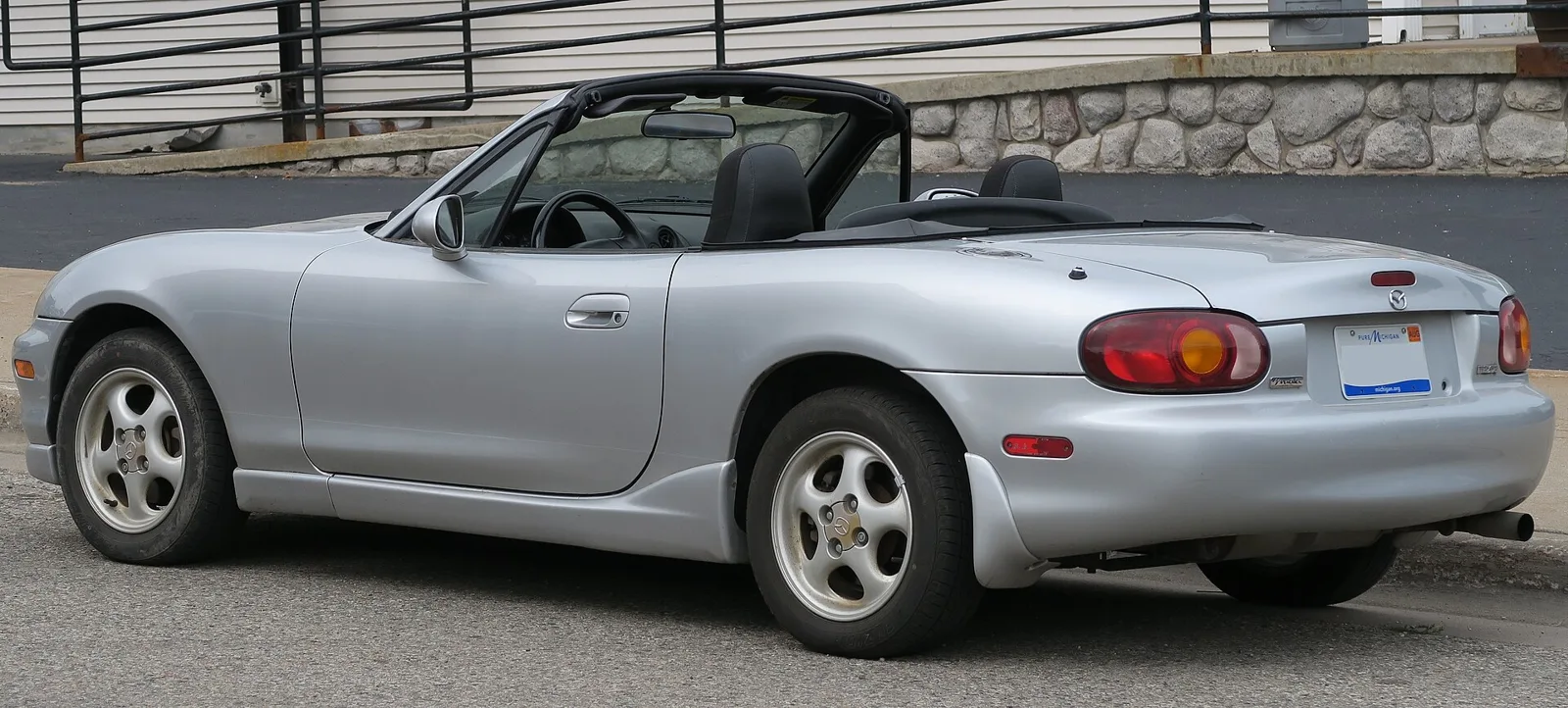
Fixed headlamps, a limited 10th Anniversary run and the turbocharged Mazdaspeed defined the NB chapter of Mazda's lightweight roadster.
Built between 1998 and 2005, the NB roadster swapped retractable headlamps for fixed ones, offered a 1.8 L engine rated at 104.4 kW (140.0 bhp), and spawned the turbocharged SP and Mazdaspeed models.
The Mazda MX-5 NB was the second generation of Mazda's lightweight roadster, built from 1998 until 2005. It kept the front mid-engined, rear-drive formula of the original car while adding a stronger engine, better brakes and a turbocharged Mazdaspeed model. It is also the only generation with a factory-built turbocharged variant.
What changed from the first-generation MX-5?
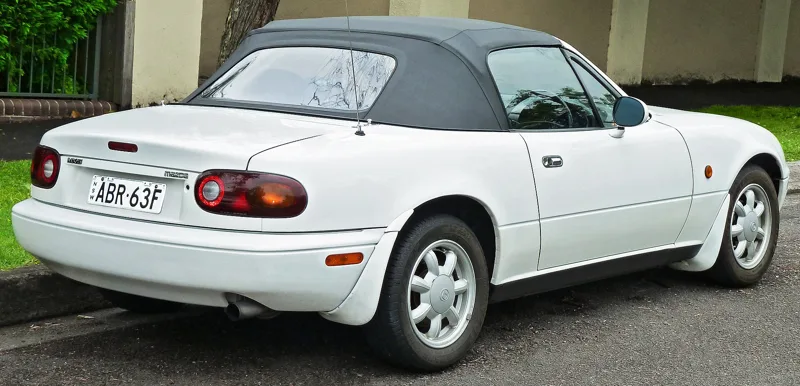
The most visible change was the headlamps. The first generation's retractable lamps no longer passed pedestrian safety tests, so the NB adopted fixed units. The body grew slightly wider than its predecessor and was more aerodynamic, with a drag coefficient of Cd=0.36, and the overall character stayed the same.
Many interior and body parts were different from the earlier car. Mazda added a glass rear window with a defogger for the convertible top, along with an optional hinged wind deflector behind the seats.
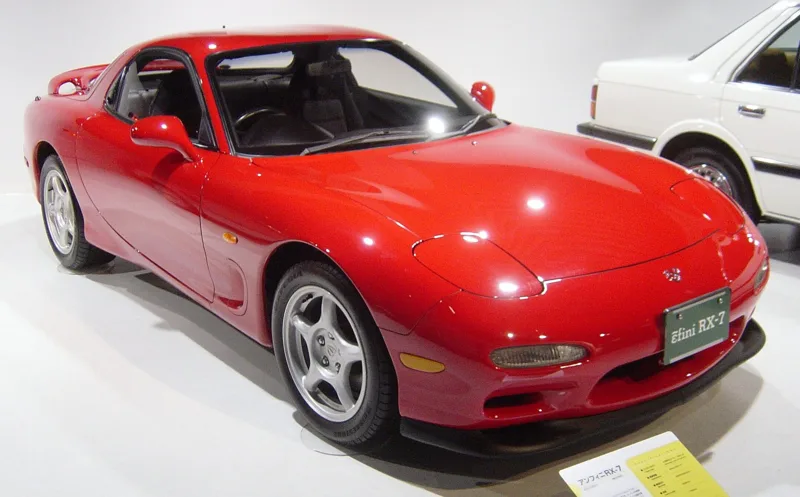
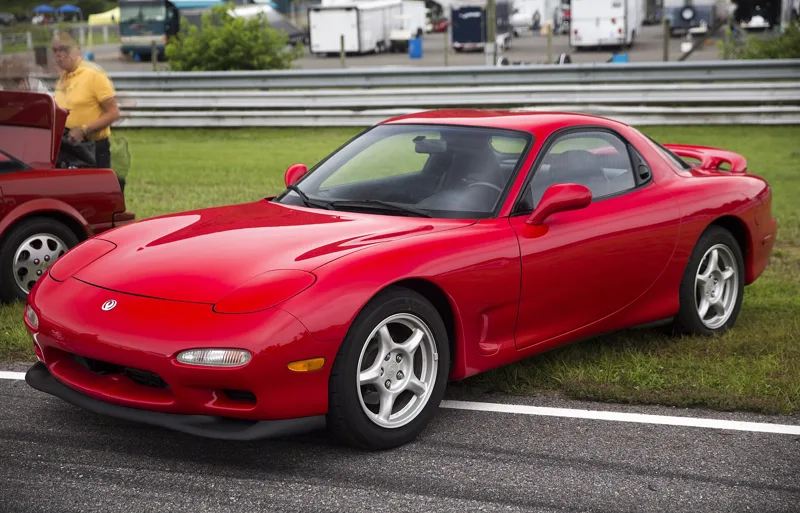
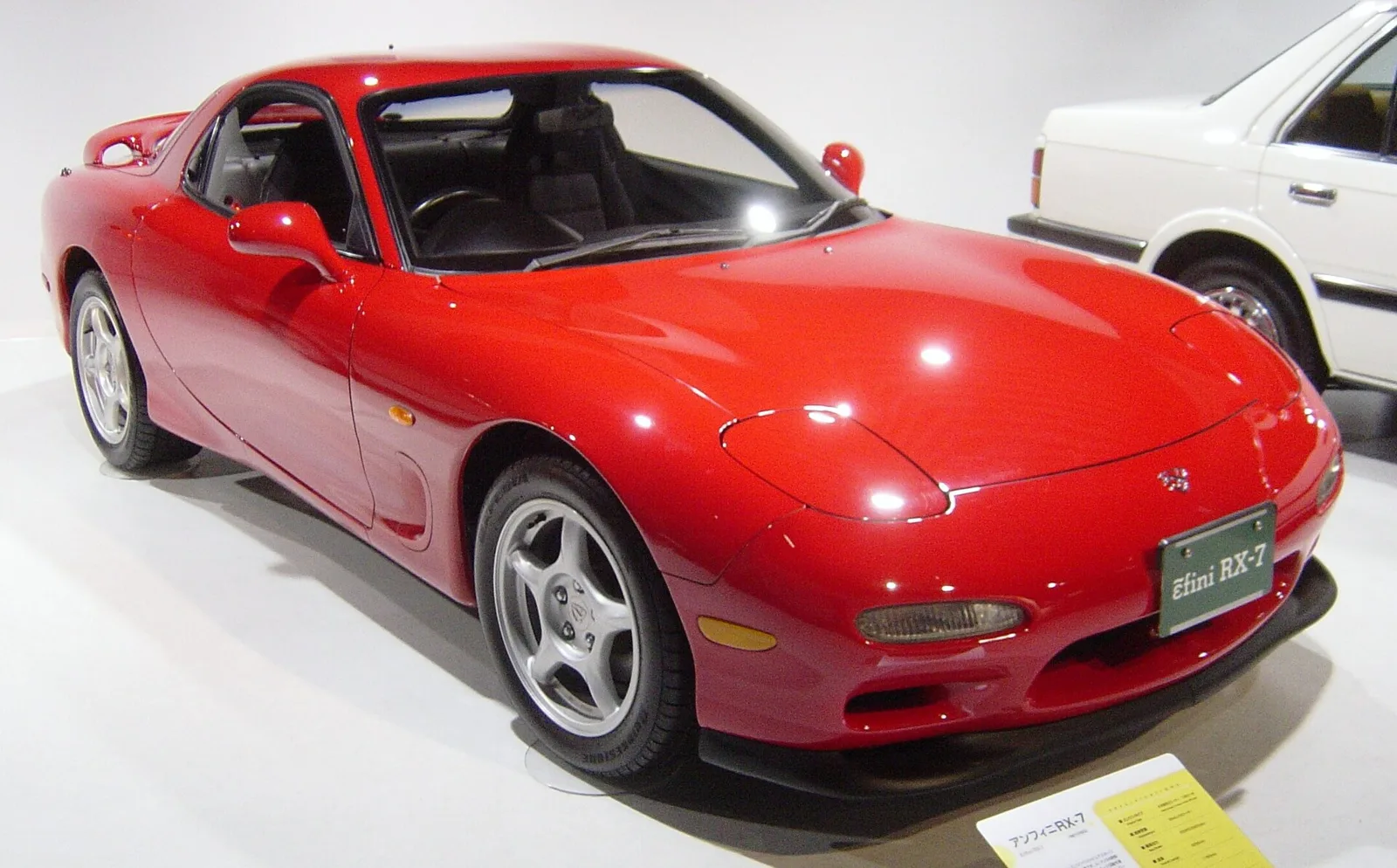
The styling borrowed cues from the third-generation Mazda RX-7, whose design dated from 1995 and was led by Tom Matano. In the United States, the MX-5's largest market, prices started at US$19,770 when the car arrived for the 1998 model year.
Fixed headlamps, a limited anniversary run and a turbocharged Mazdaspeed made the NB a distinct chapter of the MX-5 story.
How did the NB's engine and brakes change?
The 1.8 L (110 cu in) BP-4W engine stayed the same size but received a series of refinements. Compression rose from 9.0:1 to 9.5:1 through slightly domed pistons, and the intake camshaft gained a solid lifter design with a stronger profile. The new engine produced 104.4 kW (140.0 bhp) with 157 Nm (116 lbf ft) of torque.
Mazda's Variable Intake Control System was introduced at this point. At low engine speeds it gave the engine a long, narrow intake path that improved swirl, and at high revs it switched to a shorter, freer-flowing manifold for maximum breathing. The intake runners were straightened, and the manifold sat higher.
Europe and Japan kept a smaller 1.6 L (98 cu in) B6 engine. The base 1.8-litre car needed 7.8 seconds for its 0-100 km/h (62 mph) sprint, and top speed was 210 km/h (130 mph).
The NB kept four-wheel independent suspension, with larger anti-roll bars at both ends. The wheels, tyres and brakes saw bigger changes. Anti-lock braking became an option, and alloy wheels came in 14-inch (360 mm) or 15-inch (380 mm) sizes, with a 6-inch (150 mm) width depending on trim. Sports models used 195/50VR15 tyres.
What was the 10th Anniversary Model?
The 10th Anniversary Model was a 1999 limited edition marking ten years of the MX-5. It brought together several features that had until then been exclusive, including a 6-speed manual gearbox, Bilstein shock absorbers and a Torsen limited-slip differential. Polished 15-inch aluminium wheels with 195/50R15 tyres were standard.
Visually the car used Sapphire Blue Mica paint, called Innocent Blue in Japan, with two-tone black leather and blue Alcantara upholstery. Owners got a 3-spoke Nardi steering wheel with a leather wrap, a BOSE audio system and a carbon-grain centre console panel.
Every car was numbered in sequence, with the figure displayed on a badge near the front of the driver's side. Mazda President James E. Miller signed the accompanying certificate, which was dated 10 February 1999. Some markets also received a gift set with a 1:43 scale diecast model, two wristwatches and a keyring in a blue velvet box.
The sixth gear changed the figures. The car reached 100 km/h (62 mph) in 7.6 seconds, which was 0.3 seconds quicker than the standard five-speed according to Car and Driver and 0.4 seconds quicker according to Motor Trend. Top speed rose from 210 km/h to 214 km/h (133 mph), and combined consumption dropped to 8.0 L/100 km (35 mpg-imp; 29 mpg-US) from 8.5 L/100 km (33 mpg-imp; 28 mpg-US).
Why did the 10th Anniversary Model take so long to sell?
Mazda built 7,500 examples and promoted them heavily, yet it took more than a year to sell every car. Critics argued that too many had been produced, and the price was a factor too. The US manufacturer's suggested retail price of US$26,875 sat about $6,500 above a base model, which made the car harder to justify.
Distribution was broad. Europe received 3,700 cars, including 600 for the UK and 20 for Portugal. North America took 3,150, made up of 3,000 for the US and 150 for Canada. Japan received 500 and Australia 150, and car number 7,500 was sold in the UK.
US cars came with air conditioning, and roughly 100 units had the hard top. To tell the North American cars apart, US examples had a front dam and fog lights, while Canadian examples had a rear spoiler. Europe missed out on the sports appearance package and the air conditioning, so specifications varied by market.
The polished aluminium wheels proved a weak point. Once the thin lacquer coating was damaged they began to corrode, and Mazda ended up replacing thousands of sets under warranty. For comparison, 3,500 units of the third-generation NC Limited launch model were built in 2005, and regular limited editions rarely exceed 1,500 units per region.
Resale values told a similar story. A US unit numbered 3143 was 50 State emission legal and fitted with ABS. In California, cars like it sold with a premium of $3,500 to $5,000, and this one carried a $3675 premium, lifting its selling price to $30,550. It was sold in June 1999 for $28,950 without its Certificate of Authenticity.
What did the 2001 facelift change?
The 2001 facelift was a mix of visual tweaks and substantive upgrades. Fog lamps became standard equipment, the headlamps gained projector low beams with separate high-beam lenses, and the rear indicators changed from amber to clear. Inside, the centre console was redesigned and the seats gained more side support and taller headrests.
The top models, called Sport in the UK, received wheels measuring 16 inches (410 mm) and wearing 205/45VR16 low-profile tyres, larger brakes front and rear, extra chassis bracing, a limited-slip differential, a 6-speed manual, Bilstein suspension and leather seats. Those changes lifted lateral grip to 0.91 g in Car and Driver testing, and the body gained 16% in bending rigidity and 22% in torsional rigidity.
The 2001 car came in at 1,065 kg (2,348 lb) with minimal options. Under the bonnet the BP6D engine gained variable valve timing on the intake camshaft, and the intake and exhaust received minor upgrades. Output was 113 kW (152 bhp) in Japan, the UK and Australia, but only 107 kW (143 bhp) in the United States.
Mazda announced the changes in a press release dated 18 July 2000, describing the car as sportier and more forceful in its look. The new headlamps and wheels did most of the visible work, while the chassis changes were aimed at handling.
Why did Mazda offer to buy back 2001 cars?
Mazda's US catalogues had mistakenly quoted the power figure for the Japanese and Australian specification of the 2001 car. Car and Driver and many owners confirmed the missing power, and the company then made a buy-back offer to affected owners. Owners who declined the offer received an apology and free servicing for the warranty period.
The gap between 113 kW (152 bhp) and 107 kW (143 bhp) looked small on paper, but it mattered to buyers who had been quoted the higher number. The episode is a reminder that a single incorrect specification sheet can damage trust in an otherwise well-regarded car.
Which special editions followed the facelift?
Mazda built several niche models in the years after the facelift. The 2003 Shinsen Version was aimed at younger drivers and sat between the base model and the pricier LS. The Miata Club Sport and the Japanese-only Roadster Coupe reached much narrower audiences.
The Shinsen name means fresh and new in Japanese. It had most of the LS features, including cruise control and aluminum brush trim, but it came in an inverted colour scheme of the same year's Special Edition, with titanium silver paint, a dark blue roof and matching interior.
The 2003 Miata Club Sport was built at the request of the SCCA and featured prominently in that year's sales brochure. Only 50 were made, split evenly between 25 Classic Red and 25 Pure White cars, and buyers could choose a hard or soft top. It lacked power steering, air conditioning and ABS, but a Torsen limited-slip differential, a 5-speed Getrag gearbox and Bilstein suspension prepared it for SCCA Solo and road racing events.
In 2003 a division of Mazda in Japan also launched the Roadster Coupe, which had a fixed hardtop roof. The structure was reworked around the roof, which gave a noticeable rise in chassis stiffness at a cost of 10 kg (22 lb). Only 179 were made, which makes it one of the rarest MX-5 variants.
How quick was the MX-5 SP?
The 2002 MX-5 SP, short for Special Performance, was a limited run of 100 cars based on the 2001 facelift. It produced 150 kW (200 bhp), which put it 33% and 55% above the standard model in power and torque, and it reached 100 km/h in 6 seconds against 8.5 seconds for the base car. As of 2026 it remains the most powerful factory-built MX-5.
The SP's performance came from a long list of changes. A Garrett GT2560R turbocharger was fed by a cast Inconel exhaust manifold, the engine ran a custom ECU, and the car received a stainless exhaust and a carbon-kevlar air filter housing. Rerouting the air conditioning, power steering and wipers meant hundreds of unique parts. Only a visible intercooler and an SP decal at the rear hinted at the upgrade.
Mazda Motorsport tested the development prototype in the 2001 Targa Tasmania, entering it in road-going trim. It finished 20th outright, which gave the engineers real-world evidence on the road.
The SP cost far more than the base car. In Australia a 2002 SP sold for A$55,540, against A$40,530 for the base model. Allowing for inflation, its 2019 equivalent price would have been A$83,202. Its commercial success paved the way for the detuned Mazdaspeed MX-5 of 2004, which was aimed at a broader market.
What was the Mazdaspeed MX-5?
The Mazdaspeed MX-5 was the official turbocharged model, introduced for the 2004 model year as the Roadster Turbo in Japan. It used an IHI RHF5 VJ35 turbocharger on a turbocharged version of the BP-4W straight-four. Peak figures were 133 kW (178 bhp) at 6,000 rpm and 226 Nm (167 lbf ft) at 4,500 rpm, and a front-mounted intercooler cooled the boosted air.
Performance was rapid rather than extreme. Getting to 97 km/h (60 mph) took 6.7 seconds, and the top speed of 204 km/h (127 mph) was set by the 6,500 rpm rev limiter. Upgraded Bilstein shock absorbers, wider tyres, stronger clutch assemblies and drivetrain parts helped it pull over 0.98 g in lateral grip.
Racing Hart 17-inch (430 mm) alloy wheels and special interior trim set the car apart. For 2004 it was offered in Velocity Red Mica and Titanium Gray Metallic in the US, and in Velocity Red Mica in Canada. The 2005 model added Lava Orange Mica and Black Mica in the US, while Canada received only Titanium Grey Mica.
How many Mazdaspeed MX-5s were built?
US production of the Mazdaspeed MX-5 totalled 5,428 cars across the 2004 and 2005 model years. The first year accounted for 4,000 of them, while the 2005 run was cut to 1,428 after a fire at the production facility. Canada received 295 cars in 2004 and only 78 of the 300 planned for 2005.
Those totals do not include the other markets, so the wider count of turbocharged NB cars is higher. The SP and Mazdaspeed together show how Mazda moved from a low-volume halo model to a turbo car with broader appeal.
What was the Australian MX-5 SE?
In Australia the same car was sold as the MX-5 SE, with no Mazdaspeed branding except on the exhaust tip. It was slightly detuned to 121 kW (162 bhp), because its boost was 7.25 psi (0.5 bar) against 8.5 psi (0.6 bar) for the North American and Japanese cars.
The Australian car also used 3.63 differential gears and was offered in Sunlight Silver for 2005, alongside Velocity Red Mica, Titanium Gray Metallic and Black Mica. The SE has been used in both gravel and tarmac rallying in Australia, which showed how adaptable the platform was in competition.
How did the NB score in safety testing?
Euro NCAP rated MX-5s manufactured in 2002. The car earned 4 out of 5 stars for adults, but just 1 out of 4 for pedestrians. The organisation called that a poor performance, even though the low bonnet profile meant the leading edge did not need to be tested.
The pedestrian score connects to the NB's own history. The retractable headlamps of the first generation had been replaced because they did not pass pedestrian tests, so the rating shows that a change in one area did not settle the wider question of pedestrian protection.
How was the NB received by critics?
Car and Driver placed the NB on its 10Best list for 1998 and 1999, and again for 2001. The magazine also measured 0.91 g of lateral grip on the facelifted car. Those results reflected the balance and feel that the roadster was built around, and they helped it hold a strong reputation with enthusiasts.
The car also found its way into popular culture. It appeared as a hero car in the 1998 television series V.I.P. Anime fans know it from Initial D, where Satoshi Omiya, the downhill racer of Team 246 in Kanagawa, drives an orange NB8C with an oversized rear wing. His race ends in a spin after that wing snaps.
What were the Mazda MX-5 NB specifications?
| Specification | Detail |
|---|---|
| Production | 1998 to 2005 |
| Base engine | 1.8 L (110 cu in) BP-4W, 104.4 kW (140.0 bhp), 157 Nm (116 lbf ft) |
| Europe and Japan engine | 1.6 L (98 cu in) B6 |
| Drag coefficient | Cd=0.36 |
| Base 0-100 km/h | 7.8 seconds; top speed 210 km/h (130 mph) |
| 2001 weight | 1,065 kg (2,348 lb) with minimal options |
| 2001 facelift output | 113 kW (152 bhp) in Japan, UK and Australia; 107 kW (143 bhp) in the US |
| SP (2002) | 150 kW (200 bhp), 0-100 km/h in 6 seconds; 100 built |
| Mazdaspeed MX-5 | 133 kW (178 bhp), 226 Nm (167 lbf ft), 204 km/h (127 mph); 5,428 US cars in 2004 and 2005 |
| Australian SE | 121 kW (162 bhp), 3.63 differential gears |
| 10th Anniversary (1999) | 6-speed manual, 7.6 seconds 0-100 km/h, 214 km/h (133 mph); 7,500 built |
| Euro NCAP (2002 cars) | 4 of 5 stars adult; 1 of 4 stars pedestrian |