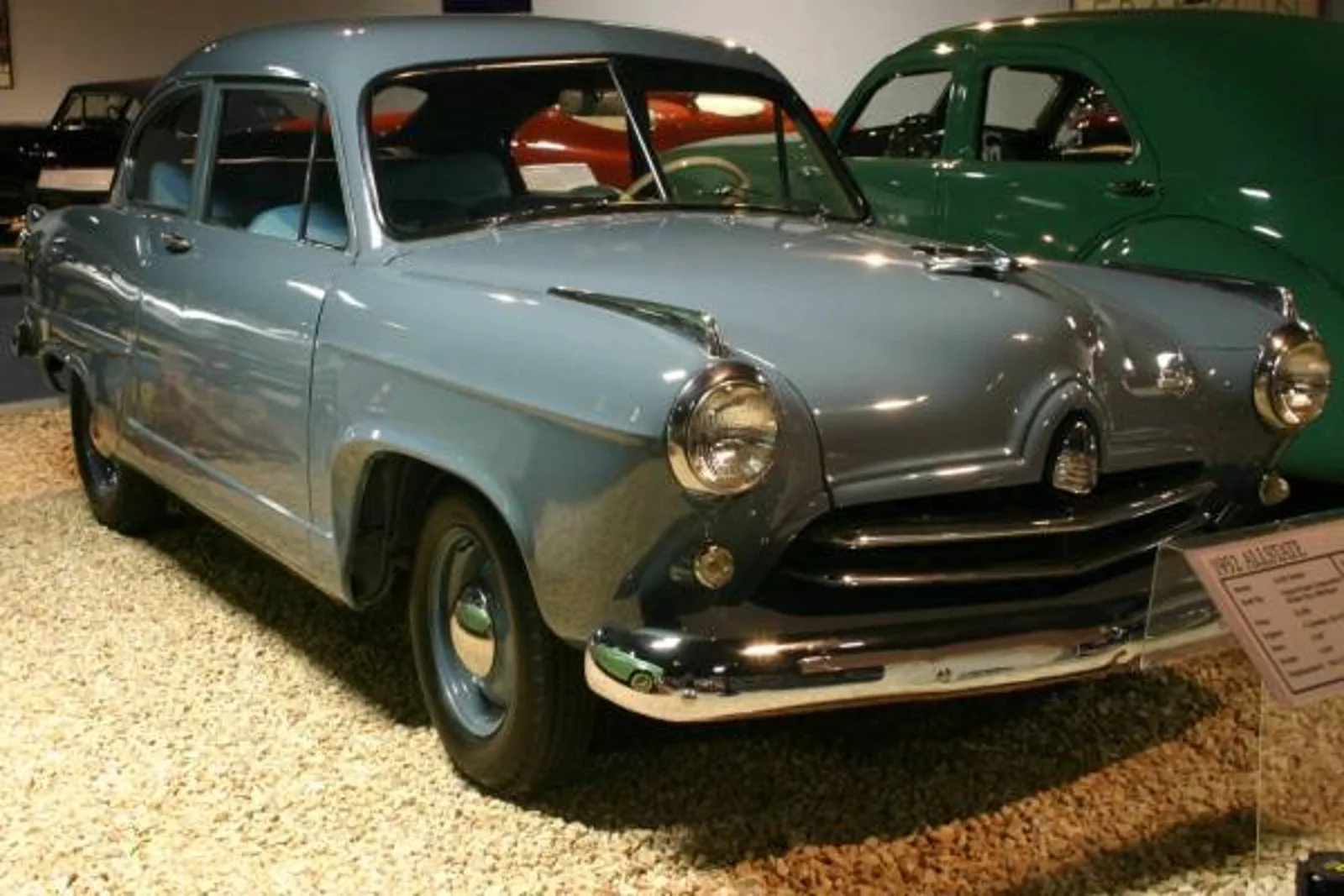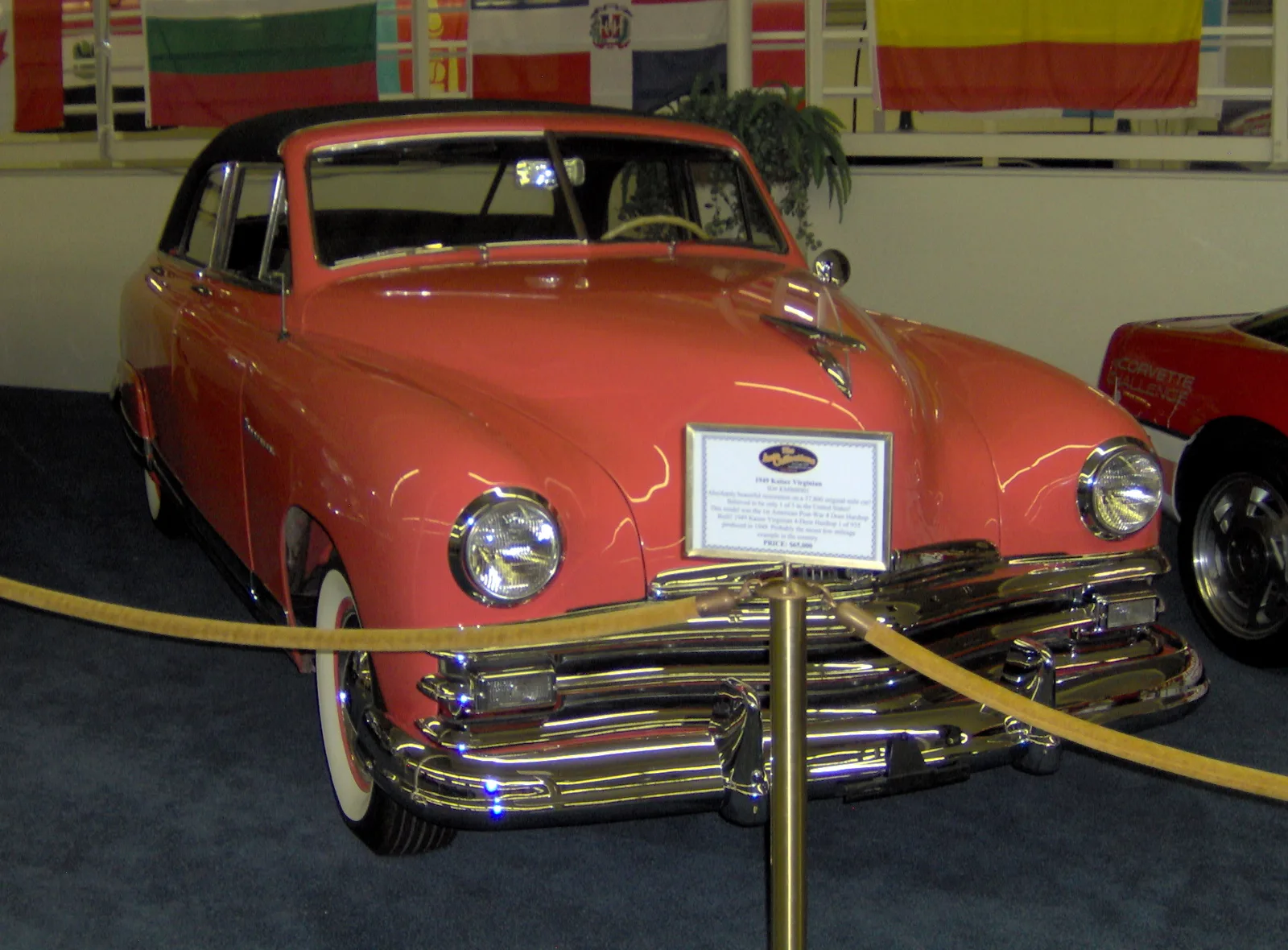
A pontoon saloon from Willow Run that gave Kaiser its face, with a Darrin Dip roof and a range reworked almost every season.
Built by Kaiser-Frazer in Michigan from 1946, the Kaiser Special was a four-door saloon with a 3,707 cc six-cylinder engine and a Darrin Dip roof from 1951. Its range changed nearly every season before car production ended in 1955.
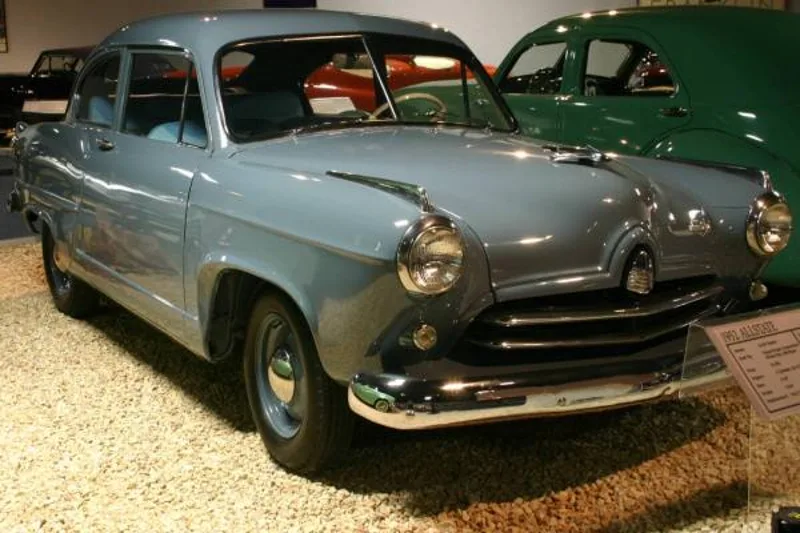
The Kaiser Special was a four-door pontoon saloon that Kaiser-Frazer launched in August 1946 from its plant at Willow Run, Michigan. It came with front-hinged doors and a split windscreen, and across nine model years the company changed its engines, trim and body styles almost every season until car production ended in 1955.
Where did the Kaiser Special come from?
The Kaiser Special came from the Kaiser-Frazer Corporation, which built it in Willow Run, Michigan, and launched it in August 1946 as the "Model 1947". A near-identical car with slightly better equipment had already appeared in June 1946 under the name Frazer Standard, and the Kaiser was one of the first pontoon bodies built in the USA.
The four doors were hinged at the front and carried swing-out quarter windows, while the windscreen was split into two parts. Under the body sat a box-section chassis, the frame on which the rest of the car was built.
Its success left something to be desired, because almost nobody wanted such an ugly car.
What engine did the Kaiser Special use?
The Kaiser Special had a front-mounted six-cylinder in-line engine with side valves, a displacement of 3,707 cc (226.2 cu in) and an output of 100 PS (74 kW; 99 hp) at 3,600 rpm. Power went to the rear wheels through a single-plate dry clutch and a manual three-speed synchromesh gearbox with steering-column shift.
A split propeller shaft carried the drive, and an overdrive could be ordered on request. The rear axle was rigid and sat on leaf springs, while the front wheels were each carried on double wishbones, with coil springs and an anti-roll bar.
The car used roller steering and hydraulically operated drum brakes on all wheels, and it had telescopic dampers at each corner.
How did the engine develop over the years?
Output rose in steps across the range, though the early changes were modest. From mid-way through the 1948 model year a twin-carburettor version giving 112 PS (82 kW; 110 hp) was available at extra cost, and from 1951 every model had twin carburettors and 115 PS (84.5 kW; 113 hp).
The 1953 model year brought an engine with 118 PS (87 kW; 116 hp) at the same displacement. The 1954 Supercharged Manhattan went further with 140 PS (103 kW; 138 hp). Despite the name, that engine was naturally aspirated, with no turbocharger or compressor.
Which model years and trims did Kaiser offer?
Kaiser sold the car as the Special, the Custom, the DeLuxe, the Manhattan and the Dragon, and each season renamed the series with a code such as K 481, K 501 or K 511. The Dragon began as a trim line in February 1951 and became a model of its own in 1953, when the economy Carolina also arrived.
Model year 1947
The entry model, the Special K 100, came with plain equipment, yet it already included hydraulic brakes, a radio and bumper horns. From September 1947 the better-equipped Kaiser Custom appeared, with the Custom K 101 series gaining whitewall tyres, extra chrome, a different dashboard and better seats.
Model year 1948
The 1948 cars began after the factory holidays of 1947, and the basic model, now the Special K 481, looked little changed. Minor alterations to the grille and bumpers, a slightly higher compression ratio with no effect on output, and slightly wider tyres marked the difference. The Custom K 482 adopted the Special's changes.
Model year 1949
The most striking change was the pair of broad chrome strips that replaced the old grille of small horizontal and vertical bars. New was the Special K 491, a tradesman's version called the Traveller Utility Sedan, with its left rear door welded shut and a folding rear seat. The spare wheel sat behind the driver's seat, and the split boot lid had an upper part with the rear window that swung up and a lower part that swung down.
Plastic seat covers and stronger springs and shock absorbers completed the van. That stronger chassis also served the taxi version, which offered room for the driver and up to seven passengers. The DeLuxe K 492 came with the stronger engine as standard and carpets for the front seats, while the four-door Virginian hardtop had no B-pillar and a contrasting roof.
Model year 1950
The facelift planned for 1950 was not ready in time, so it was postponed by a year and every model carried on unchanged. Renamed, the Special K 491 turned into the K 501 and the DeLuxe K 492 into the K 502. The only real change was that the Traveller Utility Sedan was now also sold in DeLuxe form under the name Vagabond.
Model year 1951
The major redesign that had been planned for the previous year was ready in 1951. The cars were lower and longer overall, and despite a slightly shorter wheelbase they offered more room inside. The taxi version was dropped, and the range gained a two-door saloon, a two-door Traveller and a two-door coupe with room for three passengers.
The DeLuxe K 512 lost the Virginian hardtop and the convertible, and instead offered the Special's body styles. Its Club Coupe had a rear bench seat and seated six. From February 1951 the luxurious Kaiser Dragon offered thicker upholstery and an automatic gearbox.
Model year 1952
The cars of the 1952 model year appeared in December 1951 with few changes, and the Virginian name returned in front of the previous year's models. On 14 March 1952 the real 1952 models arrived. The DeLuxe K 521 replaced the basic Special, and the single-bar radiator grille with larger tail lamps made the cars look bigger still.
The new luxury model was the Kaiser Manhattan. The Manhattan K 522 replaced the earlier DeLuxe in that role and had carpets in every footwell. It won a Grand Prix d'Honneur at the Concours d'Elegance in Cannes, while the two Traveller Utility Sedan versions stayed in the price lists, though presumably only prototypes were built from the Manhattan line.
Model year 1953
Business for Kaiser-Frazer was no longer going well, so the 1953 changes were small and limited to one or another chrome strip and larger brakes. The coupe and two-door Traveller were dropped from the De Luxe K 531 and the Manhattan K 532.
The Dragon became a model in its own right as the Dragon K 530. It was presented on 31 October 1952, Halloween, and its standard equipment included an automatic gearbox, tinted glass, a four-speaker radio, whitewall tyres, a vinyl roof and gold-coloured nameplates. The Dragon came only as a four-door saloon.
The economy model was the Kaiser Carolina K 538, offered as a four-door saloon or a two-door Club saloon, with no chrome at all. Its success left something to be desired, because almost nobody wanted such an ugly car.
Model year 1954
A major facelift followed, but the cars left over from 1953 were sold off first as the Special K 545. The new cars got an oval grille with upright bars, a look shared with Buick that year. Their main headlamps had parking lamps set lower down, and a three-part panoramic rear window arrived too. The Special kept its 118 PS engine.
The Supercharged Manhattan K 542 had the new Special's styling with better equipment, and it carried the 140 PS engine.
Model year 1955
The last production year brought no major changes. The entry Special disappeared, leaving only the Supercharged Manhattan K 516, of which 1,231 were built.
Which cars went to Argentina and when did production end?
Of the 1955 cars, 1,021 went to Argentina to fulfil a large order, and the remaining 230 were sold in the USA alongside 270 left over from the previous year. Kaiser-Willys then stopped building cars and sold all its facilities to Industrias Kaiser Argentina.
What did the body styling look like?
The 1951 windscreen lost its centre pillar, and the roof gained a slightly V-shaped point at the centre of the front and rear. Known as the Darrin Dip after Howard A. Darrin, who worked for Kaiser, it gave both windows a slight wing shape and became the identifying mark of Kaiser automobiles.
The C-pillar had a reverse curve, a detail later known on BMW cars as the Hofmeister kink. One chrome cross bar of the radiator grille wrapped round the car's corners and added to its wide, flat look, and a rocket-shaped mascot sat on the bonnet.
Engine output by model year
| Model year | Engine | Output |
|---|---|---|
| 1947 | 3,707 cc six-cylinder, launch engine | 100 PS (74 kW; 99 hp) at 3,600 rpm |
| 1948 | Twin carburettors, extra cost from mid-year | 112 PS (82 kW; 110 hp) |
| 1951 | Twin carburettors on all models | 115 PS (84.5 kW; 113 hp) |
| 1953 | Same displacement | 118 PS (87 kW; 116 hp) |
| 1954 | Supercharged Manhattan, naturally aspirated | 140 PS (103 kW; 138 hp) |
Why does the Kaiser Special still matter?
The Kaiser Special shows how one pontoon body could be reworked again and again, from the 1949 chrome strips to the 1954 panoramic rear window. The Darrin Dip became the identifying mark of Kaiser cars from 1951 on.
The Carolina economy version drew few buyers, and the last cars of 1955 went largely to Argentina.