A saloon, coupe, wagon and pick-up on a separate frame, with V8 power, a Gran Torino trim and a starring role in a 1970s television drama.
The Ford Torino of 1972 to 1976 was an upper mid-size Ford on a separate box frame, sold as a saloon, coupe, wagon and pick-up. Its heavy body made it thirsty, and its Starsky and Hutch role made it world famous.
The Ford Torino of the 1972 to 1976 model years was an upper mid-size car from Ford, sold as a saloon, coupe and station wagon. Its Gran Torino versions were the better-equipped models, and the car is now counted among the least economical production cars of the 1970s. It became known worldwide through the television series Starsky and Hutch.
Where did the Torino name come from?
Torino is the Italian name of the city of Turin. Ford first used it for the 1968 model year on a well-equipped version of its Fairlane mid-size car, which was then called the Fairlane Torino. From 1970 the Torino became a separate mid-size range, and the Fairlane name was dropped after ten years.
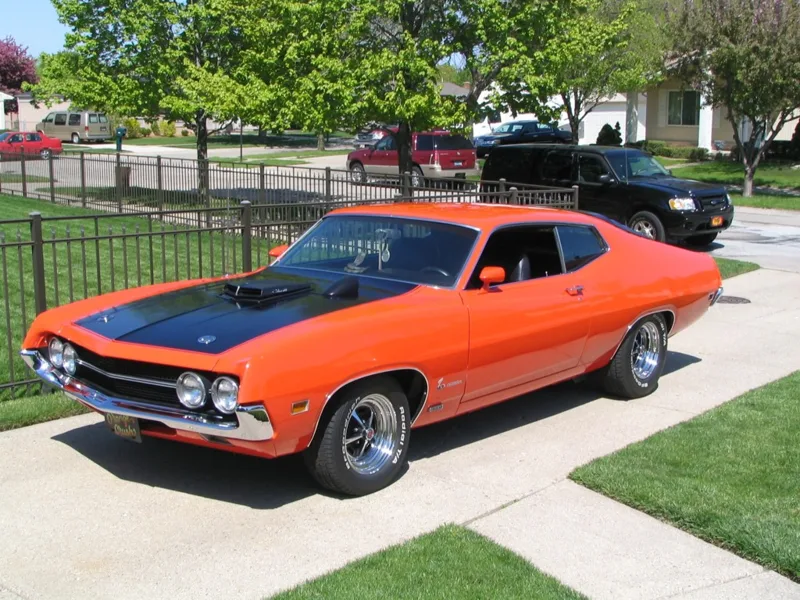
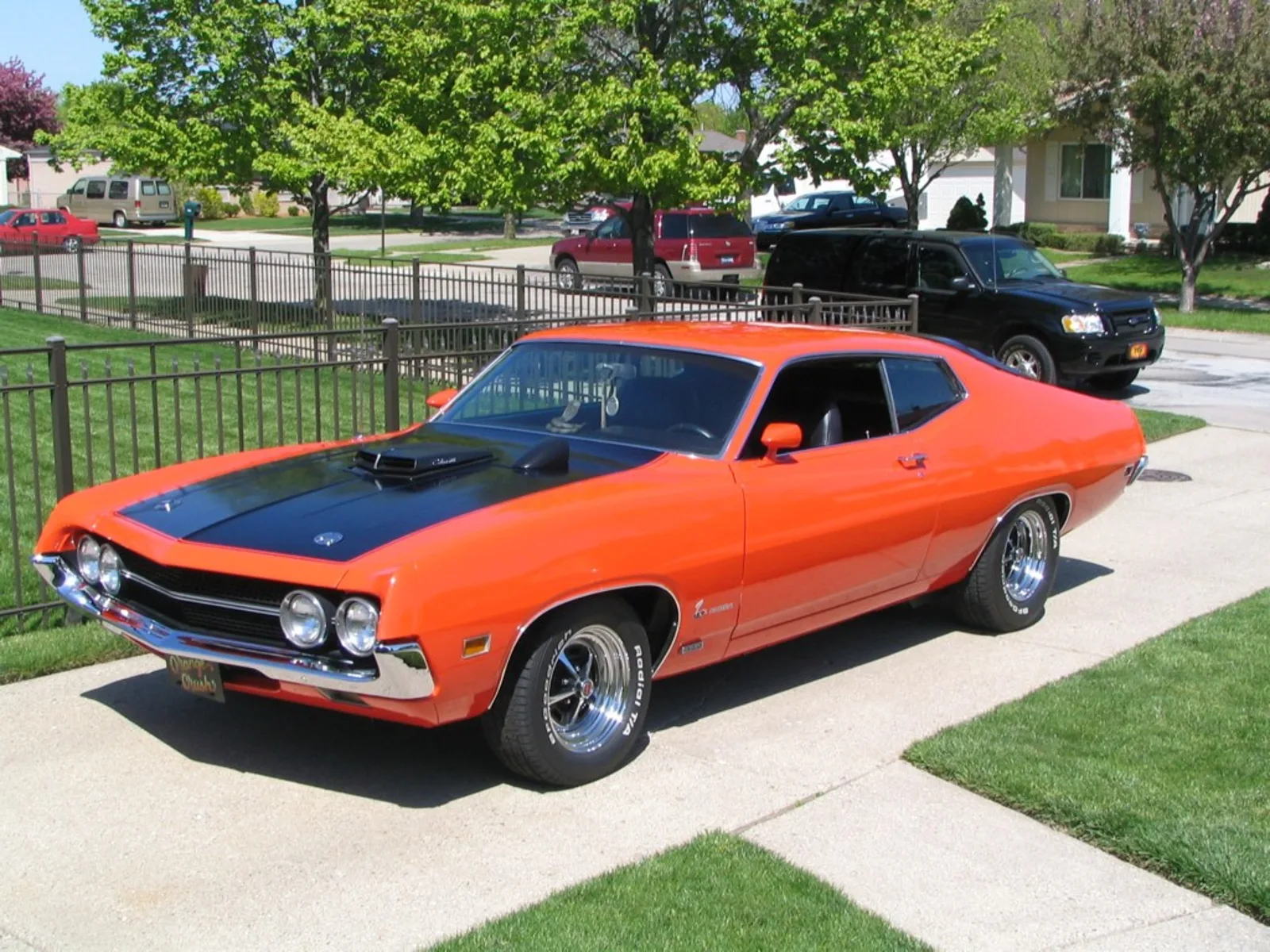
The 1970 and 1971 Torinos were large family cars with six- and eight-cylinder engines of 4.1 to 7.2 litres (250 to 439 cu in). The sporty Torino Cobra fastback came with a 375 SAE-PS (276 kW; 370 hp) engine, and it was also used in motor racing.
Until 1971 the range had a unitary body with a front subframe, and its front wheels sat on wishbones with coil springs. For 1972 Ford built a completely new car, which shared nothing with its predecessors apart from identical engines.
Heavy, thirsty and dressed in stripes for the cameras, the Torino grew well beyond its predecessors.
Why did Ford move to a separate frame?
The 1972 to 1976 Torino sat on a box frame with a steel body mounted on top, a clear break from the unitary construction of its predecessors. Ford said a separate frame reduced driving noise and vibration to a minimum, and it regarded the separate chassis as the best route to that goal. Critics replied that the choice mostly saved money and made later changes simpler.
Ford kept the same frame without alteration when the LTD II replaced the Torino in 1977.
How was the Torino styled?
Buyers could order the Torino as a saloon with four doors, a wagon with five, a coupe with two, or the Ranchero pick-up. The saloon and wagon had a wheelbase of 2,997 mm (118 in), while the two-door versions measured 2,895 mm (114 in).
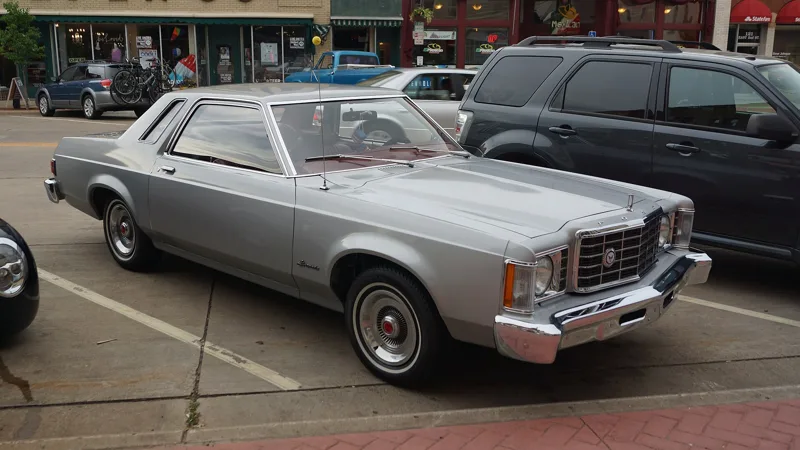
The two-door coupe came in two forms. The Sport Fastback Hardtop Coupe had a fastback roofline and was sold from 1972 to 1974, while the Formal Coupe had a suggested notchback and ran from 1972 to 1976.
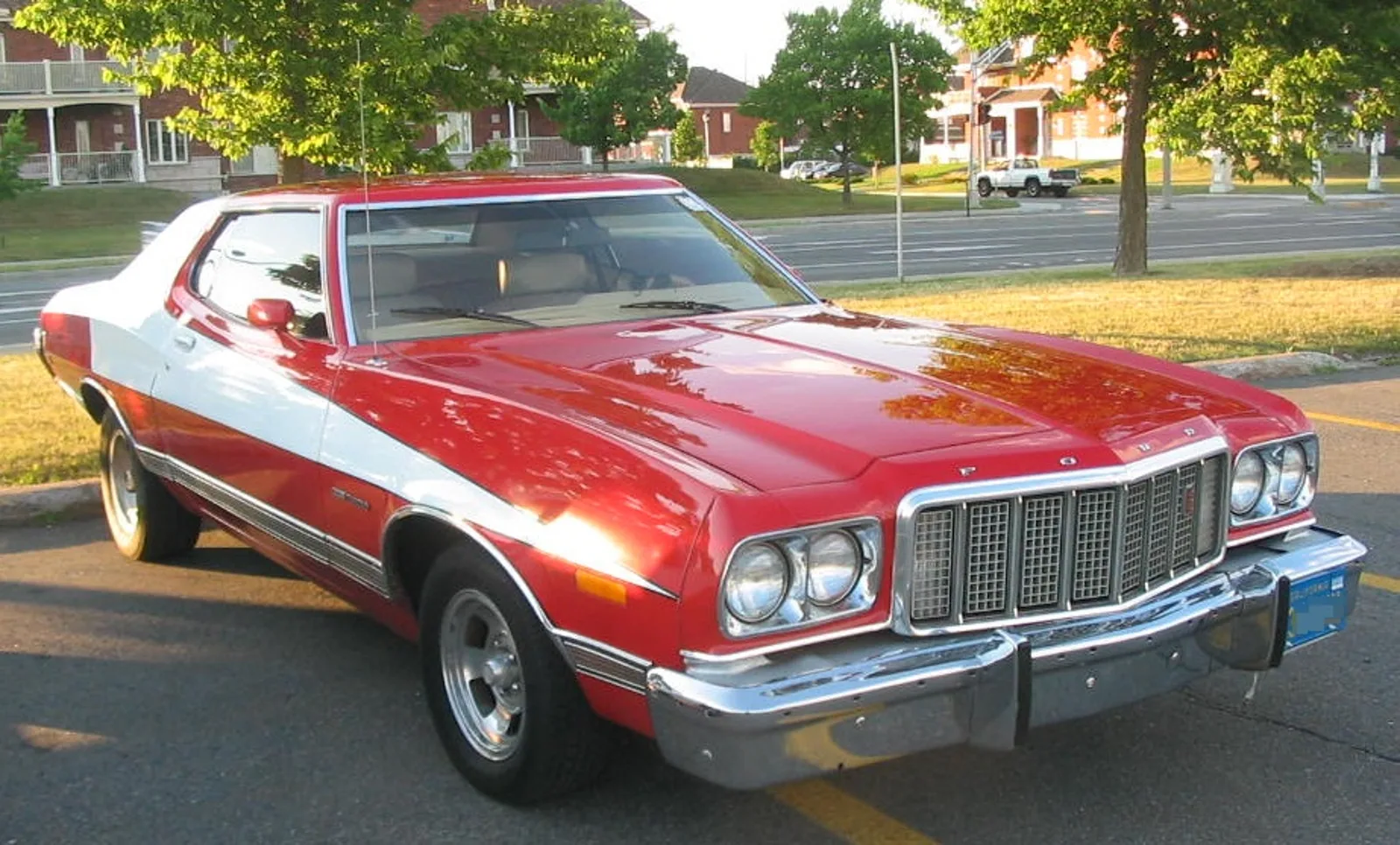
The styling is most often described as bloated. The long bonnet and front grille contrasted with a short boot, and the bodywork followed the so-called Coke-bottle line. The rear wings bulged outwards with pronounced pressings.
Some versions had a strongly shaped radiator grille with a Knudsen nose in the first two model years, which meant the front bumper had to dip in the middle of the car. In 1974 the front changed. Heavy, straight bumpers met tighter American crash rules, and a broad but lower grille integrated the indicators.
Engines and specifications at a glance
| Item | Figure |
|---|---|
| Model years | 1972 to 1976 |
| Body styles | Saloon, five-door station wagon, two-door coupe, pick-up |
| Wheelbase, saloon and wagon | 2,997 mm (118 in) |
| Wheelbase, two-door | 2,895 mm (114 in) |
| Engines | V8, with an inline six at times |
| Engine size, 1970 and 1971 | 4.1 to 7.2 litres (250 to 439 cu in) |
| Torino Cobra | 375 SAE-PS (276 kW; 370 hp) |
| Heaviest variant | Over 2,400 kg (5,291 lb) empty, Squire wagon |
| Fuel use in tests | 25 to 30 l/100 km (9.4 to 7.8 mpg-US) |
| Chassis | Box frame with steel body |
Engine outputs changed from year to year, because Ford had to adapt the engines to exhaust rules that kept tightening. Individual engines could be had with different carburettor combinations, so one displacement could produce several power figures.
How heavy was the Torino?
The Torino was a heavy car. Even the base version weighed more than two tonnes, and the fully equipped Squire wagon, fitted with the large engine, tipped the scales at over 2,400 kg (5,291 lb) without passengers. Magazine measurements repeatedly came out between 25 and 30 l/100 km (9.4 and 7.8 mpg-US).
Its external size was not matched by its room. Measurements by the magazine Consumer Guide found that the interior space was no larger than that of the compact Ford Maverick.
Where did the Torino sit in the Ford range?
The Torino was formally an upper mid-size car, but its external dimensions were larger and wider than those of its rivals. Within the brand it moved closer to the slightly larger full-size Ford LTD.
The two-door cars had the shorter of the two wheelbases, while the saloon and wagon were the longer versions.
Ford tried to cut weight in 1974 with design measures aimed at lightening the car and lowering its consumption, and the attempt failed. From 1975 the Torino received a larger fuel tank to extend its range.
What did the press make of the Torino?
The press widely criticised the Torino as uneconomical, and one verdict said it stood for all the mistakes made in Detroit at that time. Reviewers faulted its soft suspension and vague steering, and said its handling was unpredictable in quick changes of direction.
Critics were harsh about the driving experience as well, saying the soft springs and very vague steering left the driver with no sense of the road.
Critics also judged it a poor use of space. The car was unnecessarily large, and room was wasted at almost every corner. By summer 1975 Consumer Guide had reached a blunt verdict: the longer a buyer lived with the Torino, the stronger the case for the Granada, a model that had appeared in 1974.
How did Starsky and Hutch make the Torino famous?
In the television series the police officer David Starsky drove a red Gran Torino Formal Coupe with striking white side stripes. The paint scheme, which earned the car the nickname Striped Tomato, had first been developed exclusively for film production.
The series producer, Spelling Goldberg Productions, received two Torinos fitted with a 6.6 litre (403 cu in) V8. One car carried a camera on its roof to show the protagonists' view while driving, and the second, without a camera, filmed exterior shots.
The response led Ford to a limited special series in 1976. The production version was shown at the Chicago Auto Show in February 1976, and production began the following month with the 5.8 litre (354 cu in) V8 of the Cleveland range as standard.
Production was limited to 1,000 cars. Good examples now bring five-figure dollar sums, and many regular coupes were later repainted by their owners in the coveted red-and-white pattern.
What sister models and derivatives existed?
Mercury, part of the Ford Motor Company, sold its own version of the Torino from 1972 to 1976 as the Montego. It had its own body on largely identical engineering, and the Cougar XR-7 luxury coupe was derived from that body. The Ford Elite of 1974 was in turn based on the Cougar XR-7.
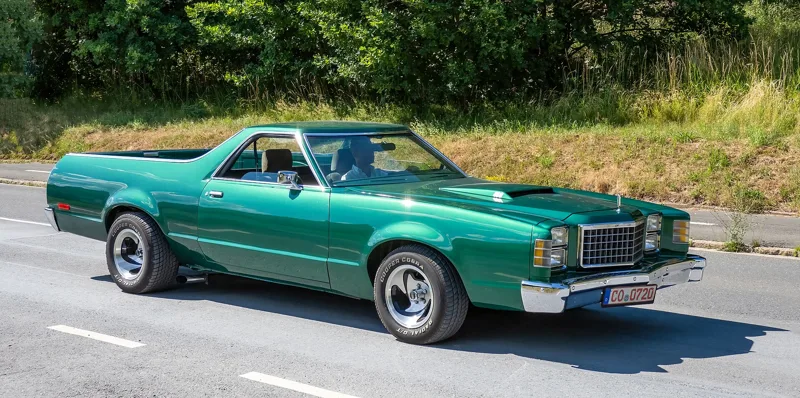
Ford's Ranchero pick-up was based on the Torino throughout 1972 to 1976.
How many Torinos were built?
Ford sold roughly half a million Torinos in each of the first two production years. Sales then fell by more than half as the oil crisis reached the mid-1970s, and a good share of buyers turned to a smaller alternative.
The newly developed Granada was smaller, lighter and more economical, yet it still gave occupants more room inside. Many customers chose it instead of the Torino.
Coupes were the most successful body style of the range. Across five years Ford built 1,678,514 Torinos, and the Mercury Montego added about 500,000 more over the same period.
Did the Torino appear in later films?
The car also became known worldwide through the film Gran Torino.
Decades after the car was built, the 1972 Gran Torino appears in the 2008 film Gran Torino, directed by and starring Clint Eastwood. In the film the car plays a central role as a coveted symbol of lost American values.