A 4.2-litre four-cylinder luxury car from a company that also made sewing machines and bicycles, built in small numbers to order.
A hand-built luxury car from Bielefeld, the Durkopp Type P 16 ran from 1917 to 1922. Its 4,164 cc four-cylinder made 45 PS through a manual four-speed gearbox, and only a small number were built to order before the P 12 took over.
The Durkopp Type P 16, sold as the 16/45 PS, was a luxury car built in Bielefeld from 1917 to 1922. It came from a company that also made sewing machines and bicycles, and its 4.2-litre four-cylinder produced 45 PS (33 kW; 44 hp). Few were made, because each one was assembled by hand to a customer's order.
Who built the Durkopp Type P 16?
The car was made by Durkopp-werke AG, whose head office sat in Bielefeld in Westphalia. The business began as a workshop that repaired and made sewing machines. Its founder, Nikolaus Durkopp, built a large fortune on it, with bicycles, which started in 1883, and stationary gas engines, from 1886, adding to the earnings.
Automobiles arrived in 1897, when the firm was still called Durkopp & Co. AG. Passenger cars never became a major division, because hand-built work and low numbers made them unprofitable for long periods. Other divisions had to carry them, yet the cars did a great deal for the company's reputation.
Few were built, and each one was assembled by hand to a customer's order.
How did the company's car business develop?
The firm was known as Bielefelder Maschinenfabrik between 1899 and 1908. After that it adopted the name Durkoppwerke AG. In 1908 it leased the Oryx Motorwerke plant in Berlin-Reinickendorf, and in 1911 it bought that site outright. By 1920 at the latest, the large Durkopp passenger cars and the lorries were built there.
Car building could take up a big slice of the workforce, with 1,500 of the company's 6,000 employees on automobiles at one point. Motor sport brought results too. The company finished second twice in the Monte Carlo Rally, in 1911 and 1912. Among its stranger projects was the Type DG 40 (40/100 PS), a four-cylinder of 13.0 litres built between 1912 and 1914.
Abroad, the firm had once been ambitious. Around 1907 it gave up a wide range of international projects. These included a partnership with a French firm at Courbevoie, on the Seine near Paris, that sold cars under the Canello-Durkopp name, and sales in the United Kingdom under the Watsonia badge. A tie-up with a Verviers company, Automobiles Dasse, had also come to an end, along with the import of French electric cars sold as Cardinet. Expedition journeys in Africa and Central America, which had drawn international attention, stopped with the war.
When did production of the Type P 16 begin?
Unveiled in 1917, the model arrived while the First World War was still underway. Shortages of materials and a weak wartime economy make it doubtful that many were built before 1919. A registration document from 1920 surfaces in the records, though it may only reflect a change in local registration practice.
Production stopped in 1922, when the company dropped the P 16 together with the P 10 and the P 24. The six-cylinder P 12 (12/45 PS) followed in 1923 with just over 3.1 litres. It was built until 1926, yet never sold enough to pay its way.
Where did the P 16 sit in the Durkopp line-up?
After the war the P 16 took the place of the large DG passenger cars at the top of the range. Its size and output roughly matched the smallest DG, the DG 18, rated 18/45 PS, a four-cylinder of just over 4.5 litres built from 1908 to 1913. The DG 25 (25/60 PS), at just over 6.3 litres, had been unveiled in 1912 as its larger successor.
Beneath the P 16 came the EK 6, rated 6/24 PS, a 1.5-litre four in production since 1913, and the P 10, rated 10/30 PS, with 2.6 litres. The P series grew into the marque's only passenger car range. In 1919 a six-cylinder P 24 (24/70 PS) arrived as the new flagship, about 25 cm (9.8 in) longer than the P 16 and just over 6.2 litres in capacity.
Three further four-cylinder cars joined the P series in its later years. The P 8 A, rated 8/32 PS, had 2.1 litres and was built from 1924 to 1927. The P 8 B was a sporty model with a supercharged overhead-camshaft engine of 2.0 litres, good for up to 60 PS (44 kW; 59 hp), built from 1925 to 1927. The P 8 C, rated 8/40 PS, used a longer-stroke 2.1-litre engine and appeared only in 1926. The P series ran to eight versions in total, from 1914 to 1927.
What do the numbers in the name mean?
The 16/45 PS label follows the habit of the time of quoting power. The first figure, 16 PS, is the tax horsepower, while the second, 45 PS, is the real engine output in horsepower.
The Type P name also carries that tax rating. The letter P most likely stood for Personenwagen, or passenger car, because Durkopp had decided to offer its cars as one P series rather than several separate ranges. The company's lorries took the letter L as their own mark.
What was the engine like?
The engine was a water-cooled four-cylinder in-line unit with side-mounted valves. Its bore measured 101 mm (4.0 in) and its stroke 130 mm (5.1 in), which gave a quoted capacity of 4,164 cc (254 cu in), although the bore and stroke actually work out to 4,166 cc. Output was 45 PS (33 kW; 44 hp), reached at 2,000 rpm, a modest figure for the period.
A Zenith carburettor supplied the mixture, and a magneto fired the compressed charge. The chassis and engine showed a clear design kinship with the DG passenger cars and with Durkopp's small and medium lorries, which had supplied much of the know-how behind the new unit.
How did the Type P 16 drive?
A hand-operated four-speed gearbox passed the power on. Durkopp had used this layout on all of its passenger cars since 1913. The gear lever stood on the inside right, next to the driver, whose seat was on the right, as was still normal then.
That lever made getting in awkward, so the car was usually built without a front right-hand door. Drivers got in on the left-hand side at the front. A propeller shaft drove the rear axle. A relatively short gear ratio capped the top speed at 80 km/h (50 mph), and fuel use came to 20 L/100 km (11.8 mpg-imp; 14.1 mpg-US).
Braking was mechanical and worked only on the propeller shaft, which was still a common arrangement at the time. The model had no service brakes on its wheels, front or rear. Apart from that, the frame and suspension were conventional for the period.
Durkopp Type P 16 specifications at a glance
| Item | Detail |
|---|---|
| Model | Durkopp Type P 16 (16/45 PS), 1917 to 1922 |
| Engine | Four-cylinder in-line, side valves, 4,164 cc (254 cu in) |
| Bore and stroke | 101 mm (4.0 in) by 130 mm (5.1 in) |
| Output | 45 PS (33 kW; 44 hp) at 2,000 rpm |
| Gearbox | Manual four-speed |
| Top speed | 80 km/h (50 mph) |
| Fuel use | 20 L/100 km (11.8 mpg-imp; 14.1 mpg-US) |
| Wheelbase | 3,482 mm (137.1 in) |
| Track | 1,400 mm (55.1 in) front and rear |
| Length | 4,700 mm (185.0 in), varying with body |
| Width | 1,700 mm (66.9 in) |
| Height | 2,200 mm (86.6 in), for closed versions |
| Kerb weight | 1,500 kg (3,307 lb) open; up to 1,800 kg (3,968 lb) closed |
What bodies could buyers order?
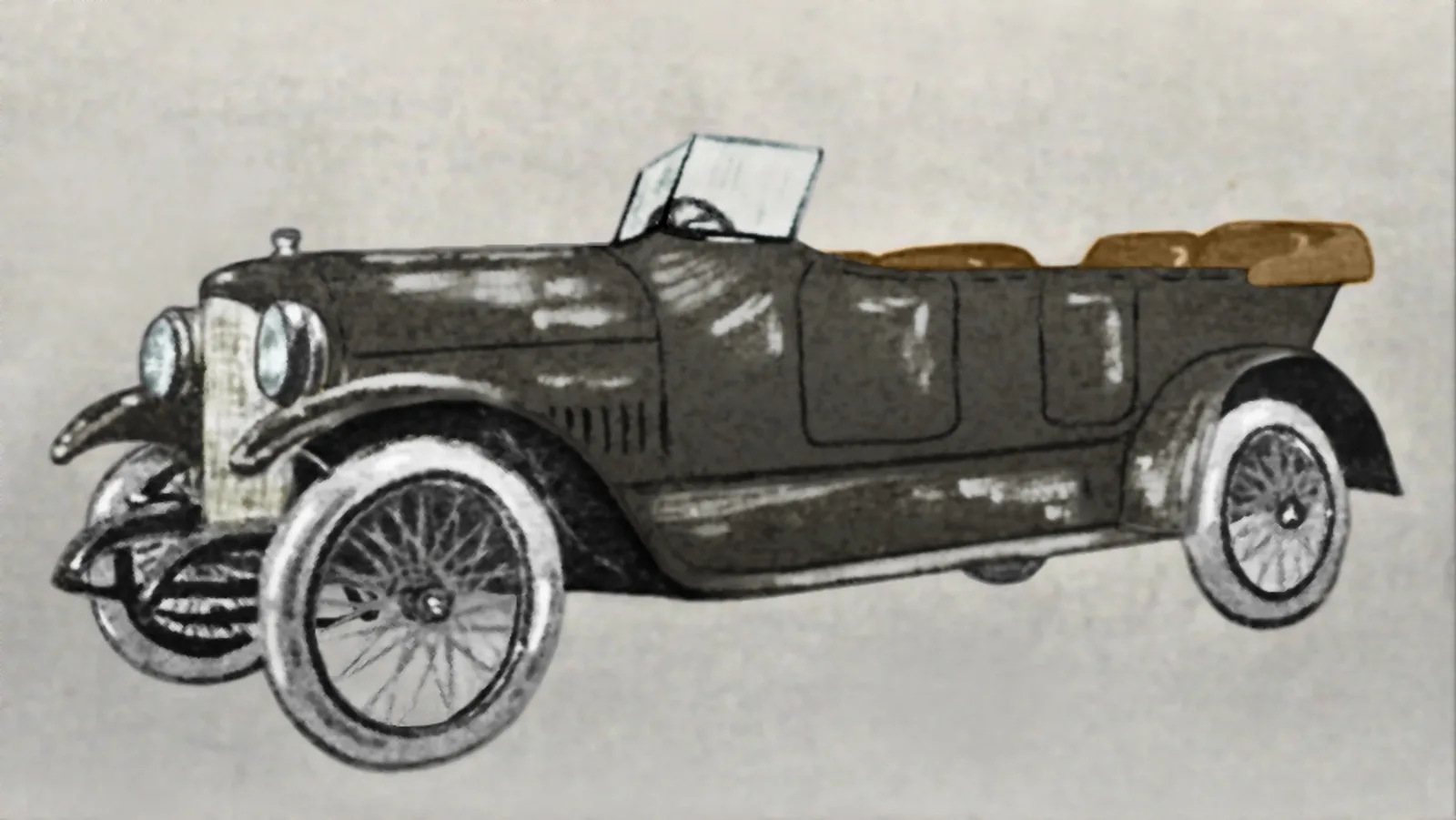
Customers chose their own bodywork, and the P 16 came as an open tourer, a limousine or a landaulet. Its most fashionable touch was a sharply pointed radiator, with the two sides leaning hard toward each other. Some cars kept a nickel-plated radiator, and others had theirs painted in the body colour.
The cheapest and lightest option was an open three-door tourer with six seats, weighing 1,500 kg (3,307 lb). Closed bodies took the figure to as much as 1,800 kg (3,968 lb), partly because they stood so tall. Some bodies may have come from outside coachbuilders, and a working relationship with the Osnabrueck firm Karmann is well documented.
The bonnet gives away the model. The P 16 typically carries seven ventilation slots per side, the P 10 has six, and the six-cylinder P 24 has eight.
Why is the P 16 so rare today?
Very few were made, and the survivors are barely known. Detailed production figures were never kept, but press coverage and the output of rival makes point to double-digit totals at most. Perhaps only single cars have come down to us.
The best-documented survivor is a 1917 saloon finished in light grey, with darker mudguards, which was on display at the automobile museum in Nettelstedt, in the Lubbecke area of East Westphalia. The wartime army then requisitioned the P 16 along with the rest of the P series, which further thinned out the surviving cars.
Who was behind the Durkopp Type P 16?
Nikolaus Durkopp had a decisive influence on the car. He had trained as a locksmith and had earlier worked with precision mechanics, watchmakers and sewing machine makers. He tried to set up an automobile division as early as 1894, but it failed, and real progress came only around 1898.
After the First World War he kept building the large cars one at a time, to order. He insisted on top quality and special customer requests, and he refused assembly-line methods even though they cut costs elsewhere in the company. He gave up his large riding stable to devote himself to cars, and he personally took part in the planning and carried out the test drives.
Gustav Mollenberg was the managing director. Paul Durkopp, his son from a first marriage, had taken over the running of the firm after his father's death in 1918, and the engineer Erich Kuchen worked as Nikolaus Durkopp's personal assistant and a close friend of Paul. The engineer Richard Kuchen later became known from the same family circle.
Other engineers worked for Durkopp at the time without much influence on the P 16. Nikolaus Henzel, who had come from Oryx in 1919, concentrated on the P 8 (8/24 PS) and a motorcycle. Kurt C. Volkhart, a racer as well as an engineer, shared the work on the supercharged P 8 B sports car, with which the racer Hans Stuck won his first motor sport successes from 1925.
How did the Type P 16 compare with its rivals?
In its class the P 16 went up against a sleeve-valve Mercedes rated 16/45 PS, a Benz rated 18/45 PS, and the Phanomen, which arrived in 1921 with the same 16/45 rating. Bigger or more powerful rivals were the Dux Type S, Elite E 18, Hansa-Lloyd Treff-Ass and, starting in 1922, Adler 18/60 PS.
The P 16's 101 mm bore was wider than most of its rivals', and only the Hansa-Lloyd of 1923 to 1925 was bigger, at 105 mm. The 130 mm stroke equalled the Mercedes and Hansa-Lloyd figures, and the other rivals ran 10 to 20 mm longer. Of these cars, only the Hansa-Lloyd had a noticeably longer wheelbase.
What did the Type P 16 mean for Durkopp?
The P 16 was the last new car the firm presented during its founder's lifetime. It was the second model in the P series, which gained six more models before car production ended in 1927. Together with the Dux Type S it was among the first new car models in Germany for the postwar market.
The model that ended production in 1922 was the final Durkopp luxury car powered by a big four-cylinder. Along with the six-cylinder P 24, it was also the last luxury model the brand made. Once the First World War ended, Durkopp had lost most of its international standing as a car maker, and its earlier foreign ventures had been dropped before the war.