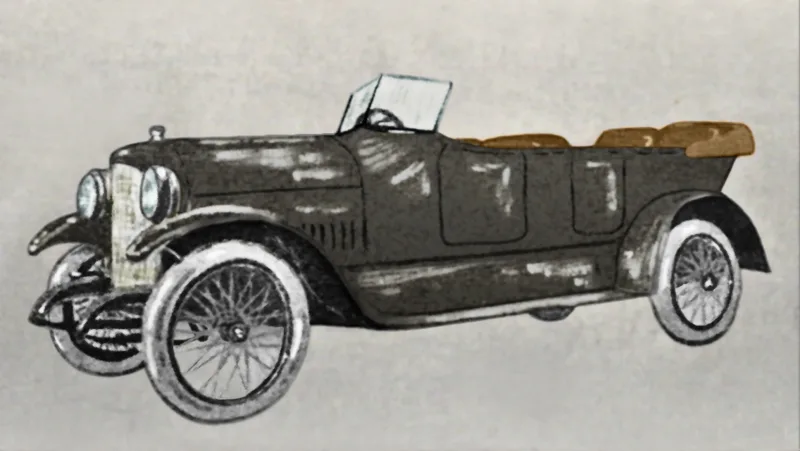
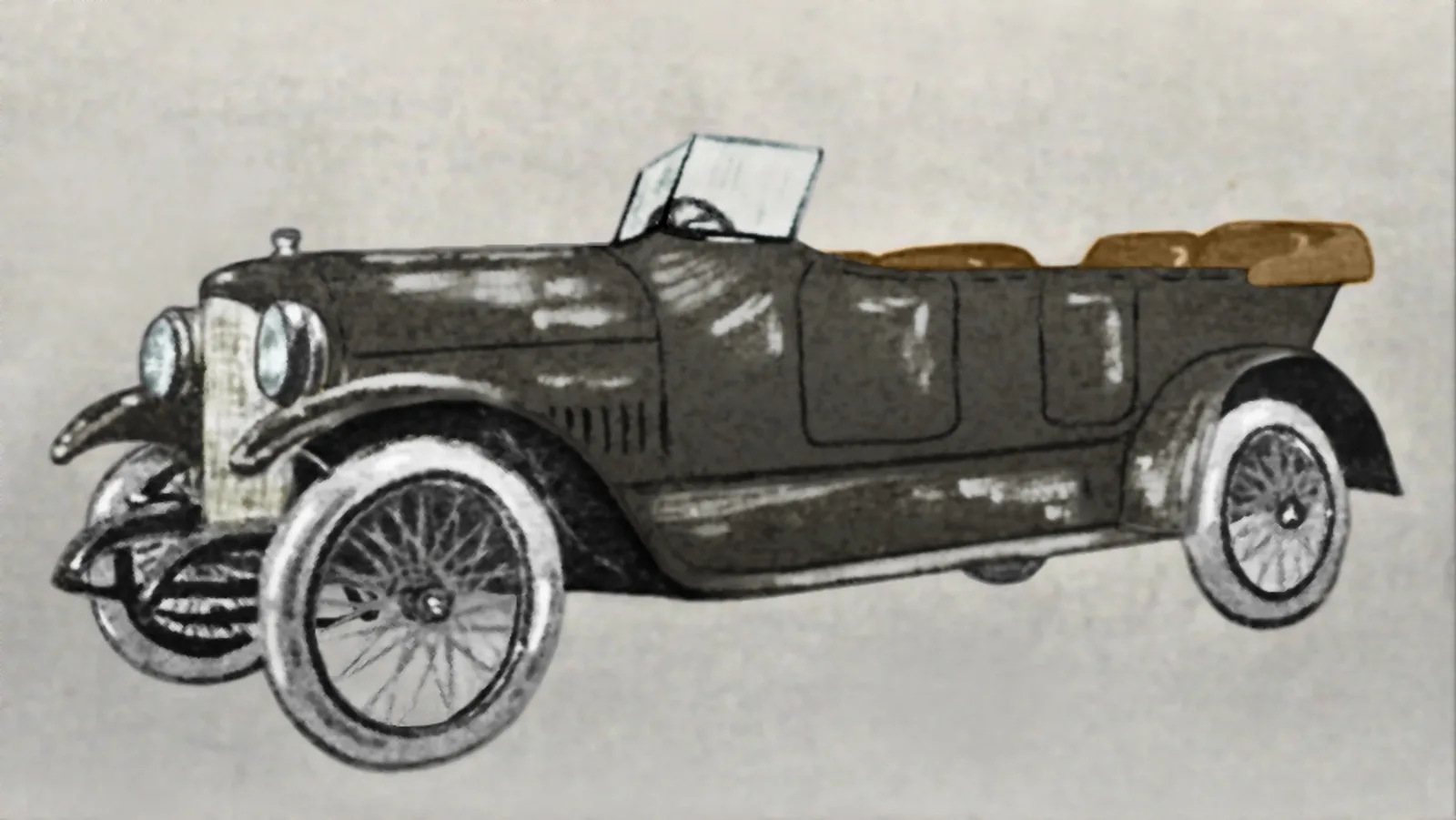
A four-cylinder upper-class car from Wahren near Leipzig, with 50 PS and coachbuilt bodies, that sold slowly and of which no example is known to survive.
Presented in 1917 by Dux-Automobil-Werke-AG and built until 1924 or 1926 (accounts differ), the Typ S was an upper-class saloon and tourer with a 4,396 cc side-valve four. It produced 50 PS (37 kW; 49 hp), cost 13,200 Reichsmarks in touring form and sold slowly, and no surviving example is known.
The Dux Typ S, also known as the Dux 17/50 PS, was an upper-class car that Dux-Automobil-Werke-AG presented in 1917 and built at Wahren, close to Leipzig, until 1924 or 1926, accounts differ. Its four-cylinder engine displaced 4.4 litres (268.3 cu in) and delivered 50 PS (37 kW; 49 hp). Sales were slow in a weak economy, and no surviving example is known.
What was the Dux Typ S and where was it built?
The Typ S came from a maker whose roots lay in music. Dux-Automobil-Werke-AG was based at Wahren, a place that became part of Leipzig in 1922. The car followed three smaller four-cylinder models introduced in 1912, and in 1923 it was joined by the six-cylinder Typ R, a machine of similar size but newer and dearer.
The Polyphon works at Wahren had built a thriving business in music automatons, music boxes, orchestrions and records as the nineteenth century closed. Its automobile department first assembled the single-cylinder Oldsmobile Curved Dash under licence, selling it as the Polymobil Gazelle, between 1904 and 1908. Larger Polymobil designs of the company's own followed, and from 1909 the cars wore the Dux name.
By 1912 Dux offered four-cylinder cars under the codes F 6, K 24 and G 10, with capacities running from just under 1.6 to 2.6 litres. Lorries of light and medium weight came too, built in big batches above all during the First World War.
A stately, well-made car that sold sluggishly, the Typ S helped end Dux as an independent car brand.
Why did Dux move up-market after the First World War?
On 19 September 1916, with the war still under way, the car department became a legally separate company, Dux-Automobil-Werke-AG. Planning started for peacetime and for a new direction for the model programme, and the firm settled on upper-class passenger cars as its focus.
In 1918 and 1919 the firm merged with Presto, and with the truck makers Magirus and Vomag, into the German Automobile Group, known as D.A.K. Inside that group Dux was to specialise in luxury cars, and for their bodies it sometimes turned to outside coachbuilders.
When did the Dux Typ S go on sale?
The Typ S was presented in 1917, but wartime shortages make it doubtful that many cars were built before 1919. A contemporary account says the maker first put the car in front of a wide audience at the Leipzig autumn fair of 1920, which is why other accounts name 1920 as the start of production.
The end of production is also uncertain. One account says the large four-cylinder was built until 1926, having been made since 1923 alongside the Typ R, perhaps latterly from leftover parts. Other accounts put the final year at 1924.
What was under the bonnet of the Typ S?
The engine was a water-cooled in-line four with side-mounted valves. Its 100 mm bore and 140 mm stroke gave 4,396 cc (268.3 cu in), and it made 50 PS (37 kW; 49 hp) at a restrained 1,800 rpm, a typical figure for the era. The gearbox was manual with four speeds.
Key specifications
| Specification | Dux Typ S (17/50 PS) |
|---|---|
| Engine | 4,396 cc (268.3 cu in), four-cylinder in-line, side valves |
| Bore and stroke | 100 mm x 140 mm |
| Output | 50 PS (37 kW; 49 hp) at 1,800 rpm |
| Gearbox | Manual four-speed |
| Wheelbase | 3,500 mm (137.8 in) |
| Top speed | 100 km/h (62 mph) |
| Unladen weight, open tourer | 1,720 kg (3,792 lb) |
| Fuel use, 1920 test | 9.24 kg per 100 km |
| Price, touring version | 13,200 Reichsmarks (RM) |
Development drew on the company's experience with small and medium lorries. The solid chassis and the new large-volume four had much in common with the commercial vehicles built until then.
Dux had already fitted a four-speed unit in the Typ G 21, a four-cylinder of a little over 2.0 litres built from 1910 to 1913, when three-speed boxes were the norm.
How did the Typ S drive and what was unusual about it?
The frame was separate, and the suspension and running gear were conventional for the period. The foot brake worked purely mechanically on the propeller shaft alone; the wheels carried no operating brakes at all. Wooden-spoked artillery wheels were fitted as standard.
The gear lever sat on the right, beside the driver's seat, which was also on the right in those days. It obstructed entry, so the front right door was often left off, and drivers climbed in from the left. As a result, the seat beside the driver was occasionally made to fold down or flip up.
The clutch was a leather cone of the old kind. Power reached the rear wheels through a propeller shaft, and the car could manage 100 km/h (62 mph). Fuel was fed by exhaust pressure, an odd idea today but common at the time.
Contemporaries described the car as stately and quite representative, a beautiful design shaped with loving care, and its quality was generally recognised.
How much did the Typ S cost and how well did it sell?
The touring version sold for 13,200 Reichsmarks (RM), which was modest for its class, while the six-cylinder Typ R cost 22,000 RM. Despite the price, sales were sluggish because of the wider economy and the brand's limited prestige. Production numbers were never recorded.
Media coverage and the output of rival models suggest two-digit or low three-digit totals. Nothing is known to survive.
Individual histories are poorly documented. The Wermsdorf fire brigade in northern Saxony acquired a Typ S saloon second-hand in 1931 and kept it in service until 1952.
Which coachbuilders gave the Typ S its bodies?
Buyers could choose among bodies from several makers. Many, if not all, came from outside, often small, coachbuilding firms, and some had two-tone paint. The simplest and lightest was an open four-seat tourer, weighing 1,720 kg (3,792 lb) unladen. Three- and four-door special bodies seating four to seven were also built.
- Seegers and Son of Leipzig supplied a landaulet in 1921.
- The Schlesienwerk of S. S. Seehausen and Staar, in Liegnitz, made a well-appointed saloon in 1921 and a double phaeton in 1923.
- Zander produced a phaeton in 1923.
- The Weinsberg coachworks offered a finely equipped 'salon saloon' from 1923, sold as a standard series type, with light grey offered as an alternative to the usual black.
- Gustav Hornig and Co. of Meerane fitted a Dux with an elaborately equipped saloon body around 1923.
- Kruck-Werke, based in Frankfurt am Main and Wiesbaden, built a landaulet in 1924.
August Zschau of Leipzig regularly worked on Dux chassis from 1913 to around 1924, including a six-cylinder Typ R tourer, so it may also have built Typ S bodies. Ludwig Kathe and Son of Halle and Ernst Dietzsch of Glauchau also collaborated with Dux, and either could have bodied Typ S chassis.
Who were the men behind the Dux Typ S?
The diploma engineer Gustav Schurmann (1872 to 1962) played a central part in the Typ S. Born in Isselhorst in North Rhine-Westphalia, he worked for Fahrzeugfabrik Eisenach AG, maker of the Dixi cars, before joining the Polyphon automobile department in 1908.
At Dux he ran the works, sat on the board and acted as chief designer, with the Typ S as a particular focus. In 1921 he took out a patent for light-metal pistons for combustion engines, and in 1925 the University of Karlsruhe gave him an honorary doctorate, Dr.-Ing. E. h.
Gustav Stresemann (1878 to 1929) was a second figure tied to the company and the post-war car. He sat in the Reichstag from 1907 and later served as Reich Chancellor and Reich Foreign Minister. At the end of the war he held shares in both the Polyphon works and the Dux car maker, and he was deputy chairman of Dux's supervisory board. Those posts gave him influence over the move into the upper-class segment and the design of the Typ S. He ended his business ties in 1923, the year he became Reich Chancellor.
How did the Typ S compare with its rivals?
The Typ S was Dux's first upper-class model and the first new Dux after the company gained independence in 1916. With the Durkopp Typ P 16 it was among the first new German passenger cars for the postwar market. It was also one of the last German upper-class models with a large four-cylinder engine instead of a six or an eight.
Dux concentrated its sales and service in Saxony and nearby areas including Thuringia, Brandenburg and Upper Silesia. In those regions its rivals were Mercedes (a 16/45 PS with a sleeve-valve engine), Benz (18/45 PS), Durkopp (Typ P 16) and, from 1920, Phanomen (16/45 PS).
Rivals that were a touch bigger or stronger included the Adler 18/60 PS, introduced in 1921, along with the Elite E 18 and the Hansa-Lloyd Treff-Ass. Of these, only the Hansa-Lloyd had a longer wheelbase.
Dux's 100 mm bore matched most of these rivals. The Phanomen was smaller at 97 mm, while the Durkopp and the 1923 to 1925 Hansa-Lloyd were larger at 101 and 105 mm, with a shorter stroke of 130 mm. Only the Benz, the Elite and the Adler used a longer 150 mm stroke.
Occasionally the model is placed in the upper middle class, but its size, equipment and engine point to the upper class.
What do the 17/50 PS figures mean?
The name 17/50 PS followed a common practice of quoting power. The 17 stands for the tax horsepower, and the 50 for the actual output in horsepower, a split that was widespread at the time. The 'Typ S' designation is less clear, because the reasons for it are not established.
The Polyphon works' first Polymobiles, designed in 1907, had been labelled Typ P. Dux types from 1909 carried codes such as G 21, and by 1912 codes such as K 24 and F 6 were in use. Lorries used type names with an L component, such as LI, LK and LO.
It seems unlikely that the S honours Gustav Schurmann, the works manager and chief designer, who had been responsible for every type from D onwards. A link to Gustav Stresemann is only speculation.
The six-cylinder successor was named Typ R, which hints that the six may have been planned first and then shelved. The economic situation at the end of the war is one explanation, though open engineering questions over its light-metal pistons and a self-designed twin carburettor may also have mattered.
How did the Typ S perform and how was it judged?
In a 1920 fuel economy run organised by the Saxon Automobile Club, supervised by the Dresden Technical University institute, the Typ S drove through hilly country with six people aboard. It used 9.24 kg of fuel per 100 km and won first prize for the lowest consumption among 39 vehicles.
In 1921 Dux exhibited a Typ S at The Hague with an engine-driven tyre pump, so the tyres could be pumped up while under way.
Abroad the model drew little comment. In 1969 the British motoring author Baron Montagu of Beaulieu called its look ponderous and uninspired, and named its sheer bulk as its greatest merit.
Given the economic development up to the mid-1920s, the upper-class strategy proved a mistake. The Typ S, technically outdated by the end of its run, contributed greatly to the end of Dux as an independent car brand.