A post-war American three-wheeler with aircraft-style details, a bold sales pitch and a production run that never got going.
The Davis Divan was a three-wheeled convertible built by the Davis Motorcar Company in Van Nuys, California, between 1947 and 1949. Only 13 cars were built, including two prototypes, and 12 are known to have survived. It never reached mass production because the company collapsed before it could deliver cars to dealers.
Few American cars of the late 1940s looked as unusual as the Davis Divan, a three-wheeled convertible that its maker hoped would win over buyers after the Second World War. Its promoter, Glen Gordon 'Gary' Davis, built dealer demand through heavy publicity long before the car was ready to build. The venture collapsed into lawsuits and a fraud conviction, and only 13 Divans were ever made.
Where did the Davis Divan come from?
The Divan grew out of a custom three-wheeled roadster called The Californian. Frank Kurtis built that car in 1941 for the racer Joel Thorne, and Glen Davis bought it in 1945 for $50. Davis then used it as the template for his own design.
Davis had been a used-car salesman from Indiana. After buying the car he hired a team of engineers, among them Peter Westburg from Douglas Aircraft Company, to reverse engineer it. Their quarter-scale model appeared in a Hollywood Citizen-News story on 22 July 1947, in which the team claimed a factory could build 50 cars a day and sell each for $995.
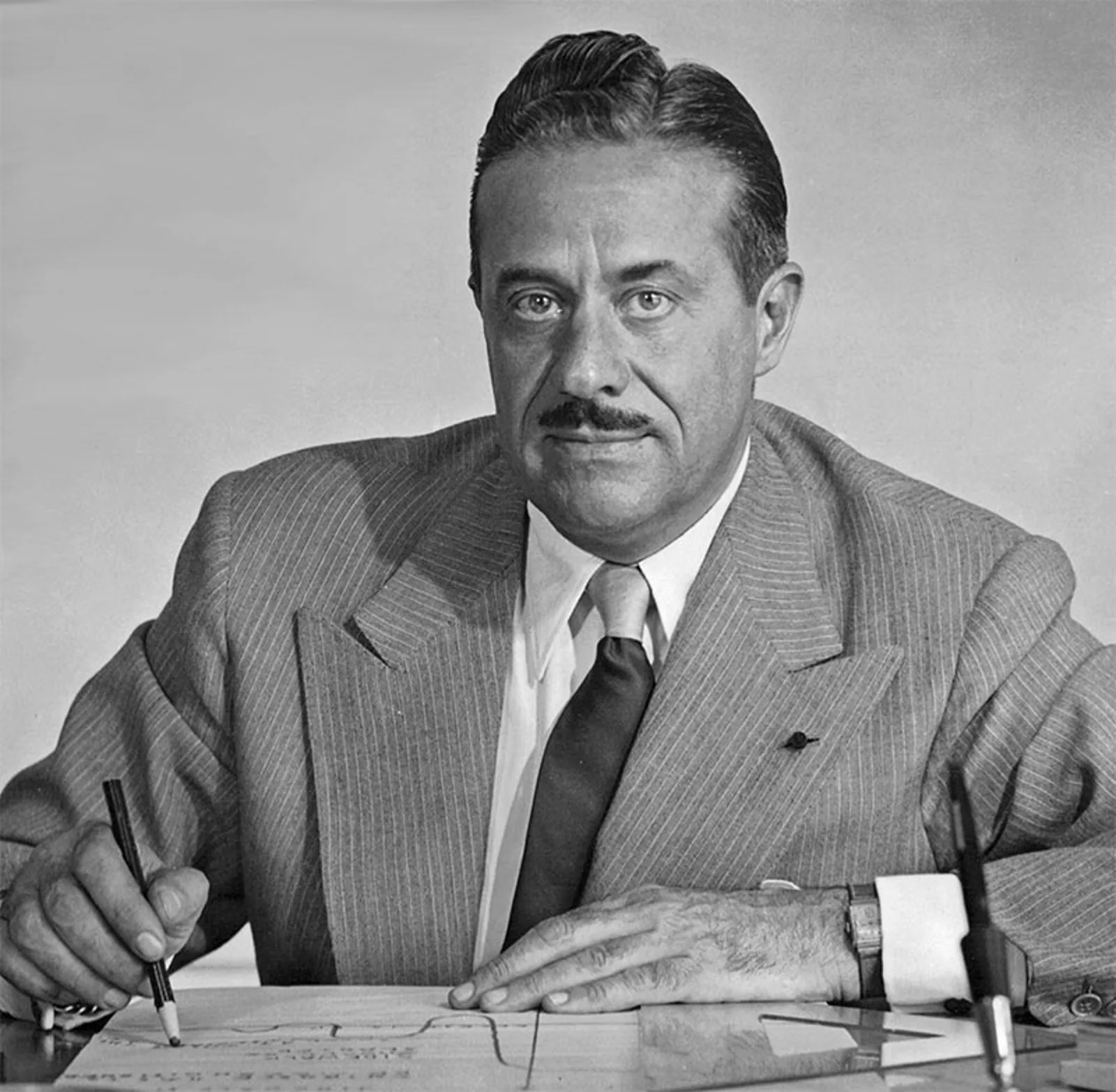
Later that year the Bendix family put up $2,500, which allowed Davis to set up the Davis Motorcar Company. To make a stronger impression on investors he borrowed the office of the designer Raymond Loewy for his pitch. Two prototypes were built in 1947: the D-1, nicknamed 'Baby', and the D-2, called 'Delta', which had a removable hardtop.
A three-wheeled convertible sold on dealer enthusiasm that the factory never turned into cars.
What did the Davis Divan look like?
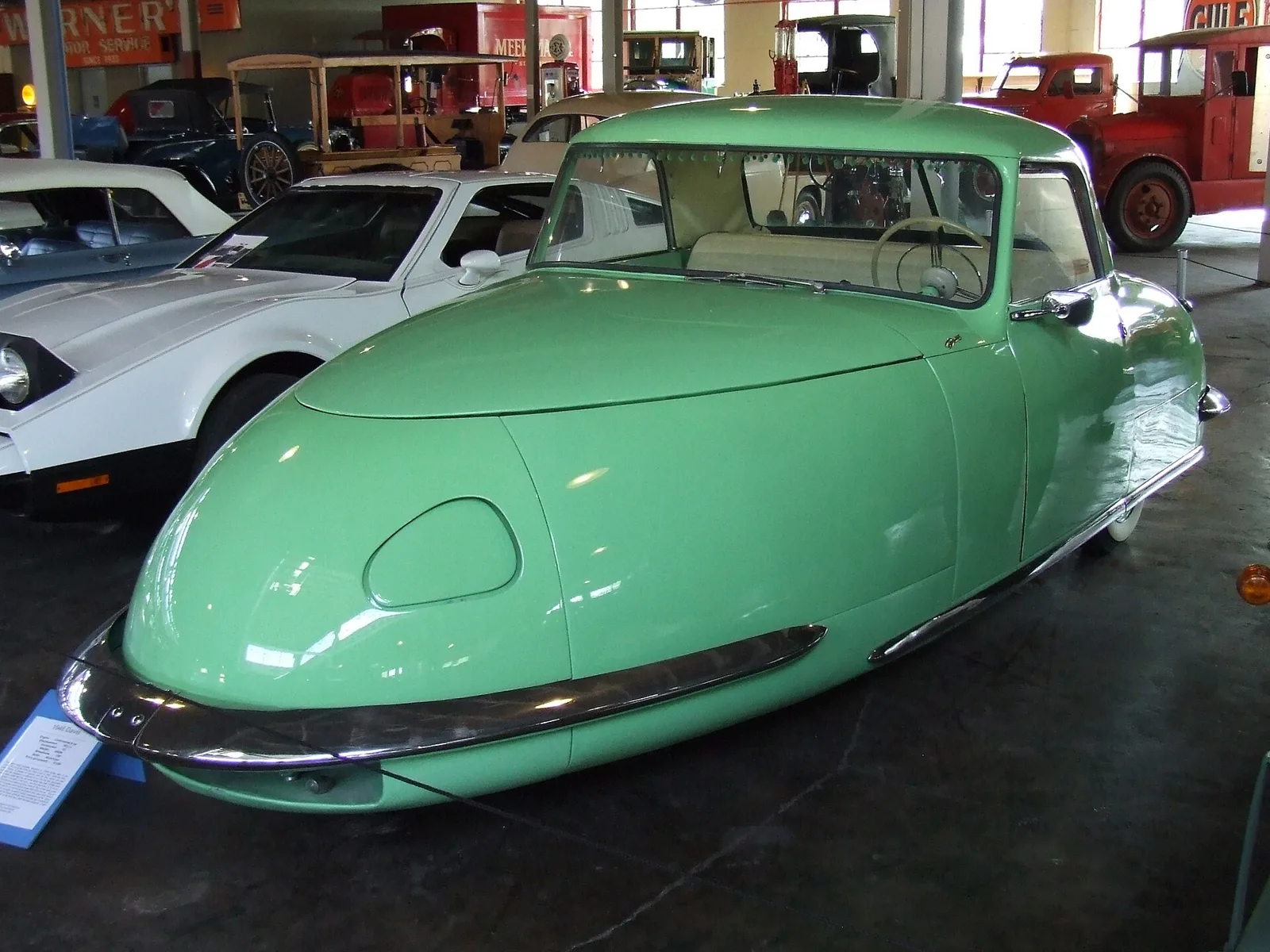
The Divan measured 466 cm (183.5 in) long and had one wheel at the front and two at the rear. Its chrome-trimmed aluminium body carried aircraft-inspired details, 15-inch wheels, disc brakes and hidden headlights. Jacks were built into each corner, so a tyre change was easier.
The body sat on a steel chassis and used a removable fibreglass top. The single bench seat was wide enough for four adults, and the name came from an Arabic word for a couch or day bed. At the November 1947 unveiling, four airline stewardesses sat side by side on that bench to prove the point.
Production cars used a channel steel frame and 11 body panels of aluminium and zinc. The Baby prototype was different, built on a tube steel space frame. The prototypes were meant to be economy cars, and their styling borrowed heavily from aircraft.
What powered the Davis Divan?
Most Divans used a 2,600 cc (160 cu in) inline-four Continental engine producing 47 kW (63 hp). The two prototypes, the Baby and the Delta, ran a 35 kW (47 hp) Hercules industrial four-cylinder instead. Power went through a three-speed Borg-Warner manual gearbox and a Spicer differential.
Davis claimed top speeds between 160 km/h (100 mph) and 187 km/h (116 mph). Estimated fuel economy ranged from 0.047 L/km (50 mpg-US) to 0.067 L/km (35 mpg-US). Davis also said the Divan could make a U-turn at 89 km/h (55 mph), while the three-wheeled layout was promoted for less tyre wear and easier parking.
How did the Davis Divan get its publicity?
Davis won coverage in Business Week, Life and Parade, along with a period newsreel and a syndicated television crime drama. The November 1947 unveiling at the Ambassador Hotel in Los Angeles, plus a $1,000 automobile pitch, helped dealership sales climb and paid for a promotional trip across the United States.
Davis brought in help for the launch. Actress Cleo Moore posed with the Baby prototype, and Jack Adams, a former Los Angeles Herald-Express reporter, ran public relations. Baby then went on display in a Philadelphia department store for the holiday season and was readied for Pasadena's Rose Parade before the 1948 Rose Bowl.
Davis presented the Divan as the car of the future, and that image drew prospective dealers in large numbers, even though no car had yet been delivered to one.
Why did the Davis Divan never reach production?
The company sold 350 dealerships and raised $1.2 million, but it never delivered cars on the 90-day timetable it promised. Its production chief was fired after spending $45,000 of company money on production. By 1949, dealers and employees had both taken legal action.
Pre-production moved at a frantic pace. Workers at the Van Nuys hangar sometimes stayed for 72 hours at a time, sleeping in a nearby house Davis had rented. Bob 'Pinky' Howells, the production chief, ordered a drop hammer press, two gas furnaces and kirksite dies from a Pasadena tool-and-die maker. Davis himself drew a monthly salary of $1,000.
Investors grew uneasy and began turning up at the factory unannounced to press engineers for firm delivery dates. Some workers had agreed to work for free during pre-production in return for double pay once output began, and many were never paid. The company's assets were sold off to pay back taxes, and the cars already built went to creditors instead of buyers.
Was Gary Davis convicted of fraud?
Yes. A jury convicted Davis in 1951 on 20 counts of fraud and eight counts of grand theft after a Los Angeles County District Attorney investigation. He was sentenced to two years at a work farm labour camp in Castaic, California, and he kept insisting he was innocent.
The conviction closed a chapter that had opened with the dealer lawsuit of 1949 and the employee claims that followed. Davis maintained his innocence for the rest of his life, and he went on to a series of other ventures.
How many Davis Divans survive today?
Only 13 Divans were built, including the two prototypes, and 12 of them were confirmed to have survived as of 2005. The one that did not survive was destroyed in the United Kingdom because of British customs laws. The survivors are split between museums, collectors and a few with no known owner, in widely varying condition.
Tom Wilson of Ypsilanti, Michigan found an abandoned Divan in 1967. In 1993 he founded the Davis Registry to track down the survivors. The Lane Motor Museum and the Petersen Automotive Museum both display 1948 Divans.
How was the Petersen Divan restored?
The Petersen Automotive Museum launched an Indiegogo crowdfunding campaign in April 2015 with a $30,000 goal. Bodie Stroud Industries carried out the restoration, which was finished by November 2015 and featured on the television programme American Restoration. The car had spent years on a pole outside a Colorado body shop before the museum acquired it.
The museum expected the work to be labour-intensive, with the engine and suspension needing complete rebuilding and the interior needing replacing. Chief curator Leslie Kendall outlined the budget: $10,000 for bodywork and paint, $7,500 for the engine and under-bonnet parts, $5,000 for the interior and $7,500 for other mechanical systems, including the transmission, suspension and brakes.
The Petersen had hoped to finish by December 2015, in time for its grand reopening, and planned to place the Divan in its Innovation section. The museum noted that the Davis company was of particular interest because it was one of few automakers based in Southern California.
What were the Davis Divan specifications?
The Divan was 466 cm (183.5 in) long on a 278 cm (109.5 in) wheelbase, stood 152 cm (60.0 in) tall and weighed 1,110 kg (2,450 lb). Its 2,600 cc engine was rated at 47 kW (63 hp), and the car was planned to retail for $1,600 had it gone on sale.
| Specification | Detail |
|---|---|
| Built | 1947 to 1949, Davis Motorcar Company, Van Nuys |
| Cars built | 13 including two prototypes; 12 known to survive (as of 2005) |
| Body | Chrome-trimmed aluminium on a steel chassis, removable fibreglass top |
| Length | 466 cm (183.5 in) |
| Wheelbase | 278 cm (109.5 in) |
| Height | 152 cm (60.0 in) |
| Width | 183 cm (72.0 in) |
| Weight | 1,110 kg (2,450 lb) |
| Engine | 2,600 cc (160 cu in) Continental inline-four, 47 kW (63 hp) |
| Prototype engine | 35 kW (47 hp) Hercules industrial four-cylinder |
| Transmission | 3-speed Borg-Warner manual, Spicer differential |
| Claimed top speed | 160 km/h (100 mph) to 187 km/h (116 mph) |
| Estimated fuel economy | 35 to 50 mpg-US (0.067 to 0.047 L/km) |
| Seating | Four adults on one bench seat |
| Planned retail price | $1,600 |