Built in Detroit, hand-finished by Ghia in Turin and later in Spain, the Crown Imperial was a rare long-wheelbase flagship that few buyers chose.
The Crown Imperial was Chrysler's lengthened four-door limousine for the Imperial brand, sold from 1955 to 1966. Chrysler built the first cars in Detroit, Ghia in Italy built the middle years, and Barreiros in Spain made the cars listed for 1965 and 1966.
The Crown Imperial was the stretched four-door limousine of Chrysler's Imperial brand, offered from the factory between 1955 and 1966. It shared the styling and mechanical updates of the regular Imperials, but its body was longer and far more richly finished. The cars were built by hand at different plants in several countries, and one of the builders, Ghia in Turin, gave rise to the name Imperial Ghia that is still often used.
Why did Chrysler need an upmarket Imperial?
In the early 1950s Chrysler had no separate upper-class make, unlike General Motors and Ford. The top of the market was served by better-equipped Chrysler models sold under the Chrysler Imperial name, which had been used since 1926. Linking the models to the mass-market Chrysler name held back sales, so from 1955 Imperial became a separate fifth brand.
Early Imperials looked and drove much like the other Chrysler group cars, which helped cheaper models but stopped the badge from building a personality of its own. The press and public largely saw them as large Chryslers. To underline its claim to the top of the market, Chrysler offered a lengthened chauffeur limousine from the start, named the Crown Imperial.
The name also caused some confusion. Imperial Crown sat in the middle of the trim ladder for the regular short coupes, convertibles and saloons, and its name sounded almost identical to Crown Imperial.
Chrysler's stretched Imperial cost about twice as much as a Cadillac 75, and it never sold in quantity.
How did the Crown Imperial differ from the standard Imperial?
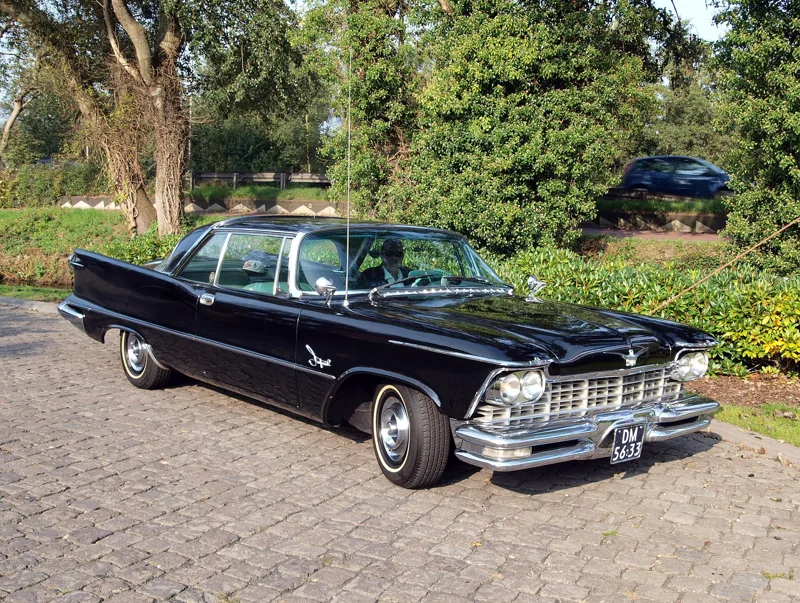
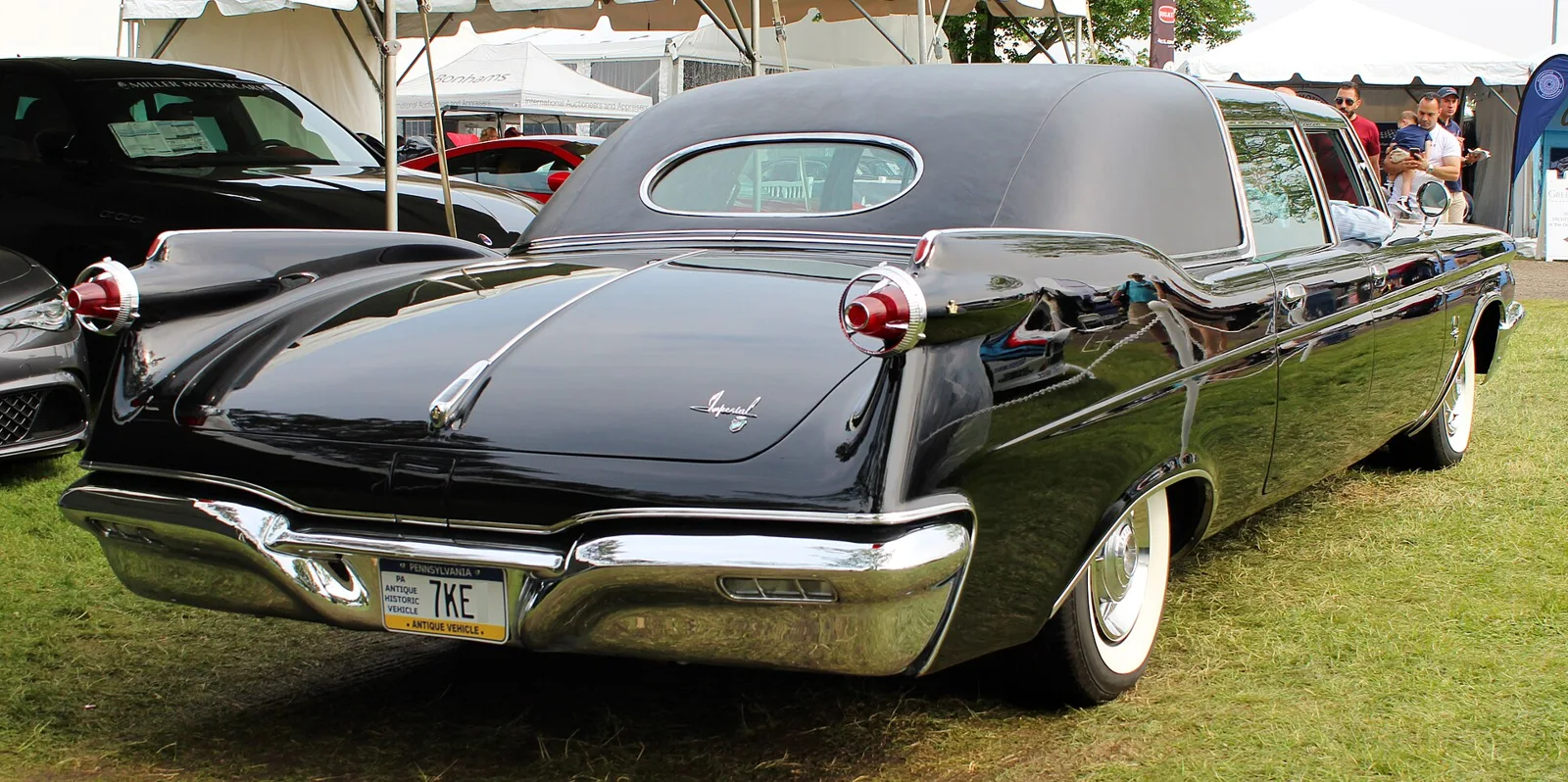
The Crown Imperial followed the short Imperial sedans in its technology and styling, but it had a wheelbase of 3,797 mm (149.5 in) and an overall length of 6,192 mm (243.8 in). Its C-pillar was broad, its rear window much smaller, and its roof section was plastic rather than metal. It was offered with six or eight seats, and the eight-seat version had two folding seats in the rear.
What did the 1955 and 1956 limousines look like?
The first Imperial model generation, factory-coded C-69, became available from November 1954 as a coupe with two doors and a four-door saloon, which became the Southampton sedan in 1956. Both looked and were engineered much like the current Chrysler models. From the outset Imperial also offered a representative limousine with a longer wheelbase, factory-coded C-70, which was sold as the Crown Imperial.
Unlike the Southampton sedan, whose rear panoramic window was drawn into the body sides, the Crown Imperial kept a broad C-pillar and a much smaller back window. Most examples also had a third, fixed pane, positioned between the back doors and the roof pillar. For model year 1956 the car took over the eight-cylinder engine of the standard Imperial, now designated C-73 and enlarged to 5.8 litres (353.9 cu in), but nothing else in the limousine changed.
Where were the early Crown Imperials built?
Chrysler produced the Crown Imperial at its Jefferson Avenue Assembly plant in Detroit, the same works as the standard Imperial. Output was small in both years. It was no more than a tenth of the Cadillac Series 75 limousines, which were about US$1,000 cheaper than the Imperial. The 1955 and 1956 cars were the last representative limousines that Chrysler built itself.
Which builders made each series?
| Period | Builder | Key detail | Price |
|---|---|---|---|
| 1955 and 1956 | Chrysler, Detroit | Wheelbase 3,797 mm (149.5 in) | US$7,000 (1955), US$7,700 (1956) |
| 1957 to 1964 | Ghia, Turin | Body lengthened by 520 mm (20.5 in) | US$15,075 (1957), US$18,500 (last year) |
| 1965 and 1966 | Barreiros, Spain | Bought Ghia's production facilities | Listed at US$18,500 |
| 1967 to 1970 | Stageway Coaches, Fort Smith, Arkansas | Wheelbase 4,104 mm (161.6 in) | US$16,000 in the last year |
How did Ghia turn kits into limousines?
Chrysler assembled half-finished kits at Detroit and shipped them to Italy by sea. Each kit carried a complete hardtop body, or a four-door sedan body in 1963 and 1964, on a stiffened convertible chassis with reinforced springs. Ghia cut the body and frame, lengthened both by 520 mm (20.5 in), fitted a third side window and extension panels, and redesigned the rear roof. A limousine took about one month to convert. Building on the standard car's frame meant each one inherited the yearly style and engineering updates of the Imperial range.
Why did Imperial move production to Italy?
The move was made for cost reasons. Converting the Detroit plant to the second model generation was estimated at US$3.3 million, while Ghia charged only US$15,000 to prepare production. Chrysler still had to fund shipment of the mechanical components and standard sheet-metal parts to Italy, plus the cost of moving the completed cars. The Ghia cars were styled under the direction of Sergio Sartorelli, and Ghia had already built show cars and very small runs for Chrysler.
How much did a Ghia limousine cost?
A Crown Imperial cost US$15,075 in 1957, more than three times a standard Southampton hardtop sedan and twice the price of a Cadillac 75. A mid-size Dodge sold for only US$2,600 at the time. By the last production year the price had climbed to US$18,500. The car never sold well: annual output usually stayed in low double figures, and 1959 was the weakest year, with only seven vehicles.
The bulk of Ghia's work fell in the 1957 to 1963 generation. For the 1964 model Ghia built another 10 limousines on the new body, which was the third Imperial generation.
Why did the Ghia partnership end?
Ghia built about 10 more limousines for the 1964 model with the new body, and then the link with Chrysler stopped. Accounts differ on the reason. One explanation is that Ghia had no experience with the unitary bodies that Imperial was to adopt from 1967. Another links the break to Luigi Segre, the head of Ghia, who died late in 1963.
What did Barreiros build for Imperial?
After the Ghia contract ran out, Imperial turned to Barreiros, a Spanish company that had been in close contact with Chrysler and produced some French and American Chrysler models under licence for the Spanish market. Barreiros bought the Imperial production facilities from Ghia at the end of 1964. About 10 examples were made in Spain, officially counted as model year 1965, though the conversion work is said to have mostly taken place in 1966. Some accounts say that all ten rested on chassis built in 1965.
The Barreiros cars had their rear doors directly behind the fronts, as the Ghia cars did, and their extension panels sat over the rear wings. They were listed at US$18,500, and among their buyers were the Shah of Persia and the Spanish dictator Francisco Franco.
What replaced the Crown Imperial after 1966?
From 1967 Imperial sold its representative cars as the LeBaron limousine. Stageway Coaches of Fort Smith, Arkansas, took over production, and about 25 cars were built up to 1970. They had a 4,104 mm (161.6 in) wheelbase, two extra seats in the centre and a cabinet containing a television and a bar. Using American body builders cut the price by more than US$2,000, and by the final year of production the LeBaron Stageway had a price of US$16,000.
Chrysler ended its factory offer of lengthened limousines with the 1970 model year. Afterwards independent coachbuilders made long limousines to order.
The LeBaron name was already used for the most expensive and best-equipped standard Imperial line, while the Crown had been the entry point of the range. Renaming the limousine was meant to make clear that it belonged to the top model series. The American builder cut the price, and the LeBaron Stageway was the longest passenger car offered by a factory in the USA.
Who else built stretched Imperials?
Alongside the factory cars, independent coachbuilders also made their own long limousines on an Imperial base, adapted largely to the buyer's wishes. Andrew Theodorou Coachbuilders of Chicago was one such firm. Its cars differed from the factory limousines because the lengthening sections were fitted between the front and rear doors.