A hand-finished roadster with a 4.9-litre V8, a Bond film role and a successor that softened the car into a grand tourer.
The BMW Z8 was an aluminium roadster built by BMW from 1998 to 2003. It used a 4,941 cc V8 producing 400 PS, was built on a hand-finished spaceframe, and reached 5,703 cars before the Alpina Roadster V8 took over in 2003.
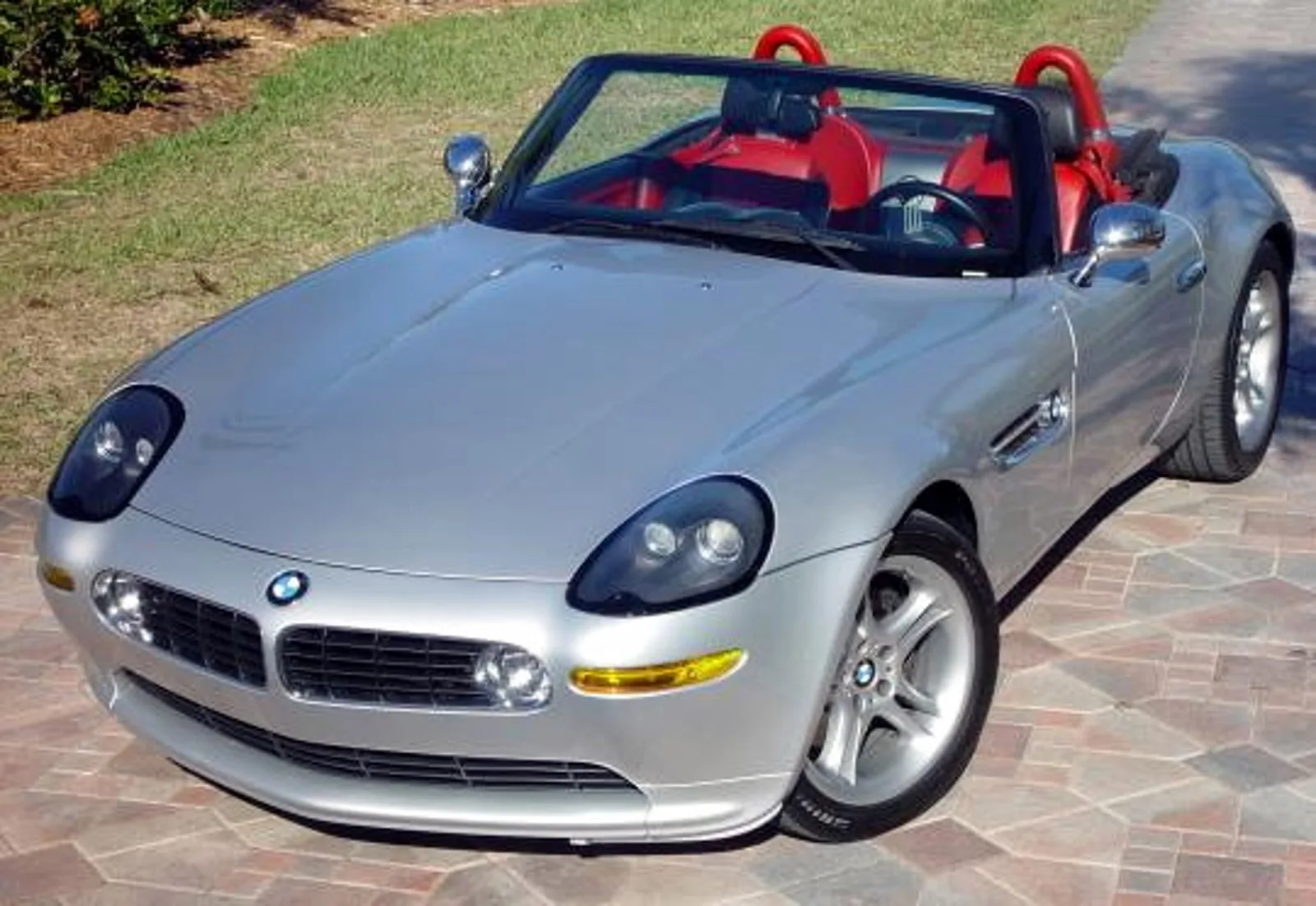
The BMW Z8 was an aluminium roadster that BMW built from 1998 to 2003. Starting life as a styling tribute to the 507, it became a limited, hand-finished flagship powered by a 4.9-litre V8. Production stopped in November 2002, and the Alpina Roadster V8 took its place in 2003.
Where did the BMW Z8 come from?
The Z8 began as a styling exercise that looked back to the 1956-1959 BMW 507. The project carried the codename E52 and ran from 1993 until 1999, under a design team led by Chris Bangle between 1993 and 1995. Henrik Fisker styled the exterior and Scott Lempert the interior.
Test prototypes were seen in action between 1996 and 1999. The car was previewed as the Z07 concept at the Tokyo Motor Show in October 1997, and because the concept ran alongside the E52 programme, few changes separated it from the production car.
The production windscreen sat more upright than the Z07's, and the front airdam was larger. The hardtop moved from a single dome with a truncated rear to a double-bubble shape with a tapering fairing. The Z07's exotic driver-side helmet fairing was dropped, so that the power soft top could still be operated easily.
A 4.9-litre V8 in an all-aluminium roadster, finished by hand in small numbers and remembered for a Bond film.
How much power did the Z8 make?
The 4,941 cc V8 makes 400 PS (294 kW; 395 hp), peaking at 6,600 rpm, with 500 Nm (369 lbf ft) arriving at 3,800 rpm. BMW Motorsport built the engine, known internally as the S62, and it was shared with the E39 M5 saloon. The factory claimed 4.7 seconds for 0-100 km/h.
The engine sits behind the front axle, which gives the car a 50/50 weight distribution. Motor Trend timed 0-96 km/h (0-60 mph) in 4.2 seconds, a figure quicker than the factory claim, and Road & Track measured lateral grip at 0.92.
Electronic limiting held the top speed at 250 km/h (155.4 mph), while the estimated unrestricted figure was 290 km/h (180 mph).
How did the Z8 compare with its rivals?
Car and Driver tested the Z8 against the Ferrari 360 Modena, a contemporary rival, and found the BMW ahead in acceleration, handling and braking. Motor Trend and Road & Track supplied independent figures, and Motor Trend's sprint beat the factory's own time.
The comparison was made against a rival of the same period, so it shows where the Z8 stood among the high-performance cars of its era. Acceleration, handling and braking were the three categories where the BMW came out ahead.
Taken together, the independent tests gave the Z8 concrete numbers for handling and acceleration rather than impressions. The table at the end of this article lists the figures side by side with the factory claims.
What did the BMW Z8 cost at launch?
The Z8 was priced at US$128,000 at launch, and that price, together with the hand-built production process, let BMW offer customised options. Buyers could choose paint and interior treatments that set their car apart from the standard model, and BMW Individual handled those requests.
The engine came from BMW Motorsport and was shared with the E39 M5, which tied the roadster to the company's performance saloon. The Z8 was therefore positioned as a performance flagship rather than a volume car.
Because just 5,703 cars were built, each Z8 was a rare purchase. The 50-year spare parts commitment was designed to protect owners of a hand-built car.
How was the Z8 built?
The Z8 used an all-aluminium chassis and body built around a MIG-welded aluminium space frame. The spaceframe was produced at the Dingolfing Plant and each car was hand-finished in Munich, which kept volumes low and made nearly every part a craft job.
The spaceframe allowed the complex compound curves of the styling to be formed. Because volume was limited, every element of the car was either constructed or finished by hand, which made BMW's ongoing support for the model all the more important.
BMW Individual, the custom division of the company, handled the bespoke work. Many buyers chose special paint and interior finishes across the four-year run, so no two cars were guaranteed to match.
What design details set the Z8 apart?
The Z8 tucked its modern equipment behind retracting panels to keep the interior looking simple. Its side turn signal repeaters sat inside the side vents and were invisible until activated, and its neon tail lights were expected to last the life of the car.
Power windows and mirrors shared one multifunction control, and the centre instrument cluster leaned slightly toward the driver. Gauges moved to the middle of the dashboard, keeping the driver's line of sight clear over the front and into the road ahead.
Every car came with a colour-matched metal hardtop that included a rear defroster. Many hardtops of the period were added for practical reasons, but the Z8 hardtop was designed from the start to suit the body's shape.
US rules changed the lights as well. Because of FMVSS requirements, the turn indicators built into the tail lights are entirely red on American cars.
How many BMW Z8s were built?
BMW built 5,703 Z8s in total, with 3,160 for the world market and 2,543 for North America. The four-year production run was complete by November 2002, and the car was built in limited volume throughout the whole run. Limited volume is central to the car's identity as a hand-built model.
BMW promised a 50-year stockpile of spare parts for the Z8 fleet. The promise was aimed at collectors who expected the car to become an instant classic, and it reflected the hand-built nature of each example.
Did the Z8 have a motorsport role?
The Z8 had one motorsport role, as a safety car variant used in the 2001 season of MotoGP. No factory racing programme for the road car is recorded, so its reputation rests on the road performance figures and that single safety car assignment.
The safety car variant was a specialist build for the motorcycle series rather than a showroom car. It sat apart from the road cars in both purpose and specification, and it remains the clearest link between the Z8 and competition.
What replaced the BMW Z8?
The Alpina Roadster V8 replaced the Z8 in 2003 and moved the car toward grand touring. It came only with an automatic transmission, a 4.8-litre Alpina-tuned BMW M62 V8 and softer suspension, and 555 units were built.
The suspension tune reflected a move away from the car's earlier sharp, sporting character. Output fell to 280 kW (381 PS; 375 hp), and torque climbed to 520 Nm (384 lb ft), arriving lower in the rev range for relaxed cruising.
Alpina fitted larger wheels with softer sidewalled tyres, a softer grade of Nappa leather and an Alpina steering wheel with three solid spokes. The limiter was set at 260 km/h (160 mph), up from the original's 250 km/h figure.
Of the 555 units, 450 went to the United States and eight to the UK. Dealers in America sold the Roadster V8 directly, and Alpina had never before used that retail route in the US.
Which James Bond film featured the BMW Z8?
The BMW Z8 appeared in The World Is Not Enough, released in November 1999, with scenes shot from early April 1999. Bond drives it in Azerbaijan until a helicopter cuts it in half, and the car was the final BMW to appear in the franchise.
The film gave the Z8 a gadget-filled role, including surface-to-air missiles, which made it one of the franchise's memorable vehicles.
The car later reappeared in the video games 007 Racing and Agent Under Fire, and Agent Under Fire featured the Z8 on its cover.
What was the Bertone Birusa concept?
The Bertone Birusa was a concept car that Bertone created and unveiled at the 2003 Geneva Motor Show. Built on the Z8, it used the same 4.9-litre V8 as the donor car and added carbon fibre gull-wing doors to the bodywork.
The Birusa showed how the Z8 platform could carry a different body. The Birusa reused the Z8's V8 rather than introducing a new engine. It remained a concept rather than a production model, and its gull-wing doors marked a clear break from the roadster's original styling.
What are the BMW Z8 specifications?
| Specification | Detail |
|---|---|
| Type | All-aluminium roadster, BMW |
| Built | 1998 to 2003; 5,703 cars |
| Engine | 4,941 cc V8 (S62), behind the front axle |
| Output | 400 PS (294 kW; 395 hp), peaking at 6,600 rpm |
| Torque | 500 Nm (369 lbf ft) at 3,800 rpm |
| Transmission | 6-speed manual |
| 0-100 km/h | 4.7 seconds (factory claim) |
| Top speed | 250 km/h (155.4 mph), electronically limited |
| Weight distribution | 50/50 |
| Price | US$128,000 at launch |
| Alpina Roadster V8 | 280 kW (381 PS; 375 hp), 520 Nm (384 lb ft), 555 units |