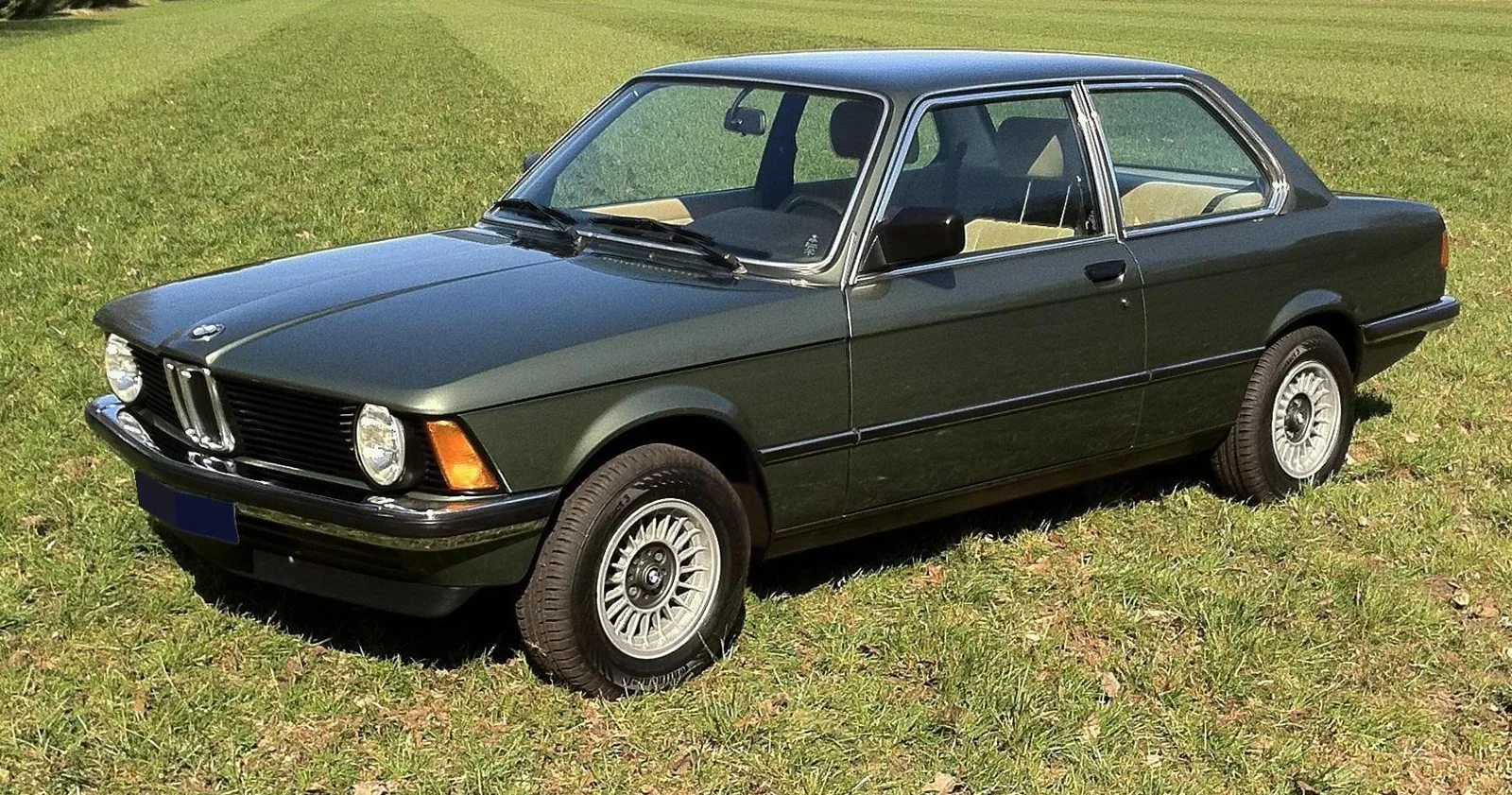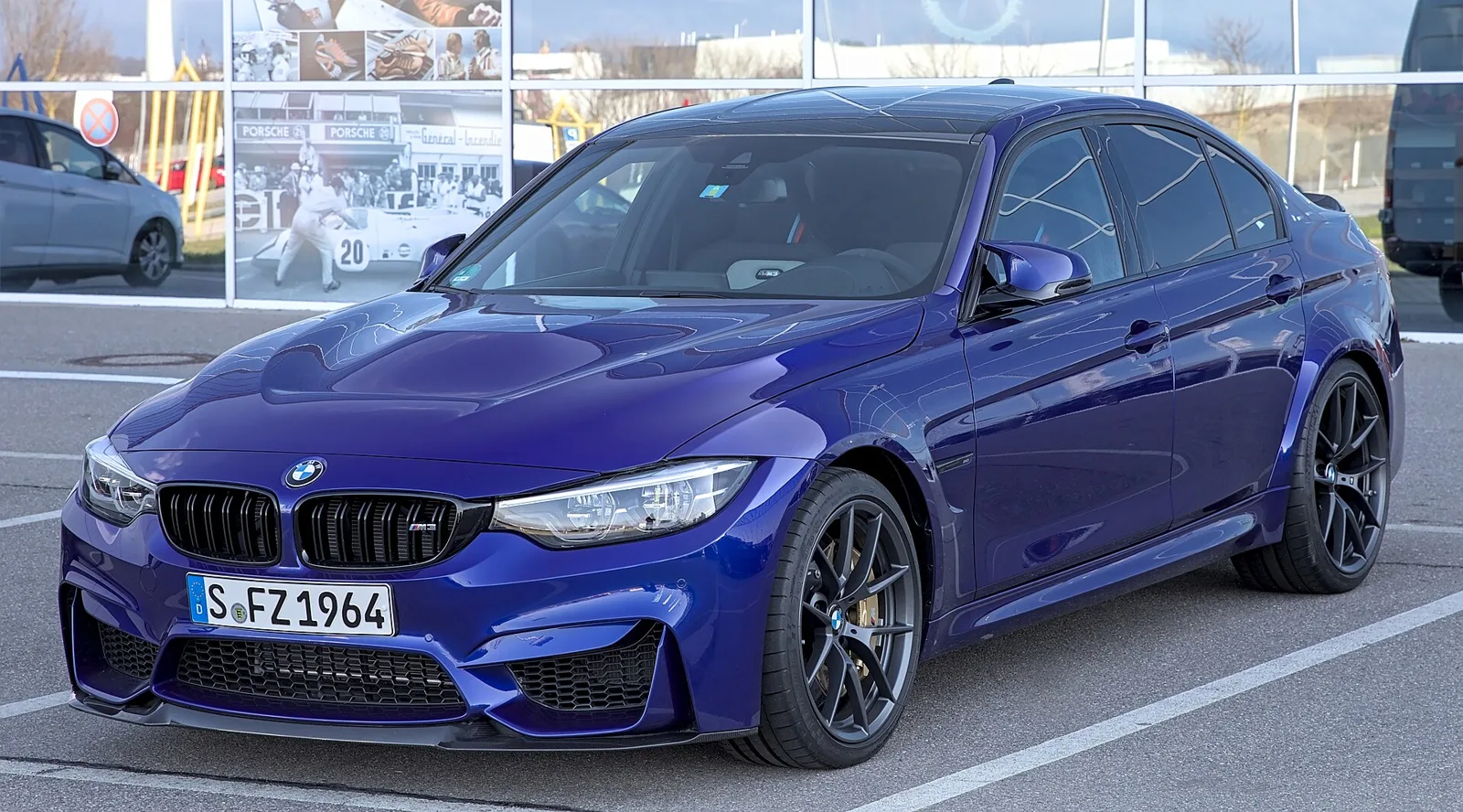
A high-revving straight-six coupe, a lightweight CSL and a V8 racer that BMW built to fit the letter of the rules.
The BMW M3 (E46) was a coupe and convertible built from 2000 to 2006, with a 3.2-litre straight-six making 252 kW (343 PS; 338 hp). Special versions included the lightweight M3 CSL, the Competition package and the V8-powered M3 GTR.
BMW's E46 M3 was a high-revving coupe and convertible built from mid-2000 until summer 2006. Its straight-six and wider body set it apart from the standard 3 Series, and a run of special versions followed, from the lightweight M3 CSL to a V8-engined racer built for the rulebook.
What set the E46 M3 apart from the 3 Series?
The E46 M3 stood apart from the standard 3 Series through wider wheel arches, a bonnet bulge called the Powerdome, a twin exhaust with four tailpipes and a front apron with air ducts. The width grew by around 40 mm (1.6 in), and the Powerdome has no technical function at all.
Buyers who wanted the larger wheels paid extra for the 19-inch set from spring 2001, while the 18-inch wheels came as standard.
Air outlets, or gills, in the front wings vent the electronics, while the apron's ducts feed the cooling.
The coupe was first shown at the Mondial de l'Automobile in 2000, and the convertible followed at NAIAS 2001, each in its original version only.
The bulge on the aluminium bonnet does nothing mechanical. Other changes were less visible, such as the wider arches that make room for the 18-inch wheels fitted as standard.
Light-alloy wheels came as 18-inch cast units or 19-inch forged ones. The arches needed 20 mm (0.8 in) more width on each side so that the wheels would fit. The track measures 1,508 mm (59.4 in) at the front and 1,525 mm (60.0 in) at the rear. A narrow spoiler strip, the Gurney flap, sits on the edge of the boot lid and is mainly responsible for reducing lift at the rear axle.
A high-revving straight-six that became a family of special models, from the lightweight CSL to a V8 race car.
How did the straight-six perform?
At 7,900 rpm the 3.2-litre engine puts out 252 kW (343 PS; 338 hp), and it could rev to 8,000 rpm. It also produced 80 percent of its maximum torque from 2,000 rpm, giving a broad usable band for a unit built to the high-revving concept.
Its suspension refined what the M3 E36 had used before. A variable M differential lock was added, with a locking value anywhere from 0 to 100 percent, along with a floating compound brake system on both axles.
From early 2005 buyers could also add a Competition package, which tightened the steering and added the M Track Mode.
Alpina offered its own E46 variants, the B3 and B3 S, which were tuned for more driving comfort than the M3.
Key specifications
| Item | Detail |
|---|---|
| Engine | Straight-six of 3.2 litres (195 cu in) |
| Power | 252 kW (343 PS; 338 hp), peak at 7,900 rpm |
| Torque | 80 percent of maximum available from 2,000 rpm |
| Rev limit | 8,000 rpm |
| Front track | 1,508 mm (59.4 in) |
| Rear track | 1,525 mm (60.0 in) |
| Wheels | 18-inch cast, or 19-inch forged (19-inch at extra cost from spring 2001) |
| M3 CSL power | 265 kW (360 PS; 355 hp) |
| M3 CSL 0 to 100 km/h | 4.9 seconds |
| M3 GTR Street V8 | 243.9 cu in (3,997.3 cc); 7,500 rpm for 285 kW (387 PS; 382 hp) |
| M3 GTR Street top speed | 295 km/h (183 mph) |
What was the M3 CSL?
The M3 CSL was a limited special model built from mid-2003 to summer 2004, with a lighter body and a 265 kW (360 PS; 355 hp) engine. The abbreviation stood for Coupe Sport Leichtbau, or coupe sport lightweight, just as it had on the BMW 3.0 CSL. A Mobile Tradition special issue puts the total at 1,383 units built in about one year.
Its prototype had already been shown publicly at the IAA 2001, before the limited run went on sale.
Lightness came from dropping comfort features and using modern materials. Several parts were made of carbon-fibre-reinforced plastic, including the interior mirror, door panels, centre console and roof. The rear window was lighter, and the boot lid and boot floor were lightened too, the floor being made of stiff cardboard.
The CSL lost its fog lamps, because they had to give way to a changed air intake. Inside, bucket seats replaced the normal chairs, the rear bench was slimmed down, and the steering wheel had Alcantara trim. Air conditioning and a radio could be ordered at no extra cost. The only gearbox offered was the six-speed sequential SMG II with Drivelogic.
The launch control was reworked so that the car shifts up at the top of the rev range. At full throttle, one tug on the shift paddle is all it takes to go from rest to top speed. Inexperienced drivers could reach the factory figures of 4.9 seconds for 0-100 km/h and 16.7 seconds for 0-200 km/h.
The chassis was partly tuned on the Nurburgring Nordschleife. In independent tests the CSL recorded 7:50 min, a time that was outstanding for its performance class. Its factory sport tyres drew criticism, since they were good on race tracks but weaker in everyday use and in the wet.
What did the Competition package add?
In early 2005 buyers of new cars could order a Competition package for 5,300 euros. It brought 19-inch CSL-design wheels on sport tyres, brakes borrowed from the M3 CSL, a retuned chassis, sharper steering and the M Track Mode.
The package could be ordered only on new cars, so it had to be chosen at the time of purchase.
The steering ratio changed from 15.4:1 to 14.5:1, which made the steering more direct. Pressing a button on the steering wheel switches on the M Track Mode, which lets the rear wheels slide more and raises the yaw rate. The CSL had a similar M button, which is why its steering wheel could no longer be ordered with multifunction controls.
What did the facelift change?
The E46 received a facelift in spring 2003. The M3 coupe and convertible stayed in their original version, but some facelift features, including the LED tail lights, were later built into them.
Why did BMW build an M3 GTR with a V8?
Because the six-cylinder M3 lost to the Porsche 911 GT3 in the American Le Mans Series (ALMS) in 2000, BMW fitted two race cars with a four-litre V8 in 2001. The move matched the wording of the rules but not their spirit, and rivals protested since BMW offered no V8 M3 for sale.
The rules required a road version, so BMW supplied one afterwards. Accounts put the number of these M3 GTR Street cars between 1 and 10. In 2002 the series changed its rules and shut out the V8 cars, which were later reworked for use at the Nurburgring.
The road version used a P60B40 V8 with dry-sump lubrication, reduced to 285 kW (387 PS; 382 hp) from 330 kW. It sat under a bonnet with extra cooling slits. A six-speed manual and a twin-plate clutch came from the race car, and carbon fibre covered the roof, rear wing and both aprons.
With every comfort item removed, the road version, a two-seater, weighed roughly 1,350 kg (2,976 lb) unladen. Its price was put at 250,000 euros.
Was there an estate M3?
BMW did build an estate study of the M3, the M3 Touring Concept, in 2000, but it never reached series production. The public did not see it until 2016. The more elaborate rear axle was hard to combine with a usable load space.
How did the GTR reach video games?
Video games made the GTR better known, among them Need for Speed and Gran Turismo. In November 2024 Electronic Arts and BMW showed a real car at BMW Welt, timed to a Need for Speed Unbound update.
The real car wore the livery of the virtual car from Need for Speed: Most Wanted.