A 300 metre motorcycle track built after a sudden closure, with an Air Fence, a junior circuit and a run of national championship rounds.
Gillman Speedway is a purpose-built motorcycle speedway in Gillman, a suburb of Adelaide, South Australia. It opened in 1998 with a 300 metre (330 yard) track and runs about 13 meetings a season, from October to March or April. The promoter is David Parker, a former sidecar racer.
Gillman's 300 metre (330 yard) circuit has staged motorcycle speedway since 1998. Its season stretches from October into March or April, with roughly 13 meetings, and the venue is now run by former sidecar racer David Parker.
Why was Gillman Speedway built?
Gillman was built after the sudden closure of North Arm Speedway at the end of the 1996-97 season. Adelaide had no weekly motorcycle venue for the first time in almost 80 years, and a replacement had to be found quickly. The founders inspected many sites before settling on a park at Gillman.
North Arm stood on land owned by the Government of South Australia, and that land was reclaimed in mid-1997. The closure was sudden and forced, which left riders and fans without a regular place to race.
David Parker, president of the Speedway Riders' Association of South Australia, and Ivan Golding, president of Motorcycling SA, examined many possible locations. They chose the Heini Becker Park Motorsport Complex at Gillman, next to a motocross track and only 2 km from the old North Arm site.
The start-up equipment was modest: an old water truck, an old grader and a Massey Ferguson tractor. The tractor kept working long after the other machines had been replaced.
A track built from salvaged dolomite after a closure left Adelaide without a weekly motorcycle venue.
How did the track take shape?
The first official practice took place on 19 October 1997, on a 213 metre (233 yard) track formed from dolomite brought from the old North Arm site. The first race meeting followed on 16 May 1998, on a larger 400 metre (440 yard) dirt track built alongside it.
The original 213 metre track ran north to south, with its start line roughly where turns one and two now stand. Its safety fence was made from used car tyres, painted white and stacked three high. Monthly practice meetings were held there while the bigger track was completed.
Lights transformed the programme. Temporary lights were installed in November 1999, and the first meeting under them was held on 7 January 2000. The meeting that night was the South Australian Solo title race, which Adelaide rider Nigel Sadler won.
During winter 2000 the Speedway Riders' Association of SA, helped by local riders and their families and friends, levelled both existing tracks. The work produced the international standard circuit that is still in use today.
What is the track like today?
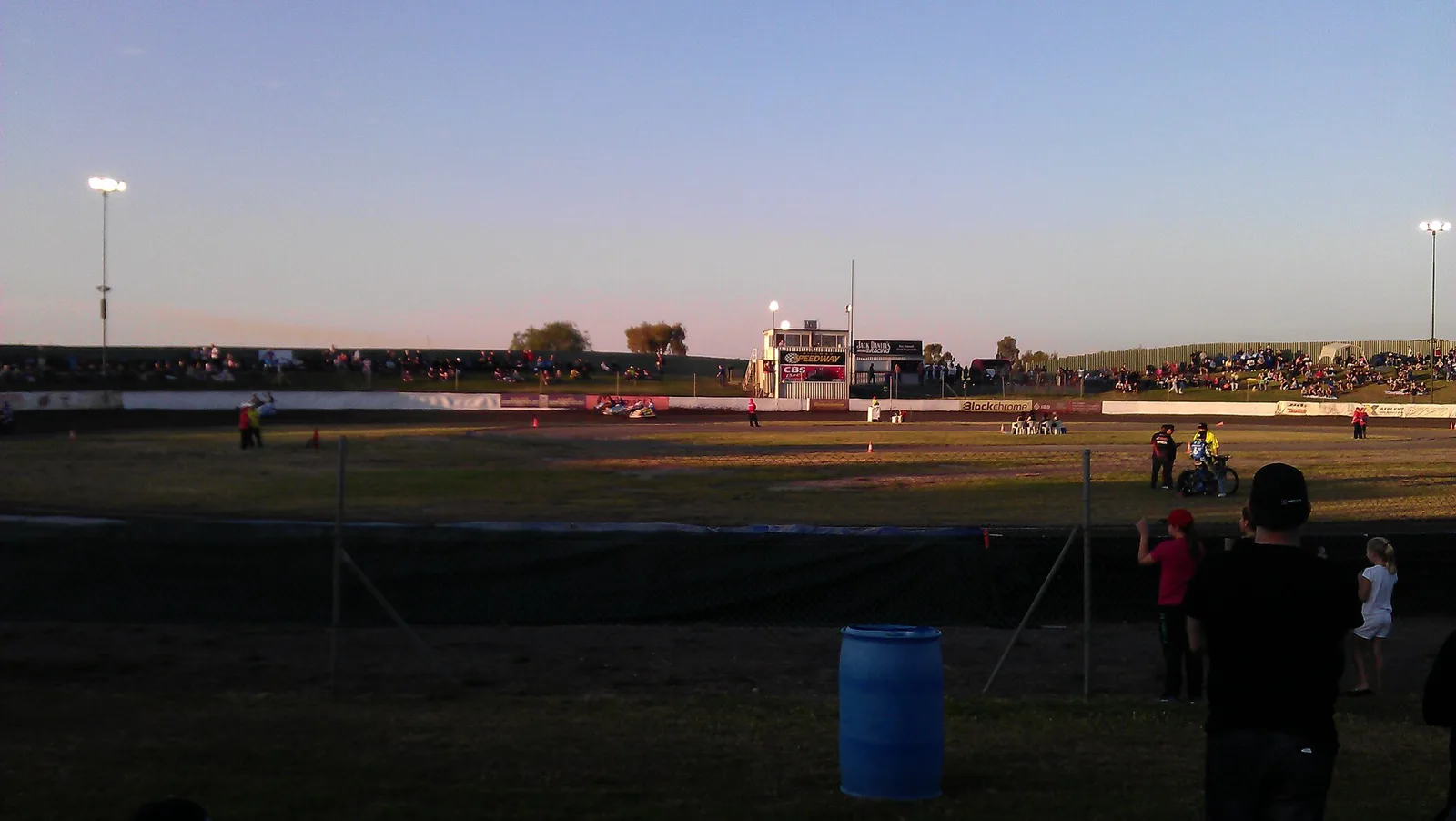
The current circuit is 300 metres (330 yards) long, 13 metres wide on the straights and 15 metres on the corners, with a slight camber. The surface is a mix of dolomite, crushed granite and clay, and the safety fence is 1.2 metre high rubber belting suspended on high tensile wire strands.
Eight 15 metre light poles carry 24 metal halide lights, each rated at 2000 watts. The referee's and commentary box at the start-finish line carries an FIM type control panel.
Banked spectator terraces ring the circuit on every side except the back straight, which holds the pits. Ground in front of the pits stayed level, leaving room for a future grandstand once money became available. An open-air grandstand for the back straight, with no roof and placed directly in front of the pits, was completed in August 2015 and seats 216 people.
A VIP area sits outside turn 3, and turn 2 serves the same role for sidecars. Up to 50 people can watch from its elevated position overlooking the track, which gives guests a clear view of the racing from start to finish.
Which championships has Gillman hosted?
Gillman has held at least one round of the Australian Solo Championship every year since 2005. It has also staged the Australian Sidecar Championship in 2008, 2011 and 2013, and the Australian Under-21 Solo Championship in 2001, 2002, 2006, 2007 and 2014.
The opening round came to Gillman in 2006, 2010 and 2013, while the final round was held there in 2009, 2012 and 2014. The Gillman Solo Championship, a separate meeting for Division 1 and Division 2 riders, has run since 2003. It was not held in 2006, 2007 or 2008.
On 11 May 2011 the venue was confirmed as host of the closing round of the 2011/12 Australian Solo Championship, scheduled for 21 January 2012. Chris Holder, from New South Wales, went unbeaten through that series and collected his fourth Australian title in five years.
Holder went on to win the 2012 Speedway Grand Prix series, which made him Australia's fifth Speedway World Champion. He joined Lionel Van Praag, Bluey Wilkinson, Jack Young and Jason Crump on that list, with Van Praag's title dating from 1936 and Crump's three titles from 2004, 2006 and 2009.
A 13 round Speedway Sidecar Grand Slam was also announced in May 2011, with its final at Gillman on a provisional date of 7 April 2012. The series began on 14 October at Pioneer Park Speedway in Ayr, Queensland, and was headlined by several Australian and world champions.
Who won the Australian Solo rounds held at Gillman?
Leigh Adams, Chris Holder and Troy Batchelor were the most frequent round winners at Gillman between 2005 and 2017. Adams took four rounds in 2005, 2006, 2007 and 2009, Batchelor won in 2010, 2013 and 2017, and Holder won in 2008 and 2012. The table lists every round and the overall series winner for each year.
| Year | Round | Round winner | Series winner |
|---|---|---|---|
| 2005 | 4 | Leigh Adams | Leigh Adams |
| 2006 | 1 | Leigh Adams | Leigh Adams |
| 2007 | 4 | Leigh Adams | Jason Crump |
| 2008 | 2 | Chris Holder | Chris Holder |
| 2009 | 3 | Leigh Adams | Leigh Adams |
| 2010 | 1 | Troy Batchelor | Chris Holder |
| 2011 | 2 | Davey Watt | Chris Holder |
| 2012 | 4 | Chris Holder | Chris Holder |
| 2013 | 1 | Troy Batchelor | Troy Batchelor |
| 2014 | 3 | Rohan Tungate | Chris Holder |
| 2015 | 1 | Jason Doyle | Jason Doyle |
| 2016 | 3 | Brady Kurtz | Brady Kurtz |
| 2017 | 1 | Troy Batchelor | Sam Masters |
Round winners and series winners do not always match. In 2007 Adams won a round while Jason Crump took the series, and in 2010 Batchelor won a round while Holder took the title. Holder won the series in 2008, 2010, 2011, 2012 and 2014, which made him the most successful series rider in the table.
How did the Air Fence change safety?
The Air Fence was installed by the start of the 2011-12 season, covering turns one and two and turns three and four. It cost over A$100,000, all raised through sponsorship packages, and it aimed to increase rider safety. Its panels sit on the corners as an extra layer of protection.
The fence is made of sixty six panels, each 3 by 1.2 metres and 75 centimetres thick. Every panel has a foam frame and a reinforced PVC cover.
The Air Fence was installed in front of the existing fence on the corners in November 2011. Tony Rickardsson, the six-time Speedway World Champion from Sweden, donated to the fund after visiting the venue and praising the venue.
The Speedway Riders' Association raised the fence money through sponsorship packages, as it had for the wider track work carried out with local help.
What does the junior track offer?
The junior track was built on the infield in 2006 to encourage younger riders, and it opened on 21 October that year. It is 111 metres (121 yards) long, has no safety fence and has a shortest run-off area of 17 metres, which gives riders time to stop or turn before reaching the main track fence.
Gillman is the second junior track in Adelaide after Sidewinders Speedway, which opened in 1978 and was still in operation as of 2016. The opening ceremony was performed by the late Kym Bonython, a Rowley Park Speedway promoter.
Six-time world champion Ivan Mauger gave a demonstration ride on the main track at the age of 67. Over four laps he was only seven seconds slower than the track record holder at the time, Leigh Adams.
What are the current lap records?
The solo four-lap record on the main track is 54.06 seconds, set by Justin Sedgmen on 3 January 2017. The sidecar four-lap record is 56.36 seconds, held by Trent Headland and Darryl Whetstone since 16 April 2017, and the junior solo record stands at 41.55 seconds.
Sedgmen, a Victorian rider, set the main-track solo mark. The junior record was set by Max Fricke, the 2016 Under-21 World Champion, on 22 January 2011 in the 125cc class.
The junior sidecar record of 42.46 seconds belongs to the New South Wales pair of Shane Hudson and Sam Gilbert, who set it in March 2011 in the 250cc class.
What happened at the 2015 benefit meeting?
On 7 November 2015 Gillman staged a benefit meeting for injured rider Darcy Ward. A crowd of 1,933 attended, and more than $40,000 was raised for the Darcy Ward Rehabilitation Fund through gate takings and an auction of signed items.
Auction lots included helmets signed by MotoGP riders Valentino Rossi and Jorge Lorenzo. Chris Holder won the solo final from Troy Batchelor, while the young German rider Kai Huckenback was the surprise of the night, finishing among the leaders in the same final.
Holder also rode four laps as a passenger on Mark Plaisted's 1000cc sidecar outfit, swapping two wheels for three. In the sidecar final Justin Plaisted and Sam Harrison beat Mick and Jesse Headland, with Trent Headland and Daz Whetstone taking third place.
Why does Gillman Speedway still matter?
Gillman is regarded as one of the premier motorcycle speedways in Australia. Its purpose-built track, its safety upgrades and its junior programme support that reputation, and it has held Australian championship rounds every year since 2005. Its roster of national winners, from Leigh Adams to Chris Holder, shows the calibre of racing it has hosted.
The venue's legacy is also tied to the riders who raced there. Chris Holder won the 2012 series that made him Australia's fifth Speedway World Champion, and Leigh Adams won the Jack Young Solo Cup on the opening day in 2001, then again in 2002 and 2003.
Finally, Gillman shows what local volunteers can build. The track was made from dolomite salvaged from a closed venue, the winter work of 2000 was done with help from local riders, their families and friends, and the Air Fence was paid for through sponsorship.