Alex Palou won the Indianapolis 500 and his fourth title in a season of Fox broadcasts, a new charter system and a long fight with Pato O'Ward for second place.
Alex Palou won the 2025 IndyCar championship for Chip Ganassi Racing, his fourth title, after a season that also included his Indianapolis 500 win. Josef Newgarden won the Nashville finale, and the first year of Fox broadcasts brought average viewership of 1.2 million.
Counting its 114th official championship season in American open-wheel racing, 2025 was the 30th year run under IndyCar Series sanction. Alex Palou, driving for Chip Ganassi Racing, won the 109th Indianapolis 500 and his fourth championship, completing a three-peat after two straight titles before it.
It was a season of firsts for the series. It was the first year with all races on the Fox broadcast network, the first year of the charter system, and a year in which the officiating system was being rebuilt after the Indianapolis 500 controversies. Palou's strong start gave him a points lead that he never lost, even as Pato O'Ward became his closest rival over the middle of the year.
What changed for the series in 2025?
The biggest change was the broadcast deal. After NBC Sports' contract lapsed in 2024, all races moved to Fox, with Will Buxton as lead commentator and former drivers Townsend Bell and James Hinchcliffe retained as analysts. On 31 July 2025 Fox Corporation also took a one-third stake in Penske Entertainment, with the TV deal extended to 2030.
The second big change was the charter system. It began in 2025 and runs until 2031, with 25 charters awarded to teams that ran full-time in 2024, up to three for each team. Chartered entries competed for the 22 Leaders Circle contracts, and every race except the Indianapolis 500 was limited to 27 starting cars, with chartered entries guaranteed a place on the grid. PREMA Racing, as a new entrant, was excluded from receiving charters.
Governance also changed. Doug Boles was named president of IndyCar on 11 February, replacing Jay Frye, and the series announced an independent officiating board for stewarding and technical inspections, targeted for 2026. A scanning system was also used during inspections, and four cars were impounded and scanned after the Portland race.
Palou's three-peat was built on early momentum, a steady run of podiums and a single Indianapolis 500 win that carried the title race.
Who joined and left the grid for 2025?
Several drivers moved to new teams. Christian Lundgaard replaced Alexander Rossi at Arrow McLaren, while Rossi signed a multi-year deal with Ed Carpenter Racing. David Malukas joined A. J. Foyt Enterprises full-time, and Callum Ilott joined PREMA Racing in the No. 90 entry, a team that also signed Robert Shwartzman for its second seat. Marcus Armstrong moved to Meyer Shank Racing, replacing Malukas in the No. 66 car.
Other changes were just as notable. Rinus VeeKay was released by Ed Carpenter Racing after five seasons and moved to Dale Coyne Racing's No. 18 car. Louis Foster took the No. 45 car at Rahal Letterman Lanigan Racing, and Devlin DeFrancesco joined that team as a third entry. Kyffin Simpson moved to the No. 8 car at Chip Ganassi Racing, and Conor Daly drove Juncos Hollinger Racing's No. 78 full-time.
Which teams changed their structure?
The team landscape shifted too. PREMA Racing entered two full-time cars with Chevrolet engines. Meyer Shank Racing switched its technical alliance from Andretti Global to Chip Ganassi Racing, and Chip Ganassi Racing reduced its operation from five cars to three. McLaren Group bought the remaining 25% of Arrow McLaren on 3 January 2025, and Dale Coyne's partnership with Rick Ware Racing ended.
Team Penske suffered the most dramatic change. Following failed inspections of the Newgarden and Power cars in Indianapolis qualifying, the team dismissed president Tim Cindric, managing director Ron Ruzewski and general manager Kyle Moyer on 21 May.
How did the opening rounds set up the title race?
Scott McLaughlin took the first pole of the year at St. Petersburg, but a first-lap collision brought out an early caution and turned the race into a tyre strategy contest. Several frontrunners, including Palou, switched off the fragile alternate tire during the stop sequence, and Palou pulled away after undercutting his teammate Scott Dixon. Dixon passed Newgarden for second on the final lap.
At the Thermal Club, Pato O'Ward took pole, but Palou won the race for his 13th career victory and extended his championship lead to 39 points over O'Ward. Long Beach was won by Kyle Kirkwood, who took pole, held off Palou and gave Andretti its first win of the year. It was the first yellow-free Long Beach race since 2016, and Kirkwood closed to within 34 points of the lead.
Palou then reeled off a run of wins. He took pole at Alabama, won the race and his third in four rounds, and built a 60-point lead over Christian Lundgaard. At the Sonsio Grand Prix on the Indianapolis road course, he held off O'Ward, who had started eighth and finished second, and went into the 500 with a 97-point lead.
| Event | Winner | Notable detail |
|---|---|---|
| St. Petersburg | Alex Palou | Dixon second on the final lap |
| Thermal Club | Alex Palou | 13th career win, O'Ward pole |
| Long Beach | Kyle Kirkwood | First yellow-free race there since 2016 |
| Alabama | Alex Palou | Third win in four rounds |
| Sonsio Grand Prix | Alex Palou | O'Ward rose from eighth to second |
| Indianapolis 500 | Alex Palou | Passed Ericsson with 14 laps left |
| Detroit | Kyle Kirkwood | Second win of the season |
| Bommarito 500 | Kyle Kirkwood | First oval win |
| Road America | Alex Palou | Lead of 93 points |
| Mid-Ohio | Scott Dixon | Won by a fraction under half a second |
| Iowa race one | Pato O'Ward | Ended a Honda 11-race win streak |
| Iowa race two | Alex Palou | Seventh win of the season |
| Toronto | Pato O'Ward | Season-first podium for VeeKay |
| Monterey | Alex Palou | Eighth win of the season |
| Portland | Will Power | Palou third secured the title |
| Milwaukee Mile 250 | Christian Rasmussen | First IndyCar win |
| Music City Grand Prix | Josef Newgarden | Season finale win |
What happened at the 109th Indianapolis 500?
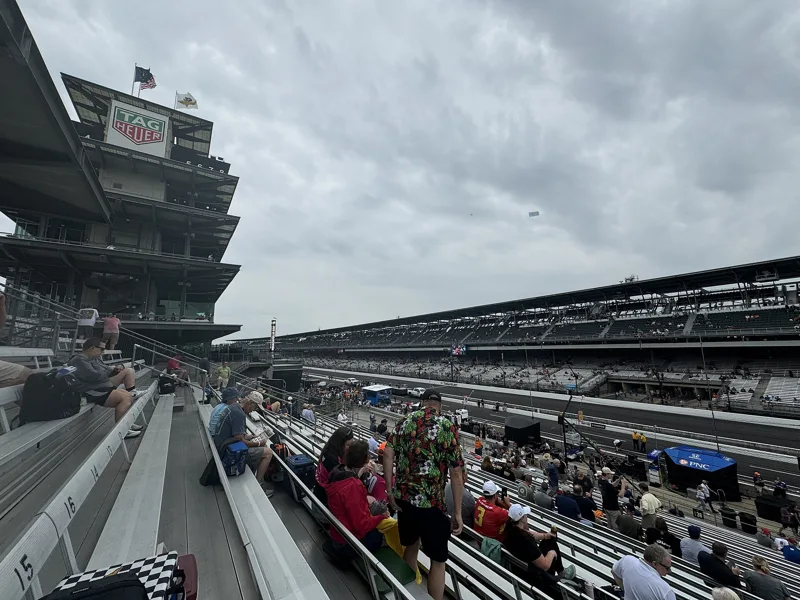
Robert Shwartzman took pole in his first Indianapolis 500, the first rookie polesitter since 1983. The weekend was overshadowed by the disqualification of Newgarden and Power from qualifying for technical violations, which sent both to the back of the grid. Shwartzman initially held firm on race day but faded and crashed before half-distance, leaving Marcus Ericsson, Palou and Malukas to contest the lead.
Palou closed in on Ericsson late on and made a decisive pass with 14 laps left, then held off the Swede to win the Indianapolis 500 after several near misses. Ericsson was later disqualified for an illegal aerodynamic modification, which promoted Malukas to second and O'Ward to third. Palou's win gave him a 112-point lead in the standings after just six races.
How did the middle of the season change the title race?
Kirkwood's Detroit win came after one of the most chaotic events of the year. Herta took pole, but Kirkwood moved forward and held off Santino Ferrucci for his second win of the season, while Palou retired after contact with Malukas and his three-race winning streak ended. His lead fell to 90 points.
At the Bommarito Automotive Group 500 at Gateway, Power took pole, his fifth at the track. Power's race ended early with a tyre failure, and Kirkwood undercut the leaders to take his first oval victory, with O'Ward second and Christian Rasmussen climbing from 25th to third. Palou finished eighth and his lead was trimmed to 73 points.
Road America was a race of recoveries. Palou dropped back after contact with Power but recovered through timely pit stops and fuel management to win ahead of Rosenqvist and Ferrucci, leaving him 93 points clear. Mid-Ohio was a different story. Palou took pole, his third of the season, but Scott Dixon won by a fraction under half a second and Christian Lundgaard was third. Palou still pushed his championship lead to 113 points, with seven events left.
Iowa was a double-header with a pair of contrasting results. Newgarden became the ninth different pole sitter of the season for the first race, but O'Ward won, ending a Honda 11-race win streak. Power was third and Palou fifth. In the second race Newgarden controlled much of the running, but Palou stopped under the second caution, kept the lead on the final restart and held off Dixon for his seventh win of the season, which left him 129 points clear of O'Ward.
Toronto was O'Ward's race. He won ahead of VeeKay, who took a season-first podium, and Kyffin Simpson, who took a career-first podium. Palou finished twelfth and saw his lead over O'Ward cut to 99 points with four races to go. At Monterey, Palou took his eighth win of the season and led by 121 points with three races remaining.
How was the championship settled at the end of the year?
After Monterey the closing rounds began at Portland, where O'Ward started from pole but his race ended with an electrical issue on lap 22. Power took the lead during the first pit stops and held it to win, while Palou's third place was enough to secure his fourth championship. That result made the three-peat complete, and it followed a season in which Palou won four of the first five events.
The Milwaukee Mile 250 was won by Rasmussen for his first IndyCar win. He overtook the race leader into turn three with 16 laps remaining, after pitting for new tyres during a light rain shower. The finale in Nashville, the Borchetta Bourbon Music City Grand Prix, was won by Newgarden. Palou finished second and ended the year with a 196-point lead.
What were the final standings and what did the season mean?
The points table followed the same logic as earlier seasons. Pole sitters earned a point at every race except the Indianapolis 500, drivers earned a point for each race they led and two more for leading the most laps, and entrant-initiated engine change-outs cost ten points. The Indianapolis 500 added its own bonus for the fastest Saturday qualifier and the Sunday pole winner.
The manufacturer table worked differently. The top two full-season entrants from each manufacturer scored points in each race, a race win earned five bonus points, and a pole earned one bonus point at races other than Indianapolis. The entrant standings listed only full-time entries, and non-chartered entries that were ineligible for the Leaders Circle were shown in a separate shade.
Palou's season was built on early momentum: four wins from the first five events, a win at the Indianapolis 500, and consistent results afterwards. O'Ward emerged as his closest rival after mid-season gains, including a victory at Iowa and a strong run of podiums, but mechanical issues at Portland ended his pursuit of the title.
The viewing figures were the strongest in years. Average viewership rose by 28 per cent in the first Fox season, reaching 1.2 million viewers, the best figures since 2012. The Indy 500 was watched by its biggest television crowd in 17 years, and several events reported record or near-record attendance.
Why does the 2025 season matter?
The 2025 season confirmed Palou as the dominant figure of his era, with three straight championships and an Indianapolis 500 win in the same year. The new charter system and the new broadcast partner were the other headline changes, and the officiating board planned for 2026 was the next major item for the series.