Kentucky Speedway hosted the debut of a new low-downforce rules package, and a race packed with cautions and lead changes went to Busch.
The 2015 Quaker State 400 was held on July 11, 2015, at Kentucky Speedway in Sparta, Kentucky. Kyle Busch won his second race of the season after leading 163 laps, while Joey Logano finished second and Denny Hamlin third in the first race run under the new low-downforce package.
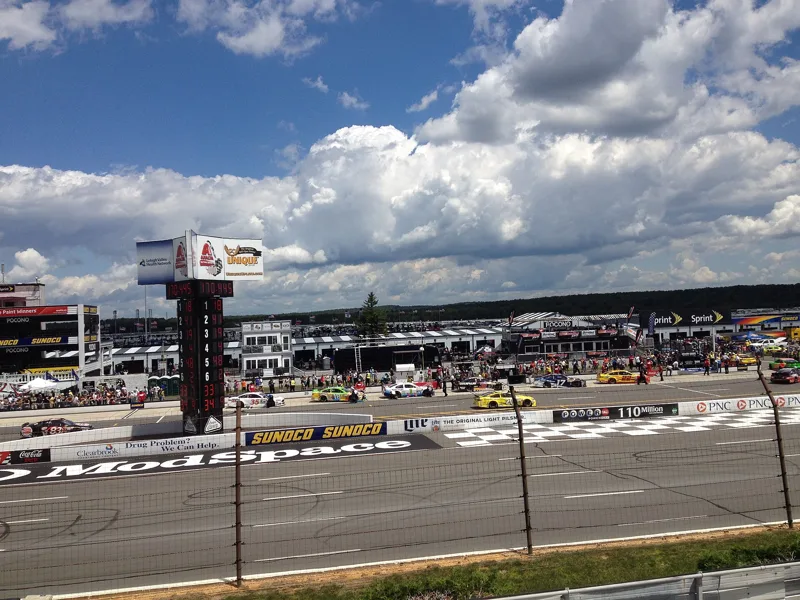
Kentucky Speedway in Sparta, Kentucky, hosted the Quaker State 400 on July 11, 2015, a Sprint Cup event in NASCAR's top division. It was the first race run under NASCAR's new low-downforce package, and Kyle Busch won it after leading a race-high 163 laps. Joey Logano finished second, while Denny Hamlin came back from two laps down to take third.
Where was the 2015 Quaker State 400 held?
The race was held at Kentucky Speedway in Sparta, Kentucky, a 2.4 km (1.5 mile) speedway. The 267-lap event was the 18th race of the 2015 Sprint Cup season. NBC Sports carried the race on NBCSN. Kyle Busch was the winner on the night, with a race-high 163 laps led.
Going into the race, Kevin Harvick led Dale Earnhardt Jr. by 63 points. Jimmie Johnson was 67 points back and Joey Logano was 75 back.
Kyle Busch won the first race under NASCAR's new low-downforce package, leading a race-high 163 laps on the way.
What was the low-downforce package?
NASCAR introduced a low-downforce package for the Kentucky race, built around a smaller rear spoiler, a wider splitter extension and tires from Goodyear with more grip. The package had first been planned for the All-Star Race, but NASCAR scrubbed that plan and used it in a points race at Kentucky instead.
NASCAR announced the package on June 16. The rear spoiler was 8.9 cm (3.5 inches) tall, and a 64 cm (25-inch) wide splitter extension was added. Teams received nine sets of Goodyear tires instead of the usual eleven.
NASCAR's Steve O'Donnell said the aim was to see more lead changes. He stressed that the package was a race rather than a test, and he cited 18 months of industry testing as the reason the sanctioning body felt confident using it.
Why was qualifying cancelled?
Because of the rain threat, NASCAR scrapped qualifying and set the grid by first-practice times, which gave Kyle Larson the pole. The grid was set without a single qualifying lap being run. Larson had been fastest in first practice, at 29.583 seconds, or 293.765 km/h (182.537 mph).
Blaney and the Wood Brothers team missed the field for a second straight week, and Travis Kvapil and Michael McDowell also failed to qualify.
NASCAR's O'Donnell later said the sanctioning body could probably have explained the decision better. The entry list had been released on Monday, July 6, with forty-six drivers entered for the race.
How did the race unfold?
Larson started from the front, but Keselowski was in front after the opening lap. Busch then exited pit road in front after the scheduled caution on lap 31, and he stayed near the top through a series of wrecks, restarts and pit stops before the late-race battle with Logano and Hamlin.
On lap 19, J. J. Yeley slid and touched Josh Wise in turn 3, bringing the first caution. None of the leaders pitted under that caution, as they all stayed out.
A scheduled competition caution came on lap 31, and Busch left the pits in front after taking two right-side tires while Keselowski took four. Keselowski had restarted eleventh, and he drove up to second.
Denny Hamlin had a flat right-front tire on lap 72 and was tagged for speeding on pit road, which sent him to a drive-through penalty. He rejoined 40th, two laps down.
Lap 80 brought the third caution, for debris in turn 4. On lap 93 Keselowski pressed hard, but Busch kept the front spot by a margin of eight one-thousandths of a second. Keselowski passed Busch in turn 3 on lap 96 to take the lead back.
Kurt Busch spun in the front stretch on lap 99 to bring out the fourth caution. A single-car wreck in turn 4 on lap 122 was the fifth caution. Dale Earnhardt Jr.'s left-front blowout in turn 3 caused the sixth.
A three-car wreck in turn 2 on lap 143 brought out the seventh caution, after Ricky Stenhouse Jr. tapped Jeb Burton while trying to avoid Tony Stewart. Another debris caution, the eighth, came on lap 147 in turn 4, and Keselowski surrendered second place by pitting under it.
A ninth caution came from debris in turn 2 on lap 187. Ryan Newman stayed out under the caution and took the lead, but he lost it to Kyle Busch on lap 193.
With 61 laps to go, the tenth caution came after Earnhardt bumped Danica Patrick into the wall in turn 3. Patrick retaliated on pit road, and Hamlin took the lead on the pit exit.
With 54 laps left Carl Edwards went three wide into the lead, but a slide in turn 1 let Hamlin retake it with 53 to run. A tire rub forced Larson onto pit road with 51 laps left, and Busch regained the front with 50 to go.
Larson's left-rear tire then went flat, sending his car into the turn 1 wall. That brought out the eleventh caution with 48 laps to go, which set a new record for cautions in a Sprint Cup race.
Logano shot past Hamlin on the restart to take the lead with 42 laps left. Busch took the lead back with 18 laps to go and pulled away to win his 31st career race.
How did drivers rate the new package?
Drivers were divided on the package. Denny Hamlin said the tires were so forgiving that drivers could abuse them, while Jeff Gordon said the tire was still way too hard. Carl Edwards praised the early racing as the best he had seen in a while.
Hamlin said the tires had been made so dummy-proof that anyone could abuse them with no consequence. He admitted that he had worn out his own tire, but he argued that a driver should not be rewarded for abusing one.
Finishing seventh in his last Kentucky start, Gordon felt the tire lacked grip when a run began. Edwards finished fourth and said the early racing, while the sun was still out, was the best he had seen in a long time.
Nate Ryan of NBC Sports argued there was enough evidence for a strong case that the package should get another shot.
Who finished in the top five?
Kyle Busch won, with Joey Logano second and Denny Hamlin third. Carl Edwards was fourth and Matt Kenseth fifth, and Kenseth also earned the Freescale Wide Open award. Busch led a race-high 163 laps on his way to the win, which was his 31st career victory.
| Finish | Driver | Note |
|---|---|---|
| Winner | Kyle Busch | 31st career win; led a race-high 163 laps |
| Second | Joey Logano | Passed Hamlin on the restart with 42 laps to go |
| Third | Denny Hamlin | Rallied from two laps down |
| Fourth | Carl Edwards | Fastest lap on lap 148 |
| Fifth | Matt Kenseth | Freescale Wide Open award |
| Seventh | Jeff Gordon | Final start at Kentucky Speedway |
| 35th | Kyle Larson | Awarded first on the grid, then crashed out late |
What did the result change in the standings?
After the win Busch was 35th in the standings: 87 points behind Cole Whitt in the 30th spot that marked the Chase cutoff, and 492 back from leader Kevin Harvick. Toyota, which had the winning car, was still 83 points adrift of Chevrolet among manufacturers.
Busch's victory was his second at Kentucky, and the third there for Joe Gibbs Racing. He also took home $214,316 in winnings for the victory.
Ryan Newman earned the Ingersoll Rand Power Move award for three positions, and Brad Keselowski won the Bake In The Race award. Carl Edwards took the Moog award alongside crew chief Darian Grubb, with a figure of 0.302 seconds, and Brett Moffitt was named Sunoco Rookie of the Race. The NASCAR Sprint Cup leader bonus rolled over to $150,000 for the next event.