A teardrop three-wheeler built in Bridgeport in 1933 to study how a flying machine might taxi, with a rear-steered third wheel, a fatal crash at the Chicago fair and one survivor.
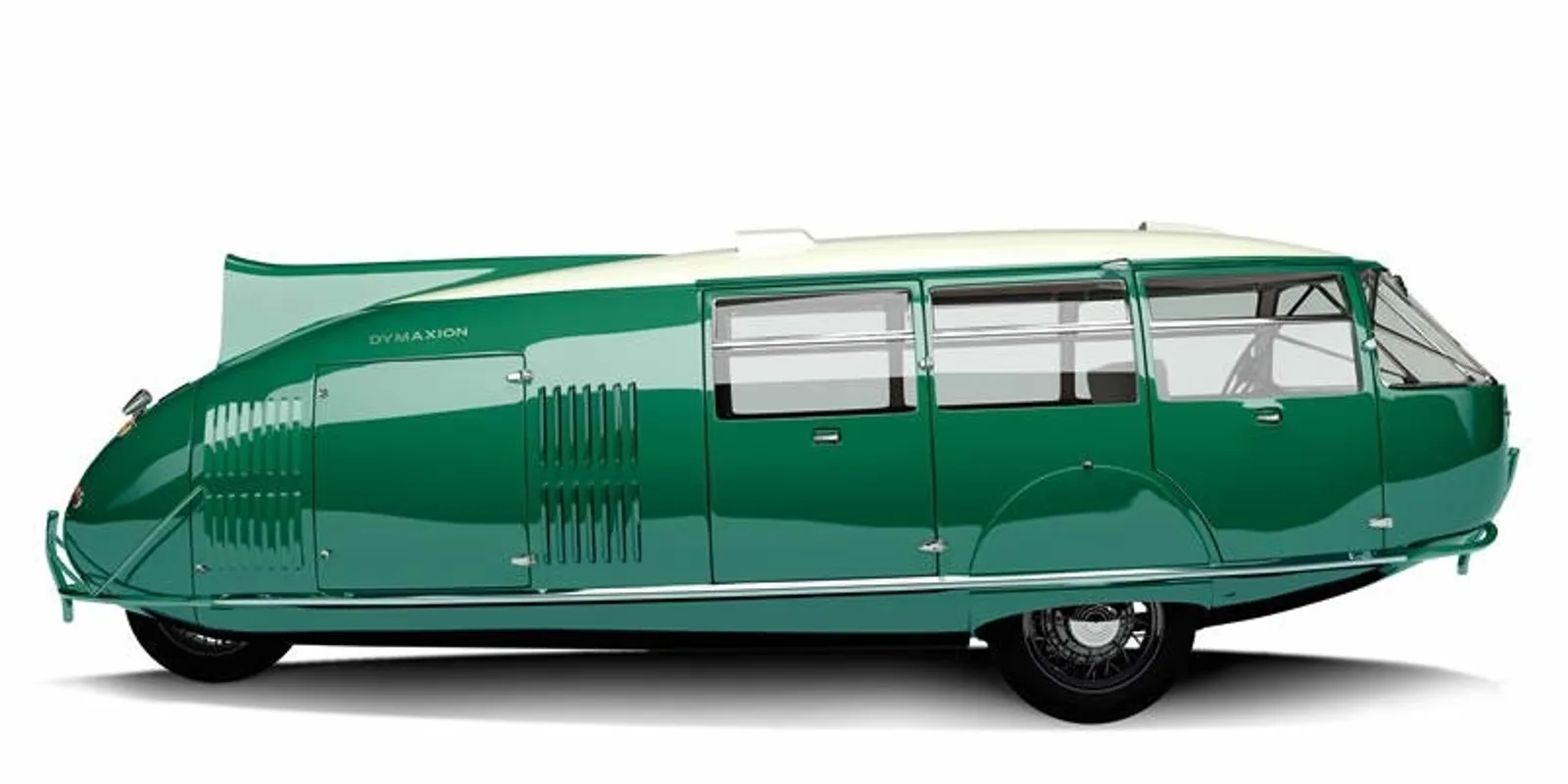
Buckminster Fuller and Starling Burgess built three Dymaxion prototypes in 1933: teardrop three-wheelers with a rear Ford V8, front-wheel drive and steering by the single rear wheel. One crashed fatally near the Chicago fair, and only Prototype Two survives today.
Buckminster Fuller did not build the Dymaxion to be a car. He built it to study the ground-taxiing phase of a vehicle that might one day land, drive and fly. Within months of its launch in 1933 a prototype rolled over near the Chicago World's Fair and killed its driver, and Fuller concluded the design was not ready for the public.
What was the Dymaxion car?
Buckminster Fuller, an American inventor, conceived the Dymaxion in the depths of the Great Depression, and the teardrop three-wheeler went on show at Chicago's 1933 and 1934 World's Fair. Working with naval architect Starling Burgess, he built three experimental prototypes paid for with donations and a family inheritance.
Fuller called the project a step towards what he named an Omni-Medium Transport, so he did not think of it as an automobile in the usual sense. The word Dymaxion, which he attached to much of his work, blends dynamic, maximum and tension and sums up his aim of doing more with less. Claims made for the car were bold: room for 11 passengers, a top speed of up to 140 km/h (90 mph) and fuel economy of 8 L/100 km (30 mpg-US). A 2009 book, Fifty Cars That Changed The World, includes it, and a 2012 documentary, The Last Dymaxion, told its story.
Fuller built the Dymaxion to study how a flying vehicle might taxi, not to sell a car.
Why did Fuller build it?
He wanted a vehicle that was not tied to roads and airports. In 1928 Fuller published sketches of a land, air and water craft he called the 4D Transport, four-dimensional meaning length, width, depth and time. He described it to his daughter Allegra as a zoomobile that could hop off the road, fly about, then settle back into traffic like a bird.
Money arrived from Philip Pearson, a wealthy former stock trader from Philadelphia, and his wife Temple, who offered $5,000 and hoped to put people to work during the Depression. Fuller worried about profit motives and short-sightedness, and wrote a contract with what he called the ice-cream-soda clause: he could spend the money however he liked, even on ice cream cones, with no questions asked.
Fuller incorporated Dymaxion Corporation on 4 March 1933, just as Roosevelt imposed a banking moratorium. He set up a workshop at Tongue Point in Bridgeport, Connecticut, in the old dynamometer building of the defunct Locomobile company, and hired Burgess plus 27 workmen, former Rolls-Royce mechanics among them. More than 1000 men had applied for those places. Three months later, on his 38th birthday, 12 July 1933, the first prototype was complete. A patent application followed on 18 October 1933, and the patent was granted in 1937.
How was the Dymaxion designed?
Fuller pictured a machine that would roll on wheels and leap into the air on what he called jet stilts, a stand-in for compact lift technology that did not yet exist. A craft for land, sea and air was beyond what money and engineering could then deliver, so he tackled the part he thought most dangerous: landing and taxiing on hard ground.
Two ideas followed from that. First, he favoured front-wheel drive, noting how a wheelbarrow pulls its load more effectively than it pitches forward when pushed. Second, he looked at steering in nature, above all the single rear fin that guides birds and fish, and chose to steer from the back. He expected a long, streamlined fuselage with trailing steering to swing into the wind as it touched down, a tendency he called ground-loopiness.
The shape was developed with the sculptor Isamu Noguchi, who made plaster wind tunnel models of the teardrop. A 2011 computational fluid dynamics analysis at Coventry University later noted the form's similarity to a humpback whale and judged it close to a drag optimum, a useful reference for low-drag shapes. Burgess, the inventor of the first delta-wing aircraft, contributed enormously but doubted the vehicle would ever take off. Although Fuller had never meant it as an automobile, he expected the public to call it one, and when he came to drive it on Connecticut roads he applied for an automobile registration.
What was under the skin of Prototype One?
Prototype One was 6.1 metres (20 feet) long. Its hinged two-frame chassis was made of lightweight chromoly steel with aircraft-style dished lightening holes, and a Ford V8 of 85 bhp (63 kW; 86 PS) sat at the rear, driving the front wheels. The layout was rare: rear engine, front-wheel drive.
The front axle was a repurposed rear axle from a Ford roadster, installed inverted so the pinion gears did not run the wrong way. Goodyear supplied the tyres, and leaf springs mounted sideways formed the suspension. Aluminium sheet was laid over a frame of ash, and part of the roof was painted canvas that snapped into place. The original blueprints show seats for four, the driver included, which sits oddly beside the claim of room for 11.
The single wheel at the back did the steering, with up to 90 degrees of lock. That let the car spin in a tight circle, which caused a sensation, but it was also the root of its problems. Prototypes Two and Three brought refinements: a lighter chassis built in three frames, a periscope in the centre for looking backwards, bigger side windows, headlights set into the body, and a stabiliser on the roof that also carried the exhaust outlet, pointing rearward.
How fast and efficient was it really?
Fuller said Prototype One reached 206 km/h (128 mph) and returned 36 mpg, about 8 L/100 km. Jeff Lane, who founded the Lane Motor Museum and owns a Dymaxion replica, reckons the real top speed was 129 to 137 km/h (80 to 85 mph), held back by engine output and poor handling. In his experience the replica returned less than half of Fuller's quoted economy.
Contemporary film shows Fuller at the wheel at speed, then slotting the car into a parking space just six inches longer than it was. He talks of averaging better than 22 mpg, and up to 30, and credits the car's stability to a centre of gravity that sat low and forward of the middle of the wheelbase. Soon after launch he took it to a Bronx race track, where it broke the track record by 50 per cent and stood out by not skidding or drifting the way the other cars did.
What happened in the 1933 crash?
The accident came on 27 October 1933, practically at the gate of Chicago's Century of Progress fair. Prototype One rolled, killing its driver, Gulf employee Francis T. Turner, and badly hurting two passengers: aviation pioneer William Sempill and Charles Dollfuss, who curated France's first air museum.
What caused it is disputed. A coroner's inquest blamed no one and recorded that another car, driven by a shoe salesman called Meyer Roth, had been involved; Fuller wrongly described Roth as a senior Chicago parks official. Eyewitnesses said Roth's car struck the Dymaxion only once it was already rolling. Fuller, who was not at the scene, gave his own version in a book written with Robert Marks: both vehicles were doing 70 mph, Turner was trying to evade the other car, and the inquest showed the design was not a factor.
Turner was belted in but died when the canvas-covered framing of the roof gave way. Dollfuss had no belt on, was thrown out and came down on his feet. Sempill took months to recover before he could give evidence. Newspaper reports never said a second car was involved. The Dymaxion was badly damaged, and Fuller and Burgess repaired it.
Why was it so hard to drive?
In a crosswind the car wanted to swing into the breeze, and testers also found the steering difficult and the tail inclined to lift. Fuller said steering from the back suited only low speeds, and he added that engineers of the day understood little about how lift and turbulence act on car bodies.
He judged that it could not go on sale to ordinary drivers without considerable improvements, and started a programme of constant refinement. In the meantime only a list of trained drivers was allowed behind the wheel, and the cars stayed off the road in high winds or poor weather.
What became of the three prototypes?
| Prototype | Notable features | Fate |
|---|---|---|
| One | Hinged two-frame chassis, 85 bhp Ford V8, seating for four on the blueprints | Badly damaged in the 1933 crash, repaired and sold to the US Bureau of Standards, then destroyed in a fire at its Washington D.C. garage |
| Two | Three-frame chassis, periscope, larger side windows | Survives at the National Automobile Museum in Reno, Nevada |
| Three | Developed from Two, once owned by Leopold Stokowski | Changed hands many times; lost and presumed scrapped in the 1950s |
Prototype Two went first to Alfred Williams, a manager at the Gulf Refining Company, who sent it across the country to promote aircraft fuel. Fuller recalls in a film that his friend Amelia Earhart asked to use the Dymaxion as her official car when she was honoured with the National Geographic gold medal, and it was driven to Washington to a great deal of publicity. Prototype Three, which once belonged to the conductor Leopold Stokowski, is estimated to have covered 300,000 miles.
The cars led a social life too. Noguchi drove a finished Dymaxion on a long Connecticut tour in 1934, with Clare Boothe Luce and Dorothy Hale as passengers; the party called on Thornton Wilder in Hamden and went on to Hartford for the first night of Four Saints in Three Acts. During the Second World War, one prototype was put to work on a fundraising tour for the Allies.
Fuller drew on his inheritance to complete the second and third cars. Despite courting publicity and the interest of manufacturers, he then sold all three, wound up Dymaxion Corporation and repeated that the car was never meant to be a business. One original survives, along with two semi-faithful replicas built in recent years.
Who was Buckminster Fuller?
Richard Buckminster Fuller entered the world on 12 July 1895 in Milton, Massachusetts, and died on 1 July 1983. He was an architect, systems theorist, writer, designer, inventor and futurist who published more than 30 books and coined or popularised terms including Spaceship Earth, Dymaxion and tensegrity.
He is best known for popularising the geodesic dome. He held 28 United States patents and received the Presidential Medal of Freedom on 23 February 1983. He was expelled from Harvard twice. After losing his job as president of the Stockade building company in 1927, he resolved to look for ways of doing more with less, which became the thread through the Dymaxion work. Isamu Noguchi arrived in 1929 and the two modelled the Dymaxion car together, drawing on recent work by Aurel Persu. Fuller kept a daily record of his life and ideas, later named the Dymaxion Chronofile, and paid for some experiments, the car among them, with inherited funds and money from collaborators.
How is the Dymaxion remembered?
As a provisional prototype rather than a product. In 2008 the New York Times described Fuller as treating the car like almost everything else, as a rough draft of a glorious future. His method fits that reading: spot a problem, work out a fix, then sit tight, possibly for a quarter of a century, until the public caught up.
That patience explains why he kept refining the design after the crash and said it could not be offered to the public without considerable improvements. The car lives on as a reference for low-drag shapes: the Coventry analysis found the teardrop close to a drag optimum, and two semi-faithful replicas have since been built.