An oil-crisis law that tied highway money to a single number, the states that dodged it, the 1995 repeal and the patchwork of limits from 25 mph streets to 85 mph tollways.
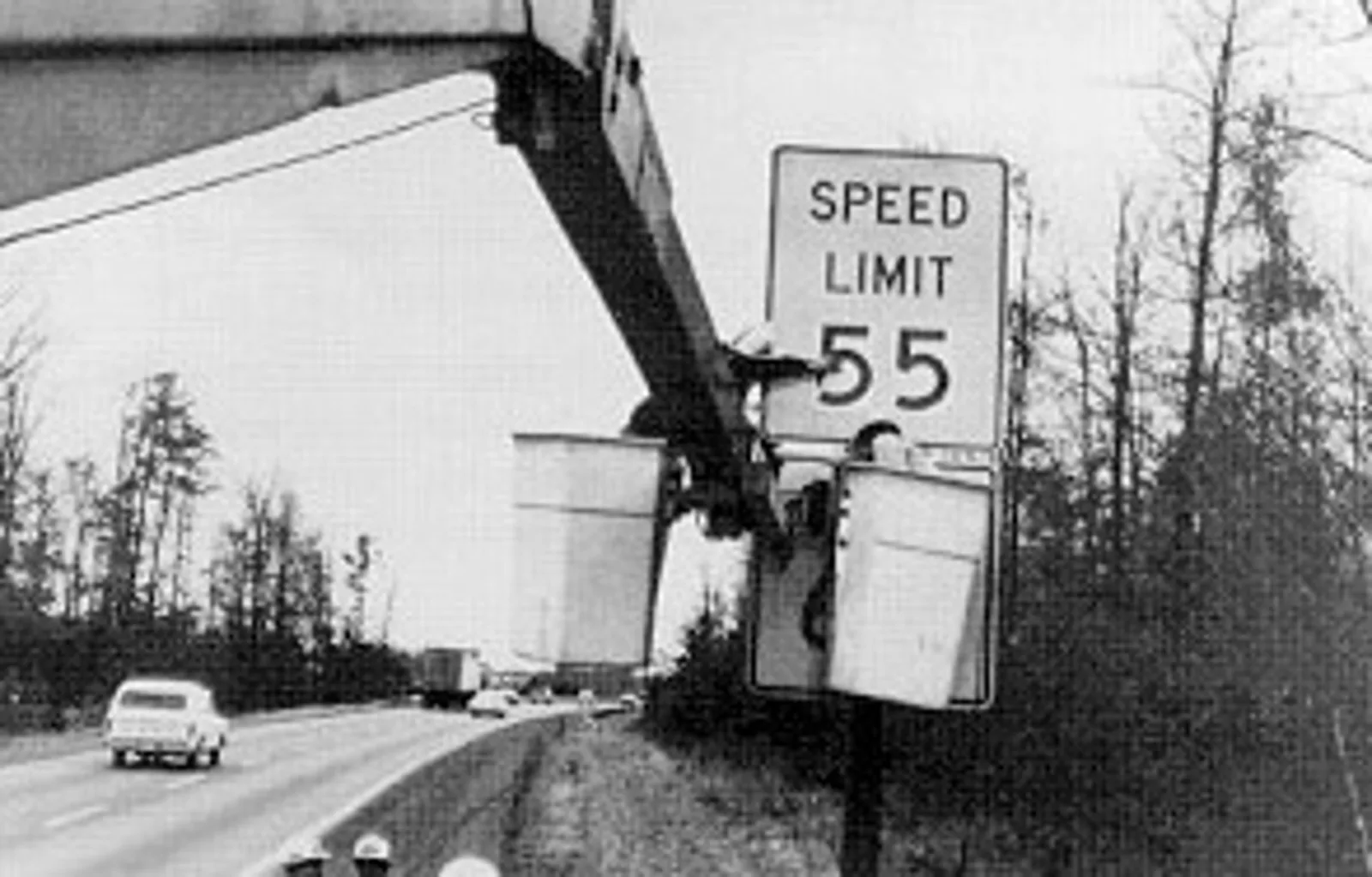
The United States set a national 55 mph limit in 1974 to save fuel after the 1973 oil crisis, using withheld highway funds to bring the states into line. Widely ignored, it was loosened to 65 mph on some roads in 1987 and repealed in 1995, so each state now sets its own limits.
In 1982, monitors on New York's interstates found that 83 percent of drivers were breaking the 55 mph limit, even though a first offence could cost $100 or 30 days in jail. The law behind that defiance began as an emergency answer to the 1973 oil crisis, and its aftermath still shapes how American states set speed limits.
Why did the United States set a national 55 mph limit?
The 1973 oil crisis prompted it. President Richard Nixon floated a national limit of 80 km/h (50 mph) for passenger vehicles and 89 km/h (55 mph) for trucks and buses on 26 November 1973, and Congress turned the idea into law the following year.
Nixon's package went well beyond speed. He also proposed banning ornamental lighting, halting petrol sales on Sundays and cutting petrol production by 15 percent, a reduction meant to save 200,000 barrels a day. His argument for the limits rested on efficiency data: cars use fuel best between 64 and 80 km/h (40 and 50 mph), and trucks and buses do best at 89 km/h (55 mph). The California Trucking Association, the largest trucking body in the country, objected to separate limits for different vehicles on safety grounds. When the final bill arrived, passenger cars were included at the higher figure, a change Nixon approved as he signed.
Until then, setting speed limits had been a state matter. The only earlier federal move came in the Second World War, when a national Victory Speed Limit of 56 km/h (35 mph) ran from May 1942 to 14 August 1945 to save fuel and rubber. Just before the new law, limits on American roads reached 121 km/h (75 mph), and Kansas had trimmed its turnpike from 130 km/h (80 mph). Montana and Nevada generally posted no numerical limits on highways, leaving drivers to choose a speed that was safe for conditions.
Some states moved ahead of Washington. By 20 November 1973 Washington, Vermont, New York, New Jersey, Massachusetts, Maryland and Rhode Island had 80 km/h (50 mph) limits, while North Carolina and Oregon had gone to 89 km/h (55 mph). Texas tried the same and tripped over its own constitution: its Highway Commission voted 3-0 on 4 December to adopt 89 km/h (55 mph), but by 6 December Attorney General John Hill had ruled that the commissioners lacked the power, because an opinion from 1943 reserved statewide limits for the legislature.
A law written to save petrol ended up proving how hard it is to enforce a number most drivers think is wrong.
How did Washington make the states obey?
It attached the limit to highway money. The Emergency Highway Energy Conservation Act required states to accept the limit if they wanted to keep receiving highway trust funds, a use of the Commerce Clause that avoided ordering the states directly.
Nixon signed it on 2 January 1974 and it took effect 60 days later. The rules required 89 km/h (55 mph) on all four-lane divided highways unless a road already had a lower limit before 1 November 1973, and capped every other road at the same figure. In places such as the New York State Thruway, an 80 km/h (50 mph) limit actually had to be raised. An Associated Press survey on the day of signing found that 12 states already used 89 km/h (55 mph), nine used 80 km/h (50 mph), and 29 had to lower their limits.
The Senate defeated Bob Dole's attempt to lift the limit to 97 km/h (60 mph) on 12 May 1974. On 4 January 1975 President Gerald Ford signed the Federal-Aid Highway Amendments of 1974, which made 89 km/h (55 mph) the uniform national limit. In all, federal law withheld highway trust funds from states with limits above that mark for 13 years, from January 1974 to April 1987.
Did the 55 mph limit save lives and fuel?
The honest answer is that nobody can say precisely. Deaths fell while the law was in force and after it ended, which makes the limit's own effect hard to isolate.
The usual explanations for falling deaths are safer cars and mandatory seat belt laws, which every state except New Hampshire passed between the mid-1980s and early 1990s. Most states reported fewer deaths in 1974 than in 1973, but Alaska, New Hampshire and Wyoming recorded rises in 1974, 1975 and 1976. A 1984 study by the National Research Council credited the lower limits with saving about 3,000 to 5,000 lives in 1974 and 2,000 to 4,000 a year after that through 1983. The Cato Institute countered that safety worsened in the first few months and that the early fall was a statistical blip.
Later, the National Academies drew a cautious line. They found a strong link between speed and crash severity, which supports maximum limits on fast roads, but said the data could not precisely measure what limit changes do to speeds, safety and journey time. They also noted that on rural interstates the speed of free-flowing traffic should be the main guide to the limit, partly because enforcing 55 mph there is difficult.
Fuel gains looked modest. A 1998 footnote from the Transportation Research Board estimated the national limit trimmed fuel consumption by 0.2 to 1.0 percent. Rural interstates, where the limit bit hardest, carried 10 percent of vehicle-miles travelled in 1973. Dropping from 121 to 89 km/h (75 to 55 mph) cuts air resistance by nearly half, but free-flowing roads tend to be efficient for fuel anyway.
Why did so many drivers ignore the 55 mph limit?
Because the number sat far below what traffic on open roads actually did. From 1981 Congress required that no more than half of free-flowing traffic on 55 mph roads exceed the limit, on pain of losing up to 10 percent of federal highway funds, yet surveys through the 1980s showed it was widely broken.
Engineering practice holds that a limit should make criminals of only the fastest 15 percent of drivers. Real figures were far higher. Monitors on New York interstates from April to June 1982 found 83 percent noncompliance, despite penalties that rose from $100 or 30 days in jail for a first offence to $500, as much as 180 days behind bars and a six-month licence loss for a third conviction within 18 months. In the last quarter of 1988, 85 percent of drivers broke the limit on Connecticut's rural interstates. A 1985 Texas survey at 101 locations found 82.2 percent of motorists over the limit on rural interstates, 67.2 percent on urban interstates and 61.6 percent across all roads.
States found ways to soften the blow. Arizona, Idaho, Montana and Nevada replaced ordinary speeding fines with energy-wasting fines of $5 to $15 for drivers who stayed under the limit that applied before the federal rule. Nevada's version, signed by Governor Robert List on 15 April 1981, covered motorists no faster than 110 km/h (70 mph) in 89 km/h (55 mph) zones, although troopers were told to keep writing regular tickets. North Dakota fined speeding up to 24 km/h (15 mph) over the limit just $15 in 1986, with no points. Minnesota, which normally suspended licences after three tickets, stopped counting tickets for speeds up to 105 km/h (65 mph) on 1 August 1986.
Politics ran the same way. The 1980 Republican platform called for repeal, and in 1981 legislators in 33 states debated measures opposing the law. In 1985 the Department of Transportation found Arizona, Maryland and Vermont out of compliance, with more than half their traffic over the limit in fiscal 1984. Some officers spoke up too: in 1986 Jerry Baum, who directed the South Dakota Highway Patrol, asked why a trooper should sit on an interstate built for 113 km/h (70 mph) watching a driver doing 100 km/h (60 mph), when he could be looking for drunk drivers.
The sharpest challenge came on 1 June 1986, when Nevada posted 113 km/h (70 mph) on 5 km (3 miles) of Interstate 80. The statute carried a clause cancelling itself if Washington suspended road funding, and the Federal Highway Administration obliged by withholding the money immediately.
When was the 55 mph limit repealed?
Congress ended it on 8 December 1995, when President Bill Clinton signed the repeal. The National Highway System Designation Act of 1995 handed the choice of speed limit back to each state.
The end came in stages. Fuel price rises had slowed by 1987, and from April of that year an amended law allowed up to 105 km/h (65 mph) on rural Interstates and rural roads built to Interstate standards. The limit was modified again in 1987 and 1988 for certain limited-access rural roads, but motorists kept disregarding the law until it was repealed.
Montana showed what freedom could mean. From 1995 until 1999 it had effectively no numerical daytime limit, just a requirement to drive at a reasonable and prudent speed, with a 105 km/h (65 mph) limit at night. The state Supreme Court threw out that law as unconstitutionally vague, and the legislature enacted a 121 km/h (75 mph) daytime limit in May 1999. Residents of the state found the new law satisfactory overall.
Speed limit rules then and now
| Period | Rule | Detail |
|---|---|---|
| May 1942 to August 1945 | Victory Speed Limit, 56 km/h (35 mph) | Set nationally to conserve fuel and rubber in wartime |
| Just before 1974 | State limits, up to 121 km/h (75 mph) | Montana and Nevada generally posted no numerical limits |
| 1974 to April 1987 | National maximum of 89 km/h (55 mph) | Highway trust funds withheld from states that exceeded it |
| April 1987 to December 1995 | Up to 105 km/h (65 mph) on rural Interstates | Amended federal law, widened again in 1988 |
| From 8 December 1995 | Each state sets its own | Repeal through the National Highway System Designation Act |
| 15 May 2017 | 41 states at 113 km/h (70 mph) or higher | 18 at 121 km/h (75 mph) or more, 8 at 129 km/h (80 mph), and Texas at 137 km/h (85 mph) on one toll road |
How do speed limits work across the states today?
Each state or territory sets its own, and states may let counties and cities post lower ones. Limits run from an urban low of 40 km/h (25 mph) to a rural high of 137 km/h (85 mph), usually in steps of 8 km/h (5 mph).
A general pattern holds. The highest limits are typically 113 km/h (70 mph) on the West Coast and in the inland eastern states, and 121 to 129 km/h (75 to 80 mph) in the inland western states, plus Michigan, Maine, Louisiana, Missouri and Arkansas. The Eastern Seaboard sits at 105 to 113 km/h (65 to 70 mph). Vermont, Rhode Island, Puerto Rico, New York, New Jersey, Massachusetts, Delaware, Connecticut and Alaska cap at 105 km/h (65 mph), and Hawaii at 97 km/h (60 mph). Further out, American Samoa has the lowest maximum of any state or permanently inhabited territory, at 48 km/h (30 mph).
The top of the scale is Texas State Highway 130, the toll road around Austin, posted at 137 km/h (85 mph). Texas alone allows 121 km/h (75 mph) on two-lane undivided roads, whereas most states east of the Mississippi keep them at 89 km/h (55 mph). In Maine, much of Interstate 95 north of Bangor allows 121 km/h (75 mph), and in Michigan up to 966 km (600 miles) of freeway does the same.
Two kinds of limit coexist. Most states use absolute limits, where going over is illegal in itself. Utah, Texas, Rhode Island, Oregon, Ohio, New Hampshire, Massachusetts and Connecticut treat limits as prima facie, which lets a driver argue that a higher speed was reasonable and prudent. California mixes the two: limits up to 89 km/h (55 mph), or 105 km/h (65 mph) on highways, are prima facie, and anything higher is absolute. Such defences seldom work, because the burden of proof sits with the accused, an expert witness can cost more than the ticket, and the hearing is awkward for out-of-town motorists.
California also sets limits with a rule built around the 85th percentile, the speed that no more than 15 percent of traffic exceeds, and its signs say Maximum Speed on higher limits. That sign category was created when the national law arrived, to tell drivers the basic speed law did not apply above the federal cap.
What do default limits look like in individual states?
They differ more than most visitors expect. Alabama, where no limit is posted, falls back on 48 km/h (30 mph) in urban areas, 56 km/h (35 mph) on unpaved roads, 72 km/h (45 mph) on rural paved county roads, 89 km/h (55 mph) on other two-lane roads, 105 km/h (65 mph) on four-lane roads and 113 km/h (70 mph) on Interstates.
Alaska defaults to 32 km/h (20 mph) in alleys and business districts, 40 km/h (25 mph) in residential districts and 89 km/h (55 mph) elsewhere, with 72 km/h (45 mph) when towing a mobile home. Many of its major highways have been upgraded since the mid-1990s, some to 97 km/h (60 mph) and others to 105 km/h (65 mph). Arizona defaults to 105 km/h (65 mph) outside business and residential districts and 40 km/h (25 mph) inside them, with Interstate maximums of 121 km/h (75 mph). Colorado posts 121 km/h (75 mph) on rural Interstates, but Interstate 70 in the Rockies drops to 105 km/h (65 mph), and to 80 km/h (50 mph) at each end of the Eisenhower Tunnel.
Arkansas shows how rules keep shifting. Act 784, approved on 8 April 2019, raised rural freeway limits to 121 km/h (75 mph) for cars and 113 km/h (70 mph) for trucks over 12 tonnes (26,000 lb) from 1 July 2020, and it reversed the burden: a study is now required to justify lowering a limit rather than raising one.
Why are speed limits still argued over?
Money and safety both feature. Traffic fines can be a lucrative income source, and there are blunt examples: the Texas town of Westlake took in $42,000 per citizen over nine years from its speed traps, and New Rome, Ohio, a 12-acre village of 60 residents, raised up to $400,000 a year in speeding tickets for its police. In Massachusetts the police department that writes a ticket receives half the money, and the court takes the other half.
On safety, the evidence points in more than one direction. Traffic deaths fell from 41,817 in 1995 to 32,479 in 2011, the lowest in 60 years, before climbing to 37,133 in 2017. Researchers at the Insurance Institute for Highway Safety argued that raising rural limits from 89 to 105 km/h (55 to 65 mph) led to 25 to 30 percent more deaths, with the full repeal adding a further 15 percent. Researchers at the University of California Transportation Science Center disagreed, finding a 3.4 to 5.1 percent fall once traffic shifting from riskier country roads to interstates was counted. A 2019 IIHS study concluded that each 8 km/h (5 mph) rise in a state's maximum limit was linked to an 8.5 percent rise in fatality rates on interstates and freeways and 2.8 percent on other roads.
Truck limits split opinion as well: the Transportation Research Board found no conclusive evidence for or against separate limits for cars and heavy trucks.
Could any state drop speed limits altogether?
Change is still arriving state by state. Arizona Representative Nick Kupper put forward HB 2059, called the RAPID Act, in late 2025. It would create derestricted speed zones, with no posted limit, on some rural state and interstate sections that meet set conditions. It is a proposal only, and it would take a vote to become law.