Eight sign categories, several rival sign families and a rule that markings be white or yellow: how traffic signs and road markings got their shapes and where they still differ.
The 1968 Vienna Convention sets an international standard for road signs, signals and markings, in force since 1978 with 75 parties in 2026. The US MUTCD, a southern African system and mixed systems elsewhere differ in detail, and markings must be white or yellow.
The oldest known traffic regulation act in Europe is more than three centuries old. In 1686 King Peter II of Portugal ordered priority signs in the narrowest streets of Lisbon, saying which traffic had to back up and give way, and one of them still exists in Salvador street in the Alfama district. Centuries later, a driver landing in another country still faces a version of the same problem: a triangle might mean danger or it might mean give way, a word might be in another script, and a line on the road might be yellow where it was white at home. A treaty from 1968 explains most of the answers, and where it does not, one of a handful of other sign families usually does.
What does the Vienna Convention on road signs standardise?
The Convention on Road Signs and Signals, known as the Vienna Convention, is a multilateral treaty setting an international standard for signs, traffic lights and road markings. It was agreed at a United Nations Economic and Social Council conference in Vienna between 7 October and 8 November 1968. Thirty-one countries signed on the final day and it came into force on 6 June 1978. The same conference produced a companion treaty, the Vienna Convention on Road Traffic, which does similar work for traffic rules.
It sits at the end of a long chain of agreements: a motor traffic convention in Paris on 11 October 1909, two more Paris treaties on 24 April 1926, a Geneva convention on unifying road signs on 30 March 1931, and a Geneva convention and protocol in 1949. The Vienna text was written to revise and extend the 1949 protocol, and amendments in 2003 added rules on legibility, priority at roundabouts and new signs for tunnel safety.
The treaty reflects what grew up in continental Western Europe during the 20th century, but it leaves room for variation to make it as universal as possible. Warning signs may be triangular or a square set on its point, and road markings may be white or yellow. Most UN members have not ratified the whole treaty, yet its signs and principles form the basis of traffic law in most places. As of 2026, 75 states are party. Several countries signed in 1968 and never ratified, including Brazil, Spain, Thailand and the United Kingdom, while Turkey acceded in 2023 and Portugal ratified in 2009.
The eight sign categories
Article 2 sorts all road signs into eight classes lettered A to H: danger warning, priority, prohibitory or restrictive, mandatory, special regulation, information and facilities, direction and position, and additional panels. For each class the treaty lays down colours, sizes and shapes, and it says which symbols and pictograms may appear and in which orientation. Where more than one version is allowed, a country must use the same one throughout. Apart from signs that do not apply at night, every sign must be reflective enough to be seen by headlights from a distance.
A new text on the way
In 2025 the UN's Global Forum for Road Traffic Safety adopted a proposal that will replace the Convention's entire text and also affect the European Supplement Agreement and the Protocol on Road Markings. The main changes are a new numbering scheme for signs, the abolition of the alternative stop sign (variant B,2b) and of the mandatory sign with a red rim and black symbols, the folding of the European Supplement signs into the convention, a few new signs and updated example images. The new text is scheduled to take effect on 12 November 2026 everywhere but Chile and the Netherlands, both of which turned it down.
A triangle might mean danger at home and something else abroad; one 1968 treaty explains most of the answers.
Which sign systems exist besides Vienna?
| System | Where it applies | Character |
|---|---|---|
| Vienna Convention | Most of Europe and a majority of places in principle | Pictorial symbols that evolved in continental Western Europe |
| MUTCD (US Federal Highway Administration) | United States; Canada and Australia substantially | Often more text-oriented, with some pictograms |
| Mixed Vienna and MUTCD | South America, Cambodia, Japan, Thailand, Malaysia, Indonesia, New Zealand | Influenced by both |
| Central American manual | Central America | Heavily influenced by the MUTCD |
| SADC-RTSM | Ten countries in southern Africa | Rules and principles similar to Vienna |
Some places follow the Convention without belonging to it. Hong Kong is not a signatory, but its transport design manual draws on British regulations from 1975 and 1981, which themselves rest on the Vienna text, a 1971 European agreement and a 1973 protocol on road markings.
The classification is different in North America and Oceania. The United States, Canada, Australia and New Zealand sort signs into regulatory, warning, guide, street name, route marker, expressway, freeway, welcome, informational, recreation, emergency management, temporary traffic control, school, railroad and bicycle signs. In the US the MUTCD legally defines the categories, placement and graphic standards.
The signs that tell you where to go
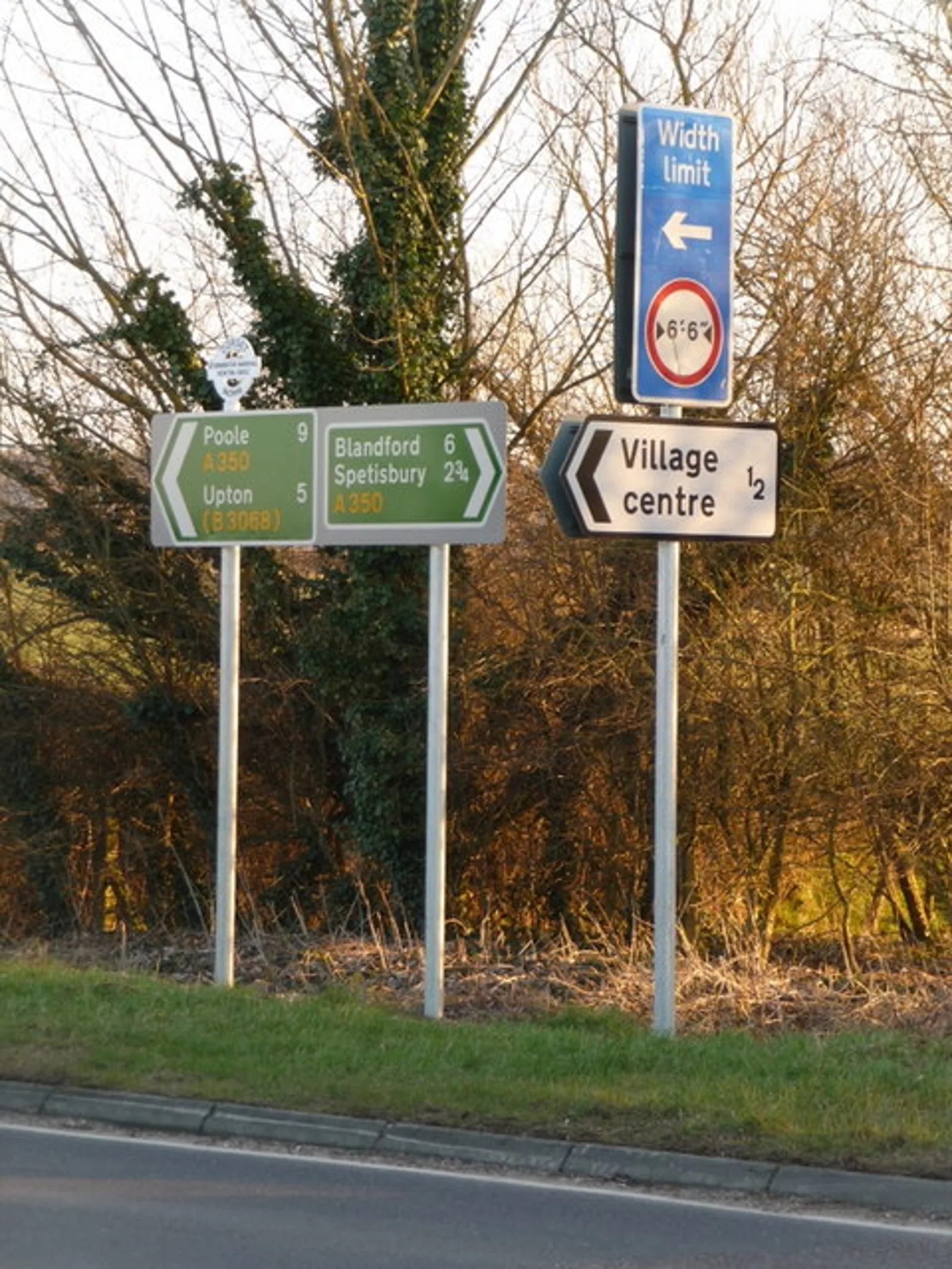
Directional signs split into advance directional signs, interchange signs and reassurance signs. Advance signs stand some distance before an exit and give information for each direction, letting drivers change lane, check they have the right exit and slow down. Some countries do not show the road ahead on these signs, a style called pull-through. Nations differ, but the opening warning for a motorway exit usually stands a kilometre or more (1,000 metres, or 3,300 ft) short of the junction, with one or two further signs after it.
Where did road signs come from?
The earliest signs were milestones. The Romans put up stone columns across their empire giving the distance to Rome, and according to Strabo, the Mauryas in India set up signboards at intervals of 10 stades along their roads. Directional fingerposts followed in Britain, with wooden counterparts in Saxony, and in the Middle Ages multi-armed signs at intersections pointed to towns.
The first modern signs on a large scale were meant for cyclists. Late in the 1870s and in the early 1880s, riders of tall "ordinary" bicycles, which were fast, silent and hard to control, toured unfamiliar roads, so cycling organisations began putting up warnings of hazards ahead, steep hills above all, rather than distances alone. That idea of warning the user gave modern signs their defining type.
Cars pushed matters further. The Italian Touring Club devised one of the first modern systems in 1895, and by 1900 a congress in Paris was weighing standardisation. Britain's government brought in four "national" signs distinguished by shape in 1903. Most basic patterns were fixed in 1909, when nine European governments settled on four pictorial symbols for a bump, a curve, an intersection and a level railway crossing, and intensive work between 1926 and 1949 eventually produced the European system. Britain adopted a version of it in 1964. The United States went its own way: American Automobile Association clubs began paying for wooden signs in 1906, and in 1914 the association launched a transcontinental project that put up more than 4,000 signs on the single run from Los Angeles to Kansas City.
Materials have changed as well. Pre-industrial signs were stone or wood, then painted cast iron became popular in the late 18th and 19th centuries, remaining in use to the mid-20th. Since 1945 most signs have been made of sheet aluminium with retroreflective plastic coatings. Today electronic signs can change their text, in over 20 countries Traffic Message Channel warnings reach navigation systems directly, and "talking signs" using infrared transmitters send the same information to a receiver or phone for blind and low-vision people.
Typefaces and the car that reads signs
Lettering is chosen for readability at speed and distance, and tall letterforms and open spacing reduce halation, the blurring that makes an "e" look like an "a", "c" or "o", which affects older drivers especially. In 1997 a team at the T.D. Larson Transportation Institute began testing Clearview as a better alternative to Highway Gothic, the US standard. Adoption was slow, with local governments and the Federal Highway Administration citing consistency, cost and doubts about the readability studies. The administration allowed interim use on request, rescinded that approval in 2016 to avoid a mix of two typefaces, and allowed it again in 2018, with Highway Gothic still the standard.
Cars have started reading signs for themselves. Camera-based recognition began in 2008 with the Opel Insignia and mainly recognises speed limits and no-overtaking zones. It also uses GPS and a speed-limit database, which helps in the many countries that show a city's speed limit only with a town name sign.
What do road markings mean?
A road surface marking is any device or material applied to a road to convey official information. Markings guide drivers and pedestrians, divide lanes, act as noise generators when laid across the road, wake a drowsy driver when placed on the shoulder, and show parking and stopping rules. In France, Italy, the Czech Republic and Slovakia, markings are conceived as horizontal traffic signs, in contrast to the vertical signs on posts. Countries categorise and specify markings differently, though efforts to standardise them across borders continue.
The Vienna Convention gives the framework. Markings must be white or yellow, under 6 mm in height, and cat's-eye reflectors may rise no more than 15 mm above the surface. In towns, lanes should be divided by a broken line; a continuous one is reserved for special cases such as poor visibility or a narrowed carriageway. Any words on the road should be place names or terms understood in most languages, such as "Stop" or "Taxi". The treaty gives no exact lengths and widths for markings, since they vary by purpose.
What is built into the road
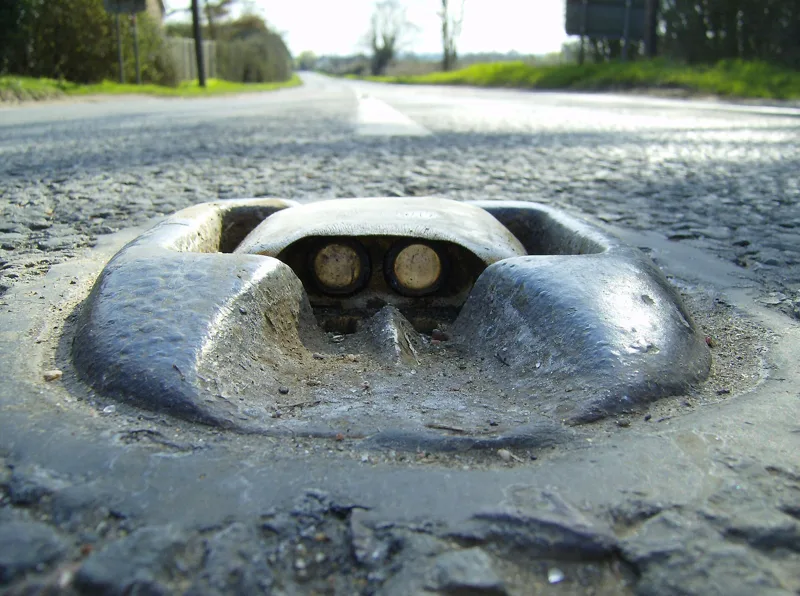
Raised and recessed devices come in many forms. The cat's eye, invented by Percy Shaw in the 1930s, is common on major British and Irish roads. It has four reflective lenses in a durable white rubber housing, two facing each way, set in a cast iron shoe into which the rubber sinks when a vehicle drives over it, so that a rubber blade wipes the lenses clean. The lenses come in white, yellow or orange, green, red and blue. Botts' dots take their name from Elbert Botts, the Caltrans engineer whose epoxy keeps them stuck down; they are low rounded white or yellow markers used to mark lane edges or alert drivers to toll booths and school zones. They are only used in warm climates, because snowploughs remove them.
Rumble strips do the same warning job by sound and vibration. A typical strip is a series of troughs about 1 cm deep and 10 cm wide ground into the asphalt, cut across the carriageway to flag a hazard ahead, or along it to flag a car straying from its lane. A musical road simply uses patterns of those vibrations to produce a tune. Reflective studs divide lanes, mark medians and exits, and are more visible at night and in bad weather than painted lines. On American freeways they are made to look white in the right direction and red from the wrong way, which warns of a head-on collision. Blue ones mark fire hydrants, and in the UK and elsewhere raised markers at pedestrian crossings help blind people cross.
What the lines are made of
| Material | Typical life | Note |
|---|---|---|
| Paint | 9 to 36 months | Low cost, in widespread use since the early 1950s; applied with glass beads for reflectivity |
| Thermoplastic | Three to six years in warm climates | Heated to about 200 degrees C (400 F); snowploughs can damage it |
| Preformed thermoplastic | 3 to 6 years | Melted into the surface; used for stop lines, crosswalks, arrows and bike symbols |
| Preformed polymer tape | About three years as an overlay | Overlay, or inlay laid during paving |
| Stones or white blocks | Long-lasting | For setts and cobblestones; slippery when wet unless matte or rough |
Marking technology keeps improving, with gains in reflectivity, durability and installation cost. Markings are also now read by advanced driver-assistance systems, and may be used by future autonomous vehicles. One oddity: roadworks sometimes leave symmetrical dashes, such as those from dowel bar retrofit, that drivers can mistake for a mysterious type of marking, so agencies try to make them less visible.