The octagon that America standardised in 1922, the languages and shapes that replaced it elsewhere, and what a driver must do where a railway crosses the road.
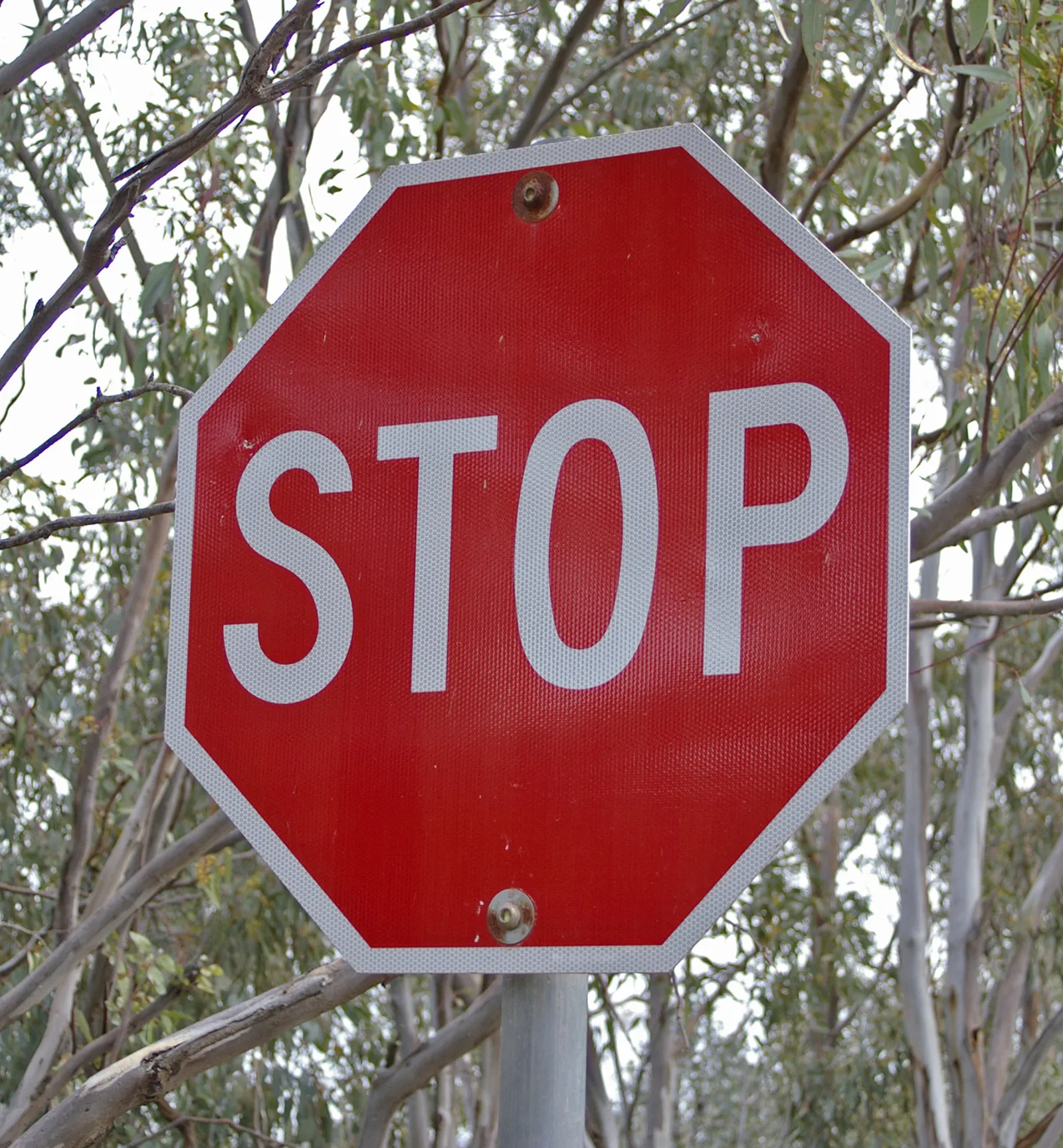
A stop sign requires a complete stop and a check that the junction or railway crossing is clear. The red octagon dates to 1922 and was adopted by the Vienna Convention in 1968, though Japan, Israel and others use different designs. At level crossings, blinking red lights mean stop.
The first stop sign was a piece of plywood with the corners sawn off. In 1914 a Detroit police sergeant, Harold "Harry" Jackson, was working as a traffic guard at a busy intersection where one side street met the junction on a nearly blind turn. He kept having to hold that street's traffic back, so he wrote STOP across the middle of the board and stood it facing the road. Traffic flowed better, his colleagues copied him, and what followed was a century of argument about shape, colour, language and what drivers owe a junction. The same few seconds of braking apply to the other place where a driver must stop for something heavier than a pedestrian: where a railway crosses the road.
How did the stop sign become standard?
Michigan adopted stop signs statewide in 1915. The first ones had black lettering on white and measured 24 by 24 inches (61 cm by 61 cm), a little smaller than today's. As use spread, a rural-led committee backed by the American Association of State Highway Officials met in 1922 to settle the design and picked the octagon, which America has used ever since.
The reasoning was practical. An eight-sided sign is distinctive from the back, so a driver approaching a sign from behind can tell that cross traffic faces a stop and avoid mistaking it for another sign. At night, when early signs had no reflective surface, the outline was easy to pick out. Highway commission reports of the time quote the committee's logic bluntly: many people struggle to read a sign, so the shape matters far more than the words on it. A more urban body, the National Conference on Street and Highway Safety, preferred a smaller red-on-yellow sign. The two groups merged into the Joint Committee on Uniform Traffic Control Devices, which published the first Manual on Uniform Traffic Control Devices (MUTCD) in 1935.
The specifications were revised eight times before 1971. For three decades after 1924 the sign carried a red or black legend on a yellow field, because fade-resistant red materials did not yet exist. Reflective material was permitted from 1935 and required from the 1948 edition. The 1954 edition specified a white legend on red, which brought signs in line with red traffic lights, so red meant stop whether it appeared on a post or a signal. The mounting height, 7 ft (2.13 m) today, was fixed in 1971.
Other designs were eliminated in the United States in 1966, and in 1968 the Vienna Convention on Road Signs and Signals adopted the American sign as part of a United Nations effort to standardise cross-border travel. Forty European countries are party to the convention. It allows the word STOP in English or the national language, and in its earlier form permitted a circular alternative with a red inverted triangle; that second type, sign B2b, was discontinued after the 2025 amendment.
A shape meant to be read from behind, in the dark, by people who could not be relied on to read at all.
What do the stop sign rules require?
The sign's job is simple to state. A driver must halt completely, check that no vehicles or pedestrians are in the way at the junction or railway crossing, and only then proceed. How the rules are written and enforced varies by jurisdiction.
Sizes are standardised more tightly than most drivers realise. The 1968 conference proposed diameters of 600, 900 or 1200 mm, and the convention came into force in 1978.
| Where | Size of the sign |
|---|---|
| Vienna Convention proposal | 600, 900 or 1200 mm (24, 36 or 48 inches) |
| United Kingdom and New Zealand | 750, 900 or 1200 mm, depending on location and traffic speed |
| United States, standard | 76 cm (30 inches) across opposite flats, with a 25 cm legend |
| United States, multi-lane expressways | 89 cm (35 inches), with a 30 cm legend |
| United States, extra-large | 110 cm (45 inches), with a 41 cm legend, where visibility or reaction distance is limited |
| United States, smallest permitted | 61 cm (24 inches), with a 20 cm legend |
American regulatory manuals treat the metric figures as rounded approximations of the customary units rather than exact conversions. The face, lettering and border are all retroreflective, and some modern signs add flashing LEDs around the edge, which has been shown to cut crashes substantially.
Stop signs around the world
The red octagon with a white English STOP is the most common design on earth, yet not universal. Japan uses an inverted red triangle, and until 2016 both Zambia and Zimbabwe used a disc bearing a black cross. Israel dispenses with words and shows a hand held palm forward. Bangladesh and Nepal also use no text. English-speaking countries and many others print the word stop, though some use a local equivalent instead or alongside it. Several languages borrowed the English word long ago, French among them, and no longer treat it as foreign.
The language question has been politically charged. In Quebec, signs read either "arret" or "stop", and since 1987 the province has removed English "stop" in favour of "arret". France puts STOP on its signs, and the Office quebecois de la langue francaise notes that the word has been attested in French on stop signs since 1927. Even so, when Bill 101, the French-language charter, was debated in 1977, "stop" was treated as English, and some signs were sprayed with red paint to turn the word into "101". The language office later ruled that "stop" counts as proper French on a sign, which makes the old dual wording redundant. Two-word stop and arret signs survive in parts of Alberta, New Brunswick and Manitoba, in Acadian Nova Scotia and Prince Edward Island, at every Canada-United States border post, and on federal land in the National Capital Region.
Elsewhere the pattern is regional. Europe generally uses the text stop whatever the local language, an arrangement that drew objections in the 1970s but is now accepted, with Turkey using "dur" as a notable exception. Spanish and Portuguese-speaking countries in the Caribbean and South America, among them Argentina, Brazil, Chile and Colombia, use "pare", while Mexico and Central America use "alto". Arabic-speaking countries use "qif", with Lebanon using only stop since 2019. China and Taiwan use the character for stop, mainland China with a bolder lettering. South Korea, Hong Kong, Taiwan and others in Asia use the octagon, with Japan the exception. Cuba and Pakistan still use old circular designs, and Vanuatu uses a circular red sign. In Russian-speaking countries, a Cyrillic version of stop marks the place where vehicles wait at traffic lights, shown on a white rectangular sign.
Where stop signs are actually used
Stop signs mean different things in different road cultures. All-way stops are used at some intersections in North America and South Africa, while some countries prohibit them in law. In most Central Asian countries and in Cuba, junctions with neither lights nor roundabouts are controlled by stop signs on the minor road and priority diamond signs on the major road. Europe and Australia keep the stop sign for places where a dead stop is needed because sight lines are severely restricted; at the vast majority of minor intersections they use give way signs or equivalent markings, and roundabouts work on the give way principle too.
In North America, stop signs often control conflicting movements at intersections too quiet to justify a signal or roundabout. In the United States the sign is meant to assign right of way or improve safety, not to calm traffic. Research is mixed: some studies conclude stop signs give no measurable safety benefit over a yield sign, and others find that multiway stops do not control speeds and cause extra noise, braking pollution, enforcement difficulties and lower compliance. Ontario adds "tiger tails", red and white striped banners, under stop signs in school zones. North American school buses carry a pivoting stop arm, on some buses two of them, that the driver swings out when the door opens, with flashing red lights or an LED-lit legend.
What are the level crossing rules?
A level crossing is a place where a railway crosses a road, a path or, rarely, a runway at the same level, rather than going over or under. It is called a railway crossing in Australia, Canada and New Zealand and a grade crossing or railroad crossing in the United States. Europe has more than 100,000 of them and North America more than 200,000. High-speed rail does not mix with them, and European high-speed lines have almost none.
From flagman to flashing lights
Early crossings often relied on a flagman in a booth who waved a red flag or lantern when a train approached. It was a dangerous job, because trains did not have enough time to stop, and it cost the lives of gatekeepers and their families. Gates became common to keep trespassers and livestock off the railway and to protect road users, and closable barriers began to appear in the second quarter of the 20th century. Automatic full-, half- or no-barrier crossings later replaced gated types in many places. In sparse rural areas the cheapest option is a warning sign alone, common across North America and many developing countries.
Some rules are harmonised internationally. Under chapter 3, article 23b of the 1968 Vienna Convention, one or two blinking red lights mean a vehicle should stop, while yellow lights mean it can pass with caution. Stop lines at crossings are suggested by article 27, and articles 33 to 36 deal specifically with crossings because they are recognised as dangerous, and article 35 says a cross sign should be present where there is neither a barrier nor lights. Many countries, including some outside the convention, have adopted these measures.
Why a train cannot stop for you
Trains have far more mass than their braking can handle, so they need a very long distance to stop and, with rare exceptions, do not stop at level crossings. They rely on road vehicles and pedestrians to be clear of the track in time. The Hixon rail crash is one of several where a heavy load crawling across on a road transporter failed to get clear in time.
Level crossings are a significant safety issue worldwide. Around 400 people a year die at level crossings in the European Union on average, and more than 300 in the United States. Collisions with pedestrians are more likely to be fatal than those with vehicles, and young people (5 to 19), those aged 60 and over, and males are considered higher-risk users.
Protection falls into two kinds. "Passive" crossings rely on signs, and for much of the 19th and 20th centuries a sign saying "Stop, look, and listen" was the only defence. "Active" crossings use flashing lights, warning sounds and barriers or gates, and fewer collisions happen where they are installed. Modern radar systems can detect whether the crossing is clear as a train approaches, which avoids lowering barriers onto trapped vehicles and tells the train to brake until the obstruction goes. What they cannot do is prevent a vehicle pulling onto the track when the locomotive no longer has any chance of slowing.
Traffic lights next to the tracks
Signal-controlled junctions near a crossing usually have signal preemption. In the United States, an approaching train triggers a sequence in which every signal phase goes red except the one just beyond the crossing, which turns green or flashing yellow so that traffic on the tracks can clear. Some places add auxiliary signals before the crossing to stop new vehicles from entering. After enough time to clear, the signal returns to red for the train's passage. What happens during that passage varies by municipality: all directions may flash red as an all-way stop, traffic parallel to the track may get flashing yellow or a green while the other directions get red, or the lights may run nearly normally with only the blocked direction held at red.
Cameras are another tool. France has installed them at some crossings to help investigators understand an incident, England has put them at some crossings, and South Australia uses them to deter drivers from ignoring signals. Because of growing road and rail traffic, and for safety, crossings are increasingly being removed. As of 2024, Melbourne is planning to close 110 level crossings by 2030 and, because some stations are close by, rebuild 51 stations.
When the crossing is a runway
A few roads cross airport runways at the same level. Winston Churchill Avenue crossed the runway at Gibraltar International Airport, with movable barricades closing when aircraft took off or landed, until a tunnel under the runway opened to regular traffic in March 2023 and the crossing was left to pedestrians, cyclists and e-scooters. Two public roads still cross the runway at Meiringen Air Base in Switzerland, closed by electrically operated gates. Manakara Airport in Madagascar is one of the few in the world crossed by an active railway line, and at Gisborne in New Zealand pilots are signalled by red and green lights that show which section of the runway is available when a train is due.