What rolling coal is and when it is illegal, what a tailpipe really releases, and how emission rules spread from Los Angeles to the rest of the world.
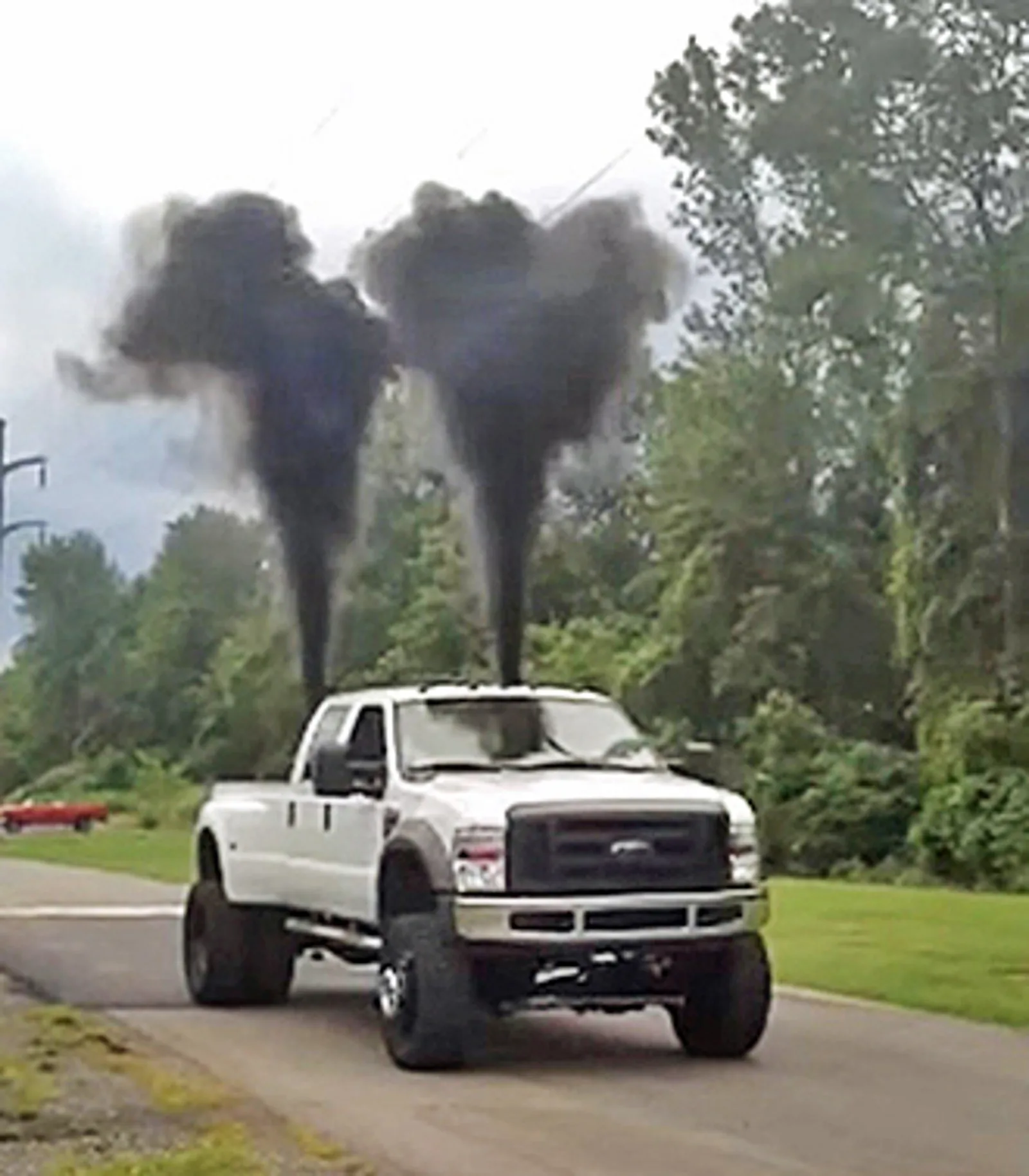
Rolling coal means modifying a diesel to emit heavy black exhaust, and the EPA says it breaks the Clean Air Act. Exhaust is mostly nitrogen, water and CO2, with a harmful minority of CO, hydrocarbons, NOx and soot. Emission standards, first enacted in 1963, now include Euro 6 equivalents in a growing list of markets.
A 2020 report from the United States Environmental Protection Agency said that 15 percent of diesel trucks in the country had been rigged to delete their emissions controls. Government estimates say tampering of that kind can multiply nitrogen oxide output by as much as 310, non-methane hydrocarbons by 1,400 and carbon monoxide by 120. Rolling coal is the loud, visible end of that story.
Behind the black clouds sits a simpler question of what leaves a tailpipe at all, and who decides how much is allowed. The answers run from the chemistry of exhaust gas to a patchwork of laws and standards that began with a smog problem in Los Angeles.
What is rolling coal?
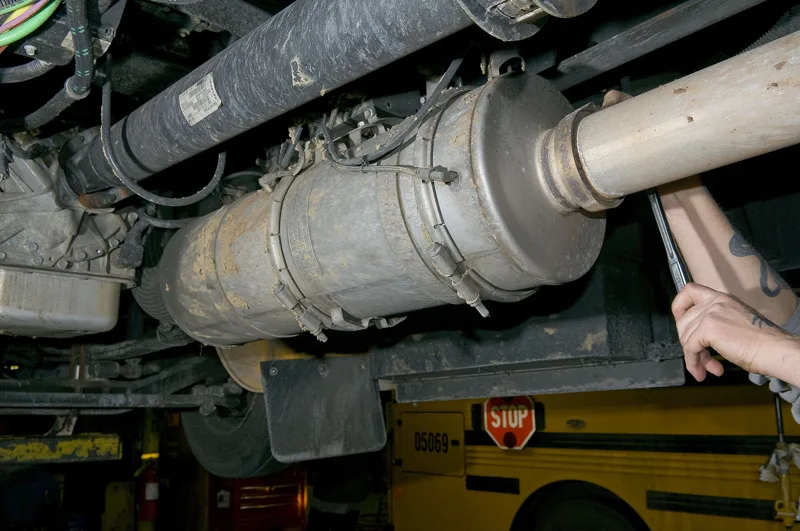
Rolling coal, also spelled rollin' coal and sometimes called coal rolling, means modifying a diesel engine so that it deliberately pours out large amounts of black or grey exhaust, full of soot and unburned fuel. Typical changes include removing the particulate filter, fitting smoke switches, and adding large exhausts and smoke stacks. The work typically costs between US$200 and US$5,000, and it makes the vehicle less economical.
The habit has been traced back to truck pull competitions, where black smoke was a side effect of tuning for performance. Away from the track it became a form of conspicuous air pollution in North America, used as entertainment or as a protest against environmentalism. Those who do it point to American freedom and to opposition to what they call rampant environmentalism. Some aim the smoke at electric and hybrid cars, a practice nicknamed Prius repellent, so that the driver loses sight of the road and breathes the fumes. Cyclists, protesters, pedestrians and foreign vehicles have also been targets.
The danger is concrete. Black smoke impairs visibility and raises the risk of a crash. In 2021 in Waller County, Texas, a 16-year-old rolling coal tried to pass a group of six cyclists training for a road race and engulf them in exhaust, and ran them over. Two were hurt badly enough to need evacuation by helicopter. He was not charged at first, which outraged local cycling groups, but six counts of felony aggravated assault with a deadly weapon followed later.
Behind the black clouds sits a simpler question: what leaves a tailpipe, and who decides how much is allowed.
Is rolling coal illegal?
In the United States, it is illegal at federal level. In July 2014 the EPA stated that the practice violated the Clean Air Act, which bars the manufacture, sale and installation of parts that bypass, defeat or disable an emission control device. The law also forbids anyone from tampering with such a device by removing it or making it inoperable, whether before or after the sale. The agency has called the issue a national priority, describing it as a significant contributor to air pollution.
Enforcement has reached businesses as well as drivers. A Justice Department official, Todd Kim, warned that firms selling devices that defeat emission controls foster pollution and put decades of progress at risk. In 2023, companies in Idaho and California admitted in federal court to conspiring to break the Clean Air Act, and each agreed to a US$1 million fine. In March 2020, the cast of the Utah reality series Diesel Brothers, along with their companies, were fined US$850,000 in total for Clean Air Act violations.
State laws vary widely. California prohibits running a vehicle so that it releases excessive smoke, flame, gas, oil or fuel residue, and rolling coal can be cited under that section by the state highway patrol or by local police. Colorado created an offence of nuisance exhibition of exhaust for vehicles of 14,000 pounds or less, and Connecticut bars smoke exhibitions made with the intent to harass, obscure a view or create a hazard. Indiana and Kansas require engines to be adjusted to prevent excessive fumes or smoke. Maryland forbids knowingly or intentionally discharging clearly visible smoke from a diesel vehicle onto another person or vehicle, with exemptions for ordinary operation, heavy commercial vehicles of 10,000 pounds or more and construction-site vehicles.
New Jersey goes further by banning the retrofit of devices and smoke stacks that boost a diesel vehicle's capacity to emit soot, and it runs a hotline for reports of smoking vehicles. North Carolina limits visible contaminants darker than a set density to five consecutive seconds. Texas has decommissioned its statewide reporting programme, though reports can still be made through a regional programme covering the Dallas-Fort Worth area. In Utah, a registration can be suspended or revoked if a local health department reports that the vehicle cannot meet air emissions standards, and diesels built after 2007 may not emit visible contaminants in normal operation.
Cities have their own rules. Hudson, Colorado passed an ordinance in September 2017 with fines up to US$499. Cheyenne, Wyoming passed one in July 2017, carrying a maximum fine of US$750 and as much as six months in jail. A first attempt had failed in July 2016, when police explained they were already ticketing coal rolling under state law.
Canada treats it as an offence too. British Columbia sets fines from CA$50 to CA$5,000. Ontario's Highway Traffic Act prohibits modifications that push a vehicle's emissions above the manufacturer's specification or that disable its emission controls, while Regulation 169/22 restricts the opacity of emissions. Fines for private vehicles start at CA$300 and top out at CA$1,000, while commercial vehicles face CA$400 to CA$20,000.
What is in exhaust gas?
Exhaust gas, or flue gas, comes from burning petrol, diesel, natural gas, fuel oil, biodiesel blends or coal, and leaves through an exhaust pipe, stack or nozzle, often dispersing downwind as a plume. Most of it is harmless in the narrow sense: nitrogen, water vapour and carbon dioxide. Water vapour and carbon dioxide are still greenhouse gases that contribute to climate change.
The troublesome part is small in volume. Carbon monoxide (CO) is a product of incomplete combustion. Hydrocarbons are fuel that never burned, nitrogen oxides (NOx) are born of excessive combustion temperatures, and particulate matter, mostly soot, is another result of burning that is incomplete. Rolling coal is a deliberate way of raising the last two.
Petrol engines show how wide the range can be. The CO content can be about 15 ppm in a well-tuned fuel-injected engine with a catalytic converter and as much as 100,000 ppm (10%) in a richly tuned carburettor engine, the kind found on small generators and garden equipment. A diesel always runs with more air than fuel, so its exhaust carries plenty of oxygen, and at idle on a test rig that may reach 10%.
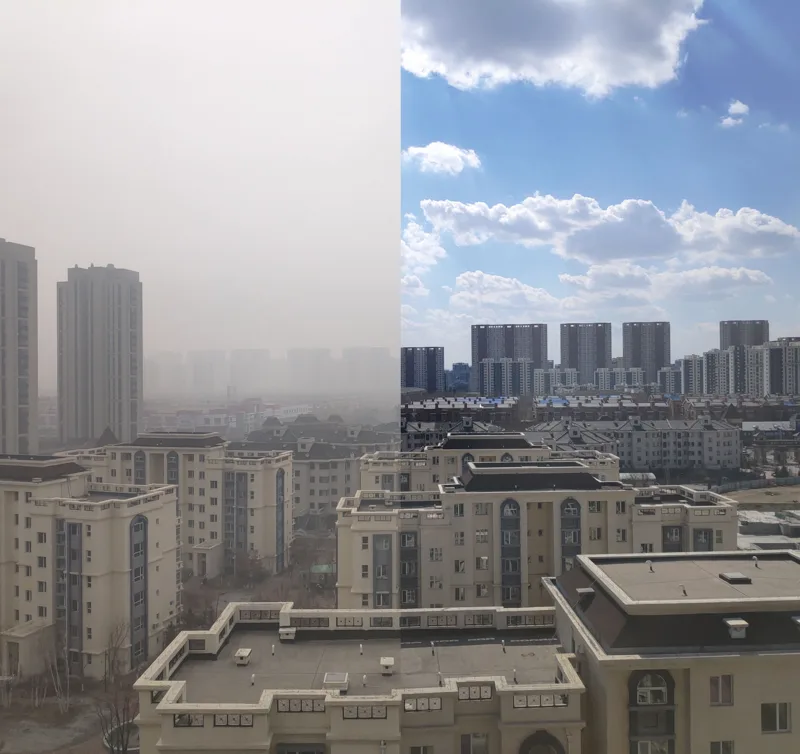
Road vehicles produce about half their emissions from the exhaust and the other half from tyre and brake wear and from disturbed road surface. Burning fossil fuels pollutes the air in ways estimated to kill over 5 million people a year, and motor vehicle emissions are a major ingredient of smog in some large cities.
What do these pollutants do to people?
Nitrogen oxides combine with ammonia, moisture and other compounds, producing nitric acid vapour and fine particles. Small particles reach deep into lung tissue and can cause premature death in extreme cases. Inhaling them raises the risk of lung and colorectal cancer, and can cause or worsen emphysema, bronchitis and heart disease. In a 2005 EPA study the largest source of NOx was on-road vehicles.
When NOx meets volatile organic compounds in sunlight, ground-level ozone forms, a primary ingredient of smog. At ground level it irritates the respiratory system and reduces lung capacity. A 2005 EPA report gave road vehicles second place among American sources of volatile organic compounds, at 26%.
Carbon monoxide is colourless, odourless and tasteless, and it ties up the haemoglobin that carries oxygen. It is the most common fatal air poisoning in many countries, and above 1000 ppm it is immediately dangerous. In 2011, 52% of US carbon monoxide emissions came from mobile vehicles. Benzene, a hazardous air pollutant, damages bone marrow with long exposure and causes leukaemia.
Particulate matter is linked to asthma, lung cancer, cardiovascular problems and premature death, because the particles are small enough to reach the deepest parts of the lungs. A 2011 UK study estimated 90 deaths a year from passenger vehicle particulates. The US Federal Highway Administration reported in 2006 that on-road exhaust, mostly from diesels, supplied about 1% of PM10 and 2% of PM2.5 emissions in 2002. Chinese, European and Indian markets require a tailpipe filter on both diesel and petrol vehicles, while the United States mandates it for diesel only. In 2022, Emissions Analytics estimated that the roughly 300 million petrol vehicles in the US would emit around 1.6 septillion harmful particles over the following decade.
Carbon dioxide is the other big number. Motor vehicles are calculated to produce about 20% of the European Union's man-made CO2, with passenger cars accounting for about 12%. European standards cap CO2 from new cars and light vehicles, and the EU average for new cars dropped by 5.4% over the year to early 2010, reaching 145.6 g/km.
Estimates of the total toll differ by study. A 2013 Massachusetts Institute of Technology (MIT) study indicated 53,000 early deaths a year in the United States because of vehicle emissions, and another study from the same university put traffic fumes alone at 5,000 deaths a year in the United Kingdom. A 2024 paper in Environmental Research Letters suggested that road and fossil-fuel transport pollution could account for 41,800 premature US deaths. Preliminary UCLA findings on children born from 1998 to 2007 point to traffic pollution as possibly linked with a 5% to 15% rise in the chance of some cancers. The California Air Resources Board found that 50% or more of the smog in Southern California comes from car emissions.
Why are the first minutes of a drive the dirtiest?
During the first two minutes after a car that has sat for hours is started, emissions can be very high. A cold engine needs a rich mixture and the fuel does not fully vaporise, so hydrocarbons and carbon monoxide climb until it reaches operating temperature. And the catalytic converter, which breaks down pollutants using a catalyst, works poorly until it warms up.
Engineers have shortened both problems. On the engine side, computer-controlled fuel injection, shorter intake lengths and pre-heated fuel or air have helped. For the converter, warm-up is quicker when it sits nearer the exhaust manifold. A small, quick-heating converter placed directly at the manifold can deal with start-up emissions while the larger main unit heats up. Further ideas include electric heating, thermal batteries, chemical preheating, flame heating and superinsulation.
How did emission standards begin, and how does the Euro 6 emission standard fit in?
Emission standards are legal limits on specific air pollutants from specific sources over specific timeframes, generally designed to meet air quality standards and protect human life. Cars were the first target. The earliest car standards came in the United States in 1963, largely in response to Los Angeles smog. Japan acted three years later, and between 1970 and 1972 Canada, Australia and several European nations followed. Early rules covered CO and hydrocarbons. NOx rules arrived in 1973 and 1974 in the United States, Japan and Canada, then in Sweden in 1976 and in the European Economic Community in 1977.
The standards have tightened steadily but have never been unified. There are broadly three main sets, American, Japanese and European, and most markets base theirs on one of them. Sweden, Switzerland and Australia had their own for years and have since moved to the European rules, and India, China and other newer markets have begun enforcing standards derived from European requirements as growing fleets have created severe air quality problems.
| Market | Standard | Date |
|---|---|---|
| ECOWAS | Euro 4 for all new vehicles | Since 1 January 2021 |
| Argentina | Euro 5 for new light and heavy vehicles | From 1 January 2018 |
| Brazil | Proconve L7, similar to Euro 6, for new light vehicles | From 1 January 2022 |
| Colombia | Euro 6b for all new vehicles | From 1 January 2023 |
| Morocco | Euro 6b for all new vehicles | From 1 January 2024 |
| Peru | Euro 6b, Tier 3 and EPA 2010 | From 1 October 2024 |
| Chile | Euro 6b for new light and medium models; Euro 6c next | September 2022; 30 September 2025 |
| China | China 6a, similar to Euro 6; China 6b, stricter than Euro 6 | Since 1 January 2021; since 1 July 2023 |
| Hong Kong | Euro 6C | Phased in since 2019 |
| India | BS VI manufacturing mandatory | April 2020 |
| Cambodia | Euro 4, then Euro 5 | Since 1 January 2022; from 1 January 2027 |
How do the big systems work?
In the United States, the EPA manages emissions standards and uses tiers to identify them. A tighter set for light-duty vehicles began in 2000, phased in from the 2004 model year, with every new car and light truck required to comply by the end of 2007. In 2014 the EPA published its Tier 3 standards, which tightened pollution limits and lowered the sulphur content of petrol. In December 2021 it set fresh greenhouse gas standards for passenger cars and light trucks, applying from the 2023 model year.
California can set tougher rules under federal law, subject to EPA approval, and does so through the California Air Resources Board (CARB). Sixteen other states had taken up CARB rules by mid-2009, and with a market that large, many manufacturers build to the CARB standard for all 50 states. CARB's policies have also influenced European standards. Its approach regulates equipment first and checks emissions second, so owners are not permitted to modify their vehicles in ways CARB has not approved if they want to drive them on public highways. Canada, by contrast, aligns its rules for cars, trucks, buses and motorcycles with the US federal standards.
Japan passed its Air Pollution Control Act on 10 June 1968, and the first emission standards followed in 1973. The mean limits for 1978 were 2.1 g/km (3.38 g/mi) for CO, and 0.25 g/km (0.40 g/mi) each for hydrocarbons and NOx. They were brought in softly: cars that missed them could still be sold, but with tax penalties, which gave manufacturers time to engineer solutions and encouraged them to fix their best sellers first.
China enacted its first car emission controls in 2000, equivalent to Euro I, moved to Euro II on 1 July 2004 and to National Standard III, equivalent to Euro III, on 1 July 2007. Beijing became the first mainland city to adopt Euro IV, on 1 January 2008. India's Bharat stage standards, based on European regulations, began in 2000. The whole country sat under BS IV, which is based on Euro 4, until April 2017, and BS VI manufacturing became mandatory in April 2020.
Where this goes next
The calendar already holds some changes. Cambodia's step from Euro 4 to Euro 5 is scheduled for 1 January 2027. Brazil's first stage of Proconve L8 for new light vehicle fleets began on 1 January 2025, and Mexico's new heavy vehicles were due to meet EPA 10 and Euro 6 from the same date.
On the enforcement side, the EPA has made tampering a national priority, Ontario has tied opacity limits into regulation, and Texas still takes reports of smoking vehicles through its Dallas-Fort Worth programme.