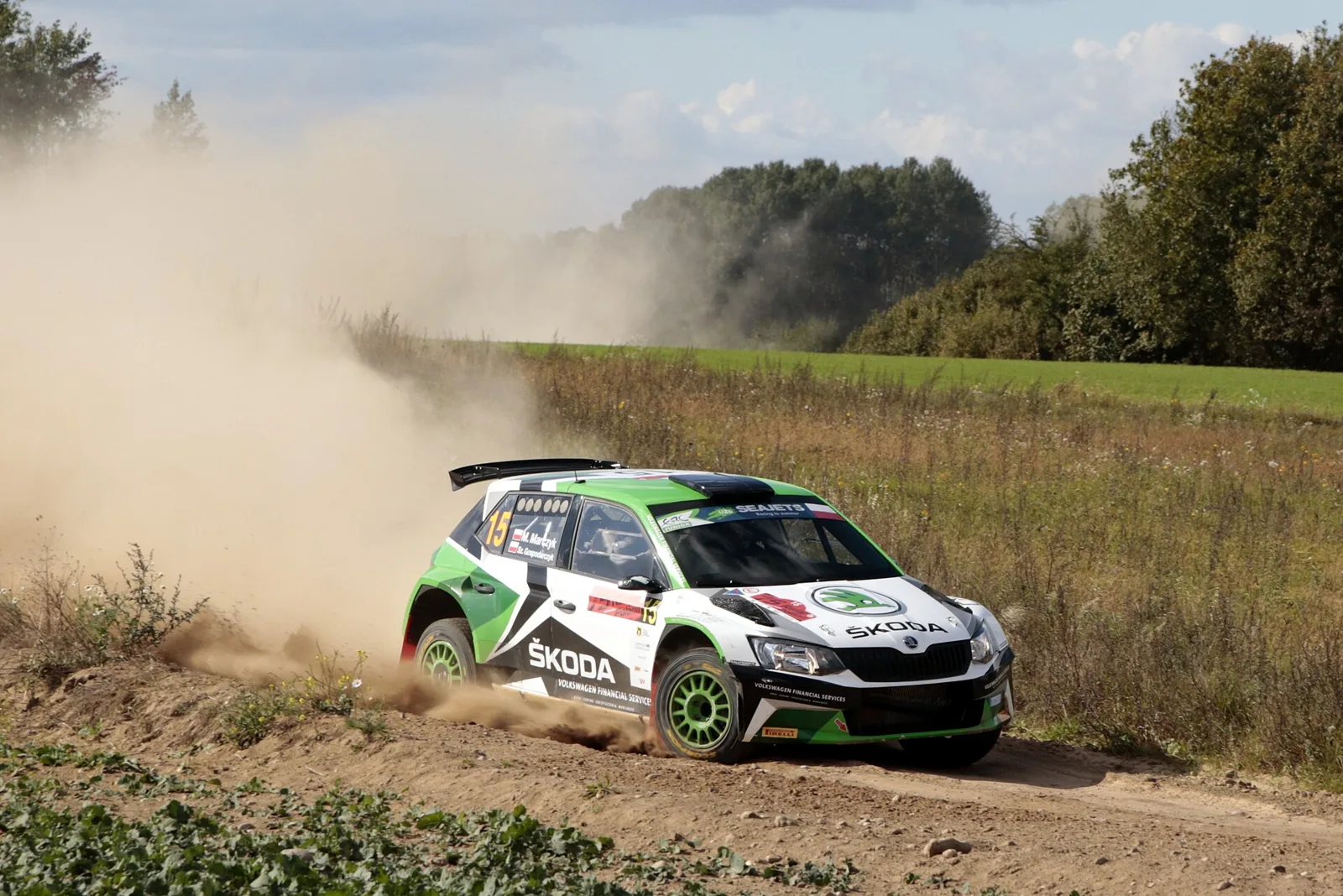
A customer car that won over 700 rallies, a junior-championship hatchback and a rulebook that lets tuned GT cars on the stages.
The Skoda Fabia R5 is a customer rally car built by Skoda Motorsport that debuted in 2015. The Ford Fiesta Rally3 is an M-Sport car for tier 3 of the FIA Rally Pyramid, debuting in 2021. Group R-GT is an FIA formula, introduced in 2011, that lets two-wheel-drive GT cars rally.
Skoda sold over 240 Fabia R5s to independent teams and owners in about three and a half years, and the car went on to win over 700 rallies around the world. The Ford Fiesta Rally3 and the Group R-GT rulebook cover different ground: a junior-championship hatchback, and a set of rules that lets tuned GT cars onto the stages.
What is the Skoda Fabia R5?
Skoda Motorsport built the Fabia R5 on the Fabia road car, to R5 regulations. It made its competition debut in 2015 as the successor to the Fabia S2000, and it went on to build a long record of wins.
Skoda sold over 240 Fabia R5s to independent teams and owners in about three and a half years, and the car went on to win over 700 rallies around the world.
What did the Skoda Fabia R5 win?
The World Rally Championship-2 was its stage. Between 2015 and 2018 the Fabia R5 took thirty-five events in the class, and a different driver won the drivers' title with it in each of three seasons. Esapekka Lappi was champion in 2016 with four victories, Pontus Tidemand followed in 2017, and Jan Kopecky took the crown in 2018. On the teams side, Skoda Motorsport won the FIA World Rally Championship-2 for Teams in 2015, 2016 and 2017. For 2019 the factory moved the car up into the professional class of the series.
The Fabia did not stay on the world stage. Gaurav Gill won the Asia-Pacific title in 2016 and 2017, and Yuya Sumiyama took the 2018 championship. In South America, Gustavo Saba won the Codasur Rally Championship three years running, from 2016 to 2018. Another fourteen rounds of the European Rally Championship also went the Fabia's way.
By commercial and competitive measures alike, the Fabia ranks high among R5 cars. The figures behind that are the 700 wins and the 240 customer sales, the latter spread across independent teams and owners rather than a single factory squad.
What is the Skoda Fabia Rally2 evo?
The Fabia Rally2 evo, first named the Fabia R5 evo, is a generational update of the original Fabia R5, built on the facelifted road car. Skoda unveiled it at the Geneva Motor Show in March 2019, four years after the first Fabia appeared, and pitched it as better than the 2015 car in nearly every area, especially engine power and response.
Homologation, the FIA's formal approval that a car matches its class rules, came on 1 April 2019, following many kilometres of testing. The evo started its competitive life with Jan Kopecky at Rallye Cesky Krumlov, the third round of the Czech Rally Championship, and won the rally outright. A short while later it reached the World Rally Championship at Rally de Portugal, where Kalle Rovanpera won in it.
Its name changed too. The Fabia was launched under the R5 group name, but in early 2020 Skoda Motorsport brought its model names into line with the new FIA pyramid, and the R5 evo became the Fabia Rally2 evo. Victories for the car are now recorded across WRC-2 Pro, WRC-2, WRC-3 and the European Rally Championship.
What is the Ford Fiesta Rally3?
M-Sport developed and built the Fiesta Rally3 to FIA Group Rally3 regulations, which place it at tier 3 of the FIA Rally Pyramid. Like the Fabia, it starts from a road car, in this case the Ford Fiesta, and it debuted in 2021.
The Estonian driver Ken Torn gave it its first outing in Finland, on SM O.K. Auto-Ralli, and ended up eleventh overall. Its first appearance in the World Rally Championship came at the 2021 Croatia Rally, with Zoltan Laszlo driving. A return followed at Rally Estonia that year, with Molly Taylor, who also races in Extreme E, and co-driver Sebastian Marshall. They crashed out on the fifth stage.
From 2022 onwards the Fiesta Rally3 has been the nominated car of the Junior WRC Championship. For a while it stood alone: until 2023 it was the only car in the Rally3 class, when the FIA homologated the Renault Clio Rally3. Wins for the Fiesta are logged in WRC3, Junior WRC, ERC Junior and ERC3.
What is Group R-GT?
Group R-GT, which is also written Group RGT, is the FIA's rally formula for GT cars, brought in during 2011. It exists because of how the FIA reorganised its classes: after it streamlined the eligible cars by creating Group R, a provision was made for GT cars to be entered, and that category became R-GT.
Its cars race for the FIA R-GT Cup, held on the tarmac rounds of the European Rally Championship and the World Rally Championship. They can also enter the World Rally Championship proper and any of the FIA's regional championships.
How did the Group R-GT approval system change?
Two different approval systems have applied. From 2014 to 2019 the FIA issued technical passports, one for each individual car prepared by a tuner to meet the rules. A passport covers one machine, while homologation covers a model the manufacturer builds. Since 2020 R-GT cars have followed the same path as other rally formulae and have to be homologated by the manufacturer.
How do the Group R-GT rules work?
The technical rules live in Appendix J of the FIA regulations, article 256: the 2019 edition for cars with passports and the 2021 edition for homologated ones. Either way, the starting point is a series production GT car with two-wheel drive. A four-wheel-drive model can be the donor, but it has to be converted so that it drives only two wheels.
Power is held in check by a restrictor, an air-limiting device in the engine intake whose diameter the FIA determines. The target is a weight-to-power ratio of 3.4 kg/hp (4.6 kg/kw, 294bhp/tonne). Think of breathing through a straw: whatever the size of the lungs, the straw sets the limit, so a heavy, powerful GT car cannot simply out-muscle a lighter, less powerful one.
How did Group R-GT begin?
Lotus showed an R-GT version of its Exige S at the 2011 Frankfurt Motor Show, yet the FIA did not homologate it until July 2012. That made it the first car to take part in the category. The Portuguese driver Bernardo Sousa drove it at Rally Vinho da Madeira at the end of July. He posted top-ten stage times on the first two special stages, and then retired on the third after an electronics glitch caused an accident. The Exige R-GT never appeared in international rallies again, and its homologation period lapsed in 2019.
The first car to run on a technical passport was a Porsche 996 GT3, entered by Marc Duez for the 2014 Monte Carlo Rally. His stage times were respectable, but he had to retire on the final day. Later that season at Rallye Deutschland, Richard Tuthill entered a modified Porsche 997 and came 27th among 63 classified cars. That was the first Porsche finish at a World Rally Championship event since 1986.
What was the FIA R-GT Cup?
The FIA ran the first international cup for R-GT cars in 2015, over five tarmac events: Rallye Monte-Carlo, the Ypres Rally, Rallye Deutschland, Rallye International du Valais and the Tour de Corse. Francois Delecour won it in a Porsche 997 prepared by Tuthill.
No cup was contested in 2016, because too few cars were entered. Interest picked up again in 2017 with the arrival of the Abarth 124 R-GT, and four R-GT participants started that year's Monte Carlo Rally, the cup's first event. The cup began as a support series for selected World Rally Championship events, and later editions added rounds of the European Rally Championship.
How did the Abarth 124 R-GT and Alpine A110 Rally fit in?
Abarth presented the 124 Spider R-GT at the 2016 Geneva Motor Show, and it first competed at the 2017 Monte Carlo Rally. Francois Delecour, Fabio Andolfi and Gabriele Noberasco were the entrants. Two of the cars retired, but Noberasco took second in the R-GT class.
A one-make series followed. The Abarth Rally Cup has run on selected European Rally Championship rounds since 2019, and its title winners are Andrea Nucita in 2019, Andrea Mabellini in 2020 and Dariusz Polonski in 2021.
Alpine announced its A110 Rally in May 2019 and presented it officially at the Rallye Mont-Blanc Morzine, held on 5-7 September 2019. The FIA gave it Group R-GT homologation in July 2020. As of March 2024 it is the sole homologated R-GT car, which means the Lotus approval has lapsed and no other maker has completed the process.
Why do the names keep changing?
Several naming systems overlap in this corner of rallying, which is why a single car can turn up under more than one label. R5 began as a group name, and it stuck to the Fabia until the FIA built its new pyramid; Skoda then relabelled the updated car as a Rally2 model, and that is why searches for the Fabia R5 evo and the Fabia Rally2 evo lead to the same machine. The Fiesta Rally3 belongs to a separate class on the same pyramid, one that was a single-car affair until the Renault Clio Rally3 arrived in 2023.
Group R-GT follows a different logic. It was created because the FIA wanted fewer classes, so Group R took in the cars that fitted the new structure and R-GT was added as the home for GT cars. The label describes the rulebook rather than a manufacturer, which explains why a Lotus, a Porsche, an Abarth and an Alpine can all sit under it.
Who actually runs these cars?
The three families serve different customers. The Fabia R5 found its market among independent teams and owners, and the evo is the refreshed version of that car. The Fiesta Rally3 sits at tier 3 of the pyramid and, from 2022, is the car used in the Junior WRC. R-GT is where GT cars go rallying, whether in a one-make series such as the Abarth Rally Cup or as a tuned Porsche. Each car starts from a road model, which is why the rules matter as much as the hardware: they decide how far a showroom car may be changed before it is no longer eligible.
How do these rally cars compare?
| Car | Maker | Introduced | Rules | Where it appeared |
|---|---|---|---|---|
| Skoda Fabia R5 | Skoda Motorsport | 2015 | R5 regulations | WRC-2, ERC, Asia-Pacific, Codasur |
| Skoda Fabia Rally2 evo | Skoda Motorsport | Homologated 1 April 2019 | Renamed under the FIA pyramid in early 2020 | Czech Rally Championship, WRC, ERC |
| Ford Fiesta Rally3 | M-Sport | 2021 | Group Rally3, tier 3 of the FIA Rally Pyramid | Junior WRC, WRC3, ERC Junior, ERC3 |
| Lotus Exige R-GT | Lotus | Homologated July 2012 | Group R-GT | One start, Rally Vinho da Madeira |
| Abarth 124 R-GT | Abarth | Presented 2016 | Group R-GT | FIA R-GT Cup, Abarth Rally Cup |
| Alpine A110 Rally | Alpine | Homologated July 2020 | Group R-GT | Presented at Rallye Mont-Blanc Morzine, 2019 |